

Round-Croppable Favicons: The Small Technical SEO Detail That Catches the Eye in Search
- September 5, 2024
- Technical SEO
Google crops favicons into a circle in mobile search results, so design a full-bleed, centered favicon that fills the circle cleanly. It is a small attention and brand-recognition win, not a ranking factor, and the round-crop tip comes from John Mueller, not Google's official docs.
Your favicon is the tiny icon that sits next to your site name in mobile search results. Most people set one once, never look at it again, and assume a square logo is fine. Then Google quietly crops it into a circle on phones, and the corners of your carefully squared-off logo get trimmed off. If you have ever wondered why your favicon looks slightly wrong in the SERP, this is usually why.
This article walks through where the favicon shows up, an undocumented tip from Google about circle-cropping, why it matters, the official requirements you actually have to meet, and how to design and ship one that holds up.
What a favicon is and where it shows in search
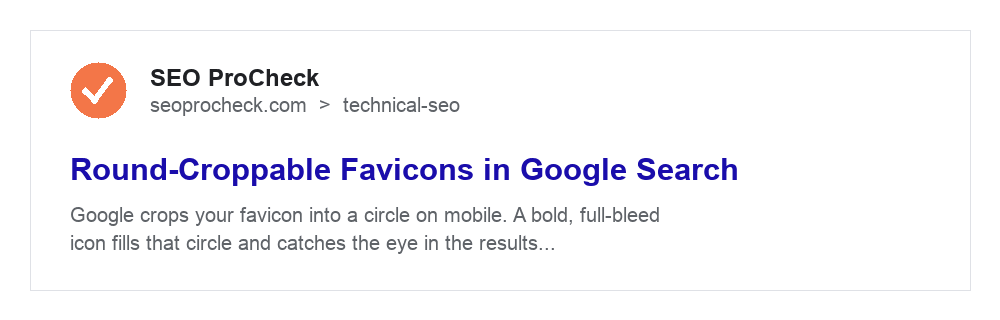
A favicon is the small brand icon associated with your site. Browsers show it in the tab. Google shows it in search results, and that placement is the one that matters here. On mobile, the favicon appears to the left of your site name and domain, above the title link of each result. It is one of the first visual things a person sees when scanning a page of results on a phone.
On mobile, Google renders that favicon inside a circle. Your source file is still a square, but the visible shape in the result is round. Anything outside that inscribed circle, including all four corners, gets clipped. That single rendering detail drives almost everything below.
Mueller's round-crop tip
In early September 2024, on a LinkedIn thread started by Mark Williams-Cook, Google's John Mueller offered a piece of advice that stuck with a lot of practitioners: "Round-croppable favicons, for those who like technical SEO." The exchange was covered by Search Engine Journal. Search Engine Journal covered it on September 3, 2024.
The point is exactly what it sounds like. Because Google circle-crops favicons in mobile results, you want a favicon that looks good as a circle, ideally one that fills the whole circle rather than floating as a small mark in the middle of empty space. Design for the shape Google actually displays, not the square you uploaded.
Here is the honest caveat: this is not in Google's official favicon documentation. It is an offhand observation from Mueller, not a documented requirement. It is one of those quietly real Google behaviors that nobody bothered to write down, which is mildly annoying, but the behavior is real and easy to verify yourself by searching your own site on a phone.
Why it matters (and what it is not)
Keep the size of this win in perspective. A favicon is not a ranking factor. Swapping a clipped logo for a clean circle will not move you up the results page on its own.
What it does is shape attention. A bold favicon that fills its circle is easier to spot when someone is thumb-scrolling a results page, and a consistent, recognizable mark supports brand recognition over repeated impressions. That is a small click-through nudge, in the same family as a sharp title tag: it influences whether someone picks your result, not where your result sits. If you are already thinking about title and CTR optimization, the favicon is the visual half of the same job.
Google's official favicon requirements
Separate from Mueller's circle tip, these are the documented requirements from Google Search Central that you do have to meet for a favicon to show at all:
- Square, 1:1 aspect ratio. The source file must be square.
- Size. The technical minimum is small, but Google recommends a favicon larger than 48x48px so it looks good across surfaces. A multiple of 48 (48x48, 96x96, 144x144) is the safe target. Bigger source, cleaner render.
- Format. Google Search supports BMP, GIF, ICO, PNG, JPEG, PPM and TIFF favicons. SVG is not on that list, so a square PNG or ICO is the safe choice.
- Referenced in the head. Declare it with a
rel="icon"link in the<head>of your homepage. A/favicon.icoat the site root is also recognized. - Stable URL. Keep the favicon on a fixed URL that Google can crawl. Do not change it constantly.
- Crawlable. Googlebot must be able to fetch the file. If robots.txt or a login wall blocks it, the favicon will not appear.
How to design a round-croppable favicon
Once the official boxes are checked, design for the circle:
Use a full-bleed background
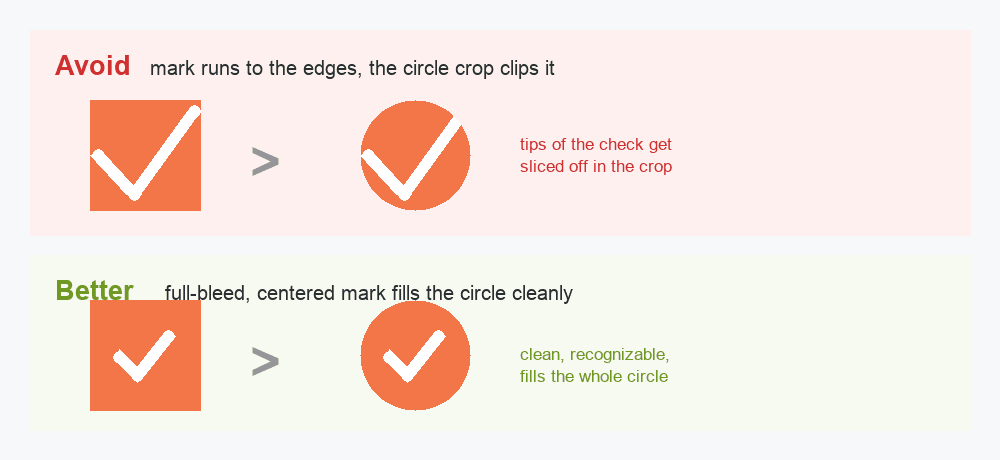
Fill the entire square with a solid brand color so the circle crop only ever trims solid color, never your logo. This is the single biggest fix. A full-bleed icon fills the circle and reads as a confident, deliberate brand mark.
Center the mark with padding
Put your glyph, letter, or symbol in the middle with breathing room around it. Nothing important should sit in the corners or hug the edges, because that is exactly what gets clipped. Center-weighted survives the crop.
Test it cropped, and keep it legible small
Before you ship, mask your favicon with a circle and look at what is left. Then shrink it to roughly 16px, the size people actually see, and check it still reads. Fine detail and thin lines disappear at that scale. Simple shapes win.
Push contrast
Google's results page is a pale, near-white background. A light or low-contrast favicon melts into it. Use a saturated, high-contrast color so the circle pops. The same legibility instinct applies to all brand imagery and graphics: it has to work at the size and in the context it is actually viewed.
How to add it
Drop the link in the <head> of your homepage:
<link rel="icon" href="/favicon.png" sizes="any">
If you run a CMS, the easier path is usually the built-in site-icon setting. WordPress has a Site Icon field under Appearance, Shopify and most platforms have an equivalent; they generate the link tag and sizes for you. Either way, also keep a /favicon.ico at the site root, since Google recognizes it as a fallback. After you ship, request a fresh crawl or just wait; favicon updates in the SERP are not instant.
Common mistakes
- Mark to the edges. A logo that touches the corners gets clipped by the circle crop. Add padding.
- Low contrast. Pale or washed-out icons disappear against Google's near-white SERP.
- Transparent background. Transparency reads as white on the results page, so a transparent square does not fill the circle and can vanish into the background. Use a solid fill.
- Tiny source file. Anything under 48px gets upscaled and looks fuzzy. Start at 48x48 or larger.
- Unstable or blocked URL. Moving the favicon around, or blocking it from Googlebot, means it may not show at all.
FAQ
Does a round-croppable favicon help my rankings?
No. It is not a ranking factor. It is a presentation and brand-recognition detail that can nudge click-through, nothing more.
Do I have to make my favicon an actual circle?
No. Keep a square source file, as Google requires. The goal is that it looks good when Google crops it to a circle, which a full-bleed square with a centered mark does naturally.
Why isn't my favicon showing in Google at all?
Usually a crawl or reference problem: no rel="icon" link, the file is blocked from Googlebot, the URL is unstable, or it is not square. Confirm those before touching the design.
Want the small wins found and fixed?
SEO ProCheck audits the details that shape how you show up in search.
Take this with you
The assistant links open with a question about this page already written. Nothing is sent until you press enter.
Claude Vincent is a technical SEO consultant focused on crawlability, rendering, and AI-search visibility. He writes the field guides and case studies at SEO ProCheck, with a bias toward the durable, unglamorous work that decides whether search engines and AI answer engines can actually read and cite a site.
About SEO ProCheck
Technical SEO consulting and GEO strategy with 20 years of enterprise experience. Case studies, resources, and tools for search and AI visibility.
Work With Me
Technical SEO audits, GEO strategy, site migrations, and international SEO. Hourly consulting for teams who need hands-on support, not just reports.
Subscribe to our newsletter!








Recent Posts
- Most Top Sites Never Say Who They Are in Structured Data October 14, 2026
- Homepage Titles Are Mostly Too Short, Not Too Long October 8, 2026
- Who Actually Serves an llms.txt? 184 Top Sites Measured September 29, 2026