

AI Summary
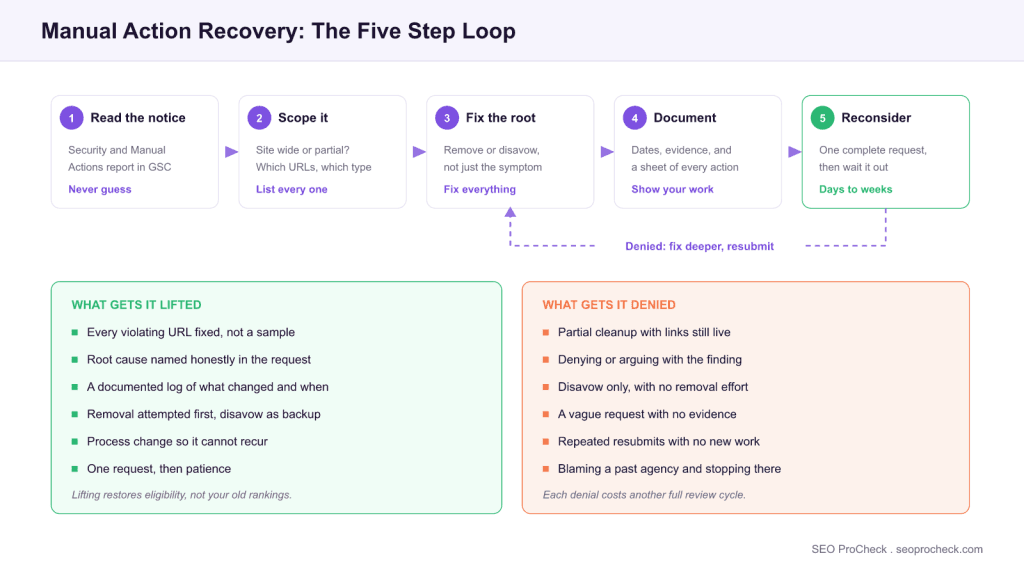
A manual action is a human penalty applied by Google’s webspam team, and unlike an algorithmic drop it is announced in Search Console under Security and Manual Actions. It is lifted only by fixing the violation everywhere it exists and then submitting a documented reconsideration request, so recovery is a cleanup project rather than a waiting game.
- If the Manual Actions report says No issues detected, you do not have one, and a reconsideration request cannot help you.
- Fix the pattern, not the sample URLs Google listed. Reviewers check whether the behaviour is gone.
- Attempt removal first for unnatural links, and use the disavow file for what you genuinely cannot get removed.
- Lifting restores eligibility, not your old rankings: whatever the spam was propping up is gone with it.
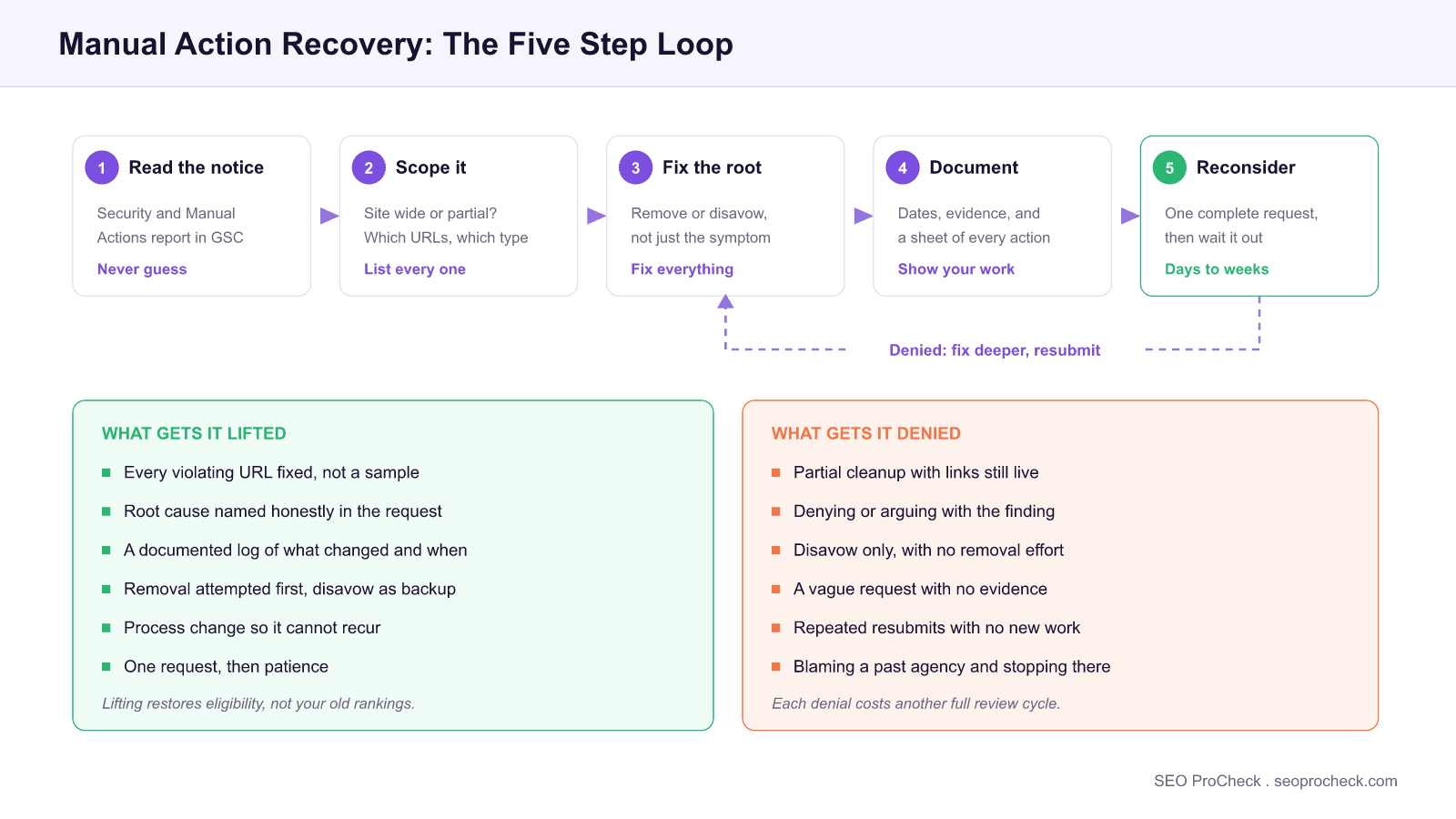
A manual action is a human-applied penalty from Google's webspam team for violating spam policies. Unlike an algorithmic suppression, it comes with a notification in Search Console under Security & Manual Actions → Manual actions, and it is lifted only through a reconsideration request after you have actually fixed the violation. Recovery is a documented cleanup process, not a waiting game.
Understanding Algorithm Recovery
Algorithm Recovery represents a critical component of modern SEO strategy. As search engines continue to evolve and user expectations shift, understanding the nuances of algorithm recovery becomes essential for maintaining and improving organic visibility. This guide covers the key concepts, implementation approaches, and strategic considerations that SEO practitioners need to master.
The first diagnostic step is always the same: distinguish a manual action from an algorithmic drop. Open Search Console and check Security & Manual Actions → Manual actions. If the report says "No issues detected," you do not have a manual action: no reconsideration request will help you, and your problem is algorithmic (a core update, spam update, or helpful-content-style suppression), which recovers only through improvement plus a subsequent update cycle. If a manual action is present, the report names the violation, states whether it affects some or all pages ("partial match" vs "site-wide match"), and links to the relevant policy. Manual actions also arrive as an email to Search Console owners, so audit the property's user list if you inherited the site.
Manual Action Types and Their Remediation Paths
Each action type in the report maps to a specific cleanup. The most common ones and how to work them:
| Manual action (as shown in GSC) | What it means | Remediation path |
|---|---|---|
| Unnatural links to your site | Google identified a pattern of manipulative inbound links (paid links, PBNs, link schemes) | Export links (GSC → Links → Top linking sites → Export), classify, request removals where feasible, disavow the remainder via the Disavow tool (domain-level entries), document everything in a shared sheet |
| Unnatural links from your site | Your site sells or trades links, or hosts undisclosed paid links | Remove the links or qualify them with rel="nofollow"/rel="sponsored"; establish an editorial policy you can cite in the request |
| Thin content with little or no added value | Doorway pages, scraped/spun content, thin affiliate pages, auto-generated pages | Enrich or consolidate the flagged page types; remove pure boilerplate at scale; do not just noindex your way out: Google expects the site's value proposition to change |
| Pure spam | Aggressive, unambiguous spam (gibberish, cloaked scraping) | Usually terminal for the domain in its current state; requires rebuilding the site's content wholesale before any reconsideration has a chance |
| Cloaking and/or sneaky redirects | Users and Googlebot see different content, or mobile users are redirected elsewhere | Use the URL Inspection tool's "Test live URL" and rendered HTML to see exactly what Googlebot sees; remove the conditional logic; check for hacked templates and rogue plugins |
| Hacked content / spam injected | Third party injected pages or links (also surfaces under Security issues) | Clean the infection, patch the entry point, remove injected URLs (they often live in odd subdirectories), then use the "Request review" flow in the Security issues report |
| Structured data issue (spammy structured markup) | Markup that misrepresents page content: fake reviews, marked-up content invisible to users | Correct or strip the offending schema types site-wide; validate with the Rich Results Test before requesting review |
| Keyword stuffing / hidden text | Hidden text, stuffed footers, repeated keyword blocks | Remove hidden elements and stuffed copy; check CSS-hidden and off-screen text your CMS theme may generate |
| Site reputation abuse | Third-party content published on a host site mainly to exploit its ranking signals (the "parasite SEO" action) | Remove or noindex the third-party sections, or genuinely integrate them under first-party editorial oversight |
Key Considerations for Recovering From Manual Actions
When approaching algorithm recovery, several factors require careful attention. Technical implementation must align with broader SEO objectives while maintaining site performance and user experience. The balance between optimization and over-optimization requires ongoing monitoring and adjustment based on performance data and algorithm changes. Industry benchmarks and competitor analysis provide context for evaluating your own implementation.
Two considerations shape every recovery I've worked: scope and evidence. Scope: a partial match affects only the listed sections: resist the urge to bulldoze the whole site; fix the flagged pattern everywhere it exists, but no wider. Evidence: the reconsideration reviewer is a human who has seen thousands of insincere requests. Your submission needs to demonstrate three things: you understand exactly what violated the policy, you fixed it comprehensively (not just the example URLs Google showed, which are samples, never the full list), and you have process changes that prevent recurrence. A shared spreadsheet documenting every removed link or cleaned URL, linked from the request, materially improves your odds.
Implementation Best Practices
Successful implementation begins with thorough auditing of current state and clear goal definition. Document baseline metrics before making changes to enable accurate impact measurement. Prioritize changes based on potential impact and implementation effort, focusing on high-impact items first. Test changes in staging environments when possible, and monitor closely after deployment to production. Maintain documentation of changes for future reference and troubleshooting.
The reconsideration workflow itself, step by step: (1) fix the violation everywhere, not just on sampled URLs; (2) gather documentation: before/after examples, removal outreach logs, the disavow file if links are involved; (3) in the Manual actions report, expand the action and click Request review; (4) write a plain, factual request: what the violation was, what you did about it (with numbers: pages removed, links disavowed, templates changed), and what changed operationally; (5) submit and wait: reviews commonly take from several days to a few weeks, and link-related cases tend to run longer than content cases; (6) watch for the outcome message in Search Console. If the request is rejected, the response sometimes includes fresh sample URLs: treat those as a hint about what you missed, go deeper, and resubmit. Do not spam repeated requests without substantive new work between them; reviewers see the full history.
What a reconsideration request has to contain, section by section
A reconsideration request is read by a person who has seen thousands of insincere versions of the same letter. Length is not what convinces them; specificity is. Structure the submission in these five parts and the reviewer can verify each claim without hunting:
| Section | What it must contain | What sinks it |
|---|---|---|
| 1. What violated the policy | Name the specific violation and the specific policy, in plain language, without hedging | Vagueness, or disputing that anything was wrong at all |
| 2. How it happened | The honest origin: an agency campaign, an old growth tactic, a compromised install, an inherited site | Blaming a predecessor and stopping there, with no ownership of the fix |
| 3. What you did about it | Concrete numbers: URLs removed or rewritten, links removed, domains disavowed, templates changed, dates | "We cleaned everything up" with nothing countable in it |
| 4. Evidence | Links to a shared, publicly readable sheet: every URL, its status, the outreach attempts, the disavow file contents | Attachments the reviewer cannot open, or a sheet with permissions locked |
| 5. How you will prevent recurrence | The process change: editorial sign-off, a link policy, a plugin audit cadence, removal of the incentive that caused it | Promising to be careful, with no mechanism behind the promise |
One request at a time. Resubmitting the same letter with no new work between attempts does not speed anything up, and each review consumes days or weeks you cannot get back. If a request is denied and the response includes fresh sample URLs, treat those samples as evidence that the pattern still exists somewhere you have not looked, not as the complete remaining list.
Common Mistakes to Avoid
Several patterns consistently cause problems in algorithm recovery implementations. Rushing implementation without proper planning leads to errors that can be costly to fix. Ignoring the interplay between different SEO factors creates conflicts that undermine results. Failing to monitor and iterate based on performance data means missing optimization opportunities. Over-optimization signals can trigger algorithmic penalties that take months to recover from.
Specific to manual actions, the recurring failures are: fixing only the sample URLs Google listed (samples are illustrative, the reviewer checks whether the pattern is gone); submitting a reconsideration request the same day the action appears, before any real cleanup; disavowing without attempting removals on the worst offenders, then writing a one-line request with no documentation; blaming a previous agency without showing what you changed (accountability without evidence reads as excuse-making); and treating a lifted action as full recovery (see below on what "recovery" actually restores).
Measuring Success
Effective measurement requires defining appropriate KPIs aligned with business objectives. Track both leading indicators (rankings, impressions, technical metrics) and lagging indicators (traffic, conversions, revenue) to build a complete picture. Establish reasonable timeframes for evaluation, as SEO changes often take weeks or months to fully manifest in results. Compare performance against historical baselines and competitor benchmarks to contextualize results.
For manual-action recovery, annotate three dates against your Search Console Performance data: when the action was applied, when you completed remediation, and when the revocation message arrived. Expect impressions to move before clicks. Critically, revocation removes the penalty: it does not refund the rankings. If your previous positions were partly propped up by the links you just disavowed or the pages you just removed, the post-recovery baseline will sit below the pre-penalty peak, and that gap is the honest measure of how much of your equity was artificial. Plan the roadmap from the new baseline, not the old peak.
Strategic Recommendations
Approach algorithm recovery as an ongoing program rather than a one-time project. Build processes for regular auditing, monitoring, and optimization. Stay current with industry developments and algorithm changes that may affect your strategy. Invest in education for team members to build internal capabilities. Consider how algorithm recovery fits within your broader digital marketing and business strategy for maximum impact.
Prevention is operational, not technical: make the Manual actions and Security issues reports part of a weekly Search Console check; keep owner-level access with a monitored mailbox so notifications are never missed; review any inherited domain's link profile and GSC message history before migration or acquisition; and require disclosure attributes (rel="sponsored") as standard policy for any paid placement. Most manual actions are the delayed bill for a decision someone made under traffic pressure: the durable fix is removing the incentive, not just the artifact.
Frequently Asked Questions
How do I know if my site has a Google manual action?
Check Search Console: Security & Manual Actions → Manual actions. If it shows "No issues detected," you have no manual action and your traffic drop is algorithmic or technical. Manual actions are always disclosed there and by email to verified owners: there is no such thing as a secret manual penalty you have to infer.
How long does it take to recover from a manual action?
The timeline has two parts: your cleanup (days to months depending on scope: a structured-data fix is fast, a multi-year unnatural-links profile is not) and Google's review, which typically takes from several days to a few weeks after you submit the reconsideration request. Link-related reviews generally take longer than content reviews. Ranking recovery after revocation is gradual, not instant.
What is the difference between a manual action and an algorithmic penalty?
A manual action is applied by a human reviewer, appears in the Manual actions report, and is lifted via reconsideration request. An algorithmic drop (core update, spam update, scaled-content suppression) shows nothing in that report, has no request process, and improves only when Google's systems re-evaluate the improved site, usually visibly around subsequent updates. The remediation work overlaps; the exit mechanism is completely different.
Should I use the disavow tool for a manual action?
For an "unnatural links to your site" action, yes, it is the standard tool for links you cannot get removed, and Google's own guidance points to it in exactly this case. Prefer domain-level entries (domain:example.com) and attempt genuine removals on the worst offenders first, because a request showing outreach effort is more credible. Without a link-based manual action, disavowing is rarely worthwhile and can do harm if you cut legitimate links.
What should I write in a reconsideration request?
Three short sections: what violated the policy (showing you understand it), exactly what you fixed with quantities and links to documentation (removal logs, cleaned URL counts, the disavow upload date), and what process change prevents recurrence. Plain factual prose beats apology theater. One well-documented page of text with a linked evidence spreadsheet is the format that gets approvals.
Will my rankings return to normal after the manual action is lifted?
Only partly, in most cases. Revocation removes the suppression, but any ranking benefit that came from the spam you removed, the paid links and the doorway pages, is gone permanently, because the assets themselves are gone. Sites whose underlying content and legitimate links were strong recover close to baseline; sites built on the violating tactic recover to a much lower level and have to rebuild from there.
Claude Vincent is a technical SEO consultant focused on crawlability, rendering, and AI-search visibility. He writes the field guides and case studies at SEO ProCheck, with a bias toward the durable, unglamorous work that decides whether search engines and AI answer engines can actually read and cite a site.
About SEO ProCheck
Technical SEO consulting and GEO strategy with 20 years of enterprise experience. Case studies, resources, and tools for search and AI visibility.
Work With Me
Technical SEO audits, GEO strategy, site migrations, and international SEO. Hourly consulting for teams who need hands-on support, not just reports.
Subscribe to our newsletter!







Recent Posts
- Can AI Crawlers Actually Read Your Site? I Measured 400 of the Biggest September 5, 2026
- The Pre-Publish Quality Gate for AI-Assisted Content August 6, 2026
- AGENTS.md vs llms.txt vs llms-full.txt: Which Agent File Does What July 18, 2026