


AI Summary
An SEO business case gets approved when it converts search opportunity into the metric your decision-maker is already accountable for, and states its assumptions openly. Build it from your own Search Console and analytics data, present it as three scenarios rather than one confident number, and attach a named cost, a timeline, and a kill criterion.
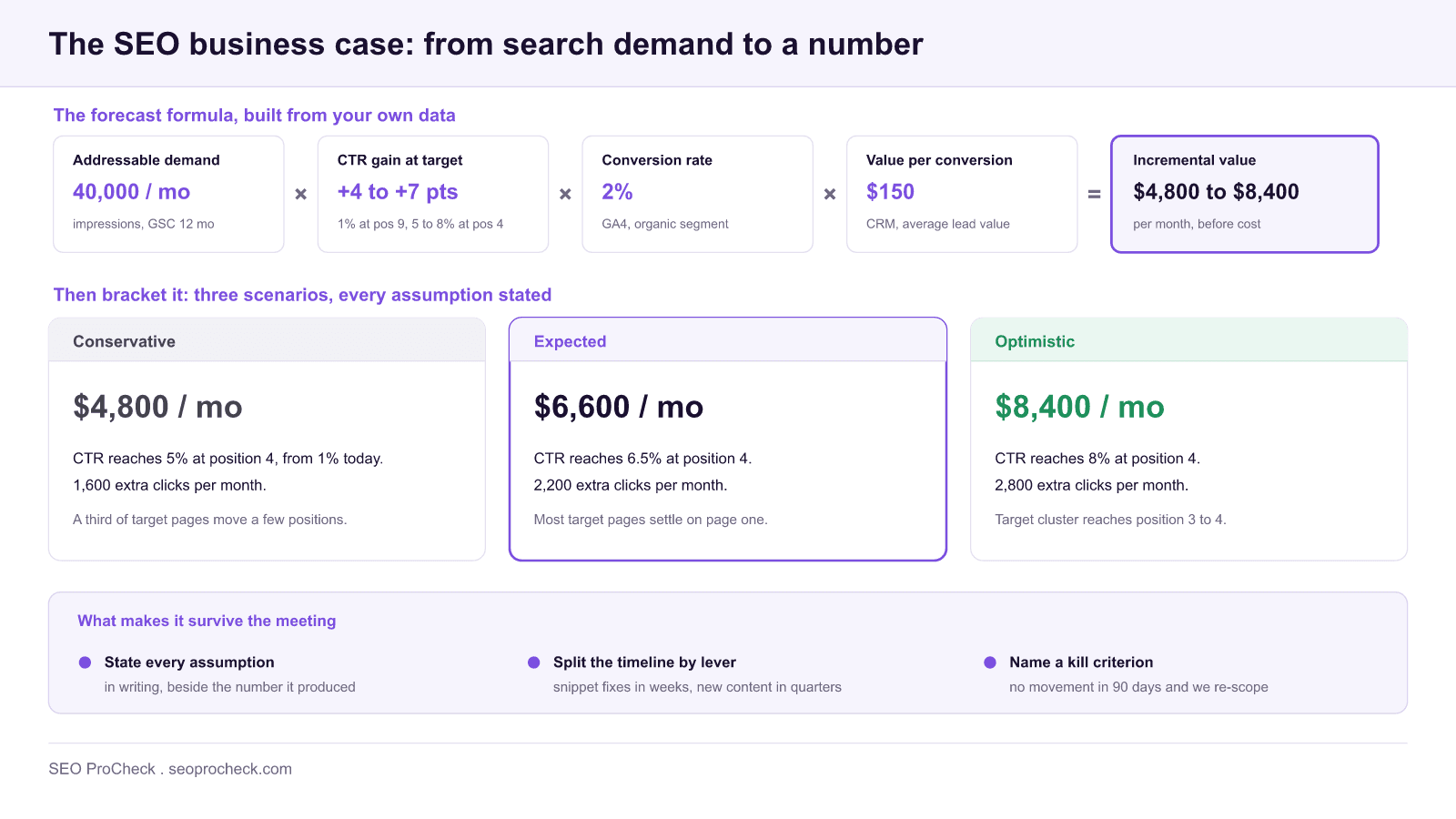
- The formula: addressable impressions, times the CTR gain at your target position, times your conversion rate, times value per conversion.
- Three opportunity buckets fall out of a Search Console export: striking distance (positions 4 to 15), CTR gaps, and content gaps.
- Present conservative, expected and optimistic scenarios, with the assumption behind each written down next to the number.
- Split the timeline by lever: snippet and on-page fixes can move in weeks, new content and authority work take one to three quarters.
- Commit to a kill criterion in advance. It is the strongest trust signal a business case can carry.
Quick answer: An SEO business case wins approval when it translates search opportunity into the metric your decision-maker already owns (revenue, leads, or cost savings) and states its assumptions openly. The working formula is: addressable search demand × achievable CTR at a target position × your conversion rate × value per conversion, presented as conservative/expected/optimistic scenarios with a named cost and timeline. Data beats adjectives: build it from your own Search Console and analytics numbers, not industry averages.
What an SEO Business Case Actually Has to Do
After twenty years of pitching SEO work internally and to clients, I can tell you the business case is rarely lost on the SEO logic. It is lost because the audience could not connect the request to something they are accountable for. A developer sprint, a content budget, a migration delay: each has an owner with their own scoreboard. Your job is to write the case in the units of that scoreboard, and to be the most honest person in the room about uncertainty. SEO forecasts are estimates; saying so explicitly, and bracketing them with scenarios, buys more credibility than any confident single number ever will.
Step 1: Quantify the Opportunity From Your Own Data
Start in Google Search Console, not in a keyword tool. Open Performance → Search results, set the range to the last 12 months, and export queries and pages with impressions, clicks, CTR, and position. Three buckets fall out of that export:
- Striking distance: queries ranking in positions 4 to 15 with meaningful impressions. These are the cheapest wins: the content already ranks, it just needs consolidation, internal links, or on-page work.
- CTR gaps: pages whose CTR sits well below what their position should deliver. Snippet and title work, low cost, fast feedback. This is where the title tag and meta description guide earns its keep, because the fix is usually a rewrite rather than a project.
- Content gaps: demand you can see competitors capturing that you have no page for. This is where a keyword tool supplements GSC, but anchor volumes to reality: if a tool says 10,000 searches and your top-3 competitor page shows modest traffic, trust the smaller signal. A structured content gap analysis keeps this bucket defensible instead of speculative.
Then attach value. Pull your organic conversion rate and value per conversion from your analytics platform (in GA4: Reports → Acquisition → Traffic acquisition, filtered to Organic Search, with your key event and its value). If the site is lead-gen, get the lead-to-customer rate and average deal size from sales: asking for that number is itself a credibility move, because it shows you intend to be measured on their metric.
Step 2: Forecast With Scenarios, Not a Single Number
The arithmetic is simple; the discipline is in the assumptions. For each opportunity bucket:
incremental clicks/mo = impressions/mo x (CTR at target position - current CTR)
incremental value/mo  = incremental clicks x conversion rate x value per conversion
Present three scenarios: conservative (you improve a third of the target pages by a few positions), expected, and optimistic. Put the assumption behind each one in writing. Use position-based CTR curves as rough guides only, and say they are rough. A worked example, with every input clearly labeled as this site's own data: a query cluster with 40,000 monthly impressions at average position 9 and 1% CTR, moved to position 4 where a 5 to 8% CTR is plausible, yields roughly 1,600 to 2,800 additional monthly clicks; at a 2% conversion rate and $150 per lead, that is roughly $4,800 to $8,400 per month. The numbers themselves matter less than showing the machinery, because the machinery is what gets interrogated in the meeting.
Always include the timeline honestly: on-page and snippet fixes can show movement in weeks, new content and authority-building typically need one to three quarters. A business case that promises quarter-one revenue from net-new content will be remembered when it misses.
Cost the ask as carefully as the return
Half-finished business cases forecast revenue precisely and then wave at cost. Finance will not. Build the cost side with the same granularity, because the ratio is what gets approved, not the top line:
| Cost line | How to size it | Where teams underestimate |
|---|---|---|
| Content production | Pieces needed × fully loaded cost per piece (brief, draft, edit, design, upload) | Only pricing the draft. Editing, subject-matter review and publishing often exceed writing cost |
| Engineering time | Sized tickets × your team's standard cost per sprint point or day | Ignoring QA and regression testing on template changes |
| Internal SEO time | Hours per month × loaded salary rate, including reporting and stakeholder meetings | Forgetting that reporting and coordination often run 30% of the total |
| Tooling and data | Annual licences apportioned to this initiative | Buying a new platform mid-programme and blowing the approved budget |
| Maintenance after launch | Refresh cadence × cost per refresh, for at least 12 months | Treating content as a one-off purchase, then watching it decay out of the index |
Then run the check that decides the pitch: does the conservative scenario cover the total cost inside twelve months? If it does not, narrow the scope until it does. A smaller case that clears its own bar is far easier to approve, and far easier to repeat next quarter, than a large one that depends on the optimistic column.
Step 3: Answer Each Stakeholder's Objection Before They Raise It
Every business case dies at a specific desk for a specific reason. Map them in advance, which is really just stakeholder management applied to a document:
| Stakeholder | Standing objection | Data that answers it |
|---|---|---|
| CFO / budget owner | "SEO is a cost center with unprovable returns." | Cost-per-click equivalence: value the forecast organic clicks at your own paid-search CPC for the same queries (from your ads account). Frame SEO as reducing dependence on a rising media cost, with your actual blended CPA as the baseline. |
| CMO / marketing lead | "Paid gives me results this quarter; SEO is too slow." | Split the roadmap: striking-distance and CTR fixes with expected movement inside the quarter, versus compounding plays. Show the traffic decay curve of what happens if content stops being maintained, using your own GSC year-over-year comparison (Performance → Date range → Compare). |
| Engineering lead | "SEO tickets are vague and never sized." | Bring sized, specific tickets (redirects list, template change, render-blocking fix) with the affected URL count and the GSC or crawl data showing the defect. One well-scoped ticket with evidence beats a 40-item audit dump. |
| Product manager | "Organic traffic isn't my KPI." | Map target queries to funnel stages and show which product surfaces (pricing, comparison, docs) capture high-intent demand. Tie the ask to signups or activation, not sessions. |
| CEO / owner | "Why now? What happens if we do nothing?" | The do-nothing scenario: competitor rank trend on your money queries over the past 12 months, plus the widening gap in share of voice. Loss aversion is a legitimate framing when the data is real. |
| Sales lead | "Marketing leads are junk." | Close-rate of organic-sourced leads versus other channels from the CRM. If you cannot get this data, that gap is finding number one in the business case. |
Step 4: Structure the Document Itself
Keep it to one or two pages plus an appendix. The order that works: the ask (budget, headcount, or sprint capacity, as one number), the expected return (the three scenarios), the evidence (your GSC-derived opportunity buckets), the risks and what happens if nothing is done, and the measurement plan: which reports will be reviewed, at what cadence, and what threshold triggers a course correction. Committing in advance to a kill criterion ("if striking-distance pages show no position movement in 90 days, we re-scope") is the single strongest trust signal you can put in the document.
Reporting Back: The Business Case Never Ends
The first business case buys one cycle of trust; the follow-up reporting buys every subsequent one. Report in the same units you forecast in, against the same scenarios, monthly. Annotate deployments and algorithm updates on your traffic charts so causality arguments are grounded. A standing Looker Studio dashboard is worth building for exactly this reason: it removes the monthly argument about whose numbers are right. When a bet misses, say so before anyone asks: misses reported early read as rigor, misses discovered late read as spin.
Overview of Content Strategy
Content Strategy is an important aspect of modern SEO that requires careful attention and strategic implementation. As search engines continue to evolve, understanding the nuances of this topic becomes essential for maintaining competitive organic visibility. This guide provides actionable insights and practical recommendations for SEO practitioners. In the business-case context, content strategy is usually the largest line item you will ask for, which is exactly why it needs the forecasting discipline above rather than a per-article price list.
Why This Matters
The significance of content strategy has grown as search algorithms become more sophisticated. Websites that excel in this area typically outperform competitors in organic search metrics. Understanding both the direct and indirect impacts helps prioritize efforts and allocate resources effectively. The return on investment for proper implementation can be substantial, but "substantial" is precisely the kind of adjective a business case must replace with a bracketed estimate and a stated assumption.
Implementation Strategy
Effective implementation starts with assessing your current state and identifying gaps. Develop a prioritized action plan based on potential impact and required effort. Execute changes methodically while maintaining documentation. Monitor results and iterate based on performance data. Build sustainable processes for ongoing optimization.
Best Practices
Industry best practices have evolved through extensive testing and experience across thousands of sites. Following established guidelines accelerates results and helps avoid common pitfalls. However, every site is unique, so test recommendations in your specific context. Focus on sustainable approaches that align with search engine guidelines for long-term success.
Key Takeaways
Success with content strategy requires a combination of technical knowledge, strategic thinking, and consistent execution. Start with fundamentals before advancing to sophisticated tactics. Measure everything to understand what works for your specific situation. Stay current with industry developments while maintaining focus on core principles that provide lasting value.
Frequently Asked Questions
Take the incremental organic conversions attributable to the work, multiply by your value per conversion, subtract the fully loaded cost of the SEO effort (people, content, tools, dev time), and divide by that cost. The honest complication is attribution and time lag: SEO investments pay back over quarters, so calculate ROI over a 12-month window and state the attribution model you used.
Build from your own Search Console data: current impressions, positions, and CTR per query cluster, then model what a realistic position improvement does to clicks using CTR curves as rough guides. Present it as a range across conservative and optimistic scenarios with the assumptions written down. Never present a tool's search-volume estimate as if it were your future traffic.
Cost, return, timeline, and risk in that order, ideally benchmarked against a spend they already understand, like paid search. Valuing forecast organic clicks at your actual CPC for the same queries turns SEO into a cost-avoidance argument a finance audience processes natively. Include the do-nothing scenario, because CFOs weigh downside as heavily as upside.
Depends entirely on the lever. Title/snippet and on-page fixes to pages that already rank can move CTR and positions within weeks; new content typically needs three to six months to mature; authority and site-architecture work often needs two or more quarters. A credible business case splits its forecast by lever rather than quoting one blanket timeline.
Derive it from the opportunity, not from a benchmark percentage of marketing spend. Size the work needed to capture your top opportunity buckets (content pieces, dev tickets, tooling), price that, and check the resulting cost against the conservative-scenario return. If the conservative case does not cover the ask within 12 months, narrow the scope before you pitch: a smaller case that wins beats a bigger one that stalls.
Monthly reporting in the same units the forecast used, against the same scenarios, with deployments and algorithm updates annotated on the charts. Flag misses early yourself and bring the corrective plan alongside them. Trust compounds exactly like rankings do, slowly, and only while you keep feeding it.
Claude Vincent is a technical SEO consultant focused on crawlability, rendering, and AI-search visibility. He writes the field guides and case studies at SEO ProCheck, with a bias toward the durable, unglamorous work that decides whether search engines and AI answer engines can actually read and cite a site.
About SEO ProCheck
Technical SEO consulting and GEO strategy with 20 years of enterprise experience. Case studies, resources, and tools for search and AI visibility.
Work With Me
Technical SEO audits, GEO strategy, site migrations, and international SEO. Hourly consulting for teams who need hands-on support, not just reports.
Subscribe to our newsletter!







Recent Posts
- Can AI Crawlers Actually Read Your Site? I Measured 400 of the Biggest September 5, 2026
- The Pre-Publish Quality Gate for AI-Assisted Content August 6, 2026
- AGENTS.md vs llms.txt vs llms-full.txt: Which Agent File Does What July 18, 2026