


AI Summary
Objective content quality scoring replaces opinion with a weighted rubric in which every criterion maps to a retrievable number from Search Console, GA4, a crawler, or a fixed editorial scale. Score each URL out of 100, then let predefined bands decide whether the page is protected, refreshed, enriched, or reworked.
- Nine criteria carry fixed weights, each scored 0, 1, or 2, and sum to 100.
- Benchmark inside template groups: a glossary stub and a 3,000 word guide never share a scale.
- Word count is a symptom, not a criterion. Score depth and original information instead.
- Run a calibration pass, two scorers against the same 10 pages, before auditing the full library.
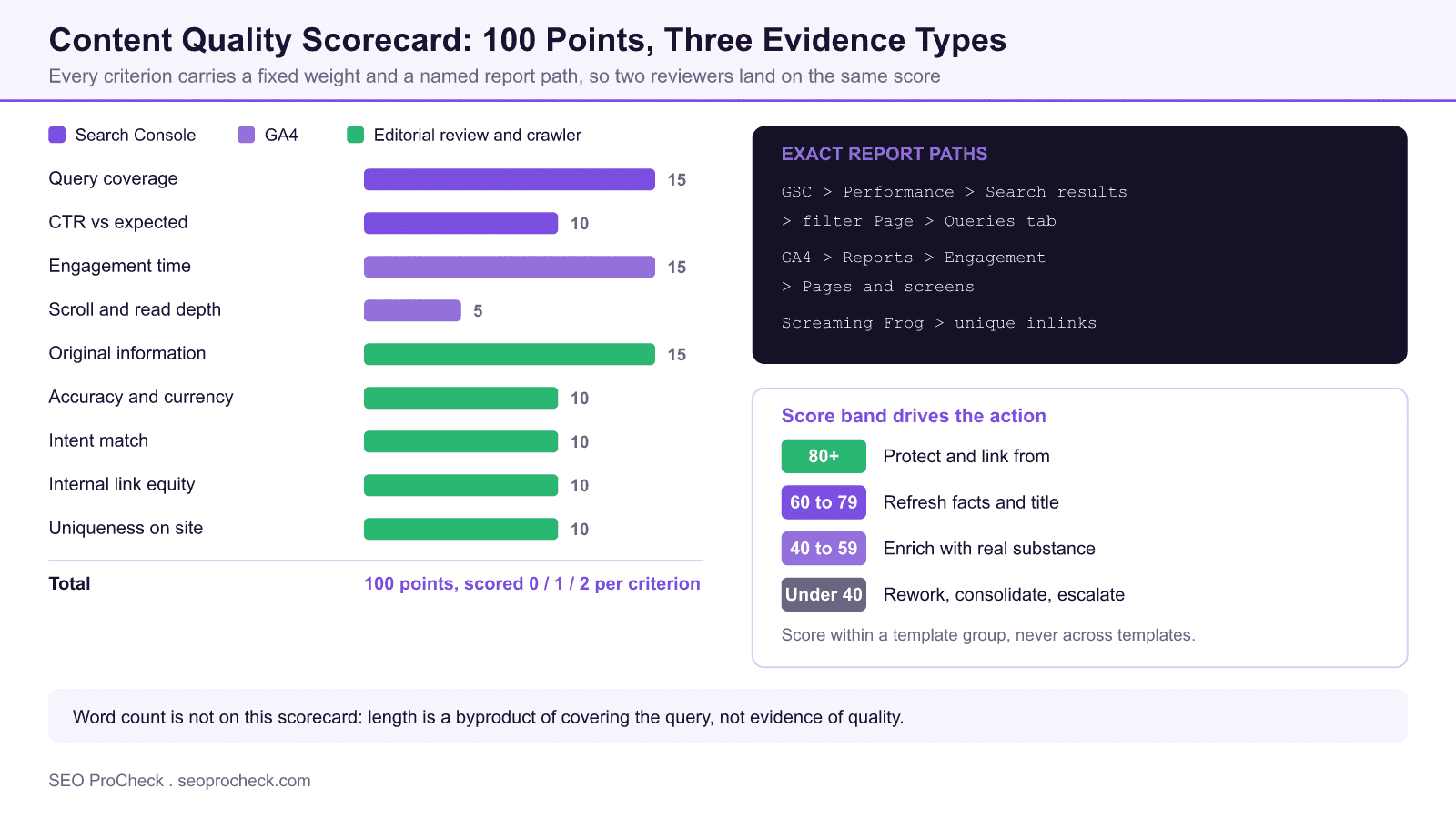
To measure content quality objectively, score each URL against a fixed rubric that combines behavioral data (engagement time, scroll depth, return visits), search performance data (query coverage, CTR vs. position, impressions trend), and editorial criteria (accuracy, depth, original information). The point is repeatability: two auditors scoring the same page should land within a point of each other, which only happens when every criterion maps to a number you can pull from GA4, Search Console, or a crawl.
Understanding Content Quality
Content Quality represents a critical component of modern SEO strategy. As search engines continue to evolve and user expectations shift, understanding the nuances of content quality becomes essential for maintaining and improving organic visibility. This guide covers the key concepts, implementation approaches, and strategic considerations that SEO practitioners need to master.
The word "objectively" matters here. Most content audits fail because "quality" gets judged by whoever is reading the page that day. The fix is to define quality as a weighted score built from measurable inputs, agree on the weights once, and then apply the same formula to every URL. You will still make editorial judgment calls, but they get constrained to a 0 to 2 scale per criterion instead of a gut-feel "keep or kill" verdict.
A Working Content Quality Rubric
Below is a rubric I use on sites in the 500 to 50,000 URL range. Each criterion is scored 0 (fails), 1 (adequate), or 2 (strong), multiplied by its weight, and summed to a score out of 100. Adjust weights to your site type: an e-commerce category page weighs search performance heavier; a documentation site weighs task completion heavier.
| Criterion | Weight | Data source | What scores a 2 |
|---|---|---|---|
| Query coverage | 15 | GSC Performance → filter Page → Queries tab | Page earns impressions for multiple distinct query clusters, not just its exact-match title |
| CTR vs. expected for position | 10 | GSC Performance (position + CTR columns) | CTR at or above what sibling pages get at the same average position |
| Engagement time | 15 | GA4 → Reports → Engagement → Pages and screens → "Average engagement time per active user" | At or above the site-section median for comparable templates |
| Scroll / read depth | 5 | GA4 enhanced measurement scroll event (90% threshold) or custom 25/50/75 events | Majority of engaged sessions reach the mid-point of the content |
| Original information | 15 | Editorial review | Contains data, examples, screenshots, or first-hand experience not available on the top-ranking competitors |
| Accuracy and currency | 10 | Editorial review | No outdated claims, dead references, or superseded UI paths; dates and figures verifiable |
| Intent match | 10 | Manual SERP check for the primary query | Format (guide vs. tool vs. list) matches what actually ranks for the target query |
| Internal link equity | 10 | Crawler (Screaming Frog → unique inlinks) | Linked contextually from topically related pages, not only from nav or sitemap |
| Uniqueness on-site | 10 | Crawler duplicate/near-duplicate report; GSC query overlap between URLs | No other URL on the site targets the same query cluster |
Score bands that work in practice: 75 to 100 = performing, leave alone or use as internal-link source; 50 to 74 = enrich (add depth, data, media, update); below 50 = rework substantially: the page needs a new angle, consolidation with a sibling, or a rewrite against the current SERP. Note the remedy is always improvement or consolidation into a better page, not blind deletion; a low behavioral score on a page with real impressions is an opportunity, not a liability.
Pulling the Numbers: Exact Report Paths
For each URL in the audit sheet, collect the following. Use a 3 to 6 month window so seasonality doesn't skew single-month readings, and record the date range in the sheet so the audit is reproducible.
- GSC clicks, impressions, CTR, position: Performance → Search results → add filter "Page" → exact URL. Export via the UI or the Search Analytics API (
dimensions: ["page","query"]) if you have more than a few dozen URLs. - Distinct query clusters: in the same filtered view, open the Queries tab and group queries manually or with a script; count distinct intents, not raw query strings.
- GA4 engagement: Reports → Engagement → Pages and screens; add a comparison or filter on "Page path". The columns you want are "Average engagement time per active user", "Views per active user", and "Event count" for
scroll. - GA4 returning readers: Explore → blank exploration → dimension "Page path" + "New / returning"; a page that earns repeat visits is doing something right regardless of its ranking.
- Indexing state: GSC Pages report (Indexing → Pages) or URL Inspection; a page stuck in "Crawled - currently not indexed" is Google telling you its quality assessment already.
Score Bands and What They Commit You To
The score is only useful if a band mechanically triggers work. Agree these thresholds before scoring, so nobody renegotiates a band after seeing which page landed in it.
| Band | Verdict | Typical work | Who owns it |
|---|---|---|---|
| 75 to 100 | Performing | Leave the content alone. Use it as an internal link source and monitor for decay. | Nobody, until decay shows |
| 50 to 74 | Enrich | Add depth, data, media, worked examples. Update superseded UI paths and figures. | Writer, with a subject specialist |
| Below 50 | Rework | New angle, consolidation with a sibling, or a rewrite against the current SERP. | Editor, as a scoped project |
| Any band, zero on accuracy | Escalate now | Correct the factual error before anything else, whatever the composite score says. | Subject specialist, same week |
This rubric is one component of a larger loop. It plugs into stage 3 of the content audit scoring methodology, which supplies the performance and engagement axes that sit alongside these editorial criteria, and it slots into the wider content audit process. If your GA4 and Search Console numbers disagree about which pages deserve attention, the reconciliation rules in our guide to GA4 and Search Console attribution explain why the two tools count differently.
Key Considerations for Measuring Content Quality Objectively
When approaching content quality, several factors require careful attention. Technical implementation must align with broader SEO objectives while maintaining site performance and user experience. The balance between optimization and over-optimization requires ongoing monitoring and adjustment based on performance data and algorithm changes. Industry benchmarks and competitor analysis provide context for evaluating your own implementation.
Two calibration rules keep the rubric honest. First, always benchmark within template groups: comparing a glossary stub's engagement time against a 3,000-word guide tells you nothing, but comparing it against the other glossary entries does. Second, run a calibration pass before the full audit: have two people independently score the same 10 pages and reconcile any criterion where they diverge by 2 points. That is where your rubric definitions are ambiguous, and it is cheaper to fix them on page 10 than on page 1,000.
Implementation Best Practices
Successful implementation begins with thorough auditing of current state and clear goal definition. Document baseline metrics before making changes to enable accurate impact measurement. Prioritize changes based on potential impact and implementation effort, focusing on high-impact items first. Test changes in staging environments when possible, and monitor closely after deployment to production. Maintain documentation of changes for future reference and troubleshooting.
Practically, that means one spreadsheet row per URL with a column per criterion, a computed score, and a "decision" column that is filled by the score bands, not by hand. When you re-run the audit two quarters later against the same rubric, the score delta per URL is your objective measure of whether the enrichment work paid off.
Common Mistakes to Avoid
Several patterns consistently cause problems in content quality implementations. Rushing implementation without proper planning leads to errors that can be costly to fix. Ignoring the interplay between different SEO factors creates conflicts that undermine results. Failing to monitor and iterate based on performance data means missing optimization opportunities. Over-optimization signals can trigger algorithmic penalties that take months to recover from.
The most common rubric-specific mistakes: treating word count as a quality criterion (it is a symptom, not a signal: score depth and original information instead); scoring pages against sitewide averages rather than template peers; and letting a single metric like bounce or engagement time drive deletion decisions when the page may simply serve a quick-answer intent well.
Measuring Success
Effective measurement requires defining appropriate KPIs aligned with business objectives. Track both leading indicators (rankings, impressions, technical metrics) and lagging indicators (traffic, conversions, revenue) to build a complete picture. Establish reasonable timeframes for evaluation, as SEO changes often take weeks or months to fully manifest in results. Compare performance against historical baselines and competitor benchmarks to contextualize results.
Strategic Recommendations
Approach content quality as an ongoing program rather than a one-time project. Build processes for regular auditing, monitoring, and optimization. Stay current with industry developments and algorithm changes that may affect your strategy. Invest in education for team members to build internal capabilities. Consider how content quality fits within your broader digital marketing and business strategy for maximum impact.
Frequently Asked Questions
How do you measure content quality objectively?
Build a weighted rubric where every criterion maps to a retrievable number: engagement metrics from GA4, query and CTR data from Search Console, link and duplication data from a crawler, plus a small set of editorial criteria scored on a fixed 0 to 2 scale. Sum to a score out of 100 and let predefined score bands drive the keep/enrich/rework decision.
What metrics indicate high-quality content?
No single metric does. The reliable pattern is a combination: the page earns impressions across multiple query clusters, its CTR holds up against sibling pages at the same position, engagement time is at or above the median for its template group, and it attracts contextual internal or external links. A page strong on all four is almost always genuinely useful.
Is word count a measure of content quality?
No. Word count correlates loosely with depth but is trivially gamed and varies by intent: a conversion-table page can be excellent at 300 words. Score depth via "original information" and "intent match" criteria instead, and treat word count only as a flag for pages worth a manual look.
What is a good average engagement time in GA4?
There is no universal benchmark worth using. Compare each page against the median of its own template group (all glossary pages, all product guides) over the same date range. A page 50% below its group median warrants review; a page compared against a sitewide average tells you nothing.
How often should you re-score content quality?
Quarterly for the full library on mid-size sites, or continuously for your top-traffic and top-revenue pages. Always re-score after a Google core update using the same rubric and date-window length, so you can see whether pages that lost visibility share low scores on specific criteria: that pattern is your remediation roadmap.
Can low-quality pages hurt the rest of my site?
Google has said sitewide quality is evaluated in aggregate, and sites with large volumes of thin, templated pages can see classifier-level suppression that affects more than the thin pages themselves. The remedy is improving or consolidating weak pages so the aggregate rises: measured, rubric-driven enrichment rather than mass deletion.
Take this with you
The assistant links open with a question about this page already written. Nothing is sent until you press enter.
Claude Vincent is a technical SEO consultant focused on crawlability, rendering, and AI-search visibility. He writes the field guides and case studies at SEO ProCheck, with a bias toward the durable, unglamorous work that decides whether search engines and AI answer engines can actually read and cite a site.
About SEO ProCheck
Technical SEO consulting and GEO strategy with 20 years of enterprise experience. Case studies, resources, and tools for search and AI visibility.
Work With Me
Technical SEO audits, GEO strategy, site migrations, and international SEO. Hourly consulting for teams who need hands-on support, not just reports.
Subscribe to our newsletter!








Recent Posts
- Most Top Sites Never Say Who They Are in Structured Data October 14, 2026
- Homepage Titles Are Mostly Too Short, Not Too Long October 8, 2026
- Who Actually Serves an llms.txt? 184 Top Sites Measured September 29, 2026