

AI Summary
SEO KPI selection means choosing the few metrics that reflect progress toward a business goal, then tracking them at the right cadence. Build a KPI tree from a top objective down to leading and lagging indicators, source each from Search Console, GA4, or rank tracking, and report them on a schedule matched to how fast each one moves.
- A KPI is a metric chosen because it maps to a business objective; keep the headline set to three to five
- Pair lagging outcome KPIs like organic revenue with leading predictive ones like indexing and average position
- Separate branded from non-brand organic traffic; non-brand is the truer measure of SEO growth
- Match reporting cadence to volatility: positions weekly, core KPIs monthly, strategic outcomes quarterly
Most SEO reports fail not because the data is wrong but because they track everything and prioritize nothing. KPI selection is the discipline of choosing the handful of numbers that actually answer the question a stakeholder cares about: is this program moving the business? This guide walks through building a KPI tree from a business goal, distinguishing leading from lagging indicators, sourcing each metric, and setting a reporting cadence that prevents overreaction to noise.
Start from the business goal, not the metric
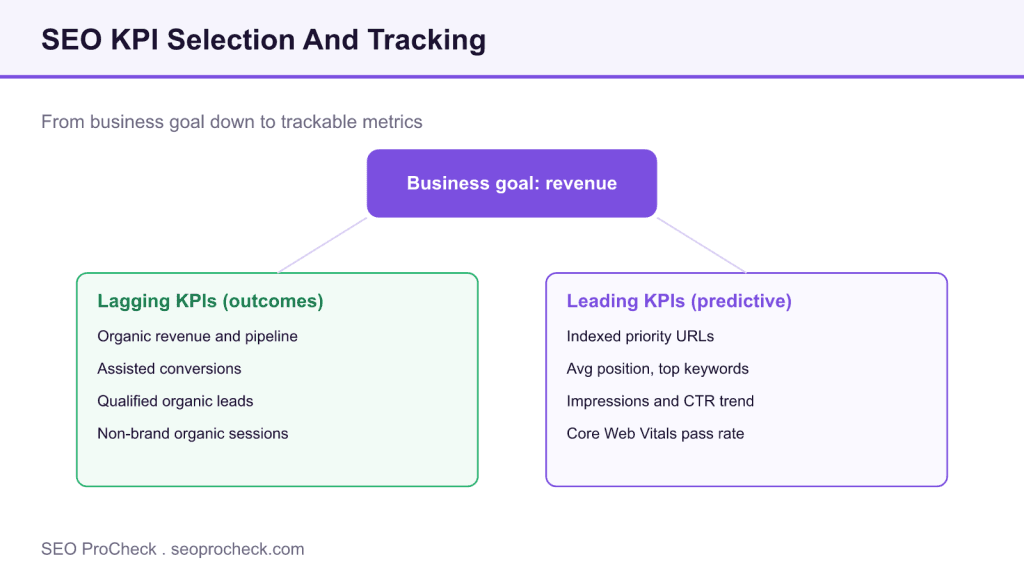
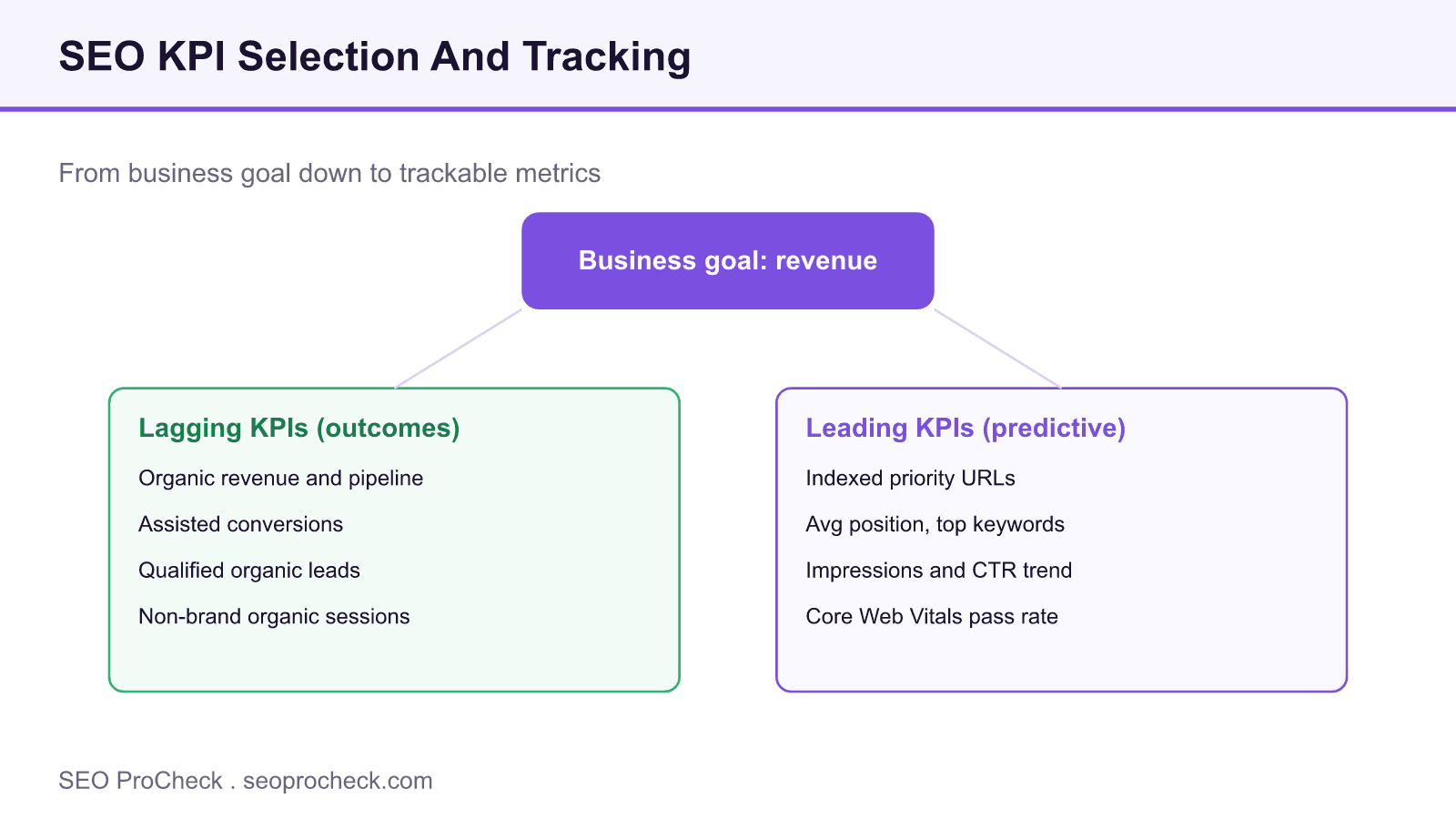
Work top down. Begin with the primary objective, usually revenue or qualified pipeline, then ask which organic outcomes drive it, then which activities drive those. That chain becomes your KPI tree. For a lead generation business the tree might run: revenue, then qualified organic leads, then non-brand organic sessions to money pages, then indexed and ranking priority URLs. Each layer is a KPI you can hold someone accountable for, and each connects explicitly to the layer above.
Balance leading and lagging KPIs
Lagging KPIs confirm results after they happen. They are the ones executives care about, organic revenue, assisted conversions, qualified leads, but they move slowly and tell you little about what to do next. Leading KPIs move earlier and predict those outcomes:
- Indexed priority URLs versus the total you intend to rank
- Average position for your target keyword set
- Impressions and CTR trend in Search Console
- Core Web Vitals pass rate for key templates
A healthy report pairs both: leading indicators to steer week to week, lagging indicators to prove the program delivered.
Source each KPI deliberately
Know where every number comes from and do not mix incompatible sources silently. Google Search Console is authoritative for impressions, clicks, average position, and CTR. GA4 owns sessions, engagement, conversions, and revenue by channel; define your organic conversion events explicitly rather than trusting defaults. Rank tracking and crawl tools such as Screaming Frog fill in position detail and technical health. Pull these into one dashboard, commonly Looker Studio, so stakeholders see a single coherent view.
Separate branded from non-branded
Branded search inflates SEO numbers with demand other channels created. To see real organic growth, split branded and non-brand performance. In Search Console or your dashboard, apply a query regex that matches your brand variants and report the two segments separately. Non-brand organic sessions and conversions are the honest measure of whether your content and technical work are winning new demand. For choosing which non-brand intents to pursue in the first place, see our guide to user intent mapping for content planning.
Set targets and a reporting cadence
A KPI without a target is just a number. Set realistic targets from your own baseline and trend, not from a competitor's vanity figure, and add guardrail metrics so you notice if a gain in one area quietly costs you elsewhere. Then match reporting frequency to how fast each metric moves: review leading indicators such as indexing and positions weekly, report core KPIs to stakeholders monthly, and assess strategic outcomes and targets quarterly. Reporting a slow outcome KPI weekly invites overreaction to normal fluctuation.
Example SEO KPI framework
| KPI | Type | Data source | Cadence |
|---|---|---|---|
| Organic revenue and pipeline | Lagging | GA4, CRM | Monthly |
| Qualified organic leads | Lagging | GA4, CRM | Monthly |
| Non-brand organic sessions | Leading | GA4, Search Console | Weekly |
| Average position, target set | Leading | Search Console, rank tracker | Weekly |
| Indexed priority URLs | Leading | Search Console, crawler | Weekly |
Measurement is a program in its own right. Explore more in the analytics and measurement hub, and if you also track AI search visibility, compare tooling in our breakdown of Profound versus Semrush and Ahrefs.
Frequently asked questions
What is the difference between a KPI and a metric?
A metric is any measurable number, such as sessions or impressions. A KPI is a metric you have chosen because it directly reflects progress toward a business objective. Every KPI is a metric, but most metrics are not KPIs; the discipline is picking the few that matter and ignoring the rest.
What are leading versus lagging SEO KPIs?
Lagging KPIs measure outcomes after the fact, such as organic revenue or qualified leads, and confirm whether SEO worked. Leading KPIs, such as indexed priority URLs, average position, and impressions, move earlier and predict where outcomes are heading, so you can act before revenue shifts.
How many KPIs should an SEO program track?
Keep the headline set small, typically three to five KPIs tied to the primary business goal, supported by a slightly larger pool of diagnostic metrics. Too many KPIs dilute focus and make reporting noisy; the point is to know at a glance whether the program is on track.
Which tools provide SEO KPI data?
Google Search Console supplies impressions, clicks, average position, and CTR; GA4 supplies sessions, conversions, and revenue by channel; and rank tracking and crawl tools fill in position and technical health. Most teams combine these in a dashboard such as Looker Studio.
How do I separate branded from non-branded performance?
In Search Console or your dashboard, filter queries with a regex that matches your brand terms, then report branded and non-branded separately. Non-brand organic traffic is the truer measure of SEO growth, because branded demand is often driven by other channels.
How often should SEO KPIs be reported?
Match cadence to the metric's volatility. Review leading indicators such as indexing and positions weekly, report core KPIs monthly to stakeholders, and assess strategic outcomes and targets quarterly. Reporting outcome KPIs too often invites overreaction to normal noise.
Claude Vincent is a technical SEO consultant focused on crawlability, rendering, and AI-search visibility. He writes the field guides and case studies at SEO ProCheck, with a bias toward the durable, unglamorous work that decides whether search engines and AI answer engines can actually read and cite a site.
About SEO ProCheck
Technical SEO consulting and GEO strategy with 20 years of enterprise experience. Case studies, resources, and tools for search and AI visibility.
Work With Me
Technical SEO audits, GEO strategy, site migrations, and international SEO. Hourly consulting for teams who need hands-on support, not just reports.
Subscribe to our newsletter!







Recent Posts
- Can AI Crawlers Actually Read Your Site? I Measured 400 of the Biggest September 5, 2026
- The Pre-Publish Quality Gate for AI-Assisted Content August 6, 2026
- AGENTS.md vs llms.txt vs llms-full.txt: Which Agent File Does What July 18, 2026