

AI Summary
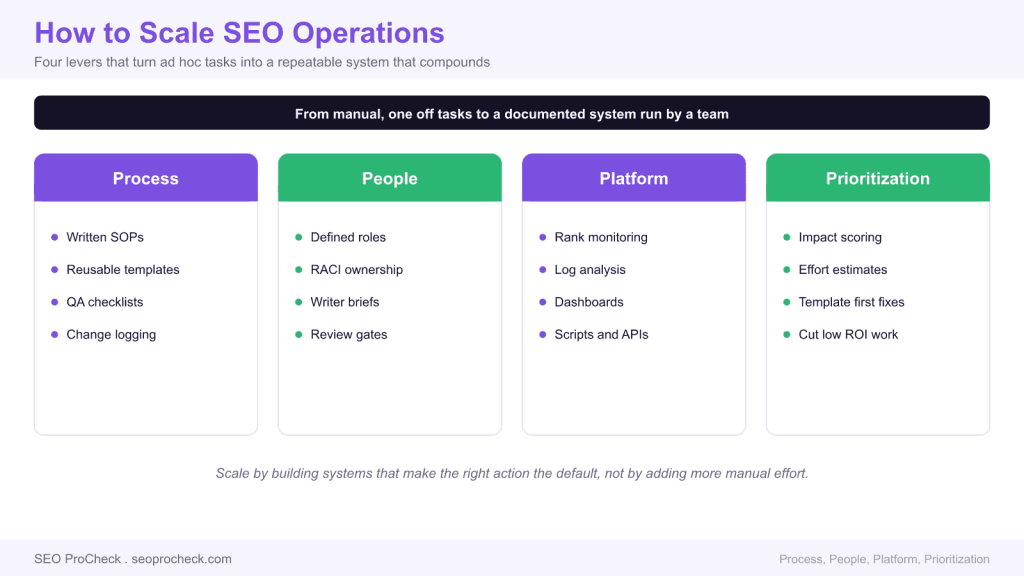
Scaling SEO operations means moving from ad hoc, manual tasks to a documented system that produces consistent results without depending on one person. You do it by strengthening four levers together: process, people, platform, and prioritization, so the right action becomes the default rather than a heroic effort.
- Standardize before you automate: document the workflow, then build tooling around the documented steps.
- Prioritize template level fixes that touch thousands of pages over one off page edits.
- Score work by impact against effort so the team spends its hours on the highest return tasks.
- Protect quality with QA checklists and review gates, since scale multiplies mistakes as fast as wins.

Doing SEO for a ten page site is a to do list. Doing SEO for a ten thousand page site, or across a dozen clients, is an operations problem. The tactics do not change much; what breaks is the delivery. Work that lived in one specialist's head does not survive more pages, more people, or more sites. Scaling SEO operations is the discipline of turning that tacit knowledge into a system that runs reliably without depending on any single person. This guide lays out the four levers that make it work, and the order to pull them.
Standardize before you automate
The most common scaling mistake is automating a process nobody has written down. Automation of a messy workflow just produces mistakes faster. The correct sequence is standardize, then systematize, then automate, then delegate. First document exactly how a task is done today, as a written standard operating procedure with the exact tools, report paths, and pass or fail criteria. Only once the steps are explicit and stable is it worth building a script or a template around them. A documented process is also the thing you hand to a new hire or a contractor, which is what actually lets the team grow.
Lever 1: Process
Process is the backbone. It converts a skilled individual's judgment into steps anyone trained can follow.
- Written SOPs for every repeatable task: keyword mapping, on page optimization, technical audits, content briefs. Each names the tool, the exact setting, and the definition of done.
- Reusable templates for briefs, audit reports, and page structures, so quality does not depend on who happens to do the work.
- QA checklists run before anything ships. At scale a single templating error repeats across thousands of pages, so the checklist is your insurance.
- Change logging so you can tie a ranking movement to a specific change weeks later.
Lever 2: People
Scale needs more hands, and more hands need structure or they collide.
- Defined roles so strategy, execution, and review are distinct jobs, not one overloaded person.
- RACI ownership (responsible, accountable, consulted, informed) on each workflow so nothing falls between people.
- Writer and specialist briefs that carry the intent, target query, internal links, and structure, so output is consistent across a bigger team.
- Review gates where a second person checks work against the QA checklist before publish.
Lever 3: Platform
Tooling is where genuine leverage lives, because a script written once runs on every URL forever. This is where SEO scaling becomes an engineering habit.
- Monitoring for rankings, indexing, and Core Web Vitals so regressions surface in days, not at the next manual audit.
- Log analysis to see how crawl budget is actually spent across a large site, using Python log file parsers.
- Bulk checks so audits that would take days by hand run in minutes; see bulk URL testing scripts for status and redirect sweeps.
- Dashboards that put the metrics that matter in front of stakeholders without a person rebuilding a report each week.
Lever 4: Prioritization
At scale the constraint is never ideas, it is capacity. Prioritization decides which of a hundred possible improvements you actually do. Score each opportunity by expected impact against required effort, and always favor template level changes.
| Work type | Reach | Priority |
|---|---|---|
| Fix a title template across a page type | Thousands of pages at once | Highest, do first |
| Internal linking rule in the CMS | Whole sections | High |
| Enrich a high traffic cornerstone page | One important page | Medium, worth it for top pages |
| Hand editing individual low traffic pages | One page each | Low, automate or skip |
The maturity path
| Stage | What it looks like | Next move |
|---|---|---|
| Ad hoc | Tasks in one person's head, nothing written | Document the top five recurring workflows |
| Standardized | SOPs and templates exist and are followed | Add QA gates and role ownership |
| Automated | Scripts and monitoring handle repetitive checks | Build dashboards and alerting |
| Compounding | System runs without founder involvement | Reinvest freed time in strategy and new bets |
Guard quality as you scale
Scale is a multiplier, and it multiplies errors as eagerly as wins. A broken canonical shipped through a template can noindex a section overnight. This is why the QA checklist and review gate are not optional overhead, they are the brakes that let you drive faster. Ground every scaled change in solid fundamentals from technical SEO, and verify template changes on live pages before declaring them done.
FAQ
It means moving from doing SEO as a series of manual, one off tasks to running it as a documented system that delivers consistent results across many pages, sites, or team members. Scaling is less about new tactics and more about repeatability: written processes, defined roles, tooling, and prioritization that let output grow without quality falling or the work depending on one person.
No. Automate last. The correct order is standardize, systematize, automate, then delegate. If you automate a process that is not written down and stable, you just make mistakes faster and at larger scale. Document the workflow with exact steps and pass or fail criteria first, then build scripts and templates around those documented steps.
Prioritize template level changes that affect many pages at once, such as fixing a title tag pattern or an internal linking rule in the CMS. A single template fix can improve thousands of pages for the same effort as editing one page by hand. Score every opportunity by expected impact against effort, and push individual low traffic page edits to the bottom or automate them.
Use briefs, QA checklists, and review gates. A brief carries intent and structure so writers produce consistent work. A checklist catches errors before publish, and a review gate means a second person verifies the work. At scale a single templated mistake repeats across thousands of pages, so these controls are what let you move quickly without breaking things.
You need monitoring for rankings, indexing, and Core Web Vitals, log analysis to understand crawl behavior, bulk testing for audits, and dashboards for reporting. Python is the common thread for the custom pieces: parsing logs, testing URLs in bulk, and pulling APIs. The goal is that repetitive checks run automatically so people spend their time on judgment, not manual data gathering.
Automate repetitive, rule based work such as status checks, log parsing, and reporting, because a script does it perfectly every time at near zero marginal cost. Hire for judgment work that does not reduce to rules: strategy, editorial quality, stakeholder communication, and reviewing the output of your automation. A healthy scaled team automates the mechanical layer and adds people at the judgment layer.
Outgrowing a manual SEO workflow?
The bottleneck at scale is usually process and prioritization, not effort. An operations focused audit maps where automation and templates recover the most time.
Take this with you
The assistant links open with a question about this page already written. Nothing is sent until you press enter.
Claude Vincent is a technical SEO consultant focused on crawlability, rendering, and AI-search visibility. He writes the field guides and case studies at SEO ProCheck, with a bias toward the durable, unglamorous work that decides whether search engines and AI answer engines can actually read and cite a site.
About SEO ProCheck
Technical SEO consulting and GEO strategy with 20 years of enterprise experience. Case studies, resources, and tools for search and AI visibility.
Work With Me
Technical SEO audits, GEO strategy, site migrations, and international SEO. Hourly consulting for teams who need hands-on support, not just reports.
Subscribe to our newsletter!
Recent Posts
- Most Top Sites Never Say Who They Are in Structured Data October 14, 2026
- Homepage Titles Are Mostly Too Short, Not Too Long October 8, 2026
- Who Actually Serves an llms.txt? 184 Top Sites Measured September 29, 2026