

AI Summary
Semantic SEO is the practice of optimizing for topics, entities and search intent rather than isolated keywords, so engines understand what a page means and how it connects to related concepts. It matters more in 2026 because Google AI Overviews and AI Mode reward pages that answer a whole topic with clear structure and supporting entities.
- Build topic clusters: one pillar page plus supporting pages tied together with descriptive internal links.
- Mark up entities with schema.org types so machines can map your content to known things.
- Match intent, not just the keyword: an informational query needs an explanatory page, not a product grid.
- Cover the full question set from People Also Ask and related searches so one page satisfies the topic.
Semantic SEO is how you get a page to rank for a topic rather than a single phrase. Instead of repeating one keyword, you cover the concepts, questions and entities that surround a subject, then connect them with structure and internal links. Google stopped rewarding exact match repetition years ago; its language models read meaning, resolve entities, and reward the page that answers the whole question. This guide explains what semantic SEO is, why it decides visibility in 2026, and exactly how to implement it.
What semantic SEO actually means
Search engines convert a query into meaning before they rank anything. Google uses systems built on natural language understanding, historically named as Hummingbird, RankBrain, BERT and MUM, to map words to entities and intent. An entity is a distinct thing that the engine already knows, for example a person, a place, a product, or a concept like "core web vitals". Semantic SEO is the deliberate practice of writing and structuring content so those systems can identify your entities, understand your intent, and connect your page to the topics it belongs to.
The practical shift is simple. You stop asking "how many times did I use my keyword" and start asking "did I cover everything a reader and an engine expect on this topic, and did I make the relationships explicit". That is the difference between a thin page and a page that owns a topic.
Why it matters more in 2026
AI Overviews, AI Mode and assistants such as ChatGPT and Perplexity now sit between the query and the click. They synthesize an answer and cite a handful of sources. To be one of those sources, your page has to state a clear answer, define its entities, and cover the neighbouring questions so the model can extract a clean, quotable passage. Pages built the old way, stuffed with a keyword and thin on substance, get skipped. Pages built semantically, with direct answers and topical depth, get cited. The business impact is real: a cited source earns visibility even when the classic blue link gets fewer clicks.
The core components
Four building blocks carry semantic SEO. Treat them as a system, not a checklist.
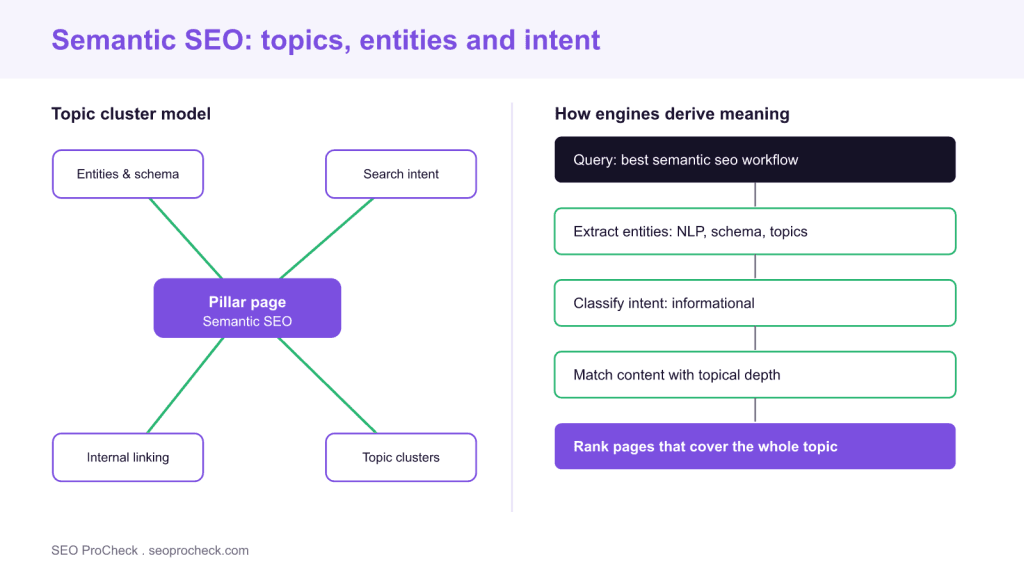
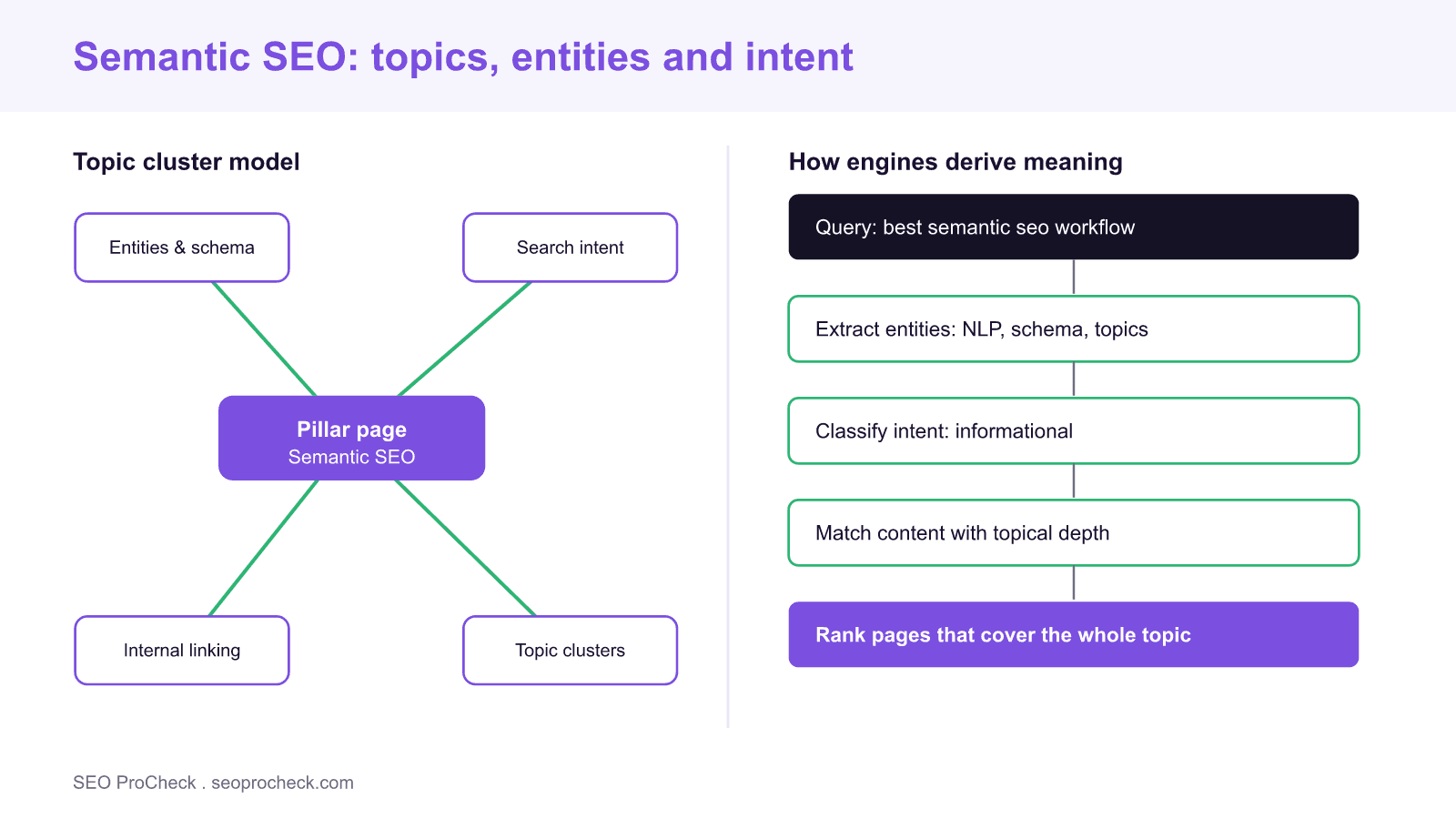
Entities and schema. Name your entities plainly in the copy, then reinforce them with schema.org markup. An Article, FAQPage or Product type tells engines what kind of thing the page is. You are not gaming rankings; you are removing ambiguity so the machine maps your content to the right node in its knowledge graph.
Search intent. Every query carries an intent: informational, navigational, commercial or transactional. Match the page type to the intent. An informational query like "what is semantic seo" needs an explainer, not a pricing page. Read the current top results; they are Google telling you which intent it believes the query has.
Topic clusters. Group your pages so one pillar page covers the broad topic and several supporting pages cover specific subtopics, all linked together. The structure signals depth and gives engines a map of how your pages relate.
Internal linking. Descriptive internal links carry both authority and meaning. Anchor text like "topic cluster model" tells the engine what the destination page is about far better than "click here". See our complete internal linking guide for the mechanics.
How to implement it, step by step
Here is the workflow we run for a topic, from research to publish.
1. Map the topic, not the keyword. Start with a seed query and pull the full question set: People Also Ask, related searches, and the subheadings your competitors use. Tools like Search Console query reports, Semrush Keyword Magic, or a simple scrape of "People Also Ask" give you the sub questions a complete page must answer.
2. Define the entities. List the concepts the page must name and explain, for example semantic SEO, entities, topic clusters, search intent, schema markup, natural language processing. Each should appear where a reader would expect it, defined in plain language on first use.
3. Decide the intent and the format. Confirm the dominant intent by reading the current top ten. Match it: an explainer, a comparison, a how to, or a listicle. Fighting the intent almost never works.
4. Draft for coverage. Write so the page answers the main question in the first paragraph, then works through every sub question with clear headings. Lead with the answer, support it with detail. This is the same structure that earns featured snippets and AI Overview citations.
5. Add structure engines can parse. Use a logical heading hierarchy, one clear H1, then H2 sections. Add an FAQ for the long tail questions, a comparison table where it helps, and schema markup that matches the content type.
6. Wire the cluster. Link the new page to its pillar and to sibling pages with descriptive anchors, and link back from the pillar. This closes the loop that tells engines the pages belong together.
Keyword SEO versus semantic SEO
The table below shows the shift in practice.
A worked example
Say you sell project management software and want to own "resource planning". Keyword SEO would produce one page repeating "resource planning software" a dozen times. Semantic SEO produces a pillar page defining resource planning, plus supporting pages on capacity planning, resource allocation, utilization rates and workload balancing, each answering its own question and linking back to the pillar. You mark the pillar up as an Article, add an FAQ block for the common sub questions, and use anchors like "capacity planning" between pages. The cluster now ranks for hundreds of related queries, feeds AI Overviews with clean definitions, and holds up as the topic evolves.
Common misconceptions
"Semantic SEO means adding LSI keywords." There is no such thing as an LSI keyword in the way SEO folklore describes it. Covering related concepts is good practice, but sprinkling synonyms is not the goal. Coverage and clarity are.
"Schema markup boosts rankings directly." It does not. Schema enables rich results and clarifies entities, which can lift click through and citation rates, but it is not a ranking factor on its own.
"Longer content always wins." Length is a side effect of covering a topic well, never a target. A tight 900 word answer that fully satisfies intent beats a padded 3,000 word page every time.
What has changed since 2022
Three things moved the ground under this topic. First, generative AI answers arrived in mainstream search, so being a citable source now matters as much as ranking. Second, Google folded its helpful content signals into the core ranking system, raising the bar for genuinely useful, first hand content. Third, entity understanding matured, so engines resolve ambiguous terms far better than they did, which rewards pages that name and define their entities clearly. The direction of travel is consistent: cover the topic, define the entities, structure the answer, and connect the cluster. For the wider picture of how classic SEO, answer engines and generative engines now overlap, see our breakdown of SEO versus AEO versus GEO.
| Dimension | Keyword SEO | Semantic SEO |
|---|---|---|
| Unit of targeting | One phrase per page | A whole topic and its questions |
| Content signal | Keyword density | Coverage, clarity, entities |
| Structure | Standalone pages | Pillar plus cluster, linked |
| Markup | Optional | Schema for key entities |
| Ranks for | The exact phrase | Hundreds of related queries |
| AI Overview fit | Weak, hard to extract | Strong, easy to cite |
Frequently asked questions
What is semantic SEO in simple terms?
Semantic SEO is optimizing for topics, entities and meaning instead of isolated keywords. You cover a subject fully and connect related ideas so search engines and AI systems understand what your page is about and how it fits the wider topic.
How is semantic SEO different from keyword SEO?
Keyword SEO chases one phrase per page and repeats it. Semantic SEO targets the whole question set around a topic, uses natural language and related entities, and relies on topic clusters and internal links rather than exact match repetition.
Does schema markup help semantic SEO?
Yes. Schema.org markup maps your content to known entity types such as Article, Product, Organization or FAQPage. It does not directly raise rankings, but it makes your entities explicit, which helps rich results and helps AI systems cite you accurately.
How do topic clusters improve semantic SEO?
A cluster pairs one broad pillar page with several focused supporting pages, all linked together. This structure signals topical depth, spreads internal link equity, and gives engines a clear map of how your pages relate to one topic.
Does semantic SEO help with AI Overviews and ChatGPT?
It helps a lot. AI Overviews and assistants favor pages that answer a question directly, define entities clearly and cover related subtopics. Clean structure, concise answers and strong internal linking make your content easier to extract and cite.
How do I measure semantic SEO results?
Track topic level visibility, not just one keyword. Watch impressions and clicks across a cluster in Search Console, monitor how many queries a single URL ranks for, and check whether your pages appear in People Also Ask and AI Overviews.
Claude Vincent is a technical SEO consultant focused on crawlability, rendering, and AI-search visibility. He writes the field guides and case studies at SEO ProCheck, with a bias toward the durable, unglamorous work that decides whether search engines and AI answer engines can actually read and cite a site.
About SEO ProCheck
Technical SEO consulting and GEO strategy with 20 years of enterprise experience. Case studies, resources, and tools for search and AI visibility.
Work With Me
Technical SEO audits, GEO strategy, site migrations, and international SEO. Hourly consulting for teams who need hands-on support, not just reports.
Subscribe to our newsletter!







Recent Posts
- Can AI Crawlers Actually Read Your Site? I Measured 400 of the Biggest September 5, 2026
- The Pre-Publish Quality Gate for AI-Assisted Content August 6, 2026
- AGENTS.md vs llms.txt vs llms-full.txt: Which Agent File Does What July 18, 2026