

AI Summary
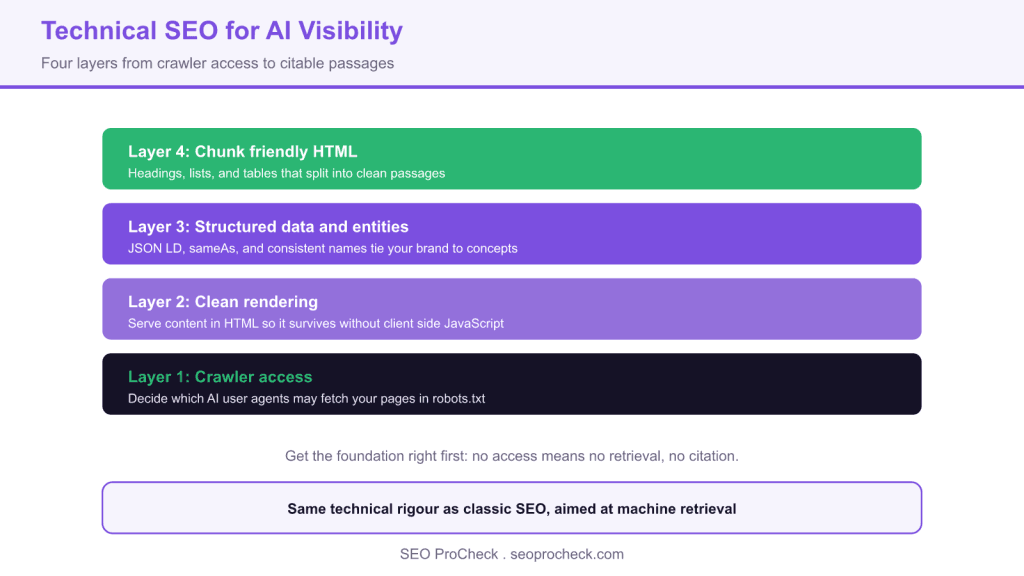
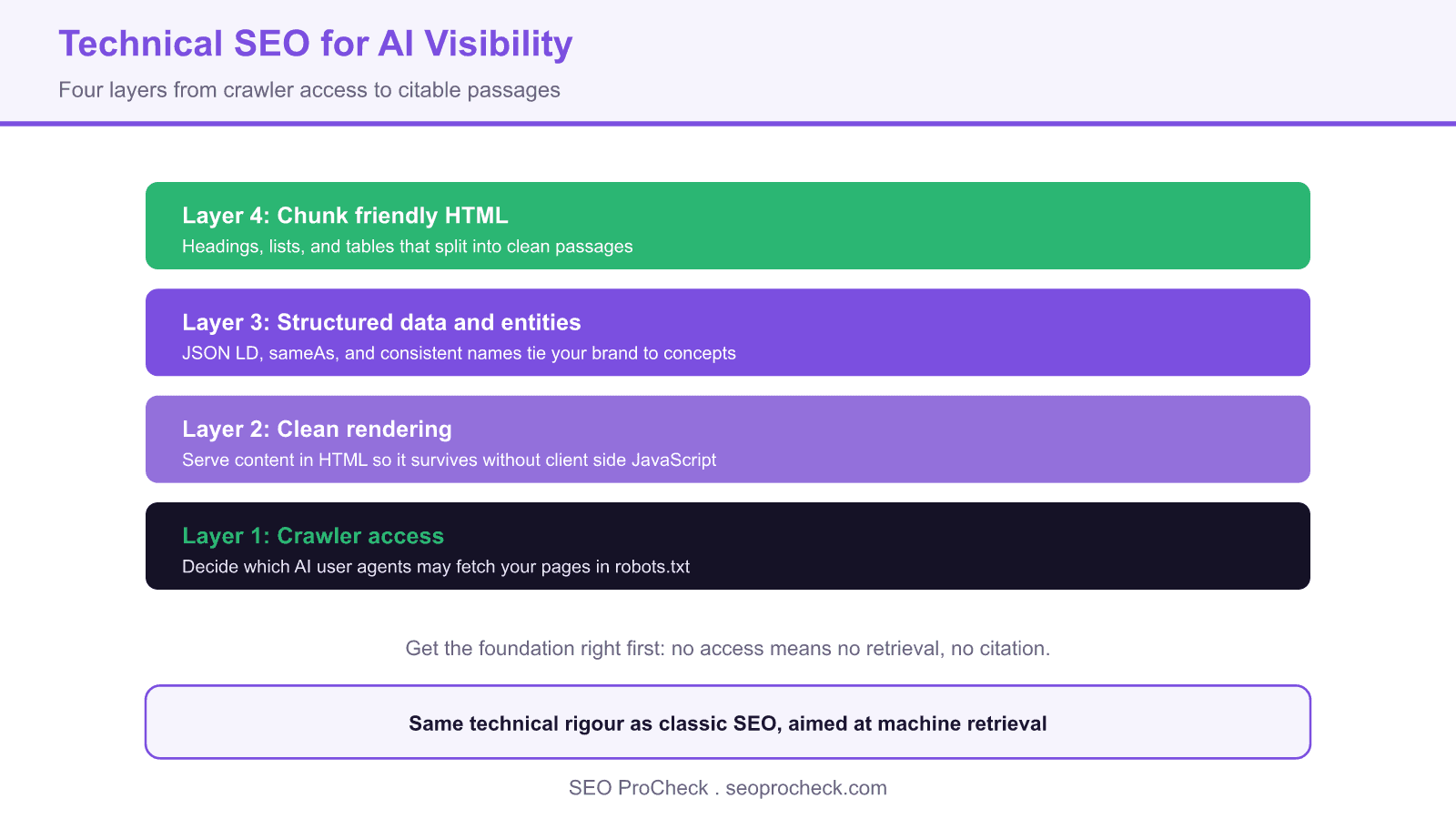
Technical SEO adapts to AI visibility across four layers: let the AI crawlers you want in through robots.txt, render your content in server HTML so it survives without JavaScript, mark up entities with structured data, and write chunk friendly passages that machines can retrieve and cite. The discipline is the same rigour you already apply, pointed at machine retrieval rather than only at ten blue links.
- Control AI crawler access explicitly in robots.txt rather than by accident.
- Content that only appears after client side JavaScript may never be retrieved.
- Structured data and consistent naming tie your brand to the right entities.
- Clean semantic HTML splits into passages that AI systems can quote.
The emergence of AI-powered search and large language models has created new considerations for content optimization. This resource explores how content creators can adapt their strategies to maintain visibility as AI increasingly mediates information discovery.
Understanding AI Content Consumption
Large language models process content differently than traditional search algorithms. They seek factual, well-structured information that can be confidently cited. Understanding these consumption patterns helps optimize content for AI visibility alongside traditional search performance.
Optimization Approaches
Research indicates specific approaches improve AI citation likelihood: including statistics with sources, maintaining factual accuracy, structuring content for easy extraction, and demonstrating clear expertise. These tactics complement rather than replace traditional SEO fundamentals.
Strategic Implications
As AI search grows, early optimization provides compounding advantages. Building citation presence now establishes your content as an authoritative source that AI systems learn to trust. The convergence of good SEO and good GEO practices suggests quality-focused strategies benefit both channels.
This resource provides actionable guidance for the evolving intersection of content strategy and AI visibility.
Source: https://dejanmarketing.com/a-technical-seos-adaptation-for-ai-visibility/
SEO ProCheck practitioner notes
The reassuring message in the source is that AI visibility does not demand a brand new skill set, it demands that you apply the technical fundamentals you already know to a new consumer. AI systems are just another category of automated client, and like search crawlers they can only use what they can fetch, parse, and understand. Here is how we work through the four layers in a technical audit.
Decide who gets to crawl you
AI systems fetch pages with named user agents, and you get to choose which ones you allow. Google uses Google-Extended to govern use of your content for its AI products, OpenAI publishes GPTBot, and other assistants publish their own agents. Set your policy deliberately in robots.txt: blocking an agent removes your content from that system entirely, which is sometimes the right call for a paywall and usually the wrong call for a page you want cited. Audit your current file so you are not accidentally excluding an assistant you would happily appear in.
Make sure the content is actually in the HTML
Rendering is where a lot of AI visibility quietly leaks away. If your main content is injected by client side JavaScript after load, an AI fetcher that does not execute scripts sees an empty shell. Serve the substantive copy in the initial server HTML through server side rendering or static generation, and verify it by fetching the page with curl and confirming the article text is present in the raw response. What is not in the fetched HTML cannot be embedded, retrieved, or cited.
curl -s https://seoprocheck.com/ | python3 -c "import sys,re;t=re.sub(r'<[^>]+>',' ',sys.stdin.read());print(len(t.split()),'words in raw HTML')"Tie your content to entities
AI systems reason about entities, the people, products, organisations, and concepts behind the words. Structured data is how you state those relationships explicitly. Use Organization and Article JSON LD, connect your brand to its authoritative profiles with sameAs, and keep your name, product names, and descriptions consistent everywhere they appear. Consistent, machine readable identity reduces the chance a model confuses you with a similarly named entity and increases the chance it associates the right facts with your brand.
Write HTML that chunks cleanly
The top layer is the passage. Retrieval splits pages on structural boundaries, so a well marked hierarchy of h2 and h3 headings, real lists, and real tables gives the chunker clean seams to cut along. Avoid burying meaning in nested div layouts and avoid one giant wall of text. Every heading should introduce a passage that answers something and stands on its own, which is the same habit that helps human readers skim.
Technical levers and their AI impact
| Technical lever | If neglected | If done well |
|---|---|---|
| Crawler access | Blocked agents cannot cite you | Chosen assistants can fetch pages |
| Rendering | JavaScript only content is invisible | Server HTML is always readable |
| Structured data | Entity confusion, weak identity | Clear brand to concept links |
| Semantic HTML | Messy chunks, poor retrieval | Clean passages, easy citation |
| Site speed | Timeouts drop pages from fetch | Reliable, complete fetches |
What has changed since this piece
Two developments have made this technical work more concrete. AI crawler user agents are now documented and widely used, so allowing or disallowing them in robots.txt is a real, testable decision rather than a theoretical one. And the llms.txt convention has appeared, a root level file that points AI systems at your key content, similar in spirit to an XML sitemap. Neither changes the fundamentals, access, rendering, structured data, and clean HTML, but both give technical SEOs new, low risk controls to add to the audit. The takeaway holds: the skills transfer, the target is new.
Related reading
- A practical framework for LLM consumption
- How AI Mode works and how SEO can prepare
- Browser extensions and daily SEO stack
Frequently asked questions
How do I control which AI crawlers can access my site?
Set your policy in robots.txt using the documented user agents, such as Google-Extended for Google's AI products and GPTBot for OpenAI. Disallowing an agent removes your content from that system, so decide deliberately per agent rather than blocking or allowing everything by default.
Does JavaScript rendering hurt AI visibility?
It can. If your main content only appears after client side JavaScript runs, an AI fetcher that does not execute scripts sees an empty page. Serve the substantive copy in the server HTML through server side rendering or static generation, and confirm it by fetching the page and checking the text is in the raw response.
What structured data helps with AI visibility?
Organization and Article JSON LD establish who you are and what a page is about, and the sameAs property links your brand to its authoritative profiles. Consistent names and descriptions across your site reinforce your identity so models associate the right facts with the right entity.
Is technical SEO for AI different from normal technical SEO?
The skills are the same, the target is new. Crawlability, rendering, structured data, clean HTML, and speed all still matter, but you are now serving AI fetchers and retrieval systems as well as search crawlers. The discipline transfers directly, which is why technical SEOs adapt quickly.
What is llms.txt in a technical context?
It is a plain text file at your site root that points AI systems toward your most important content, similar in intent to an XML sitemap. It is an emerging convention rather than a hard standard, and because it is low risk to add, many technical SEOs now include it in their audits.
Why does site speed matter for AI fetchers?
Slow responses can time out before an AI fetcher receives the full page, which drops your content from what the system can use. Fast, reliable server responses ensure the complete HTML is fetched, embedded, and available for retrieval, so the same performance work that helps users also helps machines.
Take this with you
The assistant links open with a question about this page already written. Nothing is sent until you press enter.
Claude Vincent is a technical SEO consultant focused on crawlability, rendering, and AI-search visibility. He writes the field guides and case studies at SEO ProCheck, with a bias toward the durable, unglamorous work that decides whether search engines and AI answer engines can actually read and cite a site.
About SEO ProCheck
Technical SEO consulting and GEO strategy with 20 years of enterprise experience. Case studies, resources, and tools for search and AI visibility.
Work With Me
Technical SEO audits, GEO strategy, site migrations, and international SEO. Hourly consulting for teams who need hands-on support, not just reports.
Subscribe to our newsletter!








Recent Posts
- Most Top Sites Never Say Who They Are in Structured Data October 14, 2026
- Homepage Titles Are Mostly Too Short, Not Too Long October 8, 2026
- Who Actually Serves an llms.txt? 184 Top Sites Measured September 29, 2026