

AI Summary
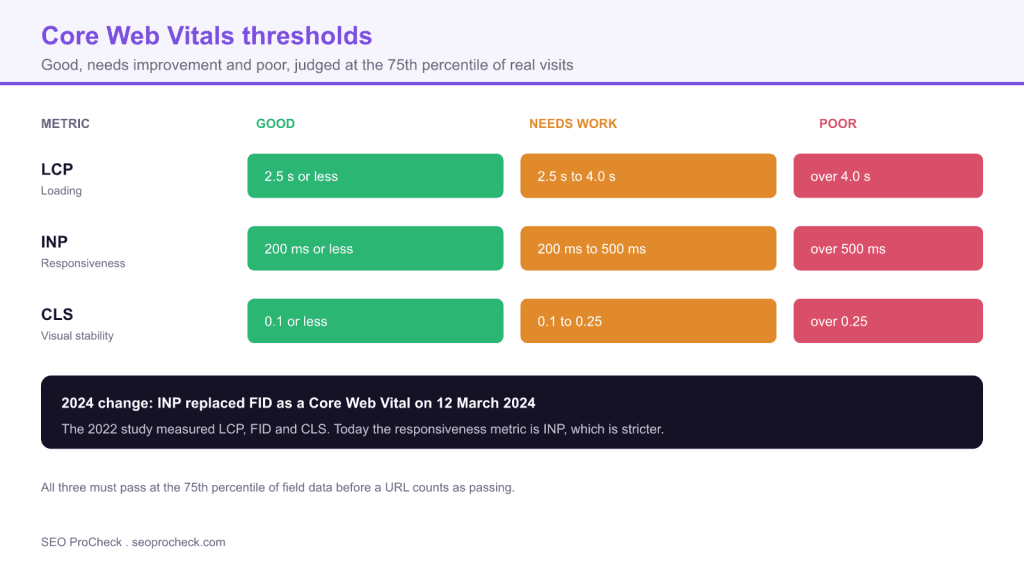
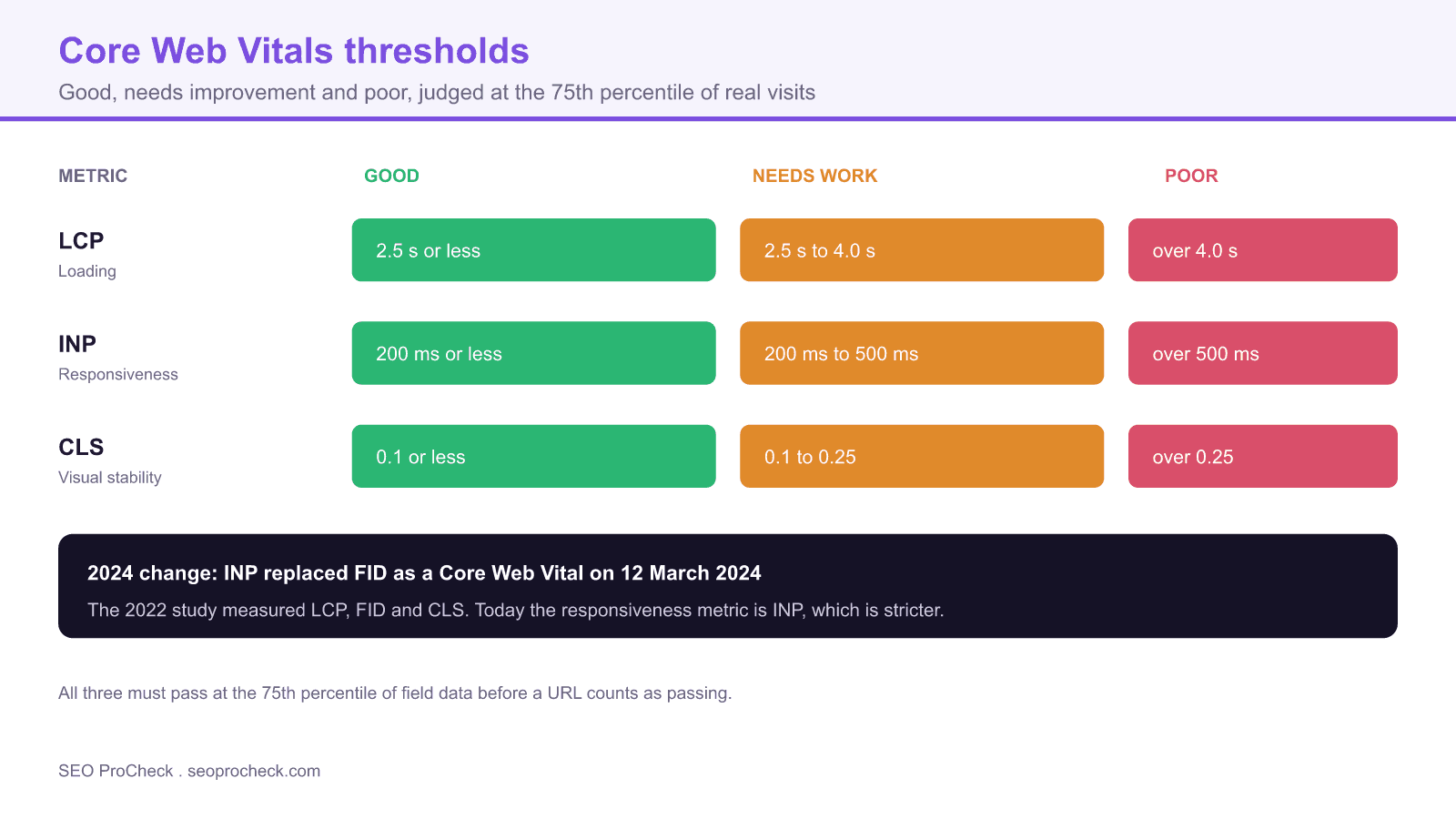
The 2022 Core Web Vitals study measured how real sites performed on Google's loading, interactivity and stability metrics, and the recurring finding across such studies is that most sites pass one or two metrics but stumble on a third, with mobile lagging desktop. The single biggest change since 2022 is that INP replaced FID as the responsiveness metric on 12 March 2024, so any 2022 benchmark now measures a metric Google no longer uses.
- Core Web Vitals are LCP, INP and CLS, each judged at the 75th percentile of real visits.
- INP replaced FID in March 2024 and is stricter, so old FID passes do not carry over.
- A URL only passes when all three metrics are in the good band on field data.
- Optimise from field data (CrUX) and use lab tools only to reproduce and debug.
Core Web Vitals Study 2022 provides valuable insights for SEO practitioners. This resource examines approaches and considerations that can improve organic search performance.
Large scale studies of Core Web Vitals, like the 2022 one referenced below, are useful because they replace opinion with a distribution: they crawl thousands of real sites, pull the field measurements, and show how many actually clear Google's thresholds rather than how many think they do. The recurring lesson from these studies is humbling. Passing is harder than it looks, most sites clear one or two metrics while failing a third, and mobile performance trails desktop by a wide margin. What has dated in the original study is not that pattern but the metrics themselves, because Google changed one of the three in 2024. This piece explains the metrics as they stand now and what a 2022 benchmark can and cannot still tell you.
What the three metrics actually measure
Core Web Vitals reduce the vague idea of a fast, pleasant page to three measurable experiences: how quickly the main content appears, how quickly the page responds when a visitor interacts, and how much the layout jumps around while loading. Each is measured from real Chrome users through the Chrome User Experience Report, and Google grades a URL at the 75th percentile, meaning three quarters of visits must hit the good threshold for the URL to pass. That percentile detail is why a page can feel fast on your fast laptop and still fail: the slowest quarter of real visits is what decides the grade.
| Metric | Measures | Good | Common cause of failure | First fix to try |
|---|---|---|---|---|
| LCP | Loading of the largest element | 2.5 s or less | Heavy hero image, slow server, render blocking CSS | Preload and compress the hero, improve server response |
| INP | Responsiveness to interaction | 200 ms or less | Long JavaScript tasks blocking the main thread | Break up long tasks, defer non critical scripts |
| CLS | Visual stability during load | 0.1 or less | Images without dimensions, injected ads, late fonts | Set width and height, reserve space for dynamic content |
What has changed since the 2022 study
Two shifts matter when you read any Core Web Vitals research from 2021 or 2022.
INP replaced FID. The 2022 study measured First Input Delay as the responsiveness metric. On 12 March 2024, Google retired FID and made Interaction to Next Paint an official Core Web Vital in its place. This is not a cosmetic rename. FID only measured the delay before the browser began processing the first interaction, which was easy to pass. INP measures the full latency, from input to the next visible frame, across all interactions on the page, and it is considerably stricter. Many pages that comfortably passed FID do not pass INP, so a 2022 pass rate for responsiveness is effectively obsolete.
Page experience was reframed. Around the 2022 period Google talked about a distinct page experience ranking system with its own report. Google has since folded that thinking into its broader guidance about helpful, reliable, people first content, and retired the dedicated page experience report in Search Console. Core Web Vitals still matter and are still measured, but you should treat them as one input into a good experience rather than a standalone ranking switch. The page experience entry covers that evolution in more detail.
Field data versus lab data, and why the study used field data
Credible Core Web Vitals studies use field data, the measurements from real users, because that is what Google grades. Lab tools like Lighthouse simulate a single load on a fixed device and network, which is invaluable for reproducing and debugging a problem but does not represent your real audience. The practical workflow is to read your standing from field data first, then switch to lab tools to find and fix the cause.
| Source | Tool | Use it to |
|---|---|---|
| Field (real users) | CrUX, PageSpeed Insights, Search Console | See your actual pass or fail grade |
| Lab (simulated) | Lighthouse, DevTools Performance panel | Reproduce and debug a specific cause |
How to use an old benchmark today
A 2022 study is still worth reading for its method and its two durable conclusions: passing all three metrics at once is the hard part, and mobile is where most sites lose. Just translate the responsiveness figures from FID to INP in your head, and expect your own INP to be tighter than any FID number implied. Run your current pages through field data, fix the one metric that is failing rather than chasing a perfect score on the two that already pass, and re measure after real users have generated fresh data, since field metrics update on a rolling 28 day window. To fold this into a wider technical review, our SEO checks put Core Web Vitals alongside the other signals that move rankings together.
Frequently asked questions
The three Core Web Vitals are Largest Contentful Paint, Interaction to Next Paint and Cumulative Layout Shift. The good thresholds are 2.5 seconds or less for LCP, 200 milliseconds or less for INP, and 0.1 or less for CLS. A URL only passes when all three sit in the good band at the 75th percentile of real user visits.
Its method and broad conclusions still hold: most sites fail on one metric rather than all three, and mobile performance trails desktop. What is outdated is the responsiveness metric, because the study measured FID, which Google retired in March 2024. Read the pattern, but do not treat its FID figures as current.
FID only captured the delay before the browser started processing the very first interaction, so it was easy to pass and did not reflect how sluggish a page felt overall. INP measures the full latency of interactions across the whole visit, from input to the next painted frame, giving a truer picture of responsiveness. It is stricter, so some pages that passed FID now fail INP.
Yes, but as one input rather than a standalone switch. Google folded the old page experience system into its wider guidance on helpful, people first content and retired the dedicated report, while continuing to measure Core Web Vitals. They act as a tiebreaker and a user experience signal, so they help most when content quality is already competitive.
Trust field data for your grade, because Google grades you on real user measurements from the Chrome User Experience Report. Use lab tools such as Lighthouse and the DevTools Performance panel to reproduce a problem and test a fix, since they run a single controlled load. The two disagree often, and that is expected: one is your audience, the other is one device.
Because grading happens at the 75th percentile of real visits, so the slowest quarter of your audience decides the result. Your fast device on a good connection is not representative. Slower phones, weaker networks and heavy third party scripts on real visits commonly push LCP or INP past the threshold even when your own experience of the page is smooth.
Take this with you
The assistant links open with a question about this page already written. Nothing is sent until you press enter.
Claude Vincent is a technical SEO consultant focused on crawlability, rendering, and AI-search visibility. He writes the field guides and case studies at SEO ProCheck, with a bias toward the durable, unglamorous work that decides whether search engines and AI answer engines can actually read and cite a site.
About SEO ProCheck
Technical SEO consulting and GEO strategy with 20 years of enterprise experience. Case studies, resources, and tools for search and AI visibility.
Work With Me
Technical SEO audits, GEO strategy, site migrations, and international SEO. Hourly consulting for teams who need hands-on support, not just reports.
Subscribe to our newsletter!








Recent Posts
- Most Top Sites Never Say Who They Are in Structured Data October 14, 2026
- Homepage Titles Are Mostly Too Short, Not Too Long October 8, 2026
- Who Actually Serves an llms.txt? 184 Top Sites Measured September 29, 2026