

AI Summary
The CSS chapter of the 2022 Web Almanac is a large scale analysis of how real websites write and ship CSS, and it matters for SEO because CSS habits feed directly into Core Web Vitals and page experience. Bloated stylesheets, render blocking rules, and unmanaged web fonts slow the metrics Google measures, so the Almanac doubles as a practical audit checklist for technical SEO.
- The Web Almanac is published yearly by HTTP Archive using data from millions of real pages, not lab tests.
- CSS size, unused rules, and render blocking styles affect Largest Contentful Paint and First Contentful Paint.
- Unsized media and font swap behaviour drive Cumulative Layout Shift, a Core Web Vitals metric.
- You can turn each Almanac finding into a repeatable check inside your own technical SEO audit.
The CSS chapter of the 2022 Web Almanac is one of the most useful free technical references an SEO can read, yet many practitioners skip it because it looks like a front end engineering document. It is worth the time. The Web Almanac is compiled by HTTP Archive from a crawl of millions of live pages, so every figure describes how the real web is actually built rather than how a tutorial says it should be. For anyone responsible for Core Web Vitals, that grounding is exactly what makes it actionable.
Why a CSS report belongs in an SEO workflow
Google confirmed page experience as a ranking input, and Core Web Vitals sit at the centre of it. Two of the three current metrics, Largest Contentful Paint and Cumulative Layout Shift, are heavily influenced by how a site delivers its CSS. A stylesheet that blocks rendering delays the moment the browser can paint the main content. A late loading web font shifts text after the reader has already started to read. Neither problem shows up in a keyword report, but both quietly suppress the scores Google records in the field through the Chrome User Experience Report.
The Almanac gives you the population level view: what share of sites ship very large CSS, how common render blocking stylesheets remain, how many pages still rely on legacy layout techniques. When your own numbers sit far from the norm, you have a defensible reason to open a ticket with the engineering team.
The findings that move Core Web Vitals
Four themes from the chapter map cleanly onto the metrics Google measures:
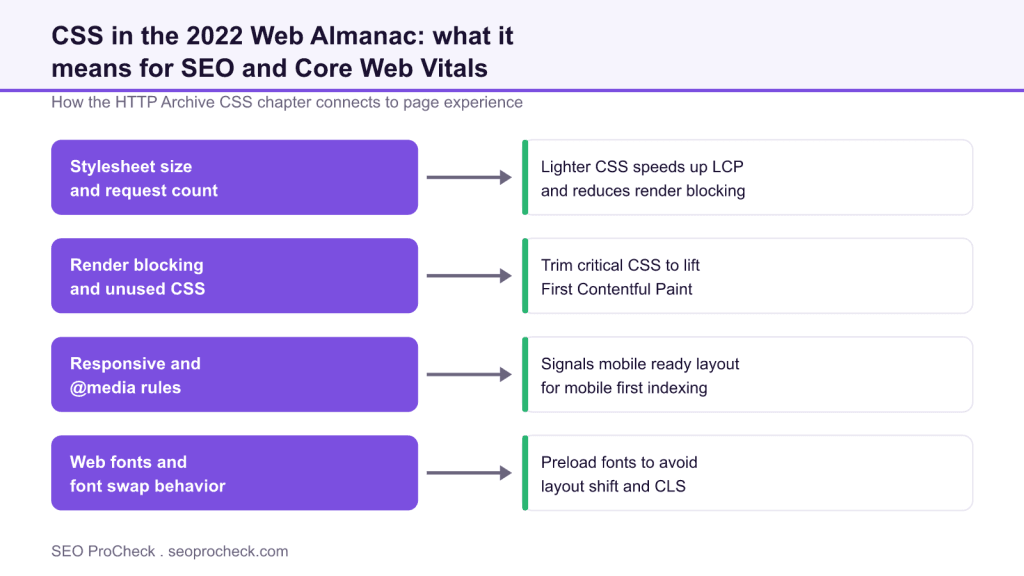
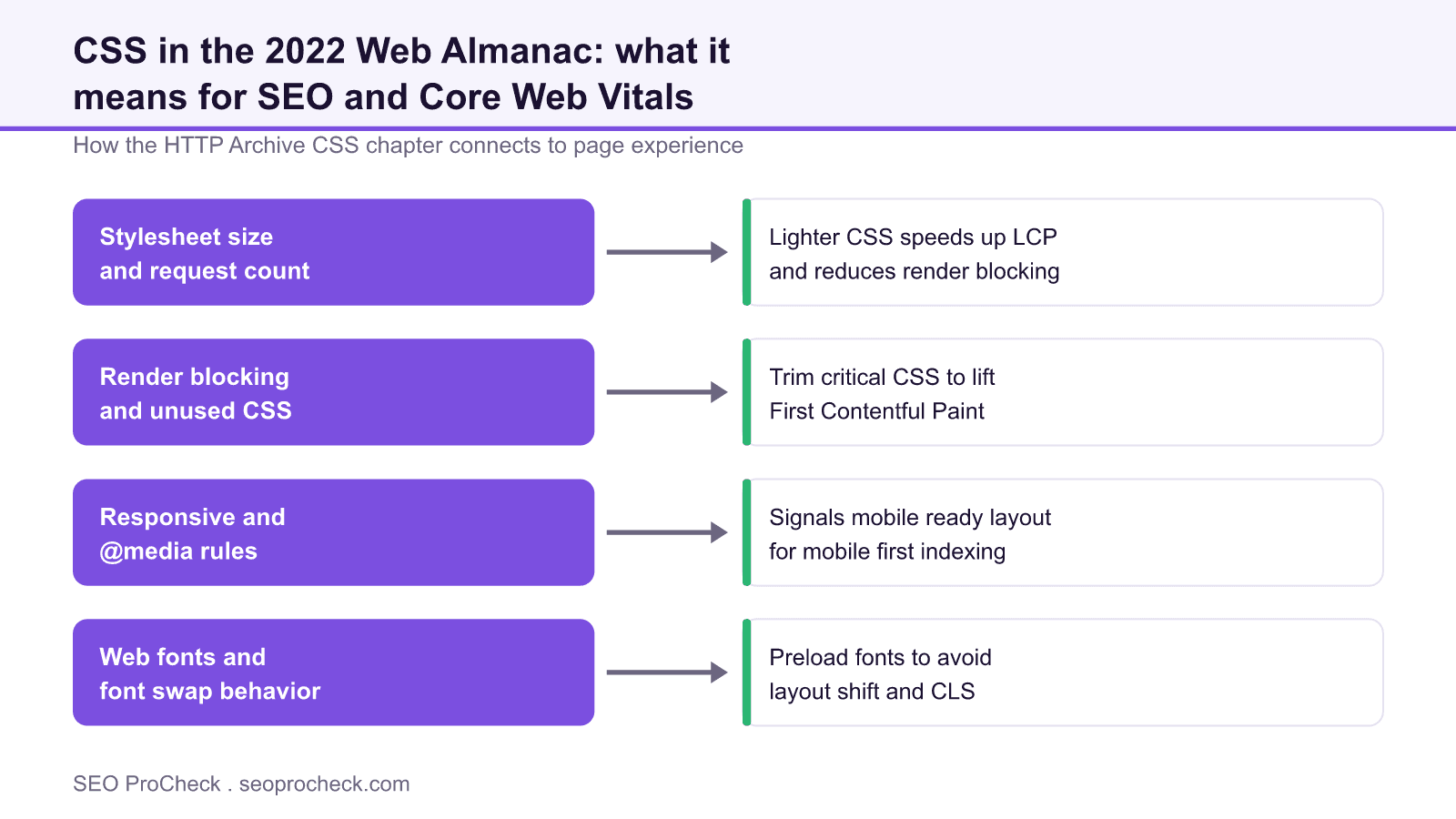
- Stylesheet weight and request count. Every extra kilobyte of CSS and every extra stylesheet request competes with the content the user came to see. Trimming and combining critical styles is one of the cheapest ways to pull LCP down.
- Render blocking and unused CSS. Most sites ship far more CSS than any single page uses. Splitting critical CSS, deferring the rest, and removing dead rules lifts First Contentful Paint and, by extension, LCP.
- Responsive and media query patterns. Clean, mobile first media queries signal that a layout is built for the small screens Google indexes first. Sloppy breakpoints often hide layout shift bugs.
- Web fonts and font swap behaviour. Fonts that load without a sensible swap strategy cause a flash of invisible or unstyled text, and the reflow that follows is a classic source of CLS. Preloading key fonts and setting a font display value fixes most of it.
Turn the report into an audit checklist
The practical move is to convert each theme into a check you run on your own templates. Pull a representative URL for each template, open Chrome DevTools, and record the numbers. The table below is the checklist I use when a client site fails a field metric and I suspect CSS is part of the cause.
| CSS check | What to look for | Core Web Vital at risk |
|---|---|---|
| Total CSS transferred | Large combined stylesheet weight per page | LCP |
| Render blocking sheets | Stylesheets in the head with no defer strategy | FCP and LCP |
| Unused CSS | High percentage of rules never applied on the page | LCP |
| Font loading | No preload or font display value set | CLS |
| Unsized elements | Images or embeds without width and height | CLS |
How this connects to rendering and indexing
CSS does more than style a page. Google has to fetch, parse, and in many cases execute your styles before it can decide what the page looks like, which ties into how the rendering pipeline treats your content. Heavy or blocking CSS can slow the render step and, on very large sites, eat into the time Google is willing to spend. Keeping CSS lean is therefore both a speed win and a crawl efficiency win.
What has changed since 2022
The 2022 chapter predates two shifts worth noting. First, the Core Web Vitals set evolved: Interaction to Next Paint replaced First Input Delay as the responsiveness metric in 2024, and while INP is driven mainly by JavaScript, oversized CSS and layout thrash can still make interactions feel slow. Second, container queries and the modern cascade layers feature moved from experimental to broadly supported, giving teams cleaner ways to scope styles and cut the unused CSS the Almanac flagged. The direction of travel is the same one the report pointed at: ship less CSS, ship it in the right order, and stop paying for rules no page uses. If you read the original chapter today, treat its raw percentages as a 2022 snapshot and focus on the durable engineering lessons.
The original summary and source for this entry are preserved below.
CSS | 2022 | The Web Almanac by HTTP Archive provides valuable insights for SEO practitioners. This resource examines approaches and considerations that can improve organic search performance.
Key Concepts
Understanding the fundamental principles behind this topic helps inform strategic decisions. Whether optimizing for traditional search or emerging AI platforms, foundational concepts remain relevant. This resource covers the essential knowledge practitioners need.
Implementation Considerations
Moving from concept to execution requires understanding practical constraints and opportunities. Different situations call for different approaches. This resource provides guidance for applying concepts in real-world contexts.
Measuring Impact
SEO efforts require measurement to demonstrate value and guide optimization. Identifying appropriate metrics, establishing baselines, and tracking progress enables data-driven improvement. This resource addresses how to evaluate success.
This resource contributes to the knowledge base SEO practitioners need for effective optimization in an evolving search landscape.
Source: https://almanac.httparchive.org/en/2022/css
Frequently asked questions
What is the Web Almanac?
The Web Almanac is an annual report from HTTP Archive that analyses how the web is built using data crawled from millions of real websites. Each edition contains chapters written by domain experts, including a dedicated CSS chapter.
Does CSS affect SEO?
Yes, indirectly but measurably. CSS influences how fast a page renders and how stable its layout is, which feeds Core Web Vitals and Google page experience signals. Bloated or render blocking CSS can lower those field scores.
Which Core Web Vitals does CSS influence most?
CSS mainly affects Largest Contentful Paint through render blocking and stylesheet weight, and Cumulative Layout Shift through web font swap behaviour and unsized elements. Interaction to Next Paint is driven more by JavaScript.
How do I reduce render blocking CSS?
Inline the critical CSS needed for the first view, defer or asynchronously load the rest, and remove rules that no page uses. Splitting CSS by template keeps each page from downloading styles it never needs.
Is the 2022 CSS data still relevant?
The engineering lessons remain relevant, but treat the exact percentages as a 2022 snapshot. Newer editions and features like container queries and cascade layers have since changed some best practices.
Where can I read the original chapter?
The full CSS chapter is available free on the HTTP Archive Web Almanac site, linked in the source note below this article.
Take this with you
The assistant links open with a question about this page already written. Nothing is sent until you press enter.
Claude Vincent is a technical SEO consultant focused on crawlability, rendering, and AI-search visibility. He writes the field guides and case studies at SEO ProCheck, with a bias toward the durable, unglamorous work that decides whether search engines and AI answer engines can actually read and cite a site.
About SEO ProCheck
Technical SEO consulting and GEO strategy with 20 years of enterprise experience. Case studies, resources, and tools for search and AI visibility.
Work With Me
Technical SEO audits, GEO strategy, site migrations, and international SEO. Hourly consulting for teams who need hands-on support, not just reports.
Subscribe to our newsletter!








Recent Posts
- Most Top Sites Never Say Who They Are in Structured Data October 14, 2026
- Homepage Titles Are Mostly Too Short, Not Too Long October 8, 2026
- Who Actually Serves an llms.txt? 184 Top Sites Measured September 29, 2026