

AI Summary
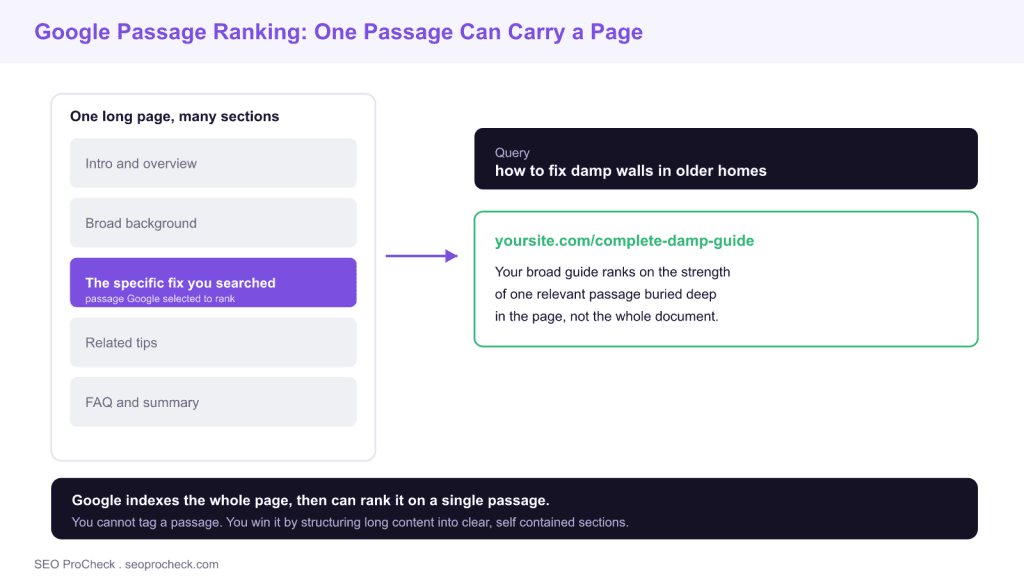
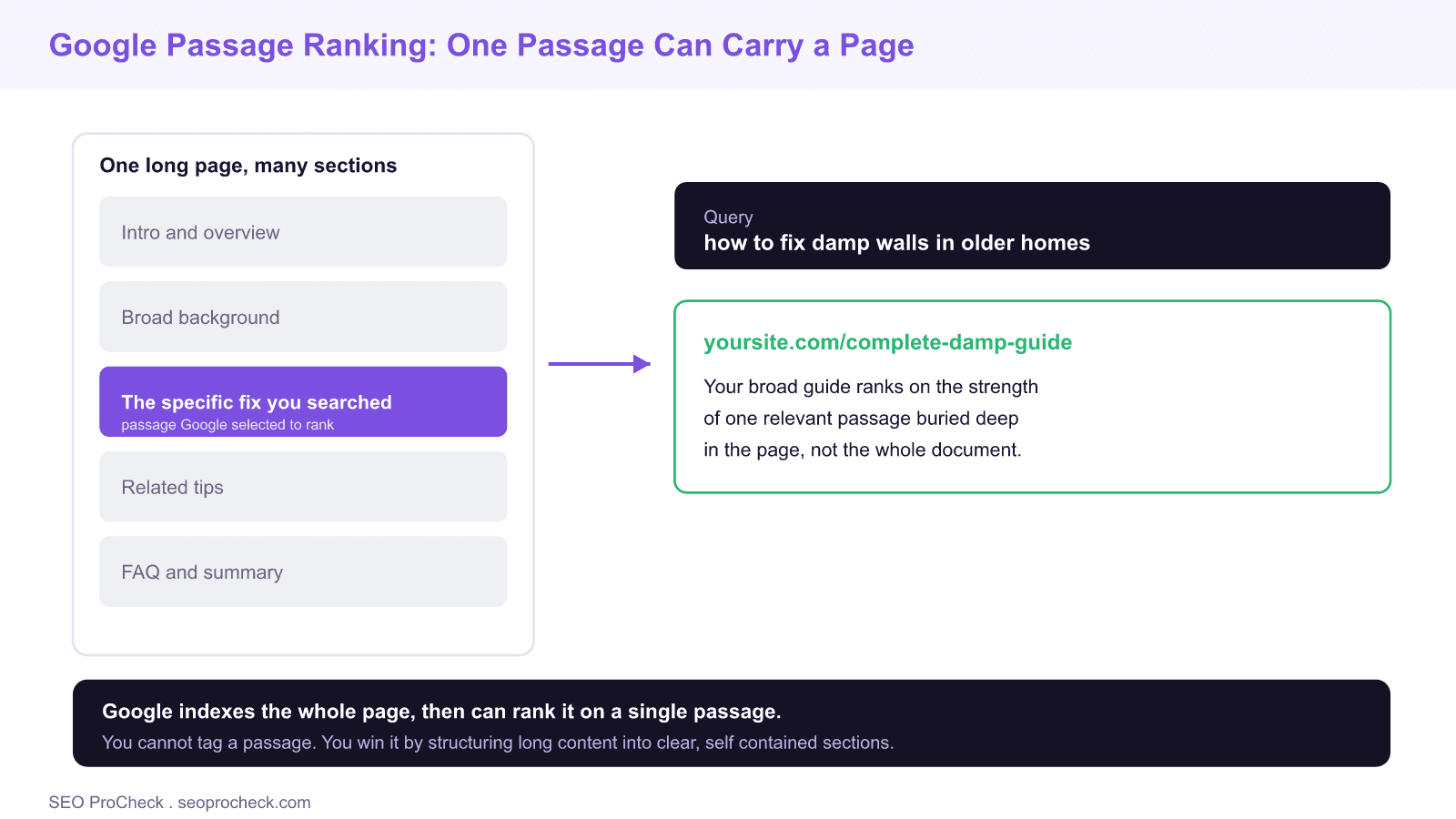
Google passage ranking lets Google rank an individual passage from deep inside a long page for a specific query, even when the page as a whole is about a broader topic. Google still indexes the entire page, so this is a ranking signal, not a separate index, and you win it by structuring long content into clear, self contained sections.
- Announced in October 2020 and rolled out for US English in February 2021, then more widely.
- The whole page is indexed as usual, but a single relevant passage can earn the ranking.
- There is no passage markup: you cannot tag a passage, you earn it with clear headings and focused sections.
- It rewards thorough long form pages, so buried but valuable answers can finally surface.
Google Passage Ranking And Indexing: A Full Guide provides valuable insights for SEO practitioners. This resource examines approaches and considerations that can improve organic search performance.
Key Concepts
Understanding the fundamental principles behind this topic helps inform strategic decisions. Whether optimizing for traditional search or emerging AI platforms, foundational concepts remain relevant. This resource covers the essential knowledge practitioners need.
Implementation Considerations
Moving from concept to execution requires understanding practical constraints and opportunities. Different situations call for different approaches. This resource provides guidance for applying concepts in real-world contexts.
Measuring Impact
SEO efforts require measurement to demonstrate value and guide optimization. Identifying appropriate metrics, establishing baselines, and tracking progress enables data-driven improvement. This resource addresses how to evaluate success.
This resource contributes to the knowledge base SEO practitioners need for effective optimization in an evolving search landscape.
Source: https://seosly.com/blog/google-passage-ranking
What passage ranking actually is
The linked seosly.com guide walks through Google passage ranking in depth, and the summary above keeps its core framing. The single most important clarification, and the one Google itself stressed, is in the name. Google indexes whole pages, not passages. Passage ranking is a change to how Google ranks, letting it identify a specific, relevant section within a page and use that section as a strong signal for a query, even when the surrounding page covers a broader subject.
Before this change, a long guide could be outranked for a narrow question by a thinner page that happened to be tightly focused, because the broad page looked less relevant overall. Passage ranking softened that penalty. Now a detailed answer buried in section seven of a long article can carry the page into the results for the exact query that section answers.
Timeline and what changed
Google announced passage ranking in October 2020, describing it as a way to better understand individual passages on a page. It began rolling out for English queries in the United States in February 2021 and expanded to more languages and regions afterward. Google later reinforced that the feature should be called passage ranking, not passage indexing, to stop people believing passages were stored separately. Nothing about your technical setup changed: there was no new tag, no markup, and no special configuration to enable.
Passage ranking versus featured snippets versus indexing
| Concept | What it does | Can you control it directly |
|---|---|---|
| Passage ranking | Ranks a page based on one relevant section | No tag, earned through clear structure |
| Featured snippet | Pulls a passage into a highlighted answer box | Influenced by concise, direct answers |
| Indexing | Stores the whole page for retrieval | Managed with crawlability and quality |
These often work together. A page that earns a ranking through a strong passage is also a good candidate for a featured snippet, because both reward a focused, self contained answer.
How to optimize for passage ranking
- Break long pages into focused sections. Each section should answer one clear question fully, so it can stand on its own if Google surfaces it. Descriptive headings help Google understand what each section is about, which is why heading structure matters so much here.
- Answer the specific question near the top of its section. Lead with the answer, then expand. A passage that opens with a direct statement is easier to select and quote.
- Keep sections self contained. Avoid answers that only make sense after reading three earlier sections. Passage ranking works best when a section is intelligible on its own.
- Do not fragment good long content. Passage ranking is a reason to keep a thorough page whole rather than splitting it into thin pages, because the depth is now an asset instead of a liability.
Passage ranking and AI answers
The same discipline that wins passage ranking also wins citations in AI answer engines. When a model builds an answer, it pulls the most relevant self contained passage it can find and attributes the source. Clear headings, direct topic sentences, and standalone sections make your content easy to lift, which is exactly what drives how AI engines choose sources. Optimizing for passage ranking is therefore future proofing: the structure that helped a buried answer rank in 2021 is the same structure that gets you quoted by an assistant today.
Frequently asked questions
What is Google passage ranking?
Passage ranking is Google ability to rank a page based on one specific, relevant section within it, even when the overall page covers a broader topic. Google still indexes the whole page, so this is a ranking signal rather than a separate index of passages.
Is passage ranking the same as passage indexing?
No, and Google specifically corrected the terminology. Passages are not indexed separately. Google indexes entire pages and then considers individual passages when deciding how to rank a page for a query.
When did passage ranking launch?
Google announced it in October 2020 and began rolling it out for English queries in the United States in February 2021, expanding to more languages and regions afterward.
How do I optimize for passage ranking?
Break long pages into focused, self contained sections, use descriptive headings, and answer each specific question near the top of its section. There is no markup to add, so clear structure is how you earn it.
Does passage ranking mean I should write longer pages?
It removes the penalty a thorough page used to face for covering many subtopics, so depth becomes an asset. Write as long as the topic genuinely needs, and structure it so each section can stand on its own.
How is passage ranking different from a featured snippet?
Passage ranking decides whether a page ranks based on one section, while a featured snippet pulls a passage into a highlighted answer box at the top of the results. A well structured passage is a strong candidate for both.
Take this with you
The assistant links open with a question about this page already written. Nothing is sent until you press enter.
Claude Vincent is a technical SEO consultant focused on crawlability, rendering, and AI-search visibility. He writes the field guides and case studies at SEO ProCheck, with a bias toward the durable, unglamorous work that decides whether search engines and AI answer engines can actually read and cite a site.
About SEO ProCheck
Technical SEO consulting and GEO strategy with 20 years of enterprise experience. Case studies, resources, and tools for search and AI visibility.
Work With Me
Technical SEO audits, GEO strategy, site migrations, and international SEO. Hourly consulting for teams who need hands-on support, not just reports.
Subscribe to our newsletter!








Recent Posts
- Most Top Sites Never Say Who They Are in Structured Data October 14, 2026
- Homepage Titles Are Mostly Too Short, Not Too Long October 8, 2026
- Who Actually Serves an llms.txt? 184 Top Sites Measured September 29, 2026