

AI Summary
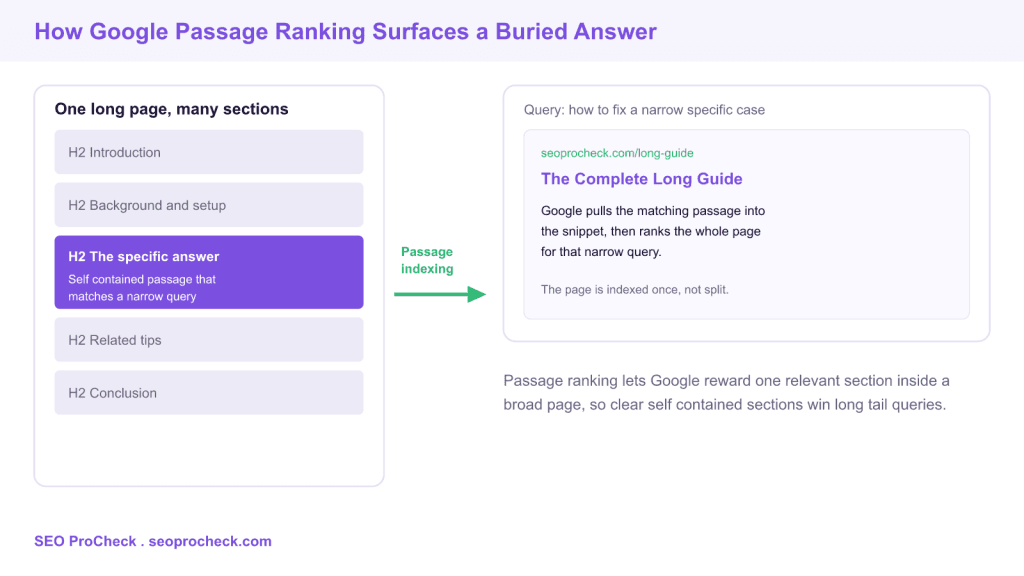
Passage ranking is a Google system that can rank a single relevant section from within a long page, even when the page as a whole covers a broader topic. Google announced it in October 2020 and launched it for US English queries in February 2021, and the practical takeaway is to write clear, self contained sections so a buried answer can still surface.
- Google indexes the whole page once, then can rank a specific passage inside it for a narrow query.
- Passage ranking is not a separate index and is not the same as a featured snippet.
- At announcement Google said it expected the change to affect about 7 percent of queries across all languages.
- You optimize for it with descriptive headings and paragraphs that answer one question completely on their own.
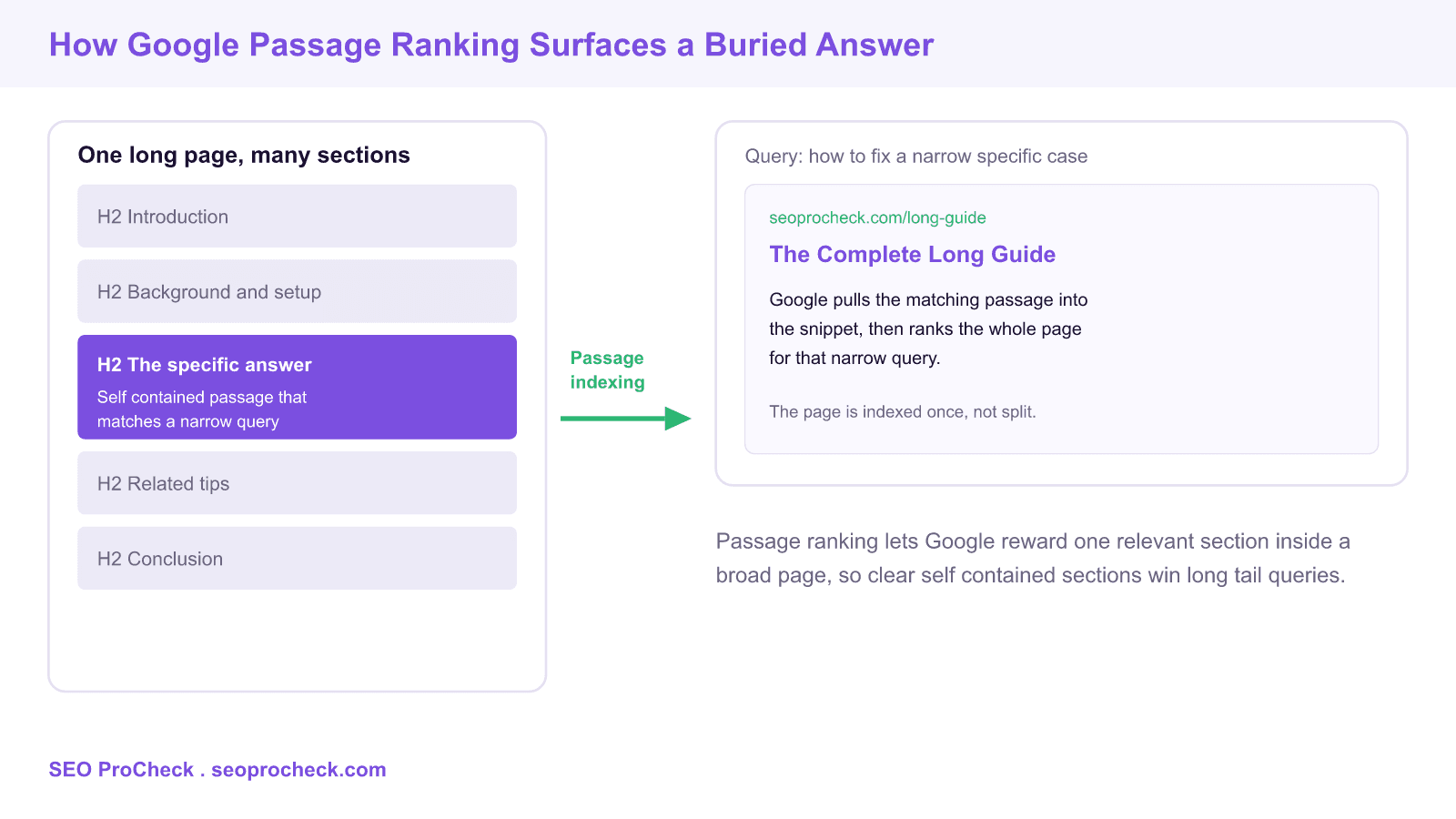
When Google announced passage ranking, it named a real problem in long form content: a page can hold the exact answer a searcher wants, yet that answer sits three sections deep and gets outranked by thinner pages built around the query. Passage ranking lets Google identify and reward that buried section. This page keeps the linked source and adds practitioner guidance on what the update actually does and how to write for it.
What passage ranking actually is
Google introduced the feature at its Search On event in October 2020, first describing it as passage indexing. That name caused confusion, so Google clarified the mechanics. Your page is still crawled and indexed as one document. Nothing is split into a separate passage index. What changed is the ranking step: Google can now consider how well an individual passage matches a query, not only how well the whole page matches. The system launched for US English queries in February 2021 and expanded to more languages and regions through the rest of that year. At announcement Google said it expected the change to improve results for roughly 7 percent of queries across all languages.
Passage ranking is not a featured snippet
These get mixed up constantly, so it is worth separating them. A featured snippet is a presentation format: Google lifts text into a box at the top of the results. Passage ranking is a ranking signal: it helps decide which pages appear at all for a query. A page can rank because of a strong passage without ever earning a featured snippet, and a page can earn a snippet without passage ranking being involved. The table below lays out the differences.
| Concept | What it is | What gets indexed | What you optimize |
|---|---|---|---|
| Passage ranking | A ranking signal for sections inside a page | The whole page, once | Clear, self contained sections |
| Featured snippet | A result presentation format | The whole page, once | Concise direct answers near a heading |
| Passage indexing myth | The idea passages are stored separately | Not how it works | Nothing, this is a misreading |
How to structure content so a passage can rank
The optimization is not a trick, it is disciplined structure. Google can only reward a passage that stands on its own, so write sections that a reader could lift out of the page and still understand. In practice that means the following.
Use descriptive headings. A heading like <h2>How to reset a router password</h2> gives Google and readers a clear topic boundary. A vague heading like <h2>Step three</h2> tells a passage matcher nothing.
Answer the question inside the section, not across the page. Put the direct answer in the first sentence or two under the heading, then expand. Do not require a reader to have read the previous four sections to make sense of this one.
Keep one idea per section. If a section drifts across three subtopics, split it. Focused sections give the ranking system a cleaner signal about what each part of the page is for.
Support the passage with real HTML. A passage can only rank if Google can read it in the rendered page. Content injected late by scripts is at the mercy of the render queue, which is why rendering strategy matters even here. See our note on server side rendering and SEO for why content should be present in the first HTML response.
A worked example
Say you publish a 3,000 word guide to home networking. One reader searches for a very specific fix, for example how to change the DNS on a particular router model. Before passage ranking, a thin page built only around that model might outrank your guide even though your guide answers it better in one section. After passage ranking, Google can recognize that your section titled <h3>Changing DNS on the model X router</h3> answers the query cleanly and rank your comprehensive page for it. The rest of the guide still earns its own queries. You did not need to carve the guide into ten separate pages to compete.
What has changed since this update
Passage ranking rolled out from US English in February 2021 to additional languages and regions through the following months, and Google has since folded it into its normal ranking systems rather than treating it as a headline feature. Google talks about it far less today, but the underlying behavior is now a stable part of how long pages compete. The advice has also aged well because it overlaps with Google helpful content guidance: write for people, structure content clearly, and answer questions directly. For more Google guidance walkthroughs, browse our general SEO articles and the related note on why an often updated sitemap can help Google recrawl your pages.
Frequently asked questions
What is Google passage ranking?
It is a ranking system that lets Google score and rank an individual passage inside a page, not just the page as a whole. This helps a specific relevant section surface for a narrow query even when the full page covers a broader topic. The page is still indexed once as a single document.
Is passage ranking the same as passage indexing?
No. Google first called it passage indexing, then clarified that passages are not stored in a separate index. The whole page is indexed as one document, and the ranking step is what considers individual passages. Passage ranking is the accurate name.
When did passage ranking launch?
Google announced it in October 2020 and launched it for United States English queries in February 2021. It then expanded to more languages and regions during that year. It is now part of Google normal ranking systems.
Is passage ranking the same as a featured snippet?
No. A featured snippet is a way of presenting a result in a box at the top of the page. Passage ranking is a signal that helps decide which pages rank at all. A page can rank on a strong passage without earning a snippet.
How do I optimize my content for passage ranking?
Write clear, self contained sections with descriptive headings, and answer each section question in its first sentence or two. Keep one main idea per section so a reader could understand it in isolation. Make sure the content is present in the rendered HTML so Google can read it.
Do I need to split a long guide into separate pages?
Usually not. Passage ranking exists so a strong section inside a long page can compete without being carved out. Keep comprehensive guides together when that serves the reader, and focus on clear structure rather than fragmentation.
Source: https://www.hallme.com/blog/googles-passage-ranking-launched-in-february-heres-what-that-means/
Take this with you
The assistant links open with a question about this page already written. Nothing is sent until you press enter.
Claude Vincent is a technical SEO consultant focused on crawlability, rendering, and AI-search visibility. He writes the field guides and case studies at SEO ProCheck, with a bias toward the durable, unglamorous work that decides whether search engines and AI answer engines can actually read and cite a site.
About SEO ProCheck
Technical SEO consulting and GEO strategy with 20 years of enterprise experience. Case studies, resources, and tools for search and AI visibility.
Work With Me
Technical SEO audits, GEO strategy, site migrations, and international SEO. Hourly consulting for teams who need hands-on support, not just reports.
Subscribe to our newsletter!








Recent Posts
- Most Top Sites Never Say Who They Are in Structured Data October 14, 2026
- Homepage Titles Are Mostly Too Short, Not Too Long October 8, 2026
- Who Actually Serves an llms.txt? 184 Top Sites Measured September 29, 2026