

AI Summary
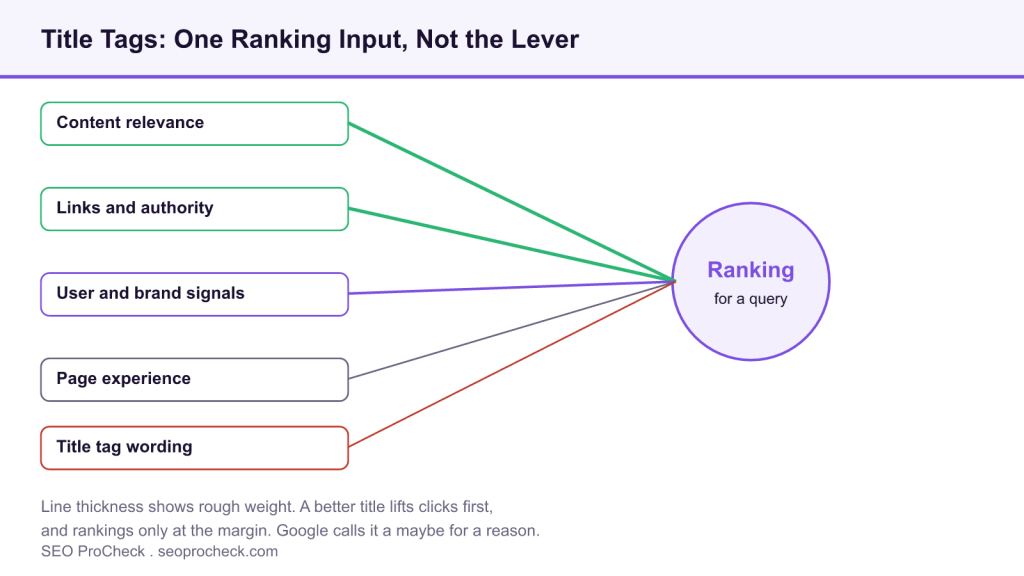
In an August 2024 exchange, Google's John Mueller said title tags "maybe" influence rankings, confirming they are a minor input rather than a decisive lever. Titles matter most for click through rate, so treat rewriting them as a way to earn clicks, with any ranking effect being marginal.
- Google frames the title tag as one small ranking input, not a primary factor.
- The title's biggest measurable effect is on click through rate in the search results.
- Google may rewrite your title in the SERP, and often does when it is unclear or keyword stuffed.
- Optimize titles for the searcher first: keep the primary term near the front and stay close to 60 characters.

Google Says Title Tags "Maybe" Impact Rankings provides valuable insights for SEO practitioners. This resource examines approaches and considerations that can improve organic search performance.
What Mueller actually said
Asked whether title tags affect rankings, Google's John Mueller answered that they "maybe" do. That hedge is not evasion, it is an accurate description of a small, situational signal. Google has said for years that the title tag is a ranking factor, but a minor one, and that its practical value is helping searchers and Google understand what a page is about. The source below has the full exchange. The takeaway for practitioners is to stop treating the title as a ranking lever you crank, and start treating it as the line that wins or loses the click.
Why "maybe" is the honest answer
A title tag influences ranking only at the margin because Google has many stronger signals for relevance: the page content itself, the links pointing at it, and how users interact with the result. What a title reliably moves is click through rate. Two pages ranking in similar positions can see very different traffic based purely on which title reads as the better answer. That is where the real return on a rewrite lives, and it is measurable in Search Console within weeks. Our title tag glossary entry covers the fundamentals, and title tag CTR optimization covers the testing loop.
How to write a title that earns the click
Because the payoff is clicks, write the title for the person scanning the results page, not for a keyword counter. The patterns that consistently win:
| Weak pattern | Why it underperforms | Stronger version |
|---|---|---|
| Keyword | Keyword | Brand | Keyword | Reads as stuffing, Google often rewrites it | Primary topic that a human would say, then brand |
| Home Page | Says nothing, wastes the strongest real estate | What the page offers and for whom |
| A 90 character title | Truncates in the SERP, the payoff is cut off | Front loaded, close to 60 characters |
| Exact duplicate across pages | Google cannot tell them apart, dilutes both | Unique title per page tied to its query |
When Google rewrites your title
Google reserves the right to replace your title in the results, and it does so in a meaningful share of cases. It typically rewrites when the title is empty, keyword stuffed, boilerplate repeated across the site, or a poor match for the query, often substituting your on page H1 or another heading. The fix is not to fight the rewrite but to remove the reason for it: write a clear, unique, honest title near the right length and Google usually keeps it. For the wider treatment of titles alongside meta descriptions, see our title tags and meta descriptions guide.
What has changed since this comment
Nothing in Google's position has reversed since the August 2024 exchange, and that consistency is the point. Google continues to describe the title as a minor ranking input whose main job is clarity for users and search engines. The title rewrite behavior, first announced in 2021, remains in force, so a stuffed or duplicated title is still likely to be replaced. The practical guidance is stable: write titles for the searcher, keep them unique and front loaded, measure the click through rate change in Search Console, and do not expect a rewrite to move your position on its own.
Frequently asked questions
Only slightly. Google describes the title tag as a minor ranking input, not a primary factor. Its largest measurable effect is on click through rate in the search results. Optimize titles mainly to earn clicks, and expect any ranking change to be marginal.
Because that is an accurate description of a small, situational signal. Google has stronger relevance signals in the page content, links, and user behavior. The title contributes at the margin, so "maybe" reflects a real but minor and inconsistent effect.
Yes, in a meaningful share of cases. Google rewrites titles that are empty, keyword stuffed, duplicated across the site, or a poor match for the query, often using your H1 instead. Writing a clear, unique, well sized title is the best way to keep your own.
Aim for roughly 60 characters, or about 600 pixels, so the title does not truncate in the results. Front load the most important words, since a truncated title still needs to make sense and carry the primary term.
Yes, but naturally and near the front. One clear use of the primary term helps both users and Google understand the page. Repeating the keyword several times reads as stuffing and increases the chance Google rewrites the title.
Neither is a strong ranking factor. The meta description is not a ranking signal at all, and the title is only a minor one. Both matter mainly for click through rate: they are your pitch in the search results, so write them for the searcher.
This resource contributes to the knowledge base SEO practitioners need for effective optimization in an evolving search landscape.
Source: https://www.searchenginejournal.com/google-says-title-tags-maybe-impact-rankings/525297/
Take this with you
The assistant links open with a question about this page already written. Nothing is sent until you press enter.
Claude Vincent is a technical SEO consultant focused on crawlability, rendering, and AI-search visibility. He writes the field guides and case studies at SEO ProCheck, with a bias toward the durable, unglamorous work that decides whether search engines and AI answer engines can actually read and cite a site.
About SEO ProCheck
Technical SEO consulting and GEO strategy with 20 years of enterprise experience. Case studies, resources, and tools for search and AI visibility.
Work With Me
Technical SEO audits, GEO strategy, site migrations, and international SEO. Hourly consulting for teams who need hands-on support, not just reports.
Subscribe to our newsletter!








Recent Posts
- Most Top Sites Never Say Who They Are in Structured Data October 14, 2026
- Homepage Titles Are Mostly Too Short, Not Too Long October 8, 2026
- Who Actually Serves an llms.txt? 184 Top Sites Measured September 29, 2026