

Google’s Search Quality Raters Guidelines: A Guide for SEO Beginners
- April 16, 2021
- General
AI Summary
Google's Search Quality Rater Guidelines are the public manual Google gives its human raters to judge whether search results are helpful and trustworthy. They do not directly change rankings, but they describe the qualities Google's algorithms are built to reward, so they are one of the clearest maps beginners have for what good content looks like.
- Quality raters score sample results to train and validate Google's algorithms, not to rank individual pages.
- The core framework is E E A T: Experience, Expertise, Authoritativeness, and Trust, with Trust as the centre.
- Needs Met and Page Quality ratings reward content that fully satisfies the searcher's intent.
- The guidelines are public, so you can read exactly what Google tells its raters to value.
The Search Quality Rater Guidelines are one of the few documents where Google spells out, in plain language, what it considers a good page. For an SEO beginner they are gold, because instead of guessing what the algorithm wants you can read the actual instructions Google hands to the thousands of people it pays to evaluate search quality.
What quality raters actually do
This is the point that trips up most newcomers. Quality raters do not set your rankings. They never see your Search Console, and their scores do not push any individual URL up or down. Instead, Google shows raters real search results and asks them to grade the quality using the guidelines. Those grades become training and evaluation data. When Google tests a change to its ranking systems, rater feedback tells it whether the change made results better or worse. So the guidelines describe the destination Google is steering its algorithms toward, even though the raters are not holding the wheel for your specific page.
E E A T, explained without the jargon
The heart of the guidelines is a framework now written as E E A T. The extra E for Experience was added to the older E A T, and it matters:
- Experience. Has the creator actually done or used the thing they are writing about? A review from someone who used the product beats a summary from someone who did not.
- Expertise. Does the creator have the knowledge or skill the topic requires? For some topics that means formal credentials, for others it means demonstrated hands on skill.
- Authoritativeness. Is the creator or site a recognised go to source on the topic? This is reputation, and it is earned through citations, mentions, and a track record.
- Trust. Is the page accurate, honest, safe, and transparent about who is behind it? Google calls Trust the most important member of the family, and the other three feed into it.
Trust sits at the centre for a reason. A page can be written by an experienced expert and still fail if it hides its sources, misleads the reader, or puts them at risk. The stakes rise sharply for Your Money or Your Life topics like health and finance, where a wrong answer can cause real harm and Google applies its highest scrutiny.
Needs Met and Page Quality
Alongside E E A T, raters give two other judgements. The Needs Met rating asks how well a result satisfies the searcher's intent, rewarding pages that fully and efficiently answer the query. The Page Quality rating weighs the purpose of the page, the effort and originality of its main content, and the reputation behind it. Together they push a simple message: understand what the searcher wants, then give them a genuinely useful answer created by someone with the standing to give it.
Turning the guidelines into content decisions
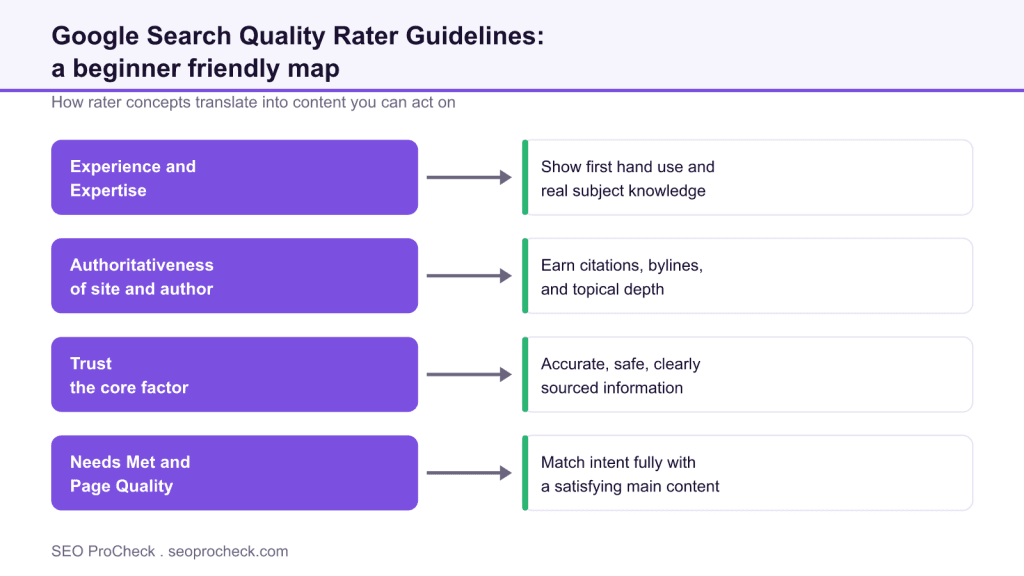
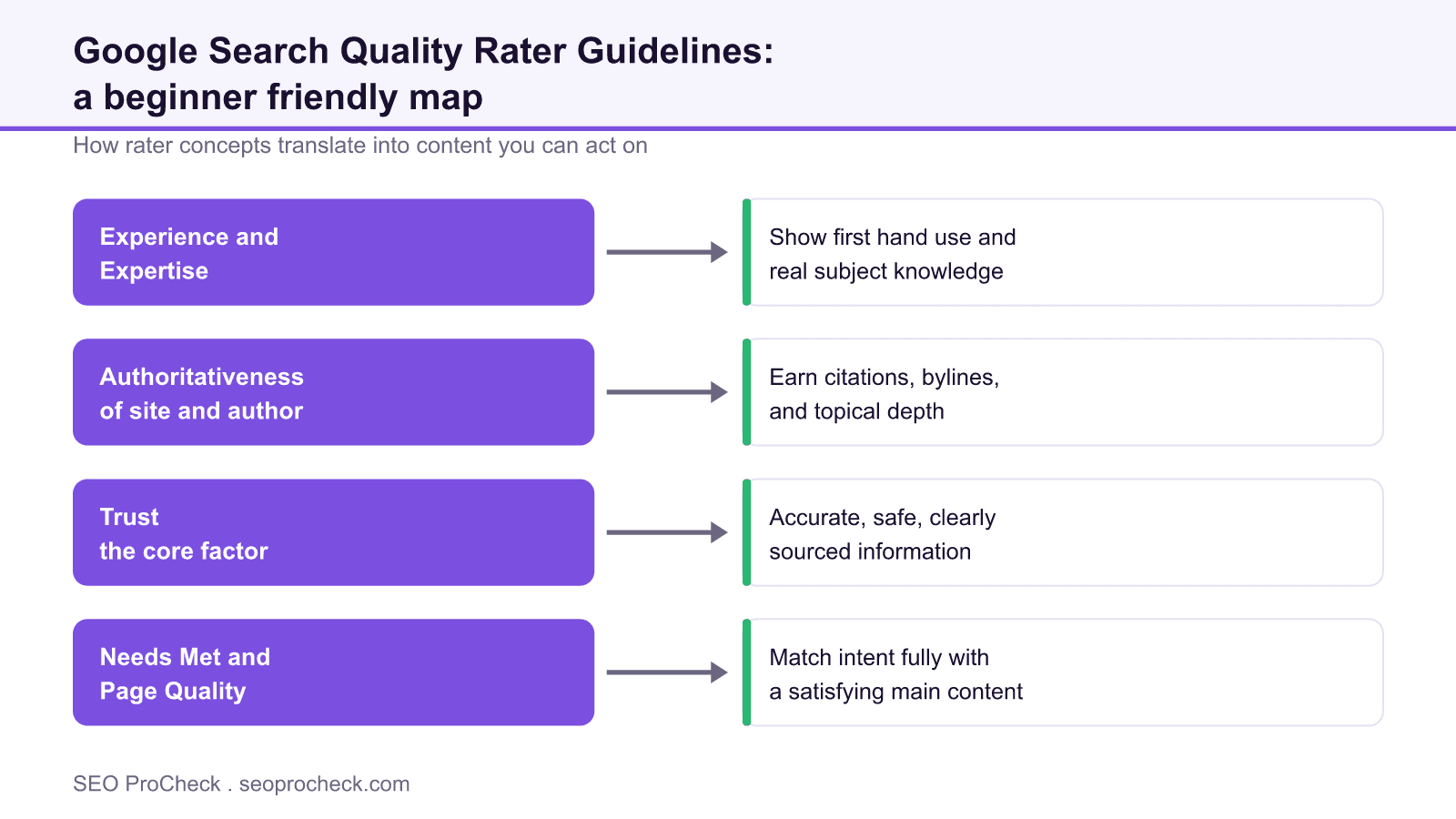
The value of the document is that each concept converts into something you can actually do. The table below maps the rater ideas onto concrete moves I make when improving a page.
| Guideline concept | What raters look for | What you can do |
|---|---|---|
| Experience | First hand use or involvement | Add original photos, tests, and lived detail |
| Expertise | Relevant knowledge or skill | Show author credentials and depth |
| Authoritativeness | Recognition as a go to source | Earn citations and build topical coverage |
| Trust | Accuracy, safety, transparency | Cite sources, show contact and author info |
| Needs Met | Full satisfaction of intent | Answer the query completely and clearly |
What has changed since this guide first appeared
The guidelines are revised regularly, and two shifts stand out. First, Experience was formally added, turning E A T into E E A T and rewarding first hand knowledge over rewritten summaries. Second, the helpful content system and its successors pushed the same philosophy deeper into the ranking algorithms, penalising content that exists mainly to rank rather than to help people. Both changes point the same way as the original guide: create content by people with real experience and expertise, be transparent and trustworthy, and answer the question the searcher actually asked. Read the current edition of the guidelines directly, since the wording and examples continue to evolve.
The original summary and source for this entry are preserved below.
Google’s Search Quality Raters Guidelines: A Guide for SEO Beginners provides valuable insights for SEO practitioners. This resource examines approaches and considerations that can improve organic search performance.
Key Concepts
Understanding the fundamental principles behind this topic helps inform strategic decisions. Whether optimizing for traditional search or emerging AI platforms, foundational concepts remain relevant. This resource covers the essential knowledge practitioners need.
Implementation Considerations
Moving from concept to execution requires understanding practical constraints and opportunities. Different situations call for different approaches. This resource provides guidance for applying concepts in real-world contexts.
Measuring Impact
SEO efforts require measurement to demonstrate value and guide optimization. Identifying appropriate metrics, establishing baselines, and tracking progress enables data-driven improvement. This resource addresses how to evaluate success.
This resource contributes to the knowledge base SEO practitioners need for effective optimization in an evolving search landscape.
Source: https://www.searchenginejournal.com/google-eat/quality-raters-guidelines#close
Frequently asked questions
What are Google's Search Quality Rater Guidelines?
They are the public manual Google gives its human quality raters, describing how to judge whether search results are helpful, relevant, and trustworthy. They reveal the qualities Google's algorithms are designed to reward.
Do quality raters affect my rankings directly?
No. Raters evaluate sample results to help Google train and test its algorithms. Their scores do not move any individual page up or down, but they shape the systems that do.
What does E E A T stand for?
Experience, Expertise, Authoritativeness, and Trust. It is the framework raters use to assess content creators and pages, with Trust treated as the most important element.
What is a YMYL page?
YMYL stands for Your Money or Your Life. These are pages on topics like health, finance, and safety where inaccurate information could harm people, so Google applies its highest quality standards to them.
How can beginners use the guidelines?
Read them as a description of good content. Focus on demonstrating real experience and expertise, being transparent and accurate, and fully answering the searcher's question rather than trying to trick the algorithm.
Are the guidelines updated?
Yes, Google revises them periodically. The addition of Experience to create E E A T is a recent example, so it is worth reading the latest edition directly rather than an old summary.
Take this with you
The assistant links open with a question about this page already written. Nothing is sent until you press enter.
Claude Vincent is a technical SEO consultant focused on crawlability, rendering, and AI-search visibility. He writes the field guides and case studies at SEO ProCheck, with a bias toward the durable, unglamorous work that decides whether search engines and AI answer engines can actually read and cite a site.
About SEO ProCheck
Technical SEO consulting and GEO strategy with 20 years of enterprise experience. Case studies, resources, and tools for search and AI visibility.
Work With Me
Technical SEO audits, GEO strategy, site migrations, and international SEO. Hourly consulting for teams who need hands-on support, not just reports.
Subscribe to our newsletter!








Recent Posts
- Most Top Sites Never Say Who They Are in Structured Data October 14, 2026
- Homepage Titles Are Mostly Too Short, Not Too Long October 8, 2026
- Who Actually Serves an llms.txt? 184 Top Sites Measured September 29, 2026