

AI Summary
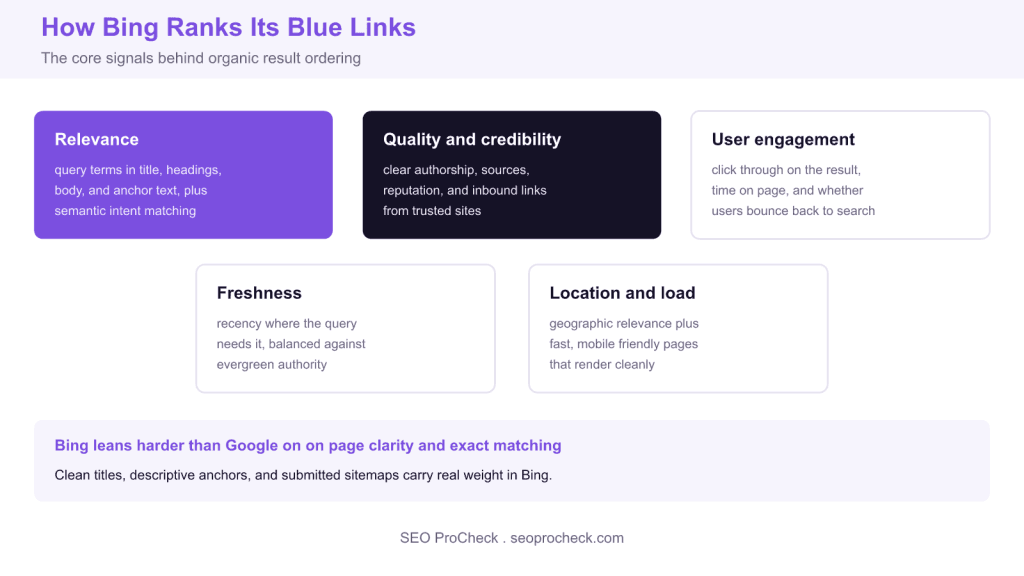
Bing ranks its organic blue links by scoring pages against the query using core signal groups it publishes openly: relevance, quality and credibility, user engagement, freshness, location, and page load time. It leans slightly harder than Google on precise on page optimisation and exact match signals, and it offers direct tools such as URL submission and IndexNow to speed up discovery.
- Relevance rewards query terms in the title, headings, body, and anchors, plus full topic coverage.
- Bing measures engagement: clicks, dwell time, and returns to the results page.
- Links from reputable, relevant sites count as credibility votes, and schemes are penalised.
- Bing now powers Microsoft Copilot, so its index feeds AI answers as well as blue links.
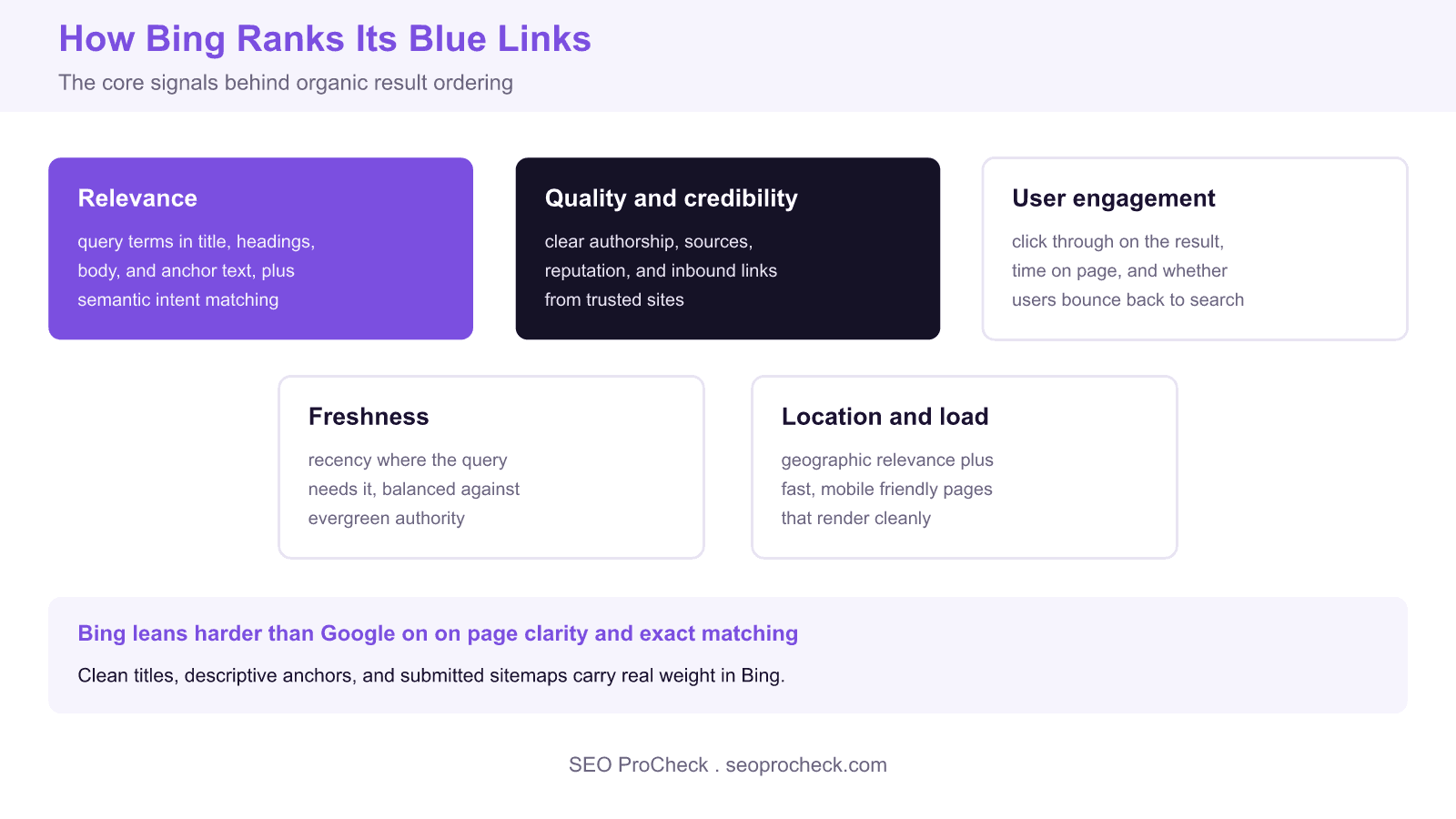
Bing ranks its organic blue links by scoring every eligible page against the query and ordering the results from most to least useful. The core algorithm rests on a handful of signal groups that Bing publishes openly in its Webmaster Guidelines: relevance, quality and credibility, user engagement, freshness, location, and page load time. Understanding how Bing weights these, and where it differs from Google, matters more than ever now that Bing also powers Microsoft Copilot and a share of AI answer experiences.
Relevance: matching the query to the page
Relevance is Bings assessment of how well a page matches the words and intent behind a search. Bing looks for query terms in the places that signal topic: the title tag, headings, the main body copy, the URL, and the anchor text of links pointing at the page. Bing has historically leaned a little more literally on exact keyword matching than Google, so a clear, descriptive title tag that contains the target phrase still carries real weight. It also parses meaning, not just strings, so pages that comprehensively cover a topic and its related concepts rank better than pages stuffed with a single phrase.
Quality and credibility
Bing evaluates whether a page and its site are authoritative and trustworthy. The signals it names include clear authorship, cited sources, the reputation of the site, and the quantity and quality of links from other reputable sites. Bing treats links as votes much as Google does, valuing editorial links from relevant, established domains and discounting or penalising manipulative link schemes. It also weighs transparency: a real business address, contact details, and an about page all contribute to the credibility picture.
User engagement
Bing states plainly that it measures how users interact with results. It asks whether searchers click your result, whether they spend time on the page once they arrive, and whether they bounce straight back to the results to pick something else, a pattern often called pogo sticking. Sustained engagement signals that the page satisfied the intent, while a quick return to search suggests it did not. This makes a compelling title and meta description, followed by content that delivers on that promise, a direct ranking lever in Bing.
Freshness, location, and page load
Freshness matters where the query implies it, so news, releases, and fast moving topics reward recency, while evergreen subjects favour established, stable pages. Location tailors results to the searchers geography and language, which is why local relevance and correct regional targeting help. Page load time and mobile friendliness round out the core signals: Bing rewards pages that load quickly and render cleanly on phones, and it penalises intrusive layouts that get in the way. Technical hygiene, from a submitted sitemap to a clean crawl, lets Bing find and assess all of this.
How Bing differs from Google in practice
The signal groups overlap heavily, but the emphasis differs. Bing tends to reward precise on page optimisation and exact match signals slightly more, so descriptive titles and clean information architecture pay off. Bing has been more openly receptive to social signals as a credibility input, and it offers direct tools that Google does not, most notably URL submission and IndexNow, which let you push new or updated URLs to Bing instantly rather than waiting to be crawled. Verifying your site in Bing Webmaster Tools and submitting your sitemap there is a quick win many sites skip.
What has changed since older Bing ranking guides
The biggest shift is Bings role beyond its own blue links. Bing now underpins Microsoft Copilot and feeds AI generated answers, so the Bing index has become a gateway to conversational search as well as traditional results. Microsoft introduced IndexNow, an open protocol that lets any site instantly notify Bing and other participating engines of new or changed URLs, which reduces the lag between publishing and crawling. Bing Webmaster Tools has also expanded its reporting and added AI powered diagnostics. The core ranking principles in its guidelines have stayed consistent, but the payoff for being well represented in Bing has grown as its index powers more surfaces.
Bing core ranking signals at a glance
| Signal group | What Bing looks at | How to strengthen it |
|---|---|---|
| Relevance | Query terms in title, headings, body, anchors | Clear descriptive titles, full topic coverage |
| Quality and credibility | Authorship, sources, reputation, links | Cite sources, earn editorial links, show contact info |
| User engagement | Clicks, dwell time, return to search | Compelling snippets, content that delivers |
| Freshness | Recency when the query needs it | Update time sensitive pages, keep dates honest |
| Location | Geographic and language relevance | Correct regional targeting and local signals |
| Page load | Speed and mobile friendliness | Fast, clean, mobile ready pages |
Related reading
- Do content or links build more trust with search engines
- Submit a clean XML sitemap to Bing and Google
- More technical SEO articles
Frequently asked questions
How does Bing decide which pages to rank first?
Bing scores every eligible page against the query using its core signal groups: relevance, quality and credibility, user engagement, freshness, location, and page load time. It then orders the blue links from most to least useful. No single factor decides the order; Bing combines them, though relevance and credibility carry the most weight.
Does Bing use backlinks like Google does?
Yes. Bing treats links from reputable, relevant sites as votes of credibility, much as Google does, and it discounts or penalises manipulative link schemes. Editorial links from established domains help, while bought or spammy links carry little value and can trigger penalties under Bings guidelines.
Is Bing SEO different from Google SEO?
The fundamentals overlap, but the emphasis differs. Bing tends to reward precise on page optimisation and exact match signals a little more, is more open about using social and engagement signals, and offers direct tools such as URL submission and IndexNow. A site optimised well for Google usually does well on Bing with a few Bing specific additions.
What is IndexNow and should I use it?
IndexNow is an open protocol championed by Microsoft that lets your site instantly notify Bing and other participating search engines whenever you publish or update a URL, instead of waiting for a crawl. If Bing traffic matters to you, enabling IndexNow through a plugin or your CDN speeds up discovery at almost no cost.
Does user engagement really affect Bing rankings?
Bing states that it measures how users interact with results, including clicks, time on page, and whether searchers return to the results to choose something else. Strong, sustained engagement signals that a page satisfied intent, so a compelling snippet backed by content that delivers is a direct ranking lever on Bing.
Why does Bing matter now that most search is on Google?
Bing powers Microsoft Copilot and feeds a growing set of AI answer experiences, so being well represented in the Bing index reaches conversational search as well as traditional blue links. For many sites Bing also converts well, and it is underused by competitors, which makes it a low competition opportunity.
Source: https://www.searchenginejournal.com/how-bing-ranks-search-results/357804
Claude Vincent is a technical SEO consultant focused on crawlability, rendering, and AI-search visibility. He writes the field guides and case studies at SEO ProCheck, with a bias toward the durable, unglamorous work that decides whether search engines and AI answer engines can actually read and cite a site.
About SEO ProCheck
Technical SEO consulting and GEO strategy with 20 years of enterprise experience. Case studies, resources, and tools for search and AI visibility.
Work With Me
Technical SEO audits, GEO strategy, site migrations, and international SEO. Hourly consulting for teams who need hands-on support, not just reports.
Subscribe to our newsletter!






Recent Posts
- Can AI Crawlers Actually Read Your Site? I Measured 400 of the Biggest September 5, 2026
- The Pre-Publish Quality Gate for AI-Assisted Content August 6, 2026
- AGENTS.md vs llms.txt vs llms-full.txt: Which Agent File Does What July 18, 2026