

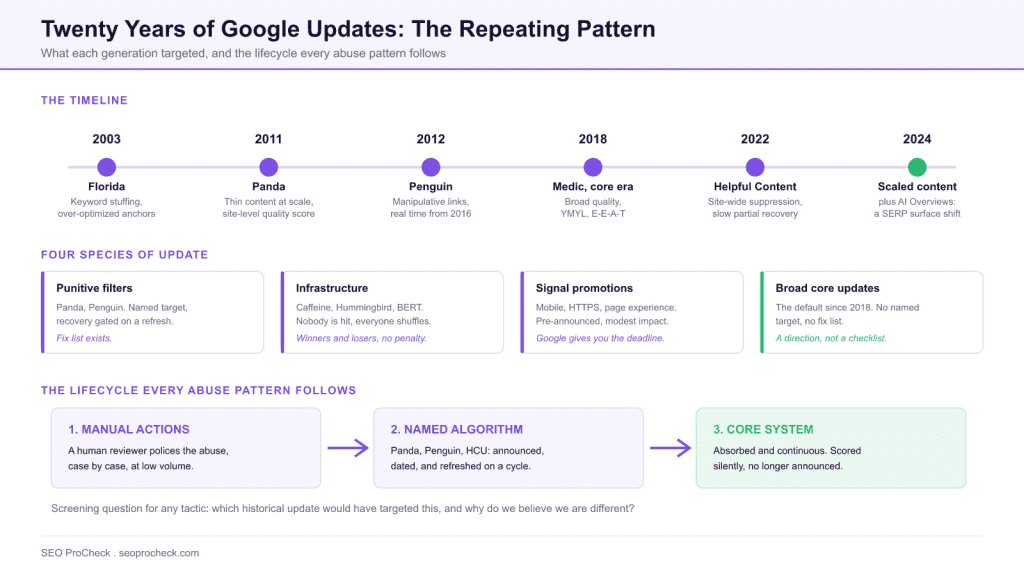
AI Summary
Historical update pattern analysis means reading twenty years of Google algorithm updates as a dataset rather than as trivia: what each generation targeted, how sites recovered, and what that predicts next. The single through-line is that Google keeps automating judgments that once needed a human reviewer, so a tactic that only survives because nobody has enforced against it yet is living on borrowed time.
- Updates come in four species: punitive filters, infrastructure changes, signal promotions, and broad core updates. The species tells you the recovery model before you open a spreadsheet.
- Every abuse pattern walks the same path: manual action, then named algorithm, then absorbed into core systems where it is scored silently and never announced again.
- Google has drifted from demoting offenders to quietly devaluing the tactic. The sharp exception is site-wide classifiers, where the downside is existential rather than merely wasted spend.
- Diagnose a drop by checking it against the published rollout window first, then segmenting by template, by query intent, and by SERP feature exposure.
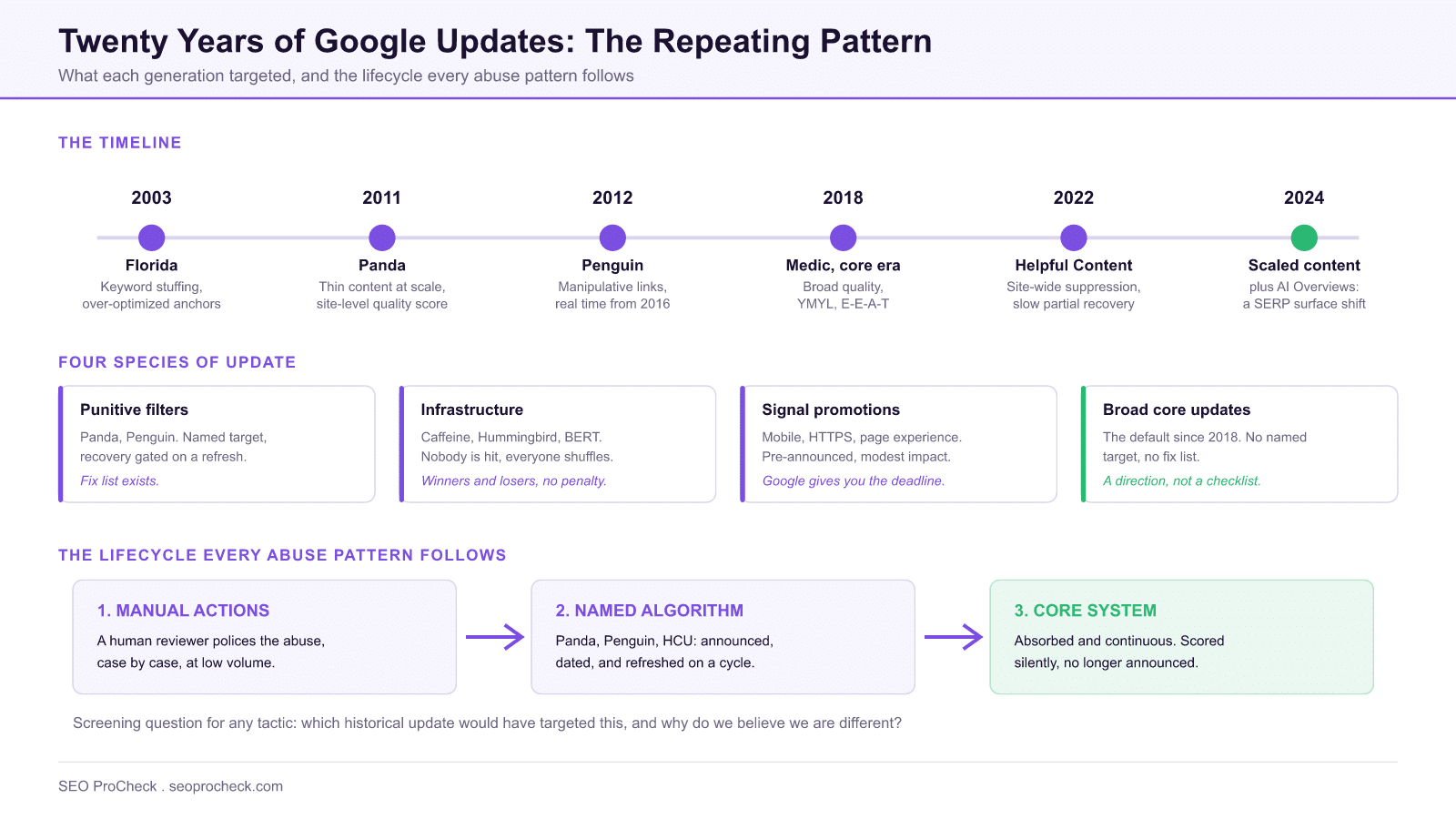
Historical update pattern analysis means studying two decades of Google algorithm updates not as trivia, but as a dataset: what each generation of updates targeted, how sites recovered (or didn't), and what that predicts about the next one. The consistent through-line is that Google keeps automating judgments that once required manual review, so the tactic that works today but "feels like" something an old update punished is usually next in line.
Understanding Algorithm Updates
Algorithm Updates represents a critical component of modern SEO strategy. As search engines continue to evolve and user expectations shift, understanding the nuances of algorithm updates becomes essential for maintaining and improving organic visibility. This guide covers the key concepts, implementation approaches, and strategic considerations that SEO practitioners need to master.
Structurally, updates fall into a few recurring species: named punitive filters (Panda, Penguin: targeting a specific abuse, with recovery gated on the next refresh), infrastructure changes (Caffeine, Hummingbird, BERT: re-platforming how Google indexes or understands queries, where nobody is "hit," but winners and losers reshuffle), signal promotions (mobile-friendliness, HTTPS, page experience: announced in advance, modest in impact), and broad core updates (the modern default since 2018: holistic re-evaluations with no single named target and no fix-list). Knowing which species you're dealing with tells you the recovery model before you touch a spreadsheet. If you want the plain definition first, our lexicon entry on the core update covers the terminology, and the full chronology lives in our Google algorithm update history.
Two Decades of Updates: The Pattern Table
The instructive way to read this table is down the last column, because the same lesson keeps being taught to new generations of sites:
| Era / update | What it targeted | Durable lesson |
|---|---|---|
| Florida (Nov 2003) | Crude keyword stuffing and over-optimized commercial anchors, famously landing before the holiday season | Google will absorb collateral damage to kill a spam pattern; "everyone does it" is not protection |
| Panda (Feb 2011, then iterative) | Thin, duplicative, low-value content at scale, the content farm era | Content quality became a site-level score; a large thin section drags down the good pages, and pruning-vs-enriching became a real strategic question |
| Penguin (Apr 2012, then real-time in Penguin 4.0, Sept 2016) | Manipulative link profiles: paid links, blog networks, anchor-text sculpting | Link tactics have a shelf life measured in years, and retroactive punishment is standard; 4.0 shifting to devaluation-over-demotion showed Google prefers ignoring spam to penalizing it |
| Hummingbird (2013) / RankBrain (2015) / BERT (Oct 2019) | Not spam at all: query understanding, covering semantics, intent, and natural language | Exact-match-keyword strategies decay structurally; content that answers the underlying intent outlives content that matches the string |
| Mobile updates (Apr 2015 "Mobilegeddon", mobile-first indexing thereafter) | Desktop-only experiences | Pre-announced infrastructure shifts are gifts: Google tells you the deadline, and laggards donate their rankings |
| Medic (Aug 2018) and the core-update era | Broad quality re-evaluation, hitting health/finance (YMYL) hardest; E-A-T (now E-E-A-T) enters the vocabulary | No named target and no fix-list: Google's own guidance says improve overall quality and wait for a future core update to re-assess; recovery timelines stretched from weeks to quarters |
| Helpful Content system (Aug 2022, decisive Sept 2023 iteration) | Content made for search engines rather than people; the Sept 2023 version suppressed whole sites, many of them small publishers | Site-wide classifiers returned with teeth: a "made-for-Google" footprint (mass templated pages, no first-hand value) suppresses everything, and recovery has proven slow and partial |
| March 2024 core + spam policies | Scaled content abuse (explicitly however produced, whether AI or human), expired-domain abuse, site reputation abuse (enforced from May 2024) | The Panda lesson restated for the AI era: production method is irrelevant, unreviewed scale is the target; helpful-content signals folded into the core system, ending the separate-system era |
| AI Overviews (rolling out from May 2024) and AI Mode | Not a ranking update at all: a SERP surface change that answers queries above the links | The newest pattern: visibility loss without ranking loss; impression and click decoupling now needs monitoring alongside position |
Recovery Model by Update Species
Before you plan remediation, classify what hit you. The species determines what "recovery" even means, what gates it, and what your first diagnostic move should be. Misclassifying here is the most expensive mistake in the whole discipline, because it sends teams down a remediation path that cannot work no matter how well they execute it.
| Species | What gates recovery | Realistic timeline | First diagnostic move |
|---|---|---|---|
| Punitive filter (Panda, Penguin era) | The next refresh of that filter, historically a discrete event | Weeks to months, tied to refresh cadence | Identify the specific violating pattern, then remove or genuinely fix it |
| Infrastructure change (Caffeine, BERT) | Nothing. There is no penalty to lift. | Immediate, but position may never return | Compare your pages against the new winners for the same intent |
| Signal promotion (mobile, HTTPS, page experience) | Meeting the announced threshold, then a re-crawl | Days to weeks after the fix is crawled | Run the relevant field-data report and fix the failing metric |
| Broad core update | A later core update reassessing the site after sustained improvement | Months to multiple quarters | Segment the loss by template and intent, then raise overall quality |
| Site-wide classifier (helpful content era) | The classifier's own reassessment of the whole site | Longest and least complete of any species | Audit the site-wide footprint, not the individual losing pages |
| SERP surface change (AI Overviews) | Nothing algorithmic. Your position may be unchanged. | Not a recovery problem at all | Compare impressions against clicks: flat position with falling CTR is the signature |
Key Considerations for Historical Update Pattern Analysis
When approaching algorithm updates, several factors require careful attention. Technical implementation must align with broader SEO objectives while maintaining site performance and user experience. The balance between optimization and over-optimization requires ongoing monitoring and adjustment based on performance data and algorithm changes. Industry benchmarks and competitor analysis provide context for evaluating your own implementation.
The meta-patterns worth extracting from the table:
Manual to algorithmic to ambient. Each abuse pattern follows the same lifecycle: first policed by manual actions, then by a named algorithm, then absorbed into core systems where it's no longer even announced. Links went through it (manual link penalties, then Penguin, then real-time devaluation); content quality is completing it now (thin-content manual actions, then Panda and the helpful content update, then core-integrated classifiers). Anything currently enforced only by manual action, and site reputation abuse is the live example, should be expected to become algorithmic.
Punishment to devaluation. Google has drifted from demoting offenders to simply neutralizing the tactic (Penguin 4.0 is the canonical case). This changes risk math: the downside of gray tactics is increasingly wasted spend rather than penalty, but the site-wide classifiers (helpful-content style) are the sharp exception, where the downside is existential.
Announced targets lag actual targets. Update announcements describe the marketing-friendly subset of what changed. Post-update winner/loser analyses across an industry consistently reveal more than the announcement does, which is why the analysis habit matters more than reading the blog post.
Implementation Best Practices
Successful implementation begins with thorough auditing of current state and clear goal definition. Document baseline metrics before making changes to enable accurate impact measurement. Prioritize changes based on potential impact and implementation effort, focusing on high-impact items first. Test changes in staging environments when possible, and monitor closely after deployment to production. Maintain documentation of changes for future reference and troubleshooting.
To run update analysis on your own site: (1) maintain an annotated timeline covering every confirmed update, since Google's Search Status Dashboard publishes start and end dates for each rollout, plus your own deployments, layered onto GSC Performance data; (2) when a drop occurs, first check the date against the rollout window, because a "hit" that started five days before the update began is not the update; (3) segment the damage three ways, by page type or template, by query intent (informational vs commercial vs brand), and by SERP feature exposure, because each signature implicates a different cause (template-wide points at a classifier or a technical fault; informational-only points at an intent shift or AI Overview capture; everything including brand points at something bigger than an update); (4) build a winner/loser set for your niche using a visibility tool's before/after data and read the winners' pages against yours, asking what the gainers share that you lack; (5) log the diagnosis and the remediation bet, so when the next update lands you're testing hypotheses instead of starting over. GSC's 16-month retention is the argument for exporting performance data on a schedule: pattern analysis across multiple update cycles needs more history than the UI keeps.
The Diagnostic Runbook, Step by Step
The five points above compress into a repeatable sequence. Here is the version worth writing into a runbook, with the exact reports named, so that the next person on your team can execute it without you.
- Freeze the dates. Record the rollout start and end from Google's Search Status Dashboard, and record the date your traffic actually inflected from GSC. If the inflection sits outside the rollout window, stop and look at your own release log, your CMS, your robots directives, and your seasonality before you write the word "update" anywhere.
- Pull two stable windows. In Search Console, open Performance, then Search results, and compare the fourteen days ending the day before the rollout began against the fourteen days starting the day after it completed. Excluding the rollout itself is the whole point: mid-flight data oscillates and will mislead you.
- Segment by page. Switch to the Pages tab on that same comparison and sort by click delta. Group the losers by URL pattern. If one template accounts for most of the loss, you are looking at a classifier or a technical fault, not a general quality judgment.
- Segment by query intent. Switch to the Queries tab and split brand from non-brand, then informational from commercial. Informational losses with commercial queries intact is the AI Overview signature. Brand losses point at something outside the algorithm entirely.
- Check position against clicks. Add both Average position and Clicks to the comparison. Positions holding while clicks fall is a SERP surface problem, and no amount of content rewriting will fix it. Positions falling is a ranking problem, and that is where remediation belongs.
- Read the winners. Build a winner and loser set for your niche in whichever visibility tool you already pay for, then actually open the gaining pages. You are looking for what they demonstrate that you do not: first-hand experience, original data, named authors with real credentials, depth on the specific intent.
- Write the bet down. One paragraph: what you think happened, what you changed, and what you expect to see at the next core update. Unrecorded diagnoses are how teams end up re-litigating the same drop three updates later.
Two supporting pieces make this runbook cheaper to operate. Our guide on how to monitor algorithm updates covers the alerting and export side so you are not rebuilding the timeline by hand every quarter, and the core update impact assessment framework gives you a scoring structure for step six when the winner/loser read is ambiguous.
Common Mistakes to Avoid
Several patterns consistently cause problems in algorithm updates implementations. Rushing implementation without proper planning leads to errors that can be costly to fix. Ignoring the interplay between different SEO factors creates conflicts that undermine results. Failing to monitor and iterate based on performance data means missing optimization opportunities. Over-optimization signals can trigger algorithmic penalties that take months to recover from.
The analysis-specific failure modes: post hoc attribution, blaming whichever update was nearest in time while ignoring your own release calendar, seasonality, or a SERP-feature change; fighting the last war, running a 2013-style disavow project in response to a content-classifier suppression because link audits are the remediation you happen to know; panic-reverting during rollouts, when updates take days to weeks to roll out, positions oscillate mid-flight, and decisions made on day three routinely look foolish on day fifteen; survivorship-biased pattern-matching, copying a "recovery case study" without knowing how many identical attempts failed; and treating confirmed updates as the whole story, when Google ships thousands of changes a year and unconfirmed ranking turbulence is normal background noise rather than evidence of a secret update every volatile weekend.
Measuring Success
Effective measurement requires defining appropriate KPIs aligned with business objectives. Track both leading indicators (rankings, impressions, technical metrics) and lagging indicators (traffic, conversions, revenue) to build a complete picture. Establish reasonable timeframes for evaluation, as SEO changes often take weeks or months to fully manifest in results. Compare performance against historical baselines and competitor benchmarks to contextualize results.
For update analysis, the operative measurement is update-over-update trajectory: compare stable windows (for example, two weeks) before and after each rollout, excluding the turbulence during it, and track whether each core update moves you up, down, or flat relative to the last one. A site trending up across consecutive core updates has algorithmic tailwind even if absolute traffic is seasonal-flat; a site that loses a slice at every update is accumulating a quality deficit and should treat the next update as a deadline. Track click-through alongside position post-2024, because AI Overviews mean a stable position can quietly lose a large share of its clicks, and that decoupling is itself now one of the patterns to analyze.
Strategic Recommendations
Approach algorithm updates as an ongoing program rather than a one-time project. Build processes for regular auditing, monitoring, and optimization. Stay current with industry developments and algorithm changes that may affect your strategy. Invest in education for team members to build internal capabilities. Consider how algorithm updates fits within your broader digital marketing and business strategy for maximum impact.
The strategic payoff of historical analysis is a simple screening question for every tactic: which historical update would have targeted this, and why do we believe we're different? Scaled programmatic pages map onto Panda, the helpful content system, and the scaled-content policy. Aggressive link acquisition maps onto Penguin. Hosting a third party's coupon section maps onto site reputation abuse. If the honest answer is "we're not different, it just hasn't been enforced here yet," you're borrowing traffic at update-cycle interest rates. Twenty years of pattern data say the bill arrives.
Frequently Asked Questions
Cross-reference the drop's start date against Google's Search Status Dashboard, which lists each confirmed update with rollout start and end times. A genuine update hit begins inside the rollout window and shows a step-change in GSC impressions or position across a coherent segment of pages or queries. If the drop predates the window, aligns with a site deployment, or affects only one page, look elsewhere before blaming the algorithm.
Core updates are broad re-evaluations of Google's ranking systems with no single named target and no specific fix: Google's guidance is to improve overall quality and expect reassessment at subsequent updates. Targeted updates (spam updates, the former helpful content system, product reviews updates) aim at a defined pattern and come with at least a described violation. The recovery model differs accordingly: targeted updates have a to-do list, core updates have a direction.
Pattern across eras: named-filter recoveries historically required waiting for the next refresh of that filter, and Panda and Penguin refreshes were the classic gating events. Modern core-update recoveries typically materialize at a later core update after sustained improvement, putting realistic timelines at months to multiple quarters. Sites suppressed by site-wide classifiers, with the September 2023 helpful content iteration being the notorious case, have seen the longest and least complete recoveries. Anyone promising week-scale core-update recovery is selling something.
The names are retired; the judgments are not. Both were folded into Google's core systems, where Panda's descendants score content quality continuously and Penguin's devalue link spam in real time. That's precisely why the history matters: the behaviors those updates punished are still scored today, just silently, and the historical record is the best public documentation of what the systems consider abusive.
Direction, yes; dates, no. The reliable predictors: whatever spam policy was recently added or clarified tends to get algorithmic enforcement later, because the written policy precedes the code; whatever currently requires manual actions gets automated; and whatever tactic is scaling fastest in the wild attracts the next named crackdown. That pattern called scaled AI content and parasite SEO well before the 2024 enforcement wave, since the policy updates were the warning shot.
Ship anything that's unambiguously good, such as fixing broken pages and technical corrections, regardless of timing. Hold strategic reversals until the rollout is confirmed complete, because mid-rollout data whipsaws and you cannot attribute effects when the ground is moving. Assess the two stable weeks after completion, diagnose against the segments described above, then commit to a remediation bet you'll evaluate at the next update.
Claude Vincent is a technical SEO consultant focused on crawlability, rendering, and AI-search visibility. He writes the field guides and case studies at SEO ProCheck, with a bias toward the durable, unglamorous work that decides whether search engines and AI answer engines can actually read and cite a site.
About SEO ProCheck
Technical SEO consulting and GEO strategy with 20 years of enterprise experience. Case studies, resources, and tools for search and AI visibility.
Work With Me
Technical SEO audits, GEO strategy, site migrations, and international SEO. Hourly consulting for teams who need hands-on support, not just reports.
Subscribe to our newsletter!






Recent Posts
- Can AI Crawlers Actually Read Your Site? I Measured 400 of the Biggest September 5, 2026
- The Pre-Publish Quality Gate for AI-Assisted Content August 6, 2026
- AGENTS.md vs llms.txt vs llms-full.txt: Which Agent File Does What July 18, 2026