

AI Summary
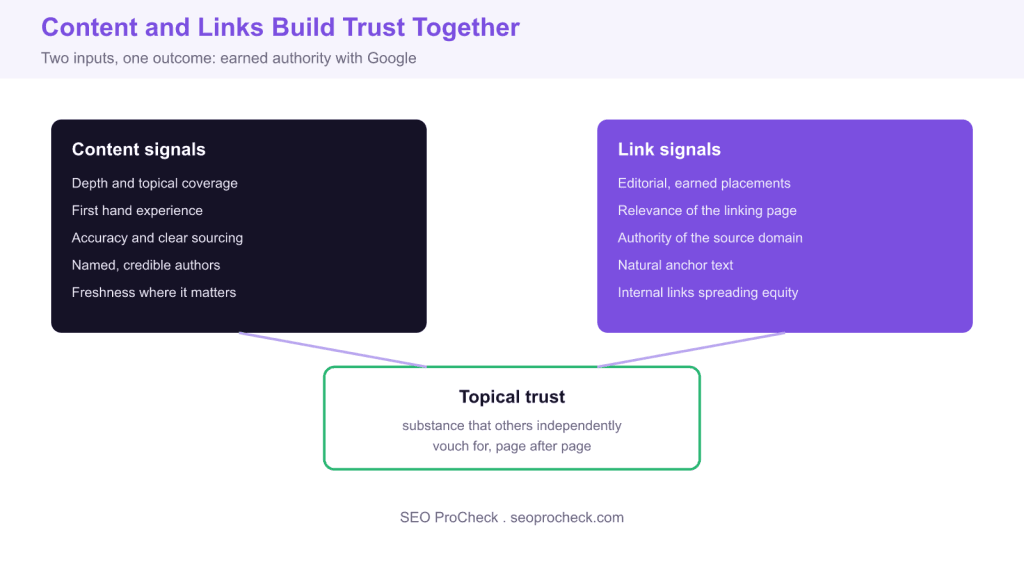
Content and links improve trust with Google in complementary ways, so it is not a contest between them. Content proves substance, expertise, and relevance, while links provide independent endorsement, and the sites Google trusts most consistently earn both.
- Content is where trust is earned first: without it there is nothing to link to or reward.
- Link value depends on relevance, source authority, editorial placement, and anchor text.
- The two form a loop: strong content earns links, and links help that content get discovered and trusted.
- Internal linking is the trust lever you control completely.
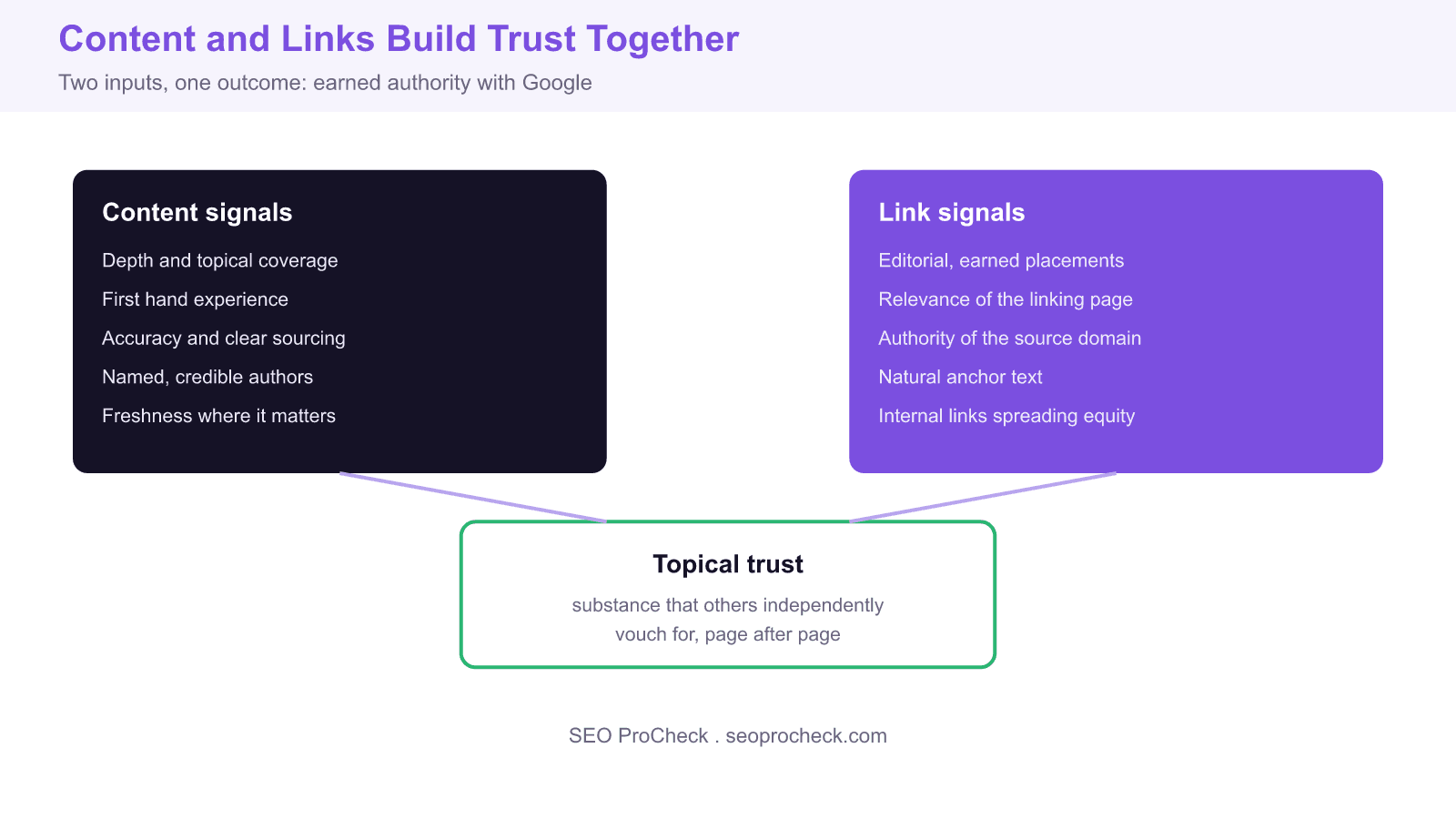
The short answer is that content and links improve trust with Google in different, complementary ways, so framing it as a contest is the wrong way to think about it. Content is the substance Google evaluates for quality, expertise, and relevance. Links are independent third party endorsements that signal other people found that content worth citing. Sites that consistently earn both are the ones Google treats as trustworthy authorities in their space.
What content contributes to trust
Content is where trust is earned in the first place, because there is nothing for anyone to link to or for Google to reward without it. Googles quality guidance, expressed through the E E A T framework of experience, expertise, authoritativeness, and trustworthiness, is entirely about signals your content carries. Depth and genuine topical coverage show you understand a subject rather than skimming it. First hand experience, clear sourcing, accurate claims, and named authors with real credentials all raise the trust a page projects. Thin, derivative, or unsourced content caps how much trust a site can build no matter how many links point at it.
What links contribute to trust
Links remain one of Googles strongest signals because they are hard to fake at scale and they come from outside your own control. A link from a relevant, authoritative page is a vote that your content deserved a citation. Four factors shape how much a link is worth: the relevance between the linking and linked pages, the authority of the linking domain, whether the placement is editorial rather than paid or manipulated, and the anchor text. This is the terrain the original discussion of trust metrics explored, and the practical takeaway has held up: the pattern of who links to you, and how naturally, tells Google a great deal about how the wider web regards your site.
Why the two reinforce each other
Content and links form a loop. Strong content earns links naturally, and those links help Google discover, crawl, and trust the content, which in turn lifts its visibility so more people see it and link to it. Break either half and the loop stalls. Excellent content with no links can sit undiscovered, especially on a new or low authority domain. A pile of links pointing at weak content produces a fragile profile that a spam update or a manual review can unwind. Digital PR works precisely because it pairs the two: it creates something genuinely worth citing, then earns the citations.
Internal linking is the lever you fully control
External links are earned, but internal links are yours to direct. Strategic internal linking passes authority from your strongest pages to the pages you want to rank, and it establishes the topical relationships that help Google map your expertise. Link from high authority hub pages to related deeper pages using descriptive, natural anchor text, and make sure important pages are never more than a few clicks from the home page. This is the highest leverage trust building work most sites leave on the table.
What has changed since older link and trust guidance
Google has never confirmed a single named trust score, and the way it talks about trust has shifted toward the E E A T vocabulary, with an extra E for experience added to stress first hand knowledge. On the content side, the helpful content system folded into the core algorithm, so people first, genuinely useful content is now assessed continuously rather than by a separate filter. On the links side, Google reaffirmed that links are still a meaningful signal while repeatedly penalising link schemes through spam updates and the link spam system powered by its SpamBrain models. The durable lesson is unchanged: earn links to content that deserves them, and never buy your way around quality.
Content signals versus link signals
| Dimension | Content signals | Link signals |
|---|---|---|
| What it proves | Substance, expertise, relevance | Independent endorsement |
| Who controls it | You, directly | Other sites, earned not bought |
| Main quality factor | Depth, accuracy, experience | Relevance and source authority |
| Failure mode | Thin or derivative pages | Manipulated or irrelevant links |
| Best use together | Create something worth citing | Earn the citations it deserves |
Related reading
- How Bing ranks search results and weighs authority
- Reinforce entity trust with LocalBusiness schema
- More technical SEO articles
Frequently asked questions
Does content or links matter more for trust with Google?
Neither wins outright because they do different jobs. Content proves your substance and expertise, while links provide independent endorsement of that content. Google rewards sites that earn both, so the strongest strategy invests in genuinely useful content and then earns links to it rather than choosing one over the other.
Can great content rank without any backlinks?
It can, but it is harder, especially on a new or low authority domain where Google has little external signal to trust. Strong content on an established site with solid internal linking can rank on its own, yet a few relevant editorial links usually accelerate discovery and lift competitive terms.
Do links still work now that content quality matters so much?
Yes. Google has repeatedly confirmed that links remain an important ranking signal, even as it cracks down on manipulation through spam updates. The difference is that low quality, bought, or irrelevant links carry little value or active risk, while relevant editorial links to strong content still help.
What is E E A T and how does it relate to trust?
E E A T stands for experience, expertise, authoritativeness, and trustworthiness, and it is how Google frames the signals that make content credible. Content carries most of these signals directly through depth, sourcing, and author credibility, while links contribute to authoritativeness by showing the wider web endorses you.
How do internal links build trust?
Internal links pass authority from your strongest pages to the pages you want to rank and map the topical relationships that show Google your expertise. Because you control them entirely, they are the highest leverage trust work available: link from hub pages to related deeper pages with descriptive anchor text.
Are bought links a fast way to build trust?
No. Buying links violates Googles link spam policies and is detected by the link spam system, so it risks devaluation or a manual action rather than lasting trust. Sustainable trust comes from earning links to content worth citing, which is slower but does not unravel during spam updates.
Source: https://www.searchenginejournal.com/trust-metrics-and-google/424679/
Take this with you
The assistant links open with a question about this page already written. Nothing is sent until you press enter.
Claude Vincent is a technical SEO consultant focused on crawlability, rendering, and AI-search visibility. He writes the field guides and case studies at SEO ProCheck, with a bias toward the durable, unglamorous work that decides whether search engines and AI answer engines can actually read and cite a site.
About SEO ProCheck
Technical SEO consulting and GEO strategy with 20 years of enterprise experience. Case studies, resources, and tools for search and AI visibility.
Work With Me
Technical SEO audits, GEO strategy, site migrations, and international SEO. Hourly consulting for teams who need hands-on support, not just reports.
Subscribe to our newsletter!








Recent Posts
- Most Top Sites Never Say Who They Are in Structured Data October 14, 2026
- Homepage Titles Are Mostly Too Short, Not Too Long October 8, 2026
- Who Actually Serves an llms.txt? 184 Top Sites Measured September 29, 2026