

AI Summary
The Google Content Warehouse API documentation that became public in May 2024 exposed the names of internal fields Google stores about documents and sites. Google confirmed the material was genuine while warning that it was out of context, potentially outdated, and incomplete, which is exactly why a field name is a research prompt rather than a ranking instruction.
- A field existing in a schema does not tell you it is used in live ranking, how it is weighted, or whether it is current.
- The useful output is a list of hypotheses, each specific enough to be proven wrong on your own site.
- Most of what the documents suggested about user interaction, site level quality and freshness was already actionable through ordinary observation.
- Practitioners who changed nothing after the leak were mostly right. The value was in retiring beliefs, not adding tactics.
In May 2024 a large volume of internal Google documentation describing the Content Warehouse API became publicly accessible, and the SEO industry spent the following weeks reading field names out loud to each other. Google confirmed the documents were authentic, and cautioned against drawing conclusions from information that was out of context, incomplete, and in places outdated. Both halves of that response are true at once, and holding both is the entire skill.
The interesting question was never "what is in the documents." It was "what am I entitled to do differently on Monday." For most practitioners the honest answer turned out to be: very little, immediately, and quite a lot over the following year, in the form of beliefs quietly retired. This page is about that translation step, because it is where the leak either improved someone's practice or wasted several weeks of it.
What a field name does and does not license you to conclude
A schema is a description of what a system can store. It is not a description of what a system does with what it stores. Those are different claims requiring different evidence, and almost every bad take about the leak collapsed the two.
| What you observed | What it supports | What it does not support |
|---|---|---|
| A field with a suggestive name exists | The concept is modelled somewhere in Google's systems | That it is read at ranking time, or read at all today |
| A field is present on many document types | It is broadly applicable within that system | That it is important, or weighted heavily |
| A field name matches a long standing SEO theory | The theory is worth re testing with fresh eyes | That the theory was correct all along |
| A field name contradicts a public Google statement | The public statement was narrower than it sounded | That Google lied, or that the opposite is now true |
| A field appears deprecated or unused | Nothing reliable, since annotations are inconsistent | That it was never used, or is not used now |
The fourth row is the one that caused the most trouble. Several apparent contradictions between the documents and Google's public statements dissolved once you read the public statement precisely: a denial that something is "a ranking factor" is not a denial that the data is stored, computed, or used somewhere in the pipeline. Reading both charitably and literally is more productive than treating either as propaganda.
Understanding User Intent
The most discussed area of the documents was user interaction: fields describing clicks and their quality, and modules referencing a system practitioners came to call NavBoost. The documents did not tell anyone how these are weighted, over what window, or against which competing pages. What they did do is make it much harder to keep asserting that Google ignores what searchers do after they search.
The practical translation is smaller and duller than the discourse suggested. If interaction quality is modelled at all, then the work is to be the result that ends the search: the page that answers the query the user actually had, near the top, in the words they used, without a bounce back to the results page to try someone else. That is not a new tactic. It is the same intent work that was already correct, now with less argument about whether it counts.
Where this changes prioritisation is in title and snippet work. A page that wins the click and immediately disappoints is a worse outcome than a page that never won the click, and clickbait titles that overpromise are actively risky under that model rather than merely tacky. Matching your title to the promise the page actually keeps is the version of this that survives any weighting scheme. Grounding that in genuine query research rather than guesswork is covered in keyword research fundamentals.
Quality and Comprehensiveness
The documents included site level attributes, among them a field named in a way that maps closely to the site wide authority concept the industry had used for years and Google had discouraged. Again the schema tells you the concept exists in some form. It does not tell you the concept behaves like the third party metric that shares its name, and treating a vendor's domain score as a proxy for an internal Google field is a category error.
What survives the uncertainty is a structural point: if any site level quality assessment exists, then thin, duplicated and machine generated pages are not just individually weak, they are a liability to the pages around them. That reframes content pruning and consolidation from a tidying exercise into a defensive one. The action is to raise the floor, not just the ceiling. A systematic content audit that identifies which pages are dragging on the aggregate is more valuable under this reading than another push to lengthen the pages that already perform.
Comprehensiveness deserves a caveat, because "cover the topic thoroughly" curdles into "write 4,000 words" faster than any other piece of advice in this field. Thorough means the reader does not need a second tab open. On many queries that is achieved in 600 words plus a table. Length is a symptom of completeness, never a substitute for it.
Content Lifecycle Management
Fields describing document dates, update history and how a page's content changes over time were present in the documentation, which is consistent with what every practitioner has observed for years: pages decay, and refreshed pages frequently recover. The documents did not reveal a threshold, a decay curve, or a refresh interval, and anyone selling one is guessing.
The usable version is a monitoring habit rather than a schedule. Watch the pages that used to earn impressions and no longer do, and treat sustained decline as a prompt to look at the page rather than as a mystery to explain away. When you do update, change the substance: refresh the examples, correct what is now wrong, add what has emerged. Changing a visible date without changing the content is the version of this that does nothing, and the documents made it less plausible than ever that a date string alone carries weight.
Where a page's decline is technical rather than editorial, the lifecycle framing sends you looking in the wrong place entirely. Confirm the page is still being crawled and served correctly before rewriting it, which is what log file analysis is for.
The four step filter
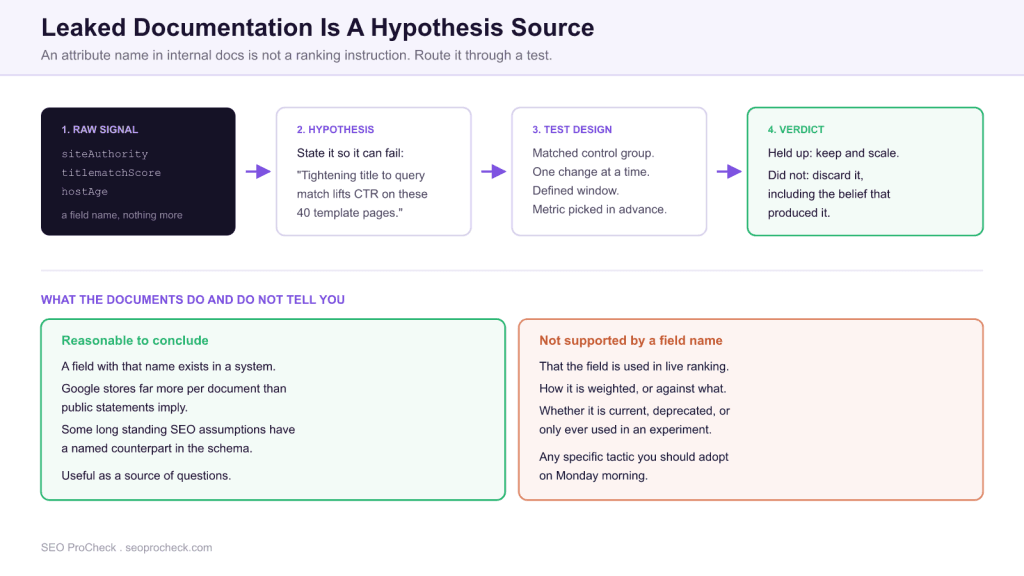
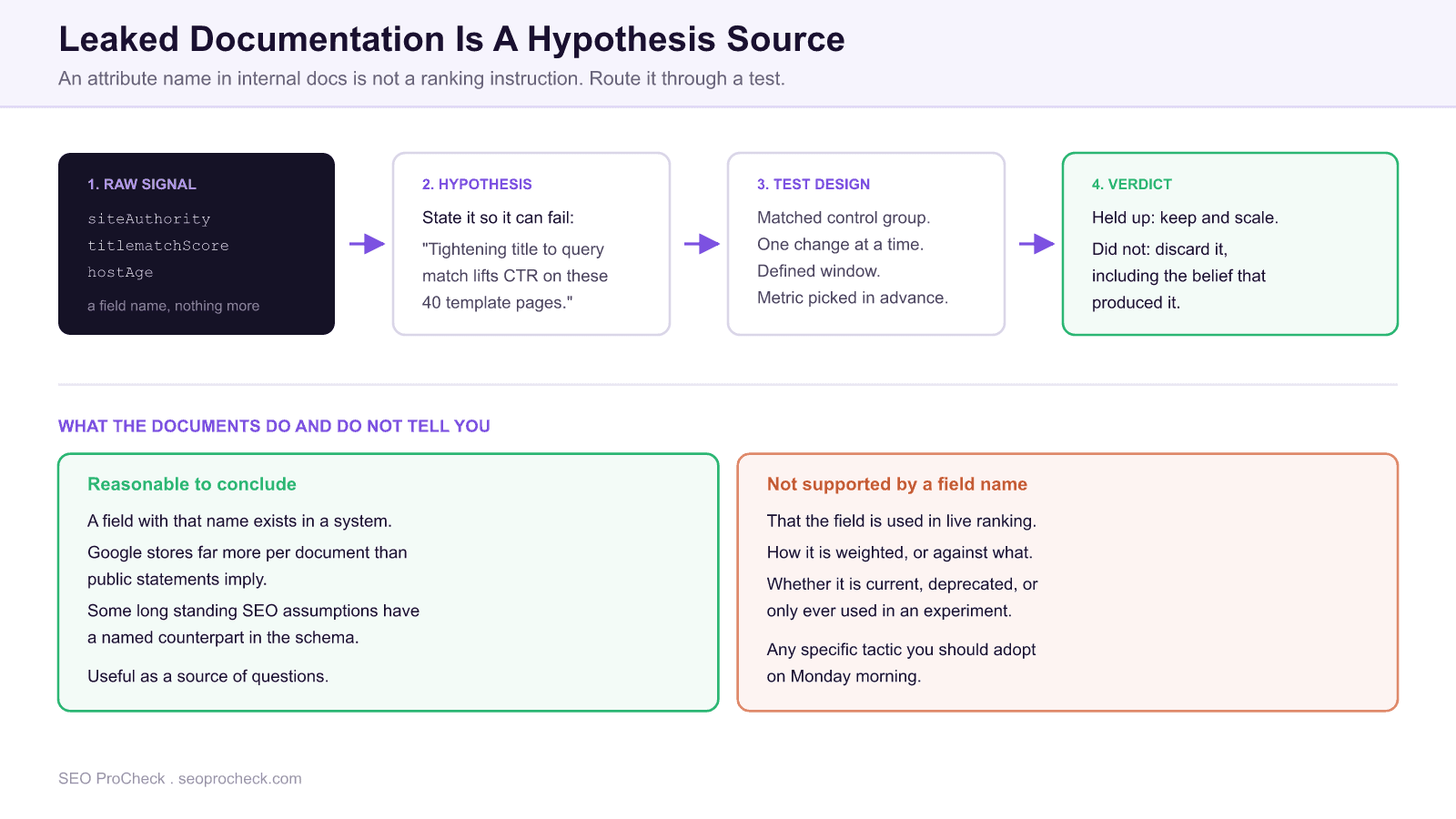
Every claim sourced from leaked documentation should pass through the same four steps before it reaches your roadmap. The point of the sequence is that it can end at step four with "discard," and that outcome has to be genuinely available or the whole exercise is theatre.
- Raw signal. Write down what you actually saw: a field name, its type, where it sits. Not what you think it means.
- Hypothesis. Restate it as something that can fail, tied to your own pages. "Tightening title to query match lifts click through rate on these 40 template pages" is testable. "Google uses click data" is not.
- Test design. A matched control group, one change at a time, a defined window, and the success metric chosen before you look. Pick the metric first or you will find one that agreed with you.
- Verdict. If it held, scale it. If it did not, discard the tactic and the belief that generated it. The second half is what most people skip.
This is slower than reading a thread and changing your titles that afternoon. It is also the only process that leaves you better calibrated afterwards rather than merely differently opinionated.
What actually changed for practitioners
A year on, the durable effects were mostly subtractive. Several confident claims about what Google definitely does not do became untenable, which is a real gain in humility even though it produces no checklist. Client conversations got easier in one specific way: it became simpler to explain why user experience and genuine topical authority are not soft concerns bolted onto technical work. And a category of advice built on "Google says it ignores this, so ignore it" lost its foundation.
What did not change is more instructive. No site was rescued by a tactic derived from a field name. The teams that had a working measurement loop before the leak used it to test a few ideas and moved on. The teams that did not have one acquired a longer list of things to feel anxious about. If the leak exposed anything urgent about the average SEO programme, it was the absence of a testing capability, not the absence of insider knowledge. Building that capability starts with the unglamorous baseline work in a technical SEO audit framework, because you cannot attribute the effect of a change on a site whose crawling and indexing are not yet stable.
FAQ
In May 2024, internal Google documentation describing the Content Warehouse API became publicly accessible. It listed the names, types and descriptions of a large number of internal fields covering documents, sites and user interaction. Google confirmed the material was genuine but warned it was out of context, incomplete, and in places outdated.
It proves click related data is modelled somewhere in Google's systems, which is a weaker claim than "used in ranking." The documents contain no weights, no thresholds and no confirmation that any given field is read at ranking time today. The reasonable conclusion is that dismissing user interaction entirely is no longer defensible, not that you now know how it works.
Mostly the apparent contradictions dissolve on close reading. Google's public statements were typically narrow and precise, and a denial that something is "a ranking factor" does not deny that related data is stored or computed elsewhere in the pipeline. Treating the statements as carefully worded rather than dishonest explains more of the evidence.
Not directly. Nothing in the documents supports a specific new tactic, because field names carry no weighting information. The defensible response is to retire beliefs that the documents made untenable, and to test any promising idea on your own site with a control group before scaling it.
A field with a site level authority name exists in the documentation, which suggests some site wide assessment is modelled. That is not the same as the domain scores sold by third party tools, which are independent estimates built from link data and have no connection to any internal Google value. Optimising toward a vendor metric remains a proxy for a proxy.
Run them through the same filter: record what the document literally says, convert it into a hypothesis about your own pages, design a test with a control group and a metric chosen in advance, and accept the verdict including a negative one. Patents in particular describe what a company considered protecting, which is even further from what it deployed.
The lasting lesson of the leak is procedural rather than tactical: build the loop that lets you answer questions about your own site, and the next disclosure becomes a set of experiments to run rather than a crisis to interpret.
Source: https://searchengineland.com/how-seo-moves-forward-google-leak-442749
Take this with you
The assistant links open with a question about this page already written. Nothing is sent until you press enter.
Claude Vincent is a technical SEO consultant focused on crawlability, rendering, and AI-search visibility. He writes the field guides and case studies at SEO ProCheck, with a bias toward the durable, unglamorous work that decides whether search engines and AI answer engines can actually read and cite a site.
About SEO ProCheck
Technical SEO consulting and GEO strategy with 20 years of enterprise experience. Case studies, resources, and tools for search and AI visibility.
Work With Me
Technical SEO audits, GEO strategy, site migrations, and international SEO. Hourly consulting for teams who need hands-on support, not just reports.
Subscribe to our newsletter!








Recent Posts
- Most Top Sites Never Say Who They Are in Structured Data October 14, 2026
- Homepage Titles Are Mostly Too Short, Not Too Long October 8, 2026
- Who Actually Serves an llms.txt? 184 Top Sites Measured September 29, 2026