

AI Summary
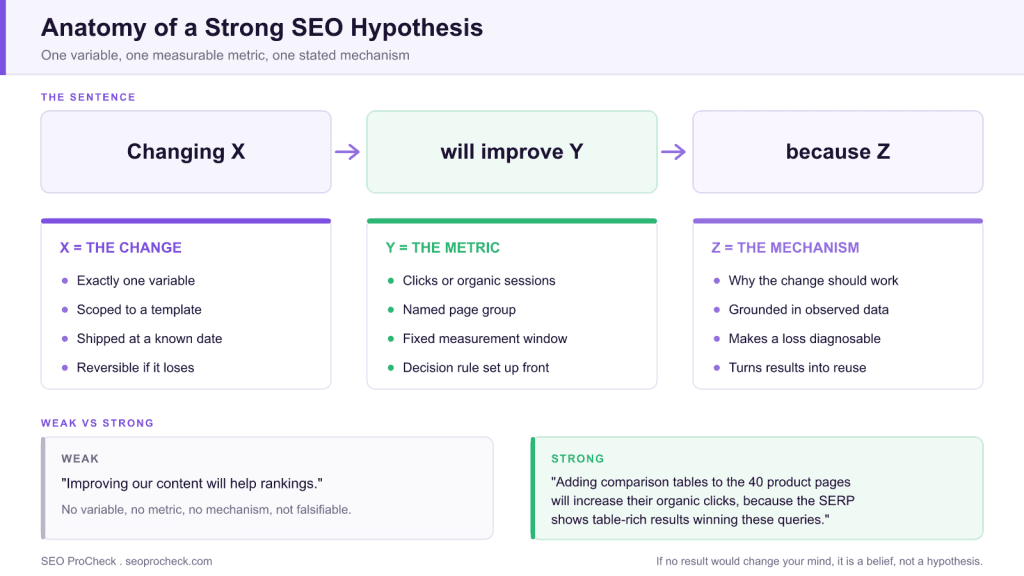
A strong SEO hypothesis names one specific change, predicts a measurable outcome on a named metric, and states the mechanism you believe connects the two, in the pattern "changing X will improve Y because Z". If any of those three parts is missing you are not running a test, you are shipping changes and hoping.
- Start from an observation in your own data: a SERP pattern, a competitor difference, or a query to page mismatch in Search Console.
- Name the primary metric and the decision rule before the change goes live, never after you have seen the chart.
- Change one variable at a time and log algorithm updates, releases, and seasonality inside the measurement window.
- Record losing tests too. A failure with a stated mechanism still tells you what to probe next.
What makes a strong SEO hypothesis? A strong SEO hypothesis names one specific change, predicts a measurable outcome on a named metric, and states the mechanism you believe connects them, in the pattern "changing X will improve Y because Z." If any of the three parts is missing, you are not testing; you are just shipping changes and hoping.
How to write a strong SEO hypothesis provides valuable insights for SEO practitioners. This resource examines approaches and considerations that can improve organic search performance.
About the source
The article linked below comes from SearchPilot, the SEO A/B testing platform that grew out of the consultancy Distilled, one of the few teams that has run controlled SEO experiments at scale across large sites for years. That background matters: their guidance on hypothesis writing is grounded in what actually survives contact with a statistical test, not in content-marketing convention. The core of their argument is that the hypothesis is the unit of learning in SEO testing, because a well-written one produces knowledge whether the test wins or loses.
Why the hypothesis is the hard part
Most "SEO tests" in the wild fail before launch, at the sentence level. Common failure modes:
- No mechanism. "Adding FAQs will increase traffic." Why would it? Without a stated mechanism (snippet capture? long-tail query coverage? better intent match?), a win teaches you nothing you can reuse, and a loss cannot be diagnosed.
- Multiple variables. Rewriting titles, adding schema, and restructuring H2s in one test means no result can be attributed to anything.
- Unmeasurable outcomes. "Improve relevance" and "strengthen E-E-A-T" are not metrics. Organic sessions, clicks, impressions, and rankings on defined query sets are.
- No evidence behind the idea. Strong hypotheses start from observed data, such as a SERP pattern, a competitor difference, or a query-page mismatch in Search Console, not from a blog post someone read.
- Unfalsifiable framing. If no outcome would convince you the idea failed, it is a belief, not a hypothesis.
How to write and run one, step by step
- Start from an observation. Example: pages ranking 4 to 8 have titles that omit the year-modifier pattern dominating the top three results for those queries.
- Draft the sentence. "Adding the current year to title tags on the affected template will increase organic clicks to those pages, because it matches demonstrated searcher language and improves SERP CTR."
- Define the metric and the decision rule up front. Which metric, measured where, over what period, and what result means adopt, revert, or iterate. Deciding after seeing the data is how teams fool themselves.
- Pick the test design your traffic can afford. Large templated sites can split similar pages into control and variant groups and compare against forecast. Smaller sites cannot reach significance that way, so use before/after with a holdout section, or accept directional evidence and say so honestly.
- Change one thing, note everything else. Log algorithm updates, releases, and seasonality during the window; they are the confounders that most often masquerade as results.
- Write down the result either way. A library of tested hypotheses, including the losers, is a compounding asset most SEO teams never build.
Weak vs. strong hypotheses: examples
| Weak version | What's wrong | Strong version |
|---|---|---|
| "Improving our content will help rankings." | No variable, no metric, no mechanism | "Adding a comparison table to the 40 product-comparison pages will increase their organic clicks, because the SERP shows table-rich results winning these queries." |
| "Adding schema will boost traffic." | Vague scope; schema rarely changes ranking directly | "Adding FAQPage markup to the support templates will increase impressions and clicks from question queries, because eligible rich results expand SERP real estate." |
| "Faster pages will rank better." | Untestable as stated; outcome too broad | "Cutting LCP below 2.5s on the category template will lift its organic sessions, because field CWV currently fails and page experience is a known lightweight signal." |
| "We should internally link more." | An action, not a hypothesis | "Linking each guide to its three closest money pages will improve those pages' rankings for their head terms, because they currently receive almost no internal links." |
Note the pattern: the strong versions are all falsifiable, scoped to a template or page set large enough to measure, and honest about the mechanism. That includes the speed example, which correctly treats page experience as a modest signal rather than a promise (you can check your own field data with our Core Web Vitals checker).
The hypothesis record: what to write down before you ship
A hypothesis that lives in a chat message is not a hypothesis, it is a rumor. Keep one row per test in a sheet or a ticket, and fill every field before the change goes live. These eight fields are the minimum that lets a colleague reconstruct the test six months later without asking you anything:
| Field | What goes in it | Why it matters |
|---|---|---|
| Hypothesis sentence | The full "changing X will improve Y because Z" statement | Forces all three parts to actually exist |
| Page set | The exact URL pattern or list, plus how many URLs it contains | Defines the unit of measurement and the ceiling on effect size |
| Control set | The comparable pages deliberately left untouched | Without one you are measuring the season, not the change |
| Primary metric and source | One metric, one source: GSC clicks, or GA4 organic sessions | Prevents metric shopping after the numbers land |
| Decision rule | What result means adopt, revert, or iterate | Written while you are still honest, before the chart exists |
| Deploy date and time | When the change actually shipped, not when it was approved | Anchors the before and after windows correctly |
| Confounder log | Algorithm updates, releases, seasonality, PR spikes in the window | The usual real explanation for a surprising result |
| Outcome | Result, decision taken, and what the mechanism turned out to be | Turns a single test into reusable institutional knowledge |
Two of those fields do most of the work. The control set is what separates a test from a coincidence: without comparable untouched pages, any seasonal swing or algorithm update becomes your "result." The decision rule stops the most common failure in SEO experimentation, which is looking at the chart first and deciding afterwards what would have counted as success. Write both down while the outcome is still unknown to you.
What's changed since the original article
The discipline has become more valuable and the measurement has become harder. AI Overviews and other SERP features now sit between rankings and clicks, so a test can improve rankings while clicks stay flat. Hypotheses should increasingly name clicks or downstream conversions as the primary metric, with rankings as a diagnostic. Ranking volatility around frequent algorithm updates argues for longer test windows and stronger controls than pre-2024 practice assumed. And a new hypothesis category has emerged around AI-surface visibility (citations in AI answers), where controlled testing is still immature, so treat claims in that space with proportional skepticism. None of this weakens the case for hypothesis-driven work; unmeasured SEO is the thing that stopped being defensible. That mindset is also the honest answer to the perennial stakeholder questions covered in how to tell if your SEO is actually working and why SEO takes time.
Frequently asked questions
A testable statement predicting that a specific change will move a specific metric for a stated reason: the "changing X improves Y because Z" pattern. It turns an SEO idea into something that can be proven wrong.
Not with user-splitting tools, because search engines see one version of a URL. SEO tests split similar pages into control and variant groups, apply the change to the variant group, and compare performance against the control group's trend.
Enough that page-group differences can beat noise: in practice, templated sections with at least hundreds of organic sessions per day across the group. Below that, use before/after comparisons with holdouts and report results as directional.
Long enough to cover reindexing of the changed pages plus a stable measurement window, so typically several weeks minimum, and longer when algorithm updates or seasonality overlap the test.
Prefer clicks and organic sessions over rankings alone, and conversions where volume allows. Rankings are a useful diagnostic but no longer guarantee clicks in feature-heavy SERPs.
A failed test with a clear hypothesis is a success of the process: it stopped a site-wide rollout of a change that did not work, and the stated mechanism tells you what to probe next. Record it and iterate.
This resource contributes to the knowledge base SEO practitioners need for effective optimization in an evolving search landscape.
Source: https://www.searchpilot.com/resources/blog/writing-an-seo-hypothesis/
Claude Vincent is a technical SEO consultant focused on crawlability, rendering, and AI-search visibility. He writes the field guides and case studies at SEO ProCheck, with a bias toward the durable, unglamorous work that decides whether search engines and AI answer engines can actually read and cite a site.
About SEO ProCheck
Technical SEO consulting and GEO strategy with 20 years of enterprise experience. Case studies, resources, and tools for search and AI visibility.
Work With Me
Technical SEO audits, GEO strategy, site migrations, and international SEO. Hourly consulting for teams who need hands-on support, not just reports.
Subscribe to our newsletter!






Recent Posts
- Can AI Crawlers Actually Read Your Site? I Measured 400 of the Biggest September 5, 2026
- The Pre-Publish Quality Gate for AI-Assisted Content August 6, 2026
- AGENTS.md vs llms.txt vs llms-full.txt: Which Agent File Does What July 18, 2026