

AI Summary
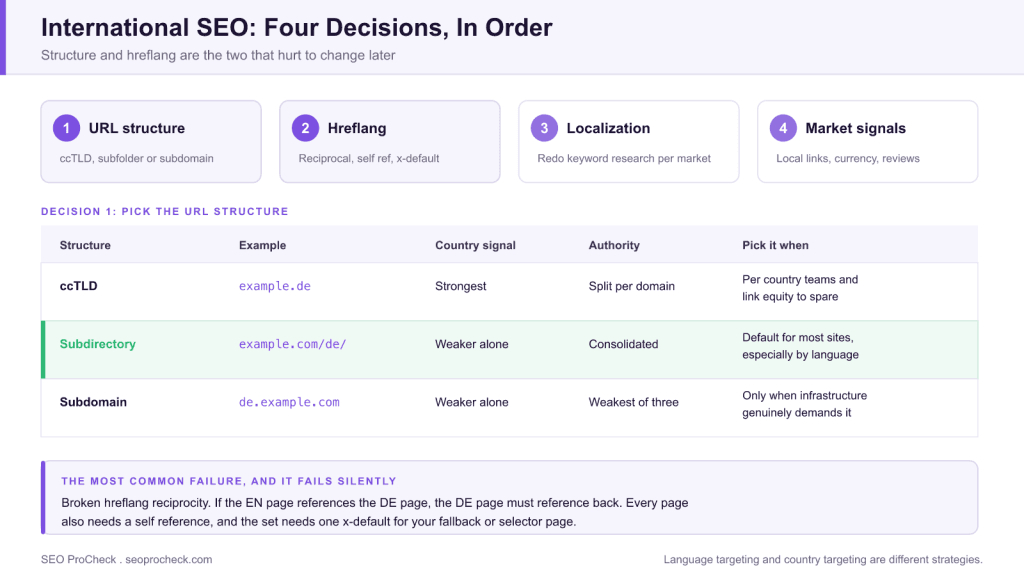
International SEO is the practice of structuring a website so search engines serve the right language or country version of your pages to the right users. It rests on four decisions, and the first two are the ones that are painful to change later: URL structure and hreflang.
- Subdirectories (example.com/de/) are the right default for most sites, because consolidated authority beats a diluted country signal.
- Hreflang must be reciprocal, include a self-reference on every page, and carry one
x-default. - Localize rather than translate: redo keyword research natively in each market.
- Google's Search Console country-targeting setting was deprecated in 2022, so country association now comes from ccTLDs, hreflang, and on-site local signals.
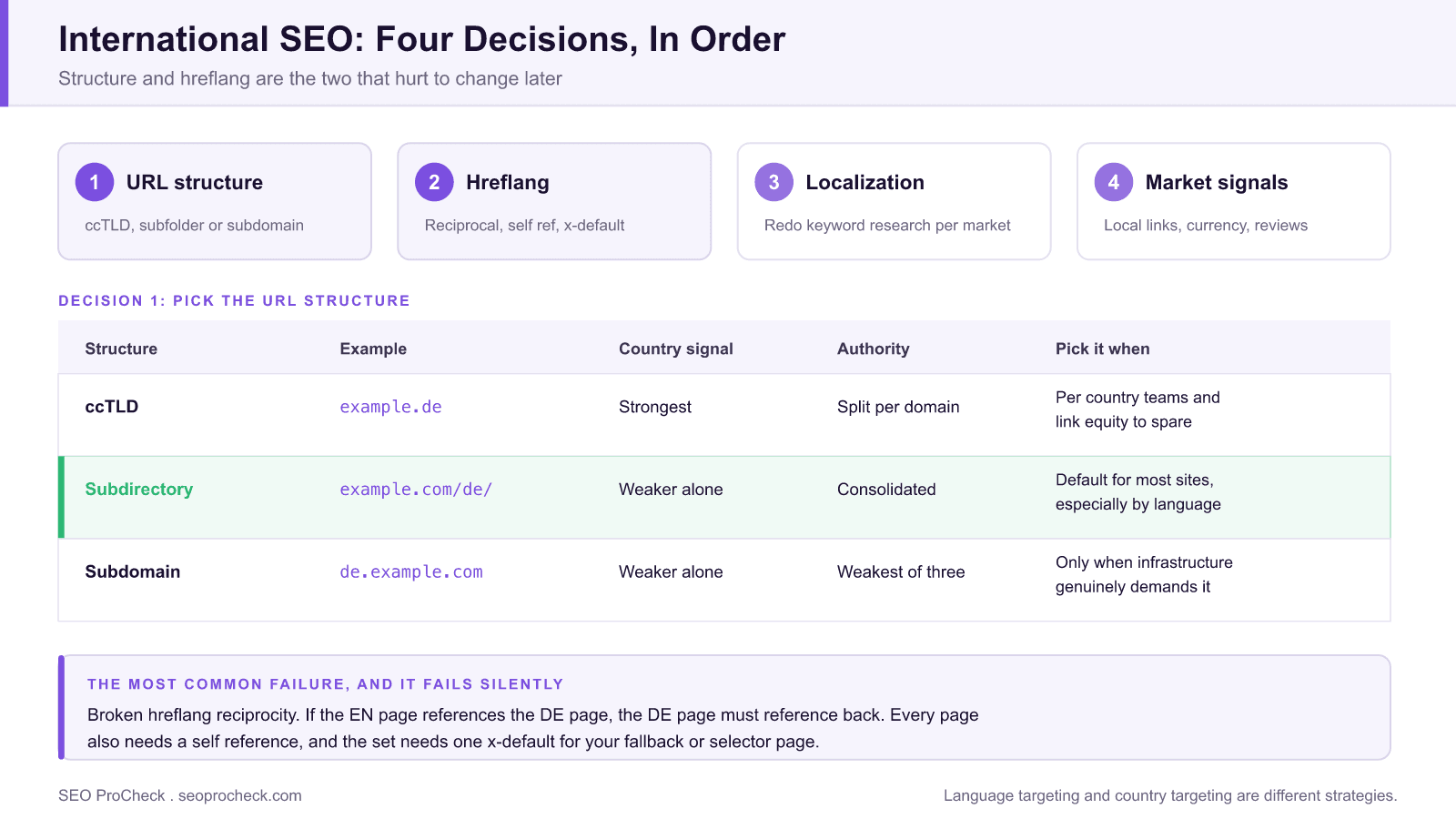
Quick answer: International SEO is the practice of structuring a website so search engines serve the right language or country version of your pages to the right users. It rests on four decisions: your URL structure (ccTLD, subdirectory, or subdomain), your hreflang annotations mapping equivalent pages across locales, genuine localization of content (not just translation), and per-market signals like local links and currency. Get the structure and hreflang right first, because they are the two pieces that are painful to change later.
The source below, Wix's SEO Hub guide, is a solid platform-agnostic primer despite living on a website builder's domain. Here is our practitioner layer on top of it: the decisions that actually determine success, in the order you should make them.
Decision 1: URL Structure
| Structure | Example | Strengths | Weaknesses | Pick it when |
|---|---|---|---|---|
| ccTLD | example.de | Strongest country signal; local user trust | Authority split across domains; cost of registering and maintaining each; some ccTLDs restricted | Large per-country business with local teams and link equity to spare |
| Subdirectory | example.com/de/ | Inherits domain authority; one site to maintain; cheapest to launch | Weaker country signal on its own; needs clean folder discipline | Default choice for most sites, especially language-targeting |
| Subdomain | de.example.com | Separate infrastructure per market possible | Authority consolidation weaker than subdirectories; few unique advantages | Only when infrastructure genuinely requires separation |
The honest guidance: subdirectories win by default because consolidated authority beats a diluted country signal for almost everyone below enterprise scale. Decide language targeting vs country targeting before choosing, because /fr/ targeting French speakers everywhere is a different strategy from /fr-fr/ and /fr-ca/ targeting France and Canada separately, and mixing the two models is where most architectures go wrong.
Decision 2: Hreflang, Done Minimally
Hreflang exists to solve one problem: stopping the wrong locale version from ranking in a market. The rules that matter: annotations must be reciprocal (if the EN page references the DE page, the DE page must reference back), every page should include a self-reference, use ISO 639-1 language and ISO 3166-1 Alpha-2 country codes (language alone is valid; country alone is not), and add an x-default for your fallback/selector page. You can declare it in the HTML head, HTTP headers, or the XML sitemap, and the trade-offs are covered in our guide on where to declare hreflang, while the full implementation walkthrough lives in our hreflang and international SEO guide. Broken reciprocity is the most common failure and it fails silently; check your setup with our free hreflang validator.
The Five Hreflang Mistakes That Cause Most Tickets
Hreflang errors are unusually expensive to diagnose because nothing visibly breaks. The pages stay indexed, the tags stay in the source, and the only symptom is that the wrong locale keeps showing up in a market. These five account for the large majority of real-world failures:
| Mistake | What it looks like in the code | Why it silently fails | Fix |
|---|---|---|---|
| Non-reciprocal annotation | The EN page lists the DE page, but the DE page lists nothing back | Google discards annotations it cannot confirm from both sides | Generate the whole cluster from one data source so every page emits the full set |
| Wrong code order or invalid region | hreflang="de-DE" written as de_DE, or a made-up region like en-EU | Only language, or language plus a real ISO country, is valid, and EU is not a country | Use ISO 639-1 plus ISO 3166-1 Alpha-2, separated by a hyphen |
| Pointing at non-canonical URLs | Hreflang targets a URL that then canonicals or redirects elsewhere | Conflicting signals cancel each other, so the cluster is ignored | Every hreflang target must be the self-canonical, final URL, returning 200 |
| Missing self-reference | A page lists its siblings but never itself | The cluster cannot be closed, so the annotation set is treated as incomplete | Include the page's own URL in its own hreflang set, every time |
No x-default | Ten locales declared and no fallback | Users outside your declared markets get an arbitrary version | Point x-default at the language selector or the global default page |
The underlying lesson is that hreflang is a cluster-level contract, not a per-page tag. Hand-maintaining these annotations across even a dozen locales fails the moment someone adds a market or renames a URL, so generate the set programmatically from one canonical mapping table and validate it on a schedule rather than at launch only.
Decision 3: Localize, Don't Just Translate
Search engines evaluate each locale version as content in its own market, competing against native content. Word-for-word translation misses the query language people actually use, so keyword research must be redone per market, not translated. Beyond keywords: currency, units, payment methods, phone formats, local proof (reviews, addresses, local links), and culturally-adapted examples all separate a page that ranks in a market from one that merely exists in its language. A useful budget rule: if you cannot afford to localize and maintain a market's content properly, you are usually better off not launching that locale than launching a thin one.
What's Changed Since This Guide's Era
Three updates to apply on top of any international SEO guide written more than a couple of years ago. First, Google removed the International Targeting report from Search Console (deprecated in 2022), which killed the old subdomain/subdirectory geotargeting override, so country targeting now comes entirely from ccTLDs, hreflang, and on-site local signals. Second, machine translation got dramatically better and cheaper, which cuts both ways: AI-assisted localization with human review is now viable for mid-size sites, but auto-translating thousands of pages without review produces exactly the scaled, thin content Google's quality systems have targeted since 2024, and near-duplicate locales (for example, five barely-differentiated English variants) increasingly get folded together by canonicalization. Third, AI answer engines have no hreflang equivalent: assistants pick sources per language largely on content strength, making genuinely-native content quality matter beyond classic rankings.
FAQ
Optimizing a website so search engines index and serve the correct language or country version of each page to each user, through URL structure, hreflang annotations, localized content, and market-level signals.
Subdirectories (example.com/de/) are the right default: they consolidate authority and cost the least to run. ccTLDs make sense for large per-country operations, and subdomains rarely offer an advantage.
Only if you run multiple regional variants of that language, such as US, UK, and AU English. Hreflang plus x-default sorts those markets out. A single-locale site needs none.
Hreflang tells Google the variants are intentional alternates, which prevents the wrong-market problem. But if variants are near-identical, Google may canonicalize them together, so differentiate them with genuinely local details or consolidate them.
Research natively in each market's language and search locale, and never translate keywords. Terms, intent, and volumes differ even between countries sharing a language, so treat each market as a fresh keyword project.
No. The International Targeting report and its country-targeting setting were deprecated in 2022. Country association now comes from ccTLDs, hreflang region codes, and local signals on the site itself.
This resource contributes to the knowledge base SEO practitioners need for effective optimization in an evolving search landscape.
Source: https://www.wix.com/seo/learn/resource/international-seo-guide
Claude Vincent is a technical SEO consultant focused on crawlability, rendering, and AI-search visibility. He writes the field guides and case studies at SEO ProCheck, with a bias toward the durable, unglamorous work that decides whether search engines and AI answer engines can actually read and cite a site.
About SEO ProCheck
Technical SEO consulting and GEO strategy with 20 years of enterprise experience. Case studies, resources, and tools for search and AI visibility.
Work With Me
Technical SEO audits, GEO strategy, site migrations, and international SEO. Hourly consulting for teams who need hands-on support, not just reports.
Subscribe to our newsletter!







Recent Posts
- Can AI Crawlers Actually Read Your Site? I Measured 400 of the Biggest September 5, 2026
- The Pre-Publish Quality Gate for AI-Assisted Content August 6, 2026
- AGENTS.md vs llms.txt vs llms-full.txt: Which Agent File Does What July 18, 2026