

Schema Markup FAQ: Complete Guide to Structured Data for SEO
- April 22, 2024
- Technical SEO FAQ
AI Summary
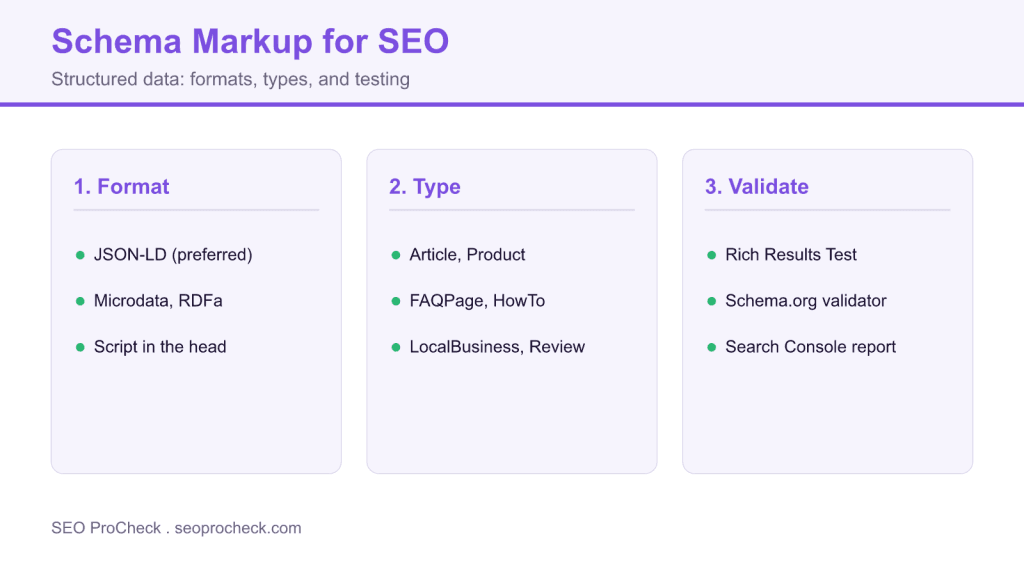
Schema markup is Schema.org structured data that describes your page to search engines and AI systems in a machine readable way, most often added as JSON-LD. It does not directly raise rankings, but it makes pages eligible for rich results that lift visibility and click through.
- JSON-LD is the format Google recommends; Microdata and RDFa also work.
- Valid schema makes rich results possible, but Google never guarantees them.
- Common types include Article, Product, FAQPage, HowTo, LocalBusiness, and Review.
- Validate every change with the Rich Results Test and the Search Console enhancements report.
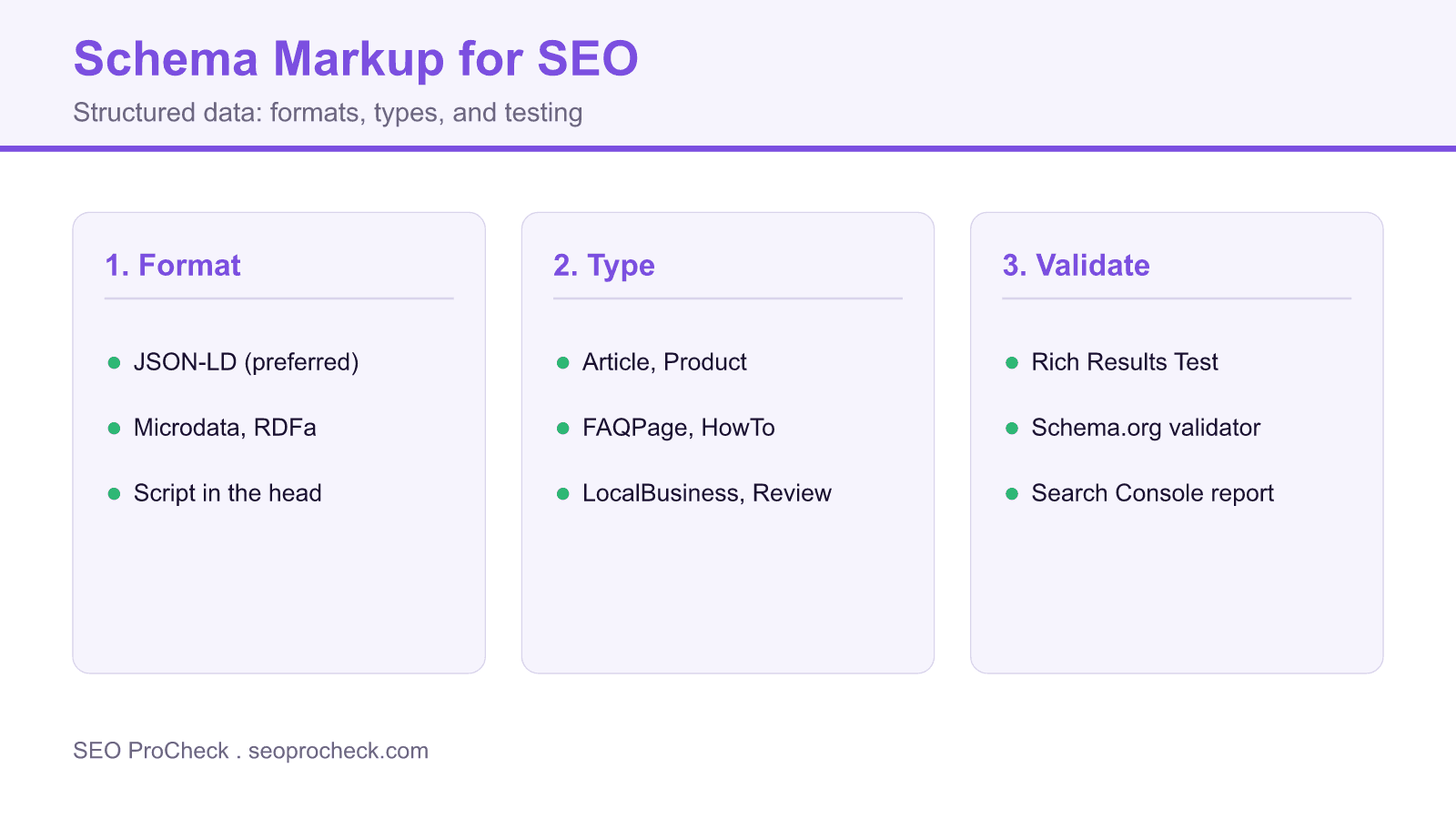
Everything you need to know about schema markup and structured data. Covers implementation, testing, rich results, and common schema types for SEO and AI visibility.
Table of Contents
- Schema Basics
- Implementation Methods
- Common Schema Types
- Rich Results
- Testing and Validation
- Advanced Topics
Schema Basics
What is schema markup?
Structured data vocabulary from Schema.org that helps search engines understand page content. It defines entities, properties, and relationships in machine-readable format. Used by Google, Bing, and other search engines for enhanced results.
Why is schema markup important for SEO?
Schema enables rich results (stars, prices in search). Improves click-through rates 20-30% for enhanced listings. Helps search engines understand content context. Increasingly relevant for AI systems parsing structured information.
Does schema directly improve rankings?
Not directly. Schema isn't a ranking factor. However, rich results from schema increase visibility and CTR. Better CTR signals can indirectly help. Schema's primary value is enhanced SERP appearance and content clarity.
What is Schema.org?
Collaborative vocabulary created by Google, Bing, Yahoo, and Yandex in 2011. Defines hundreds of entity types (Product, Article, Person, Organization) with properties. The standard for structured data on the web.
What formats can schema use?
Three formats: JSON-LD (recommended), Microdata, RDFa. JSON-LD is Google's preferred format. Placed in script tags, separate from HTML content. Microdata and RDFa embed in HTML elements. JSON-LD is easiest to implement and maintain.
Why is JSON-LD preferred?
JSON-LD separates data from HTML markup, making it easier to implement and maintain. Can be injected dynamically. Doesn't require modifying page templates. Google explicitly recommends JSON-LD over other formats.
Implementation Methods
How do I add schema to my site?
Options: CMS plugins (Yoast, Rank Math, Schema Pro), Google Tag Manager, manual code in HTML head, JavaScript injection. For WordPress, plugins are easiest. For custom sites, add JSON-LD scripts directly or via tag manager.
What does JSON-LD look like?
Script tag containing JSON object with @context (schema.org URL), @type (entity type), and properties. Example:
Where should schema be placed in HTML?
JSON-LD can go in
or; both work. Google recommends for consistency. Place early in document. Multiple schema blocks are fine. Keep related entities together when possible.Can I have multiple schemas on one page?
Yes. Pages commonly have Organization + Article + BreadcrumbList. Use separate script blocks or nest related entities. Product pages might have Product + Review + Organization. Combine appropriately without duplication.
Which WordPress plugins add schema?
Yoast SEO (basic schema built-in), Rank Math (comprehensive schema), Schema Pro by Brainstormforce (dedicated schema plugin), WP Schema Markup. Most SEO plugins now include schema features. Choose based on overall needs.
Can schema be added dynamically with JavaScript?
Yes. Google renders JavaScript and reads dynamically added schema. Useful for SPAs or when schema depends on user interaction. Ensure schema is present when Googlebot renders. Test with URL Inspection tool.
Common Schema Types
What is Article schema?
Defines news, blog, or article content. Properties: headline, author, datePublished, dateModified, image. Subtypes: NewsArticle, BlogPosting. Helps content appear in Google News, Discover, and article-specific features.
What is Product schema?
Defines products for e-commerce. Properties: name, description, image, price, availability, reviews, brand. Enables rich product results with prices, ratings, availability. Essential for shopping visibility.
What is FAQPage schema?
Defines FAQ content with questions and answers. Google showed expandable FAQ rich results for it until May 7, 2026, when it stopped for every site; Bing and AI assistants can still read it. Each Question has acceptedAnswer with text. Useful for informational pages, product pages, support content.
What is HowTo schema?
Defines step-by-step instructions. Properties: name, step (with text, image, url), totalTime, tool, supply. Google stopped showing its step-by-step rich results in September 2023, though other engines and AI assistants can still read the markup. Ideal for tutorials, recipes, DIY guides.
What is LocalBusiness schema?
Defines local businesses. Properties: name, address, geo coordinates, phone, hours, priceRange. Subtypes for specific business types (Restaurant, Store, etc.). Essential for local SEO and Google Business Profile alignment.
What is Organization schema?
Defines company/organization information. Properties: name, logo, url, sameAs (social profiles), contactPoint. Appears in knowledge panels. Include on homepage and about page. Use sameAs for social profile linking.
What is BreadcrumbList schema?
Defines site hierarchy/navigation path. Creates breadcrumb trail in search results. Properties: itemListElement containing position, name, item (URL). Helps users understand page location within site structure.
What is Review schema?
Defines individual reviews with author, rating, content. AggregateRating summarizes multiple reviews with ratingValue, reviewCount. Creates star ratings in search results. Google has strict guidelines on self-review.
Schema Types and Rich Results
| Schema Type | Rich Result | Best For |
|---|---|---|
| Article | Article carousel, Top Stories | News, blogs, editorial |
| Product | Price, availability, ratings | E-commerce products |
| FAQPage | None in Google since May 7, 2026 (Bing and AI assistants still read it) | Support, informational pages |
| HowTo | None in Google since September 2023 | Tutorials, guides |
| LocalBusiness | Local pack, hours, location | Physical locations |
| Review | Star ratings | Products, services, businesses |
Rich Results
What are rich results?
Enhanced search listings beyond standard title/description. Include star ratings, prices, images, event dates. Schema markup enables rich results. Also called rich snippets or enhanced results.
Does schema guarantee rich results?
No. Valid schema makes rich results possible, not guaranteed. Google decides based on query, competition, schema quality, page quality. Some pages never get rich results despite valid schema. It's eligibility, not guarantee.
What types of rich results exist?
Review stars, product details, recipe cards, event listings, job postings, video thumbnails, breadcrumbs. Each requires specific schema type and proper implementation.
How do I get FAQ rich results?
You can't anymore. Google stopped showing FAQ rich results for every site on May 7, 2026, and removed the FAQPage documentation on June 15, 2026. Keep valid FAQPage schema with Question and acceptedAnswer pairs on genuine FAQ content, because Bing and AI assistants can still read it.
How do I get star ratings in search results?
Use Review or AggregateRating schema on appropriate content: products, recipes, books, courses, local businesses. Cannot self-review your own business. Ratings must be from genuine user reviews. Strict Google guidelines apply.
Why did my rich results disappear?
Possible causes: schema errors introduced, Google algorithm changes, manual action for policy violation, page quality issues, competition increased. Check Search Console enhancements report and validate schema.
Testing and Validation
How do I test my schema markup?
Google Rich Results Test shows eligibility for specific rich results. Schema.org Validator checks general syntax. URL Inspection in Search Console shows what Google sees. Test after implementation and after any changes.
What is the Rich Results Test?
Google's tool at search.google.com/test/rich-results. Tests URL or code snippet. Shows detected schema types, errors, warnings, and eligible rich result types. Primary tool for schema validation.
What is the Schema.org validator?
validator.schema.org checks schema syntax against Schema.org vocabulary. More permissive than Google's tool. Useful for general validation. Doesn't indicate Google-specific rich result eligibility.
What's the difference between schema errors and warnings?
Errors prevent rich results: missing required properties, invalid values, syntax problems. Warnings indicate missing recommended properties: may reduce rich result likelihood but don't prevent eligibility. Fix errors first.
How do I check schema in Search Console?
Search Console > Enhancements shows detected schema types (Products, Breadcrumbs, etc.). Shows valid items, items with warnings, invalid items. Click each for specific issues. Monitor regularly for new errors.
How do I verify Google sees my schema?
URL Inspection tool in Search Console. Check "View Crawled Page" and "More Info" for detected structured data. Shows exactly what Googlebot rendered and parsed. Essential for JavaScript-rendered schema.
Advanced Topics
How do I nest schema entities?
Embed related entities within parent schema. Example: Product contains AggregateRating and Offer. Article contains Person (author) and Organization (publisher). Nesting shows relationships between entities clearly.
What is the sameAs property?
Links entity to external URLs representing same entity. Used in Organization for social profiles, in Person for author profiles. Helps search engines connect your entity across the web. Important for knowledge panels.
Does schema help AI visibility?
Potentially. Schema provides explicit entity relationships AI can parse. Some studies show schema correlation with AI citations, others show minimal impact. At minimum, schema improves content clarity for all systems.
What is Speakable schema?
Identifies content suitable for text-to-speech/voice assistants. Marks sections of articles for audio playback. Currently limited availability. May become more important as voice search grows.
What is VideoObject schema?
Defines video content. Properties: name, description, thumbnailUrl, uploadDate, duration, contentUrl/embedUrl. Enables video rich results, video carousels. Essential for video content visibility.
What schema do news sites need?
NewsArticle (not generic Article), Organization for publisher, Person for author, datePublished/dateModified. Include isAccessibleForFree for paywalled content. Supports Google News and Top Stories eligibility.
What schema do e-commerce sites need?
Product with Offer (price, availability), AggregateRating, Review. BreadcrumbList for categories. Organization for brand. Consider ItemList for category pages. Rich product results drive clicks and conversions.
What schema do local businesses need?
LocalBusiness (or specific subtype), PostalAddress, GeoCoordinates, OpeningHoursSpecification. Match Google Business Profile exactly. Include phone, priceRange. Supports local pack and knowledge panel.
Required vs Recommended Properties
| Schema Type | Required Properties | Recommended Properties |
|---|---|---|
| Article | None (Google lists no required properties) | headline, image, author, datePublished, dateModified, publisher |
| Product | name, image | price, availability, review, brand |
| FAQPage | mainEntity (Question+Answer) | None additional |
| LocalBusiness | name, address | phone, hours, geo, image |
| Review | itemReviewed, author | reviewRating, datePublished |
Structured data format comparison
| Format | Where it lives | Google preference |
|---|---|---|
| JSON-LD | A script block in the head or body | Recommended |
| Microdata | Attributes inside HTML elements | Supported |
| RDFa | Attributes inside HTML elements | Supported |
Related SEO references
Frequently Asked Questions
Not directly. Schema is not a ranking factor, but it can make your pages eligible for rich results such as review stars or product details, which improve visibility and click through. Those stronger clicks are the practical benefit.
Use JSON-LD. Google explicitly recommends it, it sits in a script tag separate from your HTML, and it is the easiest format to add and maintain. Microdata and RDFa still work but they entangle markup with your content.
The usual causes are a schema error introduced during an edit, a page quality issue, a policy violation, or simply more competition for the same feature. Revalidate the page with the Rich Results Test and check the Search Console enhancements report for new errors.
Yes. Pages often combine Organization, BreadcrumbList, and Article, and product pages add Product, Offer, and AggregateRating. Use separate script blocks or nest related entities, but do not duplicate the same entity.
Run the URL or code through Google's Rich Results Test to see eligibility and errors, and use the Schema.org validator for general syntax. In Search Console, the URL Inspection tool shows exactly what Googlebot parsed after rendering.
It can help. Schema states entities and relationships explicitly, which makes content easier for AI systems to parse, though reported impact varies. At minimum it improves clarity for every system that reads the page.
Take this with you
The assistant links open with a question about this page already written. Nothing is sent until you press enter.
Claude Vincent is a technical SEO consultant focused on crawlability, rendering, and AI-search visibility. He writes the field guides and case studies at SEO ProCheck, with a bias toward the durable, unglamorous work that decides whether search engines and AI answer engines can actually read and cite a site.
About SEO ProCheck
Technical SEO consulting and GEO strategy with 20 years of enterprise experience. Case studies, resources, and tools for search and AI visibility.
Work With Me
Technical SEO audits, GEO strategy, site migrations, and international SEO. Hourly consulting for teams who need hands-on support, not just reports.
Subscribe to our newsletter!








Recent Posts
- Most Top Sites Never Say Who They Are in Structured Data October 14, 2026
- Homepage Titles Are Mostly Too Short, Not Too Long October 8, 2026
- Who Actually Serves an llms.txt? 184 Top Sites Measured September 29, 2026