

AI Summary
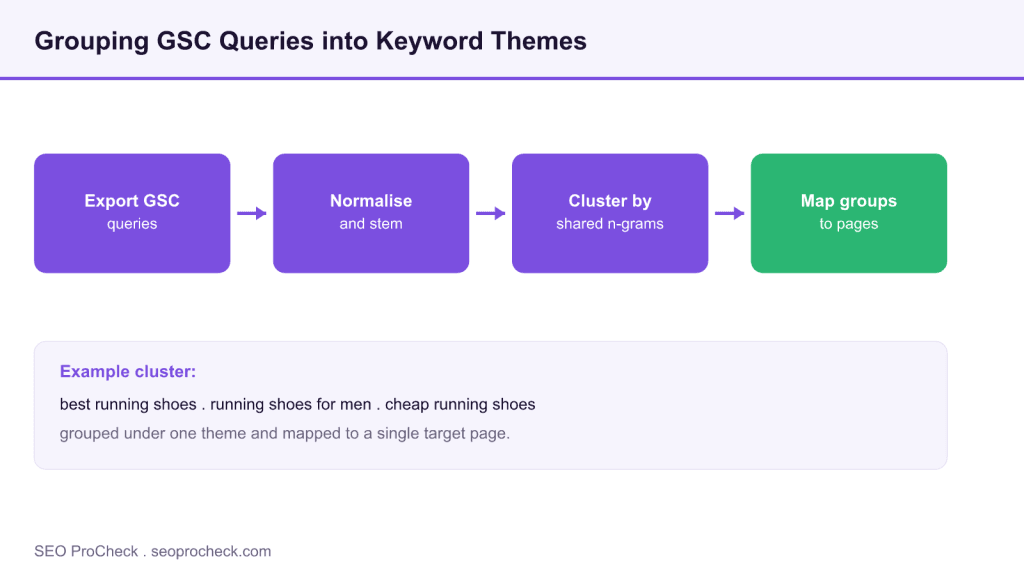
Keyword grouping with Search Console data means turning a raw query export into a handful of themes you can each map to one page. The workflow is export queries, normalise and stem them, cluster by shared words or embeddings, then assign each cluster to a target URL. Done well, it stops you spreading one topic thinly across many competing pages.
- Export the full query list from Search Console, not just the top rows.
- Normalise and stem so plural and singular variants collapse together.
- Cluster by shared n-grams for a quick pass or embeddings for a semantic pass.
- Map each finished cluster to a single target page to avoid cannibalisation.
Why group queries at all
The original resource shows a clever way to group queries straight from Search Console, so this section adds why the exercise matters and how we run it in practice. Search Console hands you thousands of individual queries, many of which are just phrasings of the same intent. If you treat each one as a separate target you end up with several thin pages competing for the same theme, which is classic keyword cannibalisation. Grouping collapses that noise into a short list of themes, and each theme becomes one strong page instead of five weak ones.
The workflow in the diagram is the reliable version. Export the whole query list, normalise the text by lowercasing, trimming, and stemming so that "running shoe" and "running shoes" land together, then cluster. A fast first pass groups by shared n-grams, the overlapping words between queries. This is close to the core idea in a solid keyword research guide, just run on your own performance data instead of a third party tool.
From word overlap to meaning
Shared word clustering is quick but literal: it misses that "cheap trainers" and "affordable running shoes" are the same intent with no words in common. That is where an embedding based pass earns its keep, because it groups by meaning rather than exact overlap. This is the practical difference between chasing keywords and organising by topic, which we unpack in keywords versus topics. Once your clusters are stable, they become the backbone of your site structure, which is how you build topic clusters that link a pillar page to its supporting articles.
What's changed since this resource was published
The mechanics got easier and better. When this method was written, grouping meant regex, n-grams, and manual review in a spreadsheet, and you can still do it all with Google Sheets formulas. Today an embedding model can cluster the same export by meaning in one pass, catching synonym groups that word overlap never would. The strategic reason to group also grew: AI answer engines reward pages that own a complete topic rather than a single phrase, so consolidating scattered queries into one authoritative page now helps both classic rankings and AI citations. The goal is unchanged: one theme, one page, no internal competition.
| Step | What you do | Tool or method |
|---|---|---|
| Export | Pull the full query list from Search Console | GSC performance export or API |
| Normalise | Lowercase, trim, and stem to merge variants | SUBSTITUTE, TRIM, or a script |
| Cluster (fast) | Group by shared words between queries | N-gram overlap in a sheet |
| Cluster (semantic) | Group by meaning, catching synonyms | Embedding model plus clustering |
| Map | Assign each cluster to one target page | Manual review against your URL list |
Keywords grouping using Google Search Console data provides valuable insights for SEO practitioners. This resource examines approaches and considerations that can improve organic search performance.
Key Concepts
Understanding the fundamental principles behind this topic helps inform strategic decisions. Whether optimizing for traditional search or emerging AI platforms, foundational concepts remain relevant. This resource covers the essential knowledge practitioners need.
Implementation Considerations
Moving from concept to execution requires understanding practical constraints and opportunities. Different situations call for different approaches. This resource provides guidance for applying concepts in real-world contexts.
Measuring Impact
SEO efforts require measurement to demonstrate value and guide optimization. Identifying appropriate metrics, establishing baselines, and tracking progress enables data-driven improvement. This resource addresses how to evaluate success.
This resource contributes to the knowledge base SEO practitioners need for effective optimization in an evolving search landscape.
Frequently asked questions
Why should I group Search Console queries?
Because Search Console lists thousands of queries that are often just phrasings of the same intent. Grouping them into themes lets you map each theme to one strong page instead of spreading a topic across several thin, competing pages.
What is the difference between n-gram and embedding clustering?
N-gram clustering groups queries that share words, which is fast but literal. Embedding clustering groups by meaning, so it catches synonyms like cheap trainers and affordable running shoes that share no words. Use n-grams for a quick pass and embeddings for accuracy.
How does keyword grouping prevent cannibalisation?
By collapsing many similar queries into a single theme mapped to one page, so you stop publishing multiple pages that target the same intent and compete with each other in the results.
Can I do this with just Google Sheets?
Yes. You can export the query list, normalise it with text formulas, and cluster by shared words using formulas and pivot tables. It is more manual than an embedding approach but works well for smaller sites.
How do groups relate to topic clusters?
Each stable query group becomes a topic, and topics form the backbone of a topic cluster: a pillar page for the theme supported by internal links from related articles. Grouping is the research step that defines those clusters.
Does query grouping help with AI search?
Yes. AI answer engines favour pages that fully own a topic over pages targeting a single phrase, so consolidating scattered queries into one authoritative page helps both traditional rankings and getting cited in AI answers.
Claude Vincent is a technical SEO consultant focused on crawlability, rendering, and AI-search visibility. He writes the field guides and case studies at SEO ProCheck, with a bias toward the durable, unglamorous work that decides whether search engines and AI answer engines can actually read and cite a site.
About SEO ProCheck
Technical SEO consulting and GEO strategy with 20 years of enterprise experience. Case studies, resources, and tools for search and AI visibility.
Work With Me
Technical SEO audits, GEO strategy, site migrations, and international SEO. Hourly consulting for teams who need hands-on support, not just reports.
Subscribe to our newsletter!






Recent Posts
- Can AI Crawlers Actually Read Your Site? I Measured 400 of the Biggest September 5, 2026
- The Pre-Publish Quality Gate for AI-Assisted Content August 6, 2026
- AGENTS.md vs llms.txt vs llms-full.txt: Which Agent File Does What July 18, 2026