

AI Summary
A topic cluster is one broad pillar page surrounded by focused cluster pages, all interlinked, so a site demonstrates real depth on a subject instead of scattering unconnected posts. The structure captures long tail queries, spreads internal link signals, and gives both search engines and AI systems clear context on what you are authoritative about.
- A pillar page covers the topic broadly; cluster pages each answer one specific question.
- Every cluster links up to the pillar with a descriptive anchor, and the pillar links back down.
- Clusters capture long tail queries a single page could never rank for.
- Comprehensive interlinked coverage also helps you get cited in AI overviews and assistants.

Why (& How) Topic Clusters Are Your Most Powerful SEO Weapon provides valuable insights for SEO practitioners. This resource examines approaches and considerations that can improve organic search performance.
Key Concepts
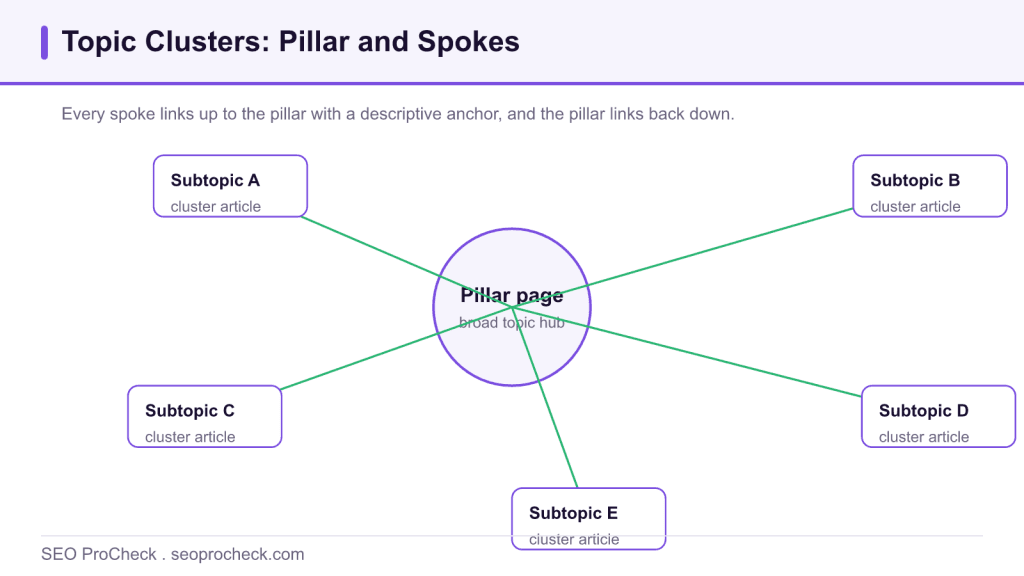
A topic cluster replaces the old habit of writing one disconnected blog post per keyword with a deliberate structure. At the center sits a pillar page that covers a broad subject at a high level and targets the head term. Around it sit cluster pages, each taking one narrow subtopic and answering it thoroughly. The hub and spoke shape in the diagram above is the mental model: the pillar is the hub, the cluster pages are spokes, and internal links tie them together. The value is not any single page but the way the set signals to a search engine that the site covers the whole subject, not just one slice of it.
This maps onto how people actually search. A broad query like the topic name is served by the pillar, while the hundreds of specific, long tail questions around it are served by the cluster pages. A single page cannot rank well for all of those at once, but a cluster can, because each spoke is free to go deep on its own question.
Implementation Considerations
Start from research, not from a page count. Group your keywords and the real questions people ask into subtopics, and let those subtopics define the cluster pages. Most clusters begin with somewhere between five and fifteen spokes and grow as you find gaps. Give each cluster page a clear, single focus so two pages never compete for the same query, which is how keyword cannibalization creeps in.
The internal linking is what makes it a cluster rather than a folder of posts. Every cluster page links up to the pillar using a descriptive anchor that names the topic, and the pillar links down to each cluster page. Where two subtopics genuinely relate, let their pages link to each other as well. If you are organizing this at scale, the data handling in our Python for SEO guide helps you cluster keywords and audit the link graph.
Measuring Impact
Judge a cluster at the topic level, not page by page. Track the combined organic traffic and the number of ranking queries across the whole pillar and its spokes, since a new cluster page can lift the pillar and its siblings as internal links flow. Watch how many long tail queries the cluster ranks for over time, because breadth of coverage is the point. Keep an eye on internal link health too, so no cluster page ends up orphaned from the pillar. When you report these gains upward, our notes on enterprise SEO reporting help you frame them as outcomes.
| Element | Role | Targets | Links |
|---|---|---|---|
| Pillar page | Broad overview of the whole topic | Head term, high volume | Links down to every cluster page |
| Cluster page | Deep answer to one subtopic | Long tail, specific query | Links up to the pillar, sideways to related clusters |
| Internal links | Tie the set together | Spread ranking signals | Descriptive anchors both directions |
What Has Changed Since This Article
Topic clusters have aged well and matter more in the AI search era. Answer engines and AI overviews reward sources that cover a subject comprehensively and connect their pages clearly, because that structure is easy to parse and cite. The advice to build depth and interlink it has shifted from a ranking tactic to a requirement for being quoted by assistants. The one caution is quality: a cluster only helps if each spoke genuinely answers its question, so depth, not a page count, is still the goal.
Frequently Asked Questions
What is a topic cluster in SEO?
It is a content structure with one broad pillar page and several focused cluster pages around a single subject, all interlinked. The pillar covers the topic widely while each cluster page answers one specific question in depth.
How is a pillar page different from a cluster page?
The pillar page targets the broad head term and links out to every cluster page, while each cluster page targets a narrower long tail query and links back up to the pillar. Together they signal topical depth on the subject.
Why do topic clusters help rankings?
Interlinked, comprehensive coverage helps search engines understand that a site is authoritative on a topic, and the internal links spread ranking signals across related pages. It also captures many long tail queries that a single page could not.
How many cluster pages do I need?
There is no fixed number; you need enough to cover the real subtopics people search for, often between five and fifteen to start. Let keyword research and actual questions define the count rather than a target.
How do I build internal links in a cluster?
Every cluster page links up to the pillar with a descriptive anchor, and the pillar links down to each cluster page. Cluster pages can also link to each other where the subtopics genuinely relate.
Do topic clusters help with AI search?
Yes. Comprehensive, well structured and interlinked coverage gives AI systems clear, extractable answers and strong context, which makes a cluster more likely to be cited in AI overviews and assistants.
Source: https://www.searchenginejournal.com/topic-clusters-seo/420172/
Take this with you
The assistant links open with a question about this page already written. Nothing is sent until you press enter.
Claude Vincent is a technical SEO consultant focused on crawlability, rendering, and AI-search visibility. He writes the field guides and case studies at SEO ProCheck, with a bias toward the durable, unglamorous work that decides whether search engines and AI answer engines can actually read and cite a site.
About SEO ProCheck
Technical SEO consulting and GEO strategy with 20 years of enterprise experience. Case studies, resources, and tools for search and AI visibility.
Work With Me
Technical SEO audits, GEO strategy, site migrations, and international SEO. Hourly consulting for teams who need hands-on support, not just reports.
Subscribe to our newsletter!








Recent Posts
- Most Top Sites Never Say Who They Are in Structured Data October 14, 2026
- Homepage Titles Are Mostly Too Short, Not Too Long October 8, 2026
- Who Actually Serves an llms.txt? 184 Top Sites Measured September 29, 2026