

Secrets from the Algorithm: Google Search’s Internal Engineering Documentation Has Leaked
- June 12, 2024
- General

AI Summary
In May 2024 a large set of internal Google Search API documentation surfaced publicly, and Google confirmed the files were genuine while cautioning they lack context on how any feature is used. The documents named thousands of attributes, which sharpened long running SEO debates about clicks, site level authority, and re-ranking, without disclosing any actual ranking weights.
- The leak came from Google Content Warehouse API documentation, not from ranking source code.
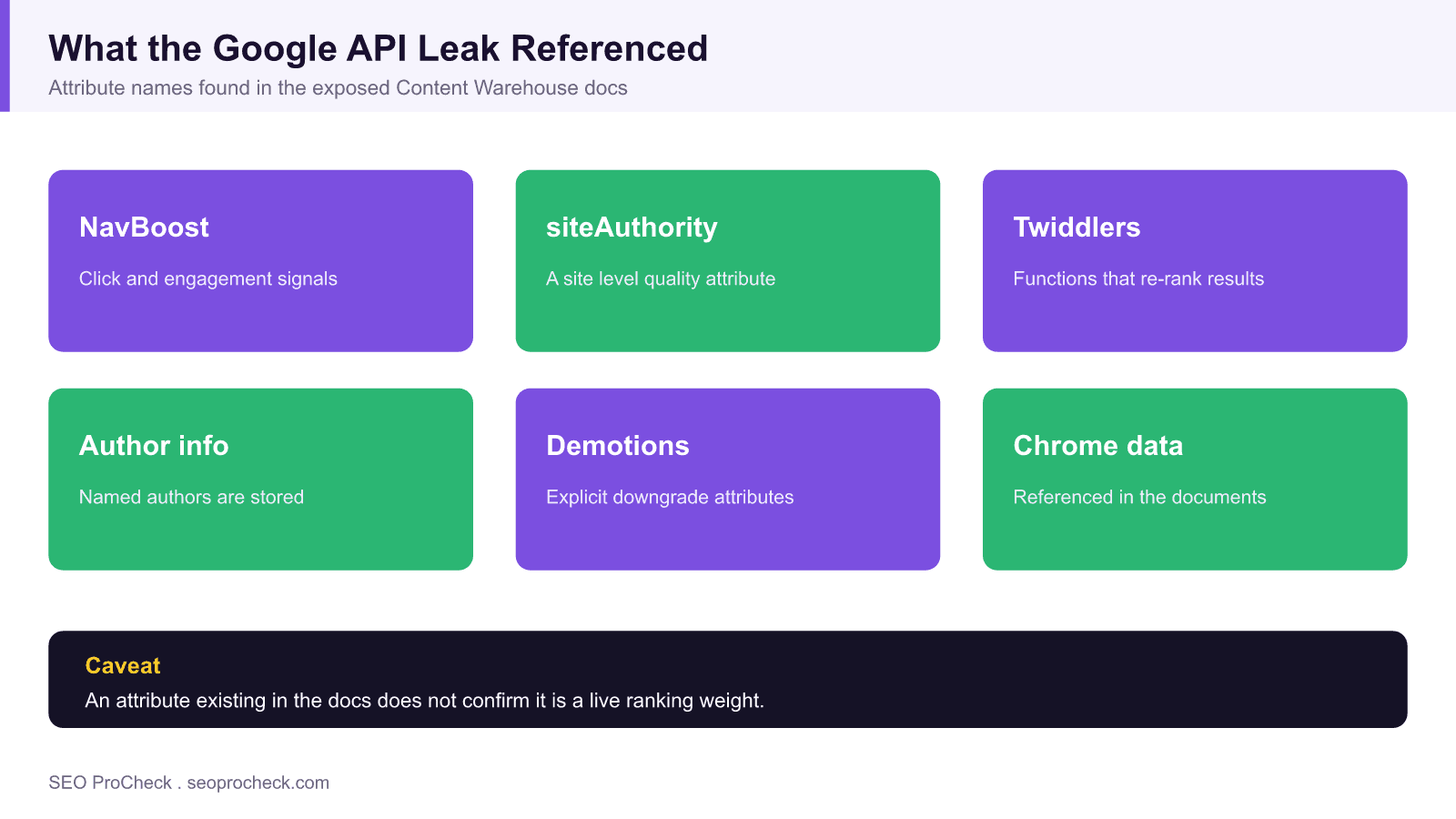
- Named attributes included click based signals, a site authority field, author storage, demotions, and re-ranking functions.
- An attribute existing in the docs does not confirm it is live, weighted, or used the way its name suggests.
- The practical takeaways reinforce fundamentals rather than reveal a shortcut.
What actually leaked
The material that circulated was documentation for a Google Content Warehouse API: reference pages describing data structures and attributes, the kind of internal docs engineers use to understand what fields exist. It was surfaced publicly and analyzed widely, and Google later confirmed the documents were authentic. Two things are worth holding in mind from the outset. First, this was documentation of fields and modules, not the ranking algorithm itself, so it shows what Google can store, not the formula that combines it. Second, Google explicitly warned that the files lack the context needed to draw conclusions about how anything is used in live ranking.
That distinction is the whole game. The leak is genuinely useful as a map of what Google models about pages, sites, and users. It is not a leaderboard of ranking factors, and treating it as one is how practitioners get burned.
The attributes that drew the most attention
- Click based signals: attributes associated with a system often referred to as NavBoost suggest user interaction data is stored and can influence results. This reopened the long standing argument about whether clicks affect ranking.
- Site level authority: a field named in a way that implies a site wide quality or authority measure. Its existence does not tell you how it is calculated or weighted, only that a site level concept is represented.
- Author information: attributes for storing author identity, consistent with Google modeling who wrote something as part of understanding trust.
- Twiddlers: re-ranking functions that adjust an initial result set, which matches the layered pipeline model of core ranking followed by refinements.
- Demotions: explicit downgrade attributes for things like poor experiences or mismatched content, a reminder that not ranking is sometimes an active push down rather than simply losing on relevance.
Reading the leak responsibly
Several traps catch people who read too much into attribute names. A field can be deprecated and still appear in documentation. A field can be logged for experimentation without feeding live ranking. A name can imply more than the field does, since internal naming is not written for outside interpretation. And crucially, none of the documentation exposes weights, so even confirmed live signals could be minor. The honest reading is that the leak validates that Google models clicks, site level quality, authorship, and re-ranking in some form, while leaving the magnitude of each an open question.
Signal, leak evidence, and practical action
| Topic | What the docs suggest | What to actually do |
|---|---|---|
| User clicks | Interaction data is stored and named | Earn satisfying clicks with strong titles and pages that deliver, not fake engagement |
| Site authority | A site level quality field exists | Build a coherent, trustworthy site rather than isolated strong pages |
| Authorship | Author identity can be stored | Use real, credentialed authors with consistent profiles |
| Re-ranking | Twiddlers adjust initial results | Expect layered scoring, do not optimize for one signal in isolation |
| Demotions | Explicit downgrades are modeled | Fix poor experiences, intrusive ads, and intent mismatches |
What has changed since
This topic is dated to May 2024, so context matters when you read it now. Google did not overhaul its public guidance in response to the leak, and its stated position stayed consistent: create helpful, reliable, people first content. The leak did shift the SEO conversation, giving weight to practitioners who had long argued that user engagement and site level trust matter, and cooling some of the insistence that clicks play no role. Since then, several broad core updates and the continued expansion of AI overviews have kept the practical priorities where they were: genuine helpfulness, demonstrated experience, and a technically sound, trustworthy site. Nothing in the leak has produced a durable shortcut, and the fields it named are best treated as confirmation of direction, not as a new set of levers to game.
The original resource
Google algorithm updates regularly reshape the SEO landscape. Understanding update patterns, impacts, and appropriate responses helps maintain visibility through algorithmic changes. This resource examines update dynamics and strategic responses.
Update Types and Impacts
Google releases different update types: core updates affecting overall ranking systems, specific updates targeting issues like spam or helpful content, and incremental improvements happening continuously. Understanding which type affects your site informs response strategy.
Analyzing Update Impact
When traffic changes coincide with updates, analysis should identify what changed: which pages, which queries, which competitors gained. Correlation with update timing suggests algorithmic cause, but confirmation requires examining what changed in the ranking landscape.
Strategic Response
Response depends on update type and impact diagnosis. Core updates often reward sustained quality improvements over quick fixes. Specific updates may require addressing identified issues. In all cases, focusing on user value and content quality remains the sustainable approach.
This resource provides guidance for understanding and responding to Google's evolving algorithm landscape.
Source: https://ipullrank.com/google-algo-leak?utm_source=substack&utm_medium=email
Frequently asked questions
Is the Google API leak real and confirmed?
Yes. A large set of Google Content Warehouse API documentation surfaced publicly in May 2024, and Google confirmed the files were authentic. Google also cautioned that the documents lack the context needed to conclude how any field is used in live ranking.
Does the leak prove that clicks are a ranking factor?
It shows that click and interaction data is stored and named in the documentation, which strongly supports the view that engagement can influence results. It does not disclose weights, so it stops short of proving how much clicks matter.
Should I change my SEO strategy because of the leak?
Not fundamentally. The takeaways reinforce established priorities: earn satisfying clicks, build site wide trust, use real authors, and avoid experiences that trigger demotions. There is no shortcut hidden in the attribute names.
What is a twiddler in the context of the leak?
Twiddlers are re-ranking functions that adjust an initial set of results, consistent with a pipeline where core ranking produces a first order and other systems refine it. They illustrate that ranking is layered rather than a single score.
Can I trust attribute names to reveal ranking factors?
Cautiously at best. An attribute can be deprecated, logged only for experiments, or named in a misleading way, and none carry disclosed weights. Treat the docs as a map of what Google can model, not a ranked list of factors.
What is siteAuthority in the leaked documents?
It is a field whose name implies a site level quality or authority measure. Its presence suggests Google represents a site wide quality concept, but the documentation does not explain how it is computed or how heavily it is used.
Related reading on seoprocheck.com
- Google algorithm: the concept explained
- E-E-A-T: what it is and how to demonstrate it
- Google's helpful content system explained
- Building algorithm resistant content
Take this with you
The assistant links open with a question about this page already written. Nothing is sent until you press enter.
Claude Vincent is a technical SEO consultant focused on crawlability, rendering, and AI-search visibility. He writes the field guides and case studies at SEO ProCheck, with a bias toward the durable, unglamorous work that decides whether search engines and AI answer engines can actually read and cite a site.
About SEO ProCheck
Technical SEO consulting and GEO strategy with 20 years of enterprise experience. Case studies, resources, and tools for search and AI visibility.
Work With Me
Technical SEO audits, GEO strategy, site migrations, and international SEO. Hourly consulting for teams who need hands-on support, not just reports.
Subscribe to our newsletter!








Recent Posts
- Most Top Sites Never Say Who They Are in Structured Data October 14, 2026
- Homepage Titles Are Mostly Too Short, Not Too Long October 8, 2026
- Who Actually Serves an llms.txt? 184 Top Sites Measured September 29, 2026