

AI Summary
A skills maturity matrix grades the core SEO disciplines against defined capability levels, so that senior stops meaning has been around a while and starts meaning something you can verify with work artifacts. This version uses six skill areas and four levels, scored honestly with evidence and a peer calibration, for self assessment, team development, and hiring.
- Six areas: technical, content, authority and PR, data, strategy, and AI search plus automation.
- Four levels: aware, practicing, proficient, and leading, each defined by what you can be left alone with.
- Score with artifacts, not vibes, and calibrate every cell against a peer or manager.
- Aim for T shaped profiles, deep in one or two areas and competent across the rest, not all L4 unicorns.
Why a matrix beats a checklist
Skill checklists ("knows canonical tags, knows GA4") tell you what someone has touched, not what they can carry. I have interviewed people who could define every directive in a robots.txt file and still could not plan a site migration without supervision. A maturity matrix fixes that by asking a different question for each discipline: not "do you know this" but "what happens when you own this." That distinction is what separates a hire who executes tickets from one who writes them.
It also removes the seniority-by-tenure problem. Twenty years in, I still meet "heads of SEO" who are Level 4 at stakeholder decks and Level 1 at log file analysis. That is fine, honestly, as long as everyone can see it on the grid and staff around it. The damage happens when the gap is invisible.
The six skill areas
1. Technical SEO. Crawling, indexing, rendering, redirects, structured data, site architecture, migrations. The plumbing.
2. Content and on-page. Intent mapping, information architecture, briefs, on-page optimization, content pruning and consolidation.
3. Authority and digital PR. Link earning, digital PR campaigns, brand mentions, and knowing which links are worth chasing versus which are noise.
4. Data and measurement. Search Console at depth, analytics, log files, dashboarding, forecasting, and designing tests that actually isolate a variable.
5. Strategy and stakeholders. Roadmapping, prioritization, business cases, getting dev tickets shipped, and translating SEO into revenue language executives act on.
6. AI search and automation. The newest column: AI answer visibility, entity optimization, scripting repetitive work, and using LLMs without publishing slop that gets the domain suppressed.
The four levels
Levels are behavioral, not academic. The test for each is what you can be left alone with.
L1 Aware: can explain the concepts and spot obvious issues, but needs direction to act. L2 Practicing: executes defined work competently with review; follows playbooks. L3 Proficient: owns the discipline end to end, handles ambiguity, and is accountable for the outcome, not the task list. L4 Leading: sets the approach others follow, teaches it, and solves problems no playbook covers.
The matrix
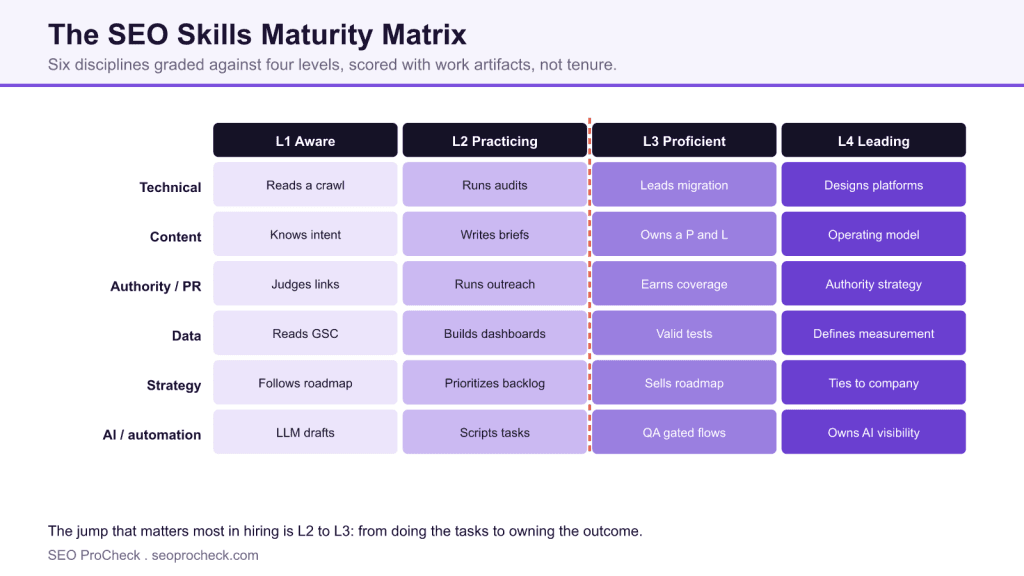
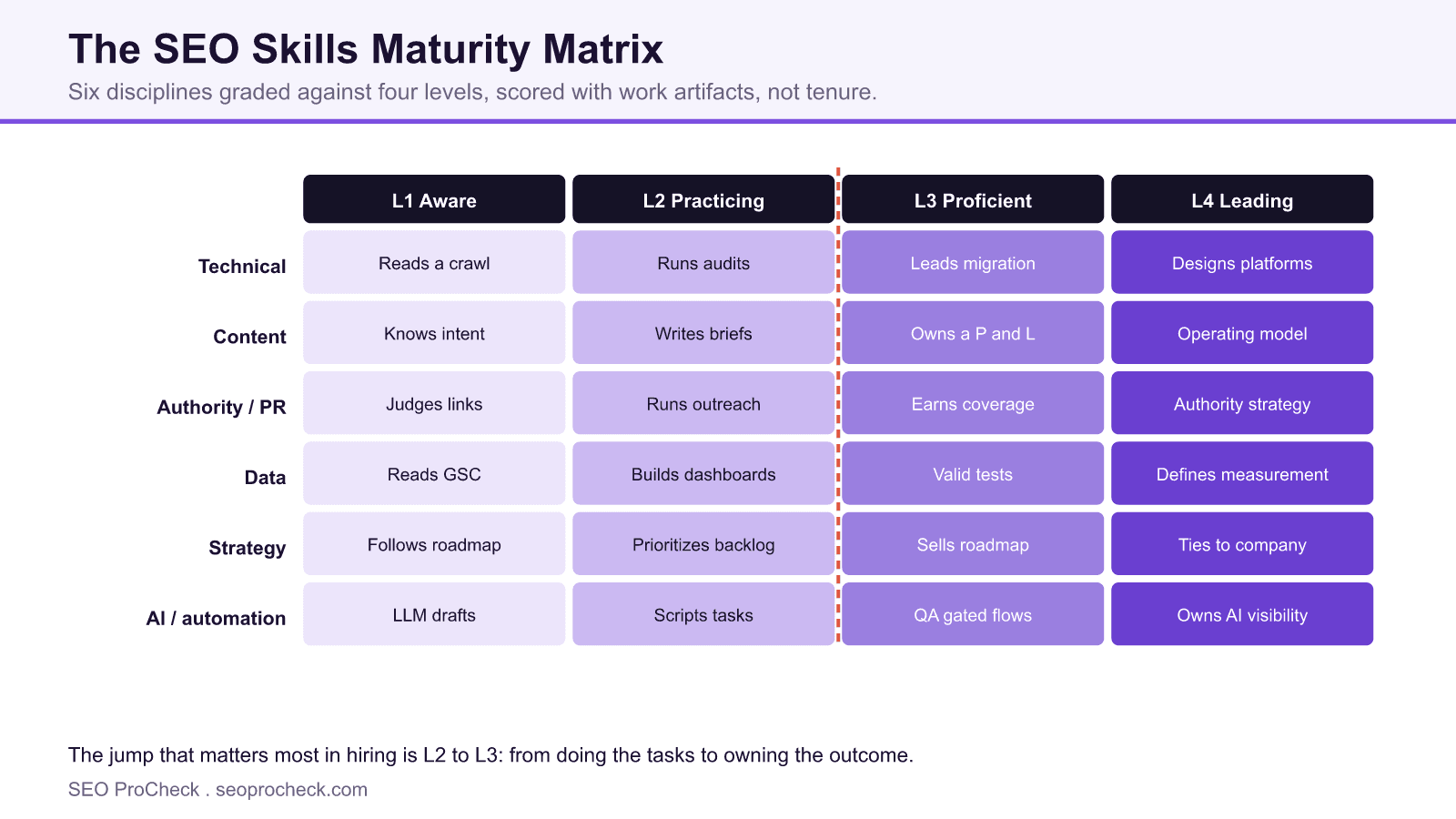
| Skill area | L1 Aware | L2 Practicing | L3 Proficient | L4 Leading |
|---|---|---|---|---|
| Technical | Reads a crawl report | Runs audits from a playbook | Leads a migration solo | Designs architecture for platforms |
| Content | Knows intent types | Writes solid briefs | Owns a content P&L area | Builds the content operating model |
| Authority / PR | Judges link quality | Executes outreach campaigns | Designs campaigns that earn coverage | Builds brand-level authority strategy |
| Data | Reads GSC reports | Builds dashboards | Runs valid tests, forecasts | Defines measurement for the org |
| Strategy | Follows the roadmap | Prioritizes a backlog | Sells the roadmap upward | Ties SEO to company strategy |
| AI / automation | Uses LLMs for drafts | Scripts repetitive tasks | Ships QA-gated AI workflows | Owns AI search visibility strategy |
How to score it honestly
Self-ratings drift toward flattery. Everyone marks themselves L3 everywhere, and the matrix turns into wallpaper. Two rules keep it honest.
Rule one: artifacts, not vibes. Every claimed level needs a piece of work behind it. Claiming L3 technical? Show the migration plan you wrote and what happened to traffic afterward. L3 data? Show the test design and the readout. If the artifact does not exist, the level does not either.
Rule two: calibrate in pairs. Score yourself, have a peer or manager score you independently, then discuss only the cells where you disagree. Those conversations are uncomfortable for about ten minutes and useful for about six months.
Using it for development and hiring
For development: pick two cells per half-year, no more. Moving one discipline one level is a real project; spreading effort across the grid moves nothing. Reassess every six months and keep the old scores, because the trendline motivates more than the snapshot.
For hiring: write the job ad from the grid. Decide which cells must be L3 on day one, which can be L2 with growth, and interview against artifacts for exactly those cells. It kills both the keyword-bingo resume screen and the charming-generalist trap.
And aim for T-shaped profiles rather than mythical all-L4 unicorns: deep (L3+) in one or two areas, competent (L2) across the rest. A team of complementary T-shapes beats a team of identical generalists every time.
- Demand a work artifact as evidence for every claimed level
- Calibrate scores with a peer and discuss only the disagreements
- Target two cells per half-year in a development plan
- Build hiring rubrics directly from the matrix cells
- Keep historical scores so the trendline stays visible
- Let tenure stand in for level; years worked is not evidence
- Accept self-ratings of L3 across the board without artifacts
- Expect L4 in every area; T-shaped profiles are the goal
- Use the matrix punitively; it is a map, not a performance weapon
- Freeze the areas; AI search did not exist as a column five years ago
FAQ
Every six months. Quarterly is too noisy to show movement; yearly lets a stalled cell hide for too long. Book the calibration session in advance or it will not happen.
Not at all. A technical specialist who is L1 at digital PR is normal and fine. The problem is not the L1; it is an L1 nobody knows about sitting under a responsibility that assumes L3.
On a team, you want L4 coverage somewhere in each area that matters to the business, but it can be spread across people, agencies, or consultants. A solo in-house SEO should aim for L3 in the one or two areas the business actually depends on.
Yes, and you should. Ask a prospective agency which cells they claim at L4 and request the artifacts, such as a migration case with numbers. The ones worth hiring answer fast; the ones who send you a logo wall just told you their level.
Our advanced SEO audit does for your site what the matrix does for your team: an evidence-based assessment of where you are strong, where you are exposed, and which gaps to close first.
Claude Vincent is a technical SEO consultant focused on crawlability, rendering, and AI-search visibility. He writes the field guides and case studies at SEO ProCheck, with a bias toward the durable, unglamorous work that decides whether search engines and AI answer engines can actually read and cite a site.
About SEO ProCheck
Technical SEO consulting and GEO strategy with 20 years of enterprise experience. Case studies, resources, and tools for search and AI visibility.
Work With Me
Technical SEO audits, GEO strategy, site migrations, and international SEO. Hourly consulting for teams who need hands-on support, not just reports.
Subscribe to our newsletter!







Recent Posts
- Can AI Crawlers Actually Read Your Site? I Measured 400 of the Biggest September 5, 2026
- The Pre-Publish Quality Gate for AI-Assisted Content August 6, 2026
- AGENTS.md vs llms.txt vs llms-full.txt: Which Agent File Does What July 18, 2026