

AI Summary
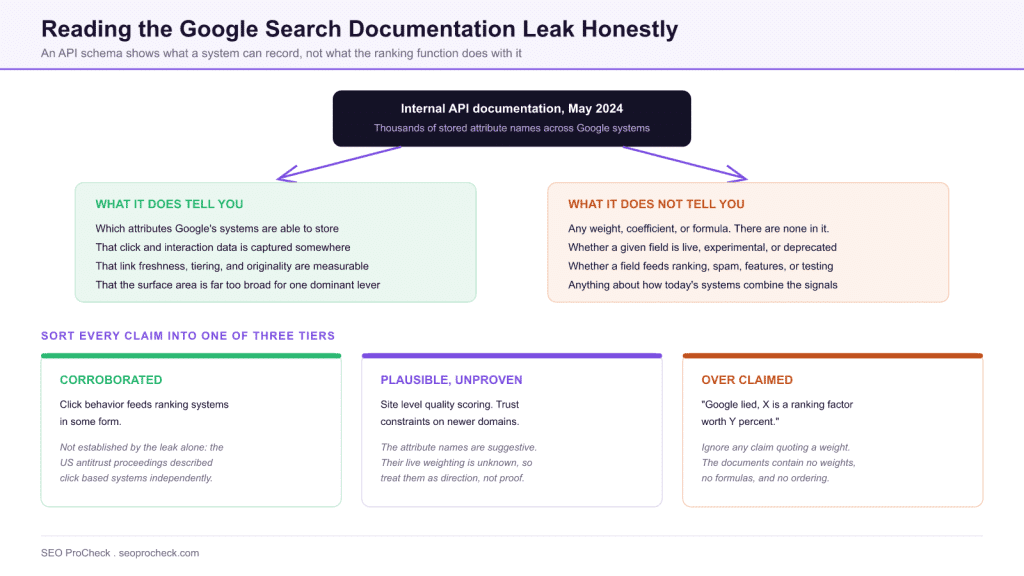
In May 2024, internal Google API documentation describing thousands of data attributes became publicly accessible and was analysed by prominent SEOs. It showed what Google's systems are able to store, including click behaviour, site-level quality measures, and link freshness. It did not show how, or whether, any of those attributes are weighted in live rankings.
- The core misread is treating "an attribute exists in storage" as "this is a ranking factor with meaningful weight." A schema describes capability, not behaviour.
- Sort every claim into three tiers: corroborated, plausible but unproven, and over-claimed. Only the first survives contact with outside evidence.
- Click-based systems are the one well-corroborated item, and the corroboration came largely from antitrust proceedings rather than from the leak itself.
- The documents contain no weights and no formulas, so any headline quoting a percentage is inventing it.
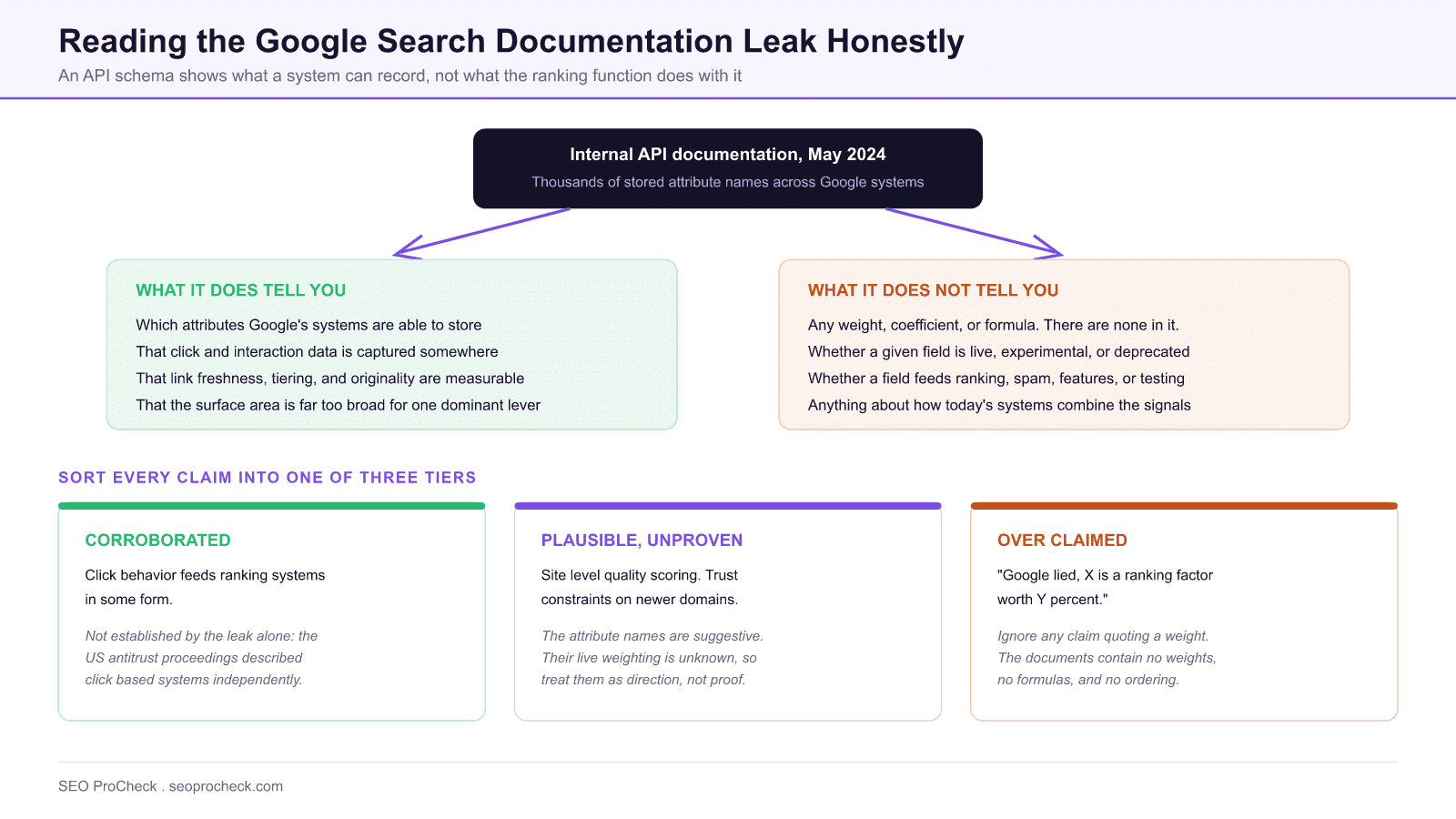
What was the Google search documentation leak? In May 2024, internal Google API documentation describing thousands of data attributes used across Google's search systems became publicly accessible and was analyzed by prominent SEOs. It revealed what Google's systems store and can measure, including click behavior, site-level quality scores, and link freshness, but not how, or whether, each attribute is weighted in live rankings.
Unpacking Google's massive search documentation leak provides valuable insights for SEO practitioners. This resource examines approaches and considerations that can improve organic search performance.
What the leaked documentation contained
The Search Engine Land piece linked below unpacks the initial analyses of the leak, which was first surfaced publicly through work by Rand Fishkin and Mike King. Categorically, the documentation described:
- Click and interaction signals. Modules referencing user click behavior, including systems associated with the name NavBoost, suggesting Google stores and segments click data around results.
- Site-level quality measures. Attributes with names suggesting site-wide authority scoring, despite Google's long-standing public position of not using a single "domain authority" metric.
- Content and link metadata. Attributes for link freshness, link indexing tiers, anchor context, content originality, and page update history.
- Classification flags. Fields suggesting special handling for certain site types and topics, including flags analysts read as demotions and as treatment lists for sensitive verticals.
- Chrome-related references. Attribute names that analysts interpreted as browser-derived data feeding search features.
Google acknowledged the documents' authenticity while cautioning against assuming completeness or current relevance. That caution matters and is the correct starting point for interpreting everything above.
Verified, plausible, and over-claimed: how to read the leak honestly
The single most common misread of the leak is treating "an attribute exists in storage" as "this is a ranking factor with meaningful weight." An API schema tells you what a system can record, not what the ranking function does with it. A disciplined reading separates three tiers:
- Corroborated: that Google's systems use click-behavior data in some form. This did not rest on the leak alone: testimony and exhibits from the US Department of Justice antitrust trial independently described click-based systems. The leak aligned with, rather than established, this picture.
- Plausible but unproven: site-level quality scoring influencing page-level performance, and stricter treatment of newer or low-trust sites. The attribute names are suggestive; their live weighting is unknown.
- Over-claimed: any specific "Google lied, X is a ranking factor with Y weight" headline. The docs contain no weights, no formulas, and no indication of which attributes are experimental, deprecated, or used only in non-ranking systems (spam, features, testing).
What each kind of evidence can actually prove
The leak was not the first piece of evidence about how Google works, and it will not be the last. The durable skill is knowing what weight to give each type of source, because they are not interchangeable and the loudest claims usually rest on the weakest type. Keep this hierarchy handy the next time a document or a study circulates.
| Evidence type | What it can establish | What it cannot establish | How much weight to give it |
|---|---|---|---|
| Internal API schema (this leak) | Which attributes a system is capable of storing, and the vocabulary engineers use | Weighting, whether a field is live, or which subsystem consumes it | Moderate, as vocabulary and direction only |
| Sworn testimony and court exhibits | That a described system exists and was used, on the record and under penalty | Current implementation details, since testimony describes a past state | High, the strongest public source |
| Google's own documentation and statements | What Google will publicly commit to and support | Anything deliberately unsaid, and the nuance behind a simplified answer | High for what is said, low for inferring what is not said |
| Granted patents | That an approach was invented and thought worth protecting | Whether it was ever shipped, and in what form | Low on its own, useful as corroboration |
| Controlled tests on live sites | Observed cause and effect for the specific pages tested | Generalisation to other sites, verticals, or query classes | Moderate, and only with a clean control |
| Large-scale correlation studies | That two variables move together across a sample | Causation, in any direction | Low, and routinely over-read |
Notice that the leak sits in the middle of that table, not at the top. Our lexicon entry on ranking factors covers why the phrase itself invites over-reading.
What practitioners should actually do with it
Almost nothing in the leak justifies changing tactics that were not already best practice, which is itself the useful conclusion. The leak strengthens the case for things good SEOs already did:
- Optimize for the click and the post-click experience. If interaction data feeds rankings in any form, titles that earn clicks and pages that satisfy them are the durable play. Manipulating clicks is neither durable nor safe.
- Build site-level trust, not just page-level optimization. Signals suggesting site-wide scoring reinforce investing in overall content quality and pruning nothing while enriching weak sections. Our briefing on people-first content and E-E-A-T covers the content side of that stack, and the complete E-E-A-T guide covers the implementation detail.
- Treat authorship and originality as measurable. Attributes around content originality and entities suggest Google can distinguish original reporting and expertise from paraphrase at scale.
- Keep links, but weight quality and freshness. The link-related attributes describe tiering and freshness, consistent with fewer, better, recently-relevant links beating volume.
- Stop chasing single-factor hacks. The sheer breadth of stored attributes is the strongest argument that no one lever dominates.
Leak claims vs. sensible practitioner responses
| What the leak suggested | Confidence level | What to do about it |
|---|---|---|
| Click behavior informs rankings (NavBoost-type systems) | High (corroborated by DOJ trial materials) | Earn and satisfy clicks; improve titles, snippets, and page experience |
| Site-level authority/quality scores exist | Medium | Raise the floor of your worst content; avoid publishing thin sections at scale |
| Newer sites face trust constraints ("sandbox"-type flags) | Medium | Set realistic timelines for new domains; front-load genuine expertise signals |
| Chrome-derived data feeds search systems | Medium-low (interpretation of attribute names) | Nothing tactical; another reason real user experience matters |
| Specific attribute weights or "proven ranking factors" | None, they are not in the documents | Ignore any claim quoting weights; the docs contain none |
A reading protocol for the next leak
There will be another one. Documents leak, discovery produces exhibits, and former employees write memoirs. The protocol below is what separates a useful forty-eight hours from a wasted quarter, and it costs nothing to apply.
- Read the primary material, or at least one analyst who quotes it directly. Second-hand summaries compound each other's inferences until an attribute name has become a confirmed ranking factor with a percentage attached to it.
- Separate the noun from the verb. A field named for a quality score is a noun. Whether anything reads it, and what it does when it does, is the verb, and leaks almost never contain verbs.
- Ask what would have to be true. If a claim were correct, what else would you expect to observe in your own Search Console data? If the claim predicts nothing observable, it is not actionable regardless of whether it is true.
- Check it against the other evidence types. Use the table above. A claim supported by both a schema field and sworn testimony is in a different class from one supported by a suggestive field name alone.
- Ask whether it changes your next sprint. If the honest answer is that you would have done the same work anyway, you have learned something about the industry rather than about your site, and that is fine. Just do not reprioritise the roadmap for it.
- Wait out the first week. The strongest claims are made earliest, before anyone has finished reading. Corrections arrive quietly and much later, and they rarely travel as far as the original headline.
What's changed since the leak
Two years on, the leak's practical legacy is smaller than the initial coverage implied, but real. The DOJ antitrust proceedings continued to surface documents describing Google's use of interaction data, keeping that thread corroborated independently of the leak. Google's public guidance did not change: helpful, reliable, people-first content remains the stated bar, and no leak-derived "new ranking factor" has been confirmed. Meanwhile the attention of the industry has partly moved to a different visibility problem, namely AI search surfaces and answer engines, where citation behavior follows its own patterns; our case study on what gets you cited by AI search covers that evidence. The leak is best used today as a corrective against dogma in both directions: skepticism toward Google's public minimalism about clicks, and equal skepticism toward anyone selling leak-based tactics. For a framework on judging whether any of this is moving your numbers, see how to tell if your SEO is actually working.
Frequently asked questions
Yes. Google acknowledged the documents were authentic internal material, while cautioning that they lacked context and might not reflect current, live ranking systems.
It strongly supported it, and DOJ trial testimony described click-based systems independently. What remains unknown is the weighting and the exact mechanisms in today's systems.
It showed attributes whose names suggest site-level quality scoring. That is not the same as validating any third-party "DA" metric, which remains vendor math.
Mostly no. Its practical takeaways, meaning earn clicks, satisfy intent, build site-wide quality, and value original content, were already best practice. Its real value is helping you deprioritize single-factor hacks.
The name analysts associate with systems that use aggregated click and interaction data around search results. Its existence is corroborated; its precise current role is not public.
Unknown, and this is the key caveat: API documentation does not distinguish live, experimental, and deprecated fields, so any specific attribute may or may not influence rankings now.
This resource contributes to the knowledge base SEO practitioners need for effective optimization in an evolving search landscape.
Source: https://searchengineland.com/unpacking-googles-massive-search-documentation-leak-442716
Take this with you
The assistant links open with a question about this page already written. Nothing is sent until you press enter.
Claude Vincent is a technical SEO consultant focused on crawlability, rendering, and AI-search visibility. He writes the field guides and case studies at SEO ProCheck, with a bias toward the durable, unglamorous work that decides whether search engines and AI answer engines can actually read and cite a site.
About SEO ProCheck
Technical SEO consulting and GEO strategy with 20 years of enterprise experience. Case studies, resources, and tools for search and AI visibility.
Work With Me
Technical SEO audits, GEO strategy, site migrations, and international SEO. Hourly consulting for teams who need hands-on support, not just reports.
Subscribe to our newsletter!








Recent Posts
- Most Top Sites Never Say Who They Are in Structured Data October 14, 2026
- Homepage Titles Are Mostly Too Short, Not Too Long October 8, 2026
- Who Actually Serves an llms.txt? 184 Top Sites Measured September 29, 2026