

AI Summary
Ranking factors are the inputs Google uses to order search results, but Google has confirmed only a handful and stayed quiet about the rest. Most 200 factors lists blend confirmed inputs with guesses and debunked myths, so the practical skill is sorting confirmed from speculated and weighting your effort toward the big, documented levers.
- Confirmed levers include relevance, content quality, links, HTTPS and Core Web Vitals.
- Debunked or speculative items include LSI keywords, keyword density and word count.
- A confirmed factor is not always a big factor: HTTPS is real but a light tiebreaker.
- Optimize the underlying goal, not a proxy metric like dwell time.
Ranking factors are the inputs Google uses to decide the order of search results. Google has confirmed a handful directly and stayed quiet about the rest, which is why almost every "200 ranking factors" list you'll find online is mostly educated guessing dressed up as fact.
The stakes here are about where you spend your effort. Chase a "confirmed" factor and you're building on solid ground. Chase a speculated one and you might be optimizing for something that either doesn't exist or barely moves the needle. Knowing which is which keeps you from wasting months on SEO folklore.
A real example: confirmed vs. folklore
Google has openly confirmed that HTTPS is a ranking factor, a small one, but real and on the record. Compare that to "LSI keywords," a term SEO blogs repeat constantly as a ranking factor. Google's own reps have flatly said they don't use "LSI keywords" at all. Same confident tone in the blog posts, opposite reality. One is documented; the other is a myth that refuses to die. That gap, documented versus repeated-until-it-sounds-true, is the whole game with ranking factors.
Here's the trap that catches even experienced SEOs. When Google confirms HTTPS, it also tells you it's a lightweight tiebreaker, not a heavy lever. Yet plenty of teams pour weeks into a security migration expecting a ranking jump and get a flat line, because the factor was real but tiny. Meanwhile the same teams under-invest in content relevance, which Google weights heavily. Knowing a factor exists isn't enough, you have to know roughly how much it counts, and Google is honest about that when it bothers to comment at all.
Confirmed factors vs. speculated factors
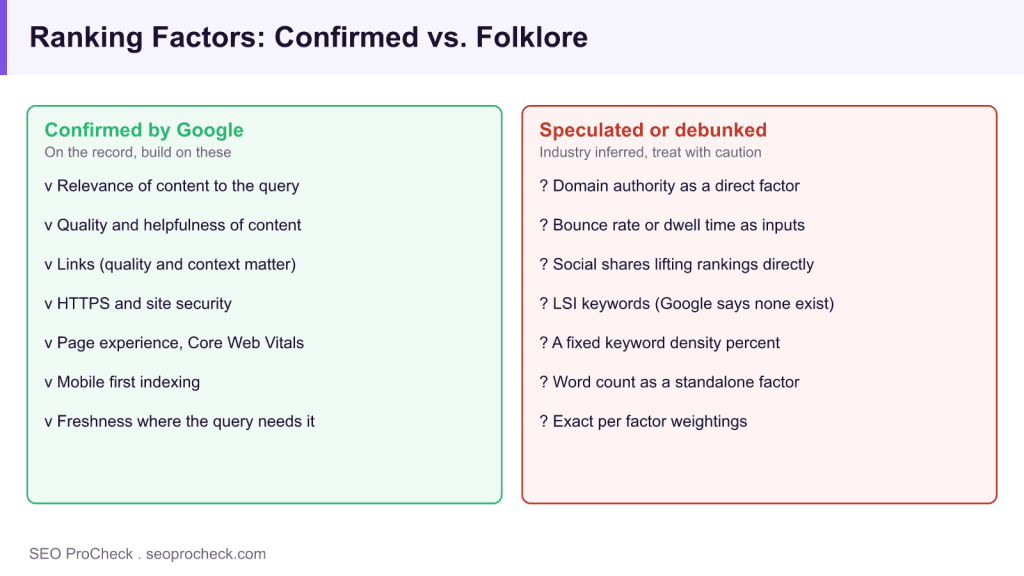
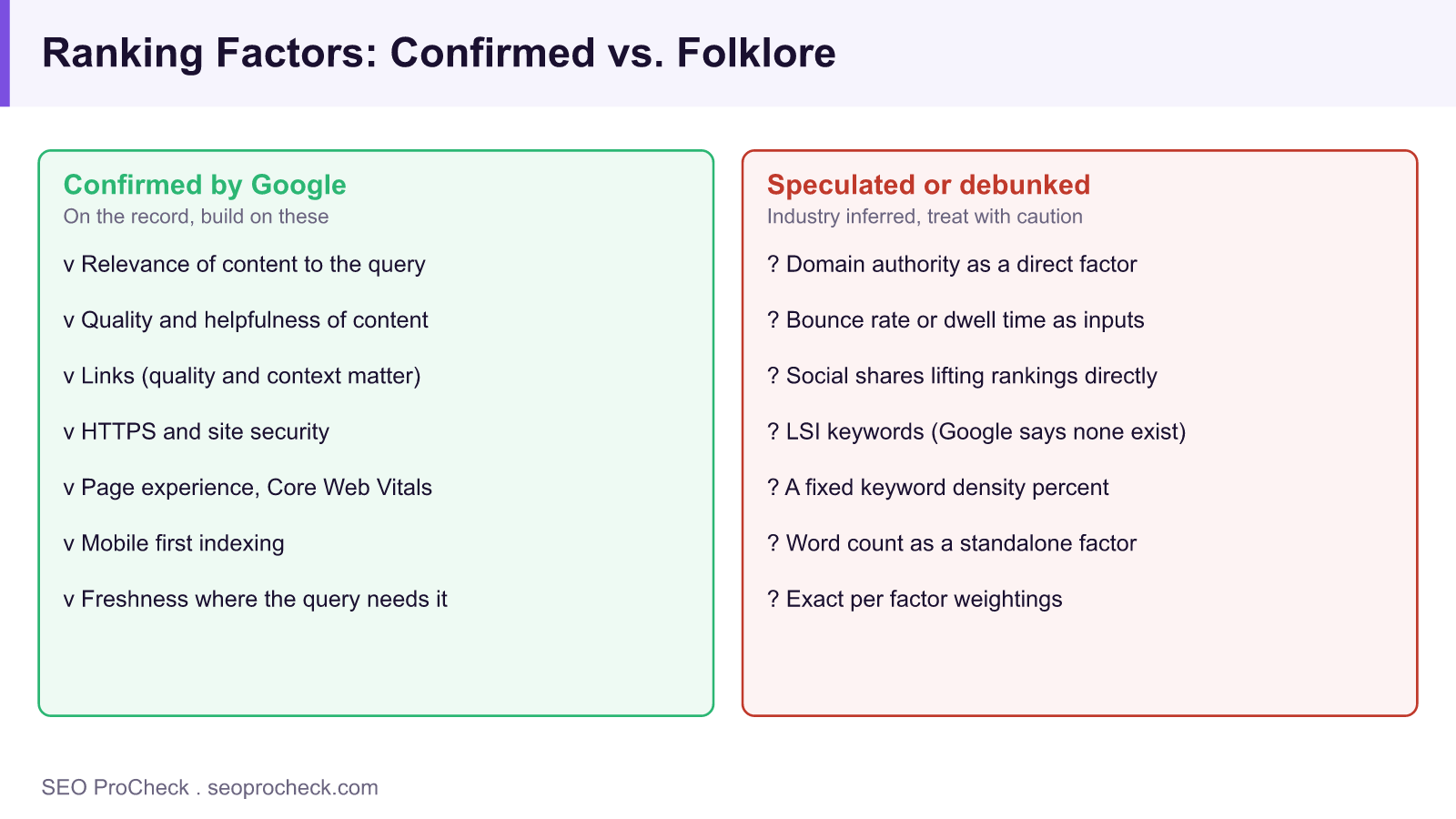
Here's an honest split. The left column is stuff Google has actually stated. The right is stuff the industry infers, argues about, or flat-out invented, some of it plausible, some of it debunked.
| Confirmed by Google (on the record) | Speculated / industry-inferred (treat with caution) |
|---|---|
| Relevance of content to the query | Exact "domain authority" score as a direct factor |
| Quality and helpfulness of content | Bounce rate / dwell time as direct ranking inputs |
| Links (with quality and context mattering) | Social shares directly lifting rankings |
| HTTPS / site security | "LSI keywords" (Google says these don't exist) |
| Core Web Vitals, used by core ranking systems | A fixed keyword-density percentage; a single "page experience" signal (Google says there is none) |
| Mobile-first indexing (Google indexes the mobile version) | Word count, or mobile-friendliness, as a standalone factor |
| Freshness for queries that need it (QDF) | Exact percentage weightings for any single factor |
How to work with ranking factors sanely
- Sort your list into confirmed vs. speculated. Before you act on any "factor," ask whether Google actually said it or an SEO blog did. Weight your effort toward the confirmed column.
- Prioritize by impact, not by list length. Relevance, content quality, and links move rankings far more than any micro-tweak. Fix the big rocks first.
- Treat speculated factors as hypotheses. You can test them, but don't bet the roadmap on them. "Might help" is not "will help."
- Optimize the underlying goal, not the proxy. Don't chase a dwell-time number, make the page genuinely answer the query, and the behavior follows.
- Re-check when Google speaks. The confirmed list shifts as Google announces things. What was speculation last year (like page experience) sometimes graduates to confirmed.
Mistakes people make with ranking factors
- Treating every list item as gospel. Most "200 factors" posts blend confirmed inputs with guesses and debunked myths, all in the same authoritative voice.
- Optimizing for a specific percentage. Keyword density targets and word-count minimums are folklore. Google has never published a magic number.
- Confusing correlation with causation. A factor that correlates with top rankings (like word count) often just reflects that thorough content covers a topic better, the count itself isn't the cause.
- Ignoring the difference between a factor and a signal. People use the terms interchangeably, but signals are the raw inputs the algorithm reads; factors is the looser umbrella term the industry uses for anything that might affect rank.
- Chasing debunked myths. "LSI keywords," a "sandbox" toggle, and other zombie ideas keep getting SEO time they don't deserve.
- Assuming a confirmed factor is a big factor. HTTPS is confirmed and tiny. Confirmation tells you it counts, not how much, sizing the factor is a separate judgment call, and getting it wrong means over-investing in a small lever while a big one goes ignored.
Frequently asked questions
How many ranking factors does Google use?
Google has referred to using "hundreds" of signals, but it has never published a definitive numbered list. The popular "200 ranking factors" figure is an industry construct, not an official count.
Are ranking factors and ranking signals the same thing?
Roughly, but not exactly. "Signals" is closer to how Google describes the raw inputs its systems read. "Factors" is the broader, looser industry term. In casual use they overlap heavily.
Which ranking factor matters most?
There's no single winner, but relevance and content quality consistently do the heavy lifting, with links close behind. Technical and page-experience factors matter but rarely outweigh giving searchers a genuinely better answer.
Should I trust "200 ranking factors" lists?
Use them as a brainstorming menu, not a to-do list. Many entries are speculative or outright debunked. Cross-check anything important against what Google has actually confirmed.
Do ranking factors change over time?
Yes. Google adjusts weightings constantly and occasionally adds or retires factors, page experience and helpful-content emphasis are recent examples. Anything you "know" about factor weighting has a shelf life.
Related reading: dig into the raw inputs in our ranking signals entry, and see the machinery behind them in Google algorithm.
Take this with you
The assistant links open with a question about this page already written. Nothing is sent until you press enter.
Claude Vincent is a technical SEO consultant focused on crawlability, rendering, and AI-search visibility. He writes the field guides and case studies at SEO ProCheck, with a bias toward the durable, unglamorous work that decides whether search engines and AI answer engines can actually read and cite a site.
About SEO ProCheck
Technical SEO consulting and GEO strategy with 20 years of enterprise experience. Case studies, resources, and tools for search and AI visibility.
Work With Me
Technical SEO audits, GEO strategy, site migrations, and international SEO. Hourly consulting for teams who need hands-on support, not just reports.
Subscribe to our newsletter!








Recent Posts
- Most Top Sites Never Say Who They Are in Structured Data October 14, 2026
- Homepage Titles Are Mostly Too Short, Not Too Long October 8, 2026
- Who Actually Serves an llms.txt? 184 Top Sites Measured September 29, 2026