

AI Summary
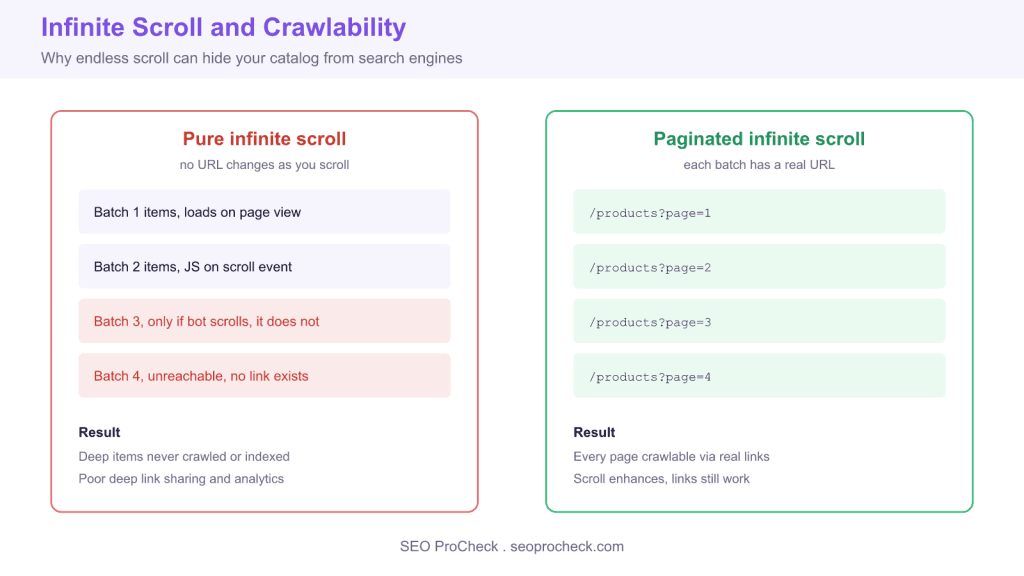
Infinite scroll harms SEO only when deep content lives behind scroll events with no crawlable URL, which leaves most of a large listing invisible to search engines. The fix is paginated infinite scroll: back every batch with a real page such as /products?page=2, include next page anchor links in the HTML, and enhance with the History API so the experience stays smooth and every item stays crawlable.
- Pure infinite scroll hides items past the first batch because crawlers do not scroll.
- Etsy tested endless scroll and found it did not deliver the expected engagement gains.
- Give each batch a real URL and next page anchor links, then enhance with History API pushState.
- Audit by requesting deep page URLs directly and checking URL Inspection in Search Console.
Infinite scroll feels modern, but as a default pattern it has a long track record of disappointing the teams that ship it. The source recounts how Etsy tested infinite scroll on its search results and found it did not deliver the engagement gains the team expected, which led them to reconsider the pattern. That story is a useful anchor because it separates two different problems infinite scroll creates: a user experience problem, and a search engine crawlability problem. Both matter, and the second one is where SEO practitioners get burned.
Why pure infinite scroll hides content from crawlers
In a naive implementation, only the first batch of items is present in the initial HTML. Every subsequent batch is fetched by JavaScript in response to a scroll event. A search engine crawler does not scroll: it renders the page, sees the first batch, and finds no links pointing to the rest. The deeper items, page two and beyond of your catalog or feed, simply do not exist from the crawler point of view. There is no URL to index, no anchor to follow, and no way for another site to deep link to item 500. On a large listing, that can leave the majority of your inventory invisible to search.
The user experience trap Etsy ran into
Beyond crawling, infinite scroll changes behavior in ways that are easy to assume and hard to predict. It removes a natural stopping point, breaks the browser back button and scroll restoration, and makes the footer nearly unreachable. It also makes a specific item impossible to bookmark or return to reliably. The lesson from the Etsy case is not that scrolling is evil, it is that swapping a familiar paginated interface for an endless one is a real product change that should be tested, not assumed to be an improvement.
The SEO safe pattern: paginated infinite scroll
The fix is to back every batch with a real, crawlable page and layer the scroll behavior on top. Google documents this pattern directly. Give each batch a canonical URL such as /products?page=2, make sure that URL returns the correct items when requested on its own, and include genuine anchor links to the next page in the HTML. Then use the History API to update the address bar as the user scrolls, so sharing and the back button keep working. The rule of thumb: the page must be fully usable and fully crawlable with JavaScript disabled, and the scroll is progressive enhancement, not the only route to the content.
// real, crawlable pagination in the HTML
<a href="/products?page=2" rel="next">Next page</a>

// enhance with History API as the user scrolls
history.pushState({page:2}, "", "/products?page=2");
// on popstate, restore the correct batch and scroll position
How to audit a page you already ship
Load the listing, open the rendered source, and search for anchor links to page two and beyond. If they are absent, deep content is at risk. Next, request ?page=3 directly in a fresh tab and confirm it returns the right items rather than redirecting to page one or an empty state. Finally, use the URL Inspection tool in Google Search Console on a deep page URL to confirm Google can fetch and render it. If deep pages are missing from your Indexed count in Search Console while shallow pages are present, infinite scroll without crawlable pagination is a prime suspect.
What has changed since this study
The Etsy write up dates to 2013, and the tooling has moved on, but the core trade off has not. The History API pushState and replaceState methods are now universally supported, which makes SEO safe infinite scroll far easier to build than it was then. Google retired its old AJAX crawling scheme and now renders JavaScript, yet it still does not scroll, so crawlable links to paginated URLs remain mandatory. On the experience side, Core Web Vitals added Interaction to Next Paint as a ranking relevant metric, and endless scroll pages that append thousands of nodes can degrade it. The modern recommendation is unchanged in spirit: use a load more button or paginated infinite scroll backed by real URLs, and never rely on scroll events as the only path to deep content.
Infinite scroll patterns compared
| Pattern | Crawlable deep content | Back button and sharing | Best use |
|---|---|---|---|
| Pure infinite scroll | No, JS only batches | Broken by default | Avoid for indexable listings |
| Load more button | Yes if button links to real pages | Works, footer reachable | Feeds and moderate catalogs |
| Paginated infinite scroll | Yes, real URL per batch | Works via History API | Large catalogs that need both |
| Classic pagination | Yes, fully crawlable | Works natively | Content that favors clarity |
Related reading
- Use XML sitemaps to expose deep pages to crawlers
- Browse technical SEO checks
- More SEO research and studies
Frequently asked questions
Is infinite scroll bad for SEO?
Infinite scroll is only bad when it is the only way to reach deep content. If batches load solely through scroll events with no crawlable URLs, search engines cannot reach items beyond the first batch. Backed by real paginated URLs and anchor links, infinite scroll can be perfectly SEO safe.
Why did infinite scroll not work well for Etsy?
According to the source, Etsy tested infinite scroll on its results and found it did not deliver the engagement improvements the team expected, so they reconsidered it. The takeaway is that replacing familiar pagination with endless scroll is a real product change that should be measured rather than assumed to help.
How do I make infinite scroll crawlable?
Give each batch a real URL such as /products?page=2, make that URL return the correct items on its own, and include genuine next page anchor links in the HTML. Then use the History API to update the address bar as the user scrolls, so the experience stays smooth while search engines follow the links.
Does Google crawl content loaded by scrolling?
Google renders JavaScript, but it does not scroll a page to trigger lazy loaded batches. Content that only appears in response to a scroll event, with no link or URL to reach it directly, generally will not be discovered. Crawlable pagination links remain necessary.
Is a load more button better than infinite scroll?
A load more button is often a good middle ground because it keeps the footer reachable and can link to real paginated URLs, which keeps deep content crawlable. Infinite scroll can match it for SEO when it is backed by the same paginated URLs, so the right choice depends on the experience you want.
Can infinite scroll affect Core Web Vitals?
Yes. Appending large numbers of DOM nodes as the user scrolls can increase interaction latency and hurt Interaction to Next Paint, a Core Web Vitals metric. Limiting how many items stay mounted at once, or using pagination, helps keep the page responsive.
Source: https://danwin.com/2013/01/infinite-scroll-fail-etsy/
Take this with you
The assistant links open with a question about this page already written. Nothing is sent until you press enter.
Claude Vincent is a technical SEO consultant focused on crawlability, rendering, and AI-search visibility. He writes the field guides and case studies at SEO ProCheck, with a bias toward the durable, unglamorous work that decides whether search engines and AI answer engines can actually read and cite a site.
About SEO ProCheck
Technical SEO consulting and GEO strategy with 20 years of enterprise experience. Case studies, resources, and tools for search and AI visibility.
Work With Me
Technical SEO audits, GEO strategy, site migrations, and international SEO. Hourly consulting for teams who need hands-on support, not just reports.
Subscribe to our newsletter!








Recent Posts
- Most Top Sites Never Say Who They Are in Structured Data October 14, 2026
- Homepage Titles Are Mostly Too Short, Not Too Long October 8, 2026
- Who Actually Serves an llms.txt? 184 Top Sites Measured September 29, 2026