

AI Summary
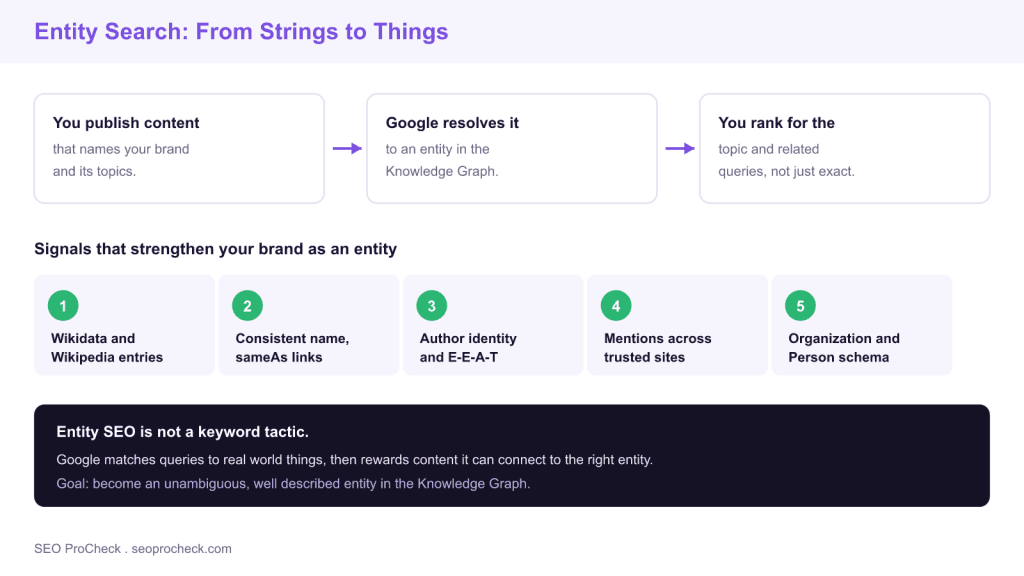
Entity search is Google understanding queries and content as real world things, people, places, brands, and concepts, rather than as strings of characters to match. Optimizing for it means becoming a clearly defined entity that Google can connect to a topic, which is now central to both classic search and AI answer engines.
- Google maps content to entities in its Knowledge Graph, then rewards pages it can confidently connect to the right thing.
- Entity relevance is built with structured data, consistent naming, and corroborating mentions across trusted sources.
- Disambiguation matters: your brand needs enough context that Google never confuses it with a similarly named entity.
- Entity clarity also drives citations in AI Overviews and assistants, because those systems reason over entities and relationships.
Why entity search is necessary for SEO success provides valuable insights for SEO practitioners. This resource examines approaches and considerations that can improve organic search performance.
Key Concepts
Understanding the fundamental principles behind this topic helps inform strategic decisions. Whether optimizing for traditional search or emerging AI platforms, foundational concepts remain relevant. This resource covers the essential knowledge practitioners need.
Implementation Considerations
Moving from concept to execution requires understanding practical constraints and opportunities. Different situations call for different approaches. This resource provides guidance for applying concepts in real-world contexts.
Measuring Impact
SEO efforts require measurement to demonstrate value and guide optimization. Identifying appropriate metrics, establishing baselines, and tracking progress enables data-driven improvement. This resource addresses how to evaluate success.
This resource contributes to the knowledge base SEO practitioners need for effective optimization in an evolving search landscape.
Source: https://searchengineland.com/why-entity-search-is-necessary-for-seo-success-379015
Strings versus things, in practice
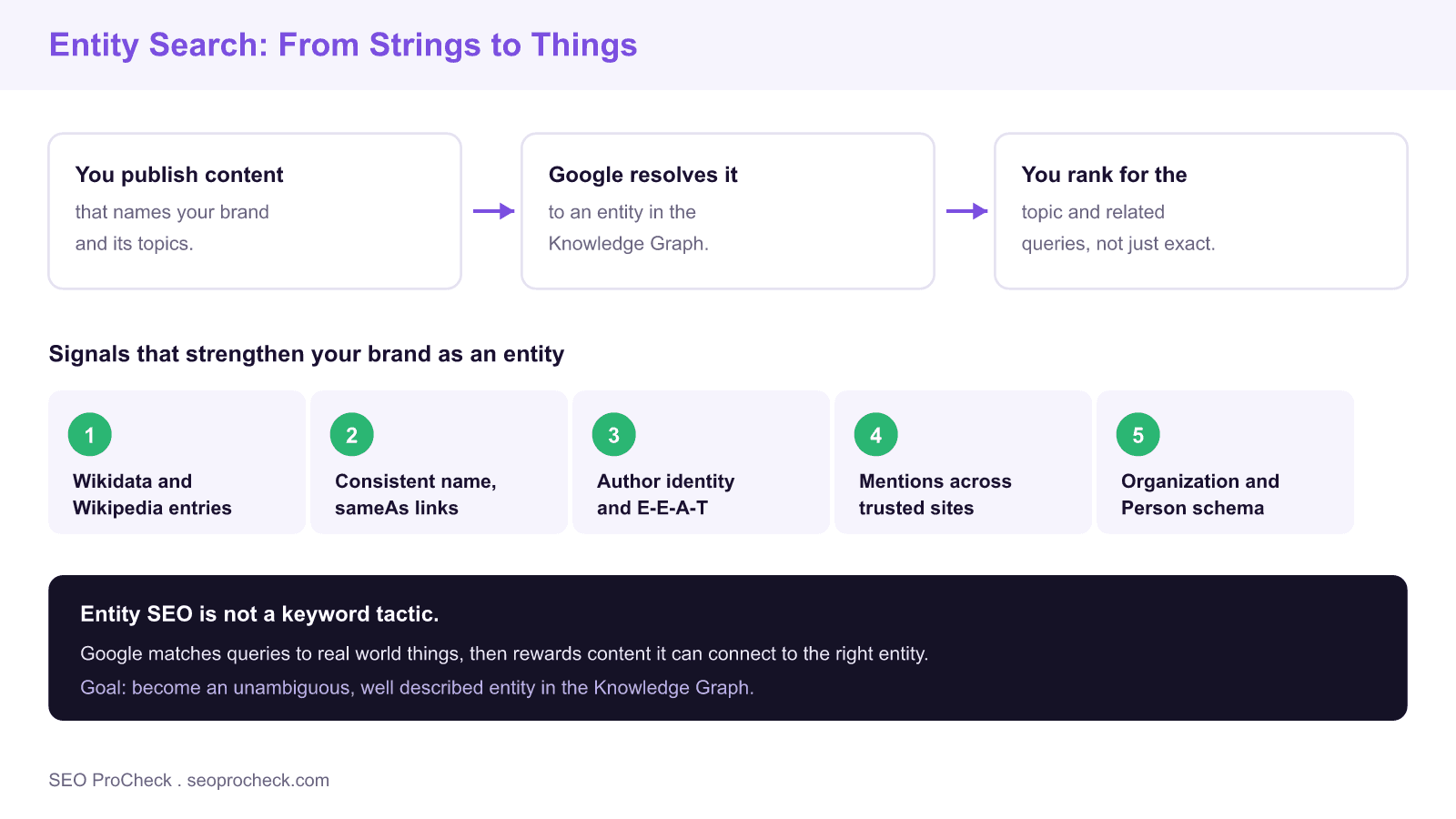
The linked Search Engine Land article frames why entity search matters for SEO success, and the shift it describes is real and durable. Classic search matched the words in a query against the words on a page. Entity search adds a layer on top: Google first tries to work out which real world thing the query is about, resolves it to an entity in the Knowledge Graph, and then serves content it can connect to that entity. The phrase practitioners use is strings to things.
A quick example. The query jaguar is ambiguous, because it can mean the animal, the car brand, or a sports team. Google does not guess from the letters alone. It uses context, your search history, and the entities each candidate page is associated with to decide which jaguar you mean, then ranks pages that are strongly tied to that entity. If your content is only loosely associated with the right thing, you lose the slot even when your keywords match.
Why entity relevance is necessary, not optional
Three forces make this unavoidable. First, Google has spent a decade moving from lexical matching to semantic understanding, and entities are the unit it reasons in. Second, AI Overviews and assistants extend the same logic, because a model that summarizes an answer is reasoning over entities and their relationships, not counting keywords. Third, competition on exact match phrases has compressed, so the durable advantage is being the entity Google trusts for a topic rather than the page that repeated a phrase most often.
The practical consequence is that you stop optimizing individual pages in isolation and start building a coherent, well described entity. When Google is confident about who you are and what you cover, it ranks you for related queries you never targeted word for word, which is the compounding payoff of entity work.
Signals that build your entity
| Signal | What it does | How to implement |
|---|---|---|
| Structured data | Names the entity and its type in machine readable form | Add Organization and Person schema with a stable identity |
| sameAs links | Ties your site to known profiles for disambiguation | Reference Wikidata, LinkedIn, and official profiles in schema |
| Knowledge base presence | Gives Google a corroborated definition of the entity | Earn a Wikidata entry, and Wikipedia where notability supports it |
| Consistent naming | Prevents the entity from fragmenting or merging with another | Use one exact brand name and consistent details everywhere |
| Corroborating mentions | Confirms the entity is real and relevant to a topic | Earn mentions and citations from trusted sites in your field |
How to start optimizing for entity search
- Define your entity explicitly. State who you are, what you do, and the topics you cover on an about page, and back it with Organization or Person schema that never changes its core identity.
- Connect to known entities. Use sameAs to link your official profiles, and pursue a Wikidata entry, so Google can anchor you to something it already trusts.
- Build topical coverage. Publish a connected set of pages around your core topic so the association between your entity and that topic is unmistakable. Clear structure also improves AI readability, which helps answer engines quote you.
- Earn corroboration. Mentions from reputable sources in your niche confirm the entity and its relevance, the same trust foundation behind AEO and GEO.
Entity search and AI answer engines
Everything above pays off twice, because AI answer engines lean even harder on entities than classic ranking does. When a model decides which source to cite for a question, it favors sources it can confidently attach to the relevant entity. Getting the entity groundwork right is therefore a prerequisite for showing up in AI results, and it connects directly to how AI engines choose sources. Treat entity clarity as the foundation, and both search and AI visibility get easier.
Frequently asked questions
What is entity search in SEO?
Entity search is Google understanding queries and content as real world things, people, places, brands, and concepts, rather than as strings of characters. It resolves a query to an entity in the Knowledge Graph and then ranks content it can connect to that entity.
Why is entity search necessary for SEO success?
Google has moved from matching keywords to reasoning about entities, and AI answer engines extend the same logic. Becoming a clearly defined entity earns rankings for related queries you never targeted word for word, which compounds over time.
What is the difference between keywords and entities?
Keywords are the literal words a searcher types, while entities are the underlying things those words refer to. Optimizing for entities means making your content unambiguously about the right thing, not just repeating a phrase.
How do I optimize my brand as an entity?
Define your entity on an about page, add Organization or Person schema with sameAs links to official profiles, pursue a Wikidata entry, build connected topical content, and earn mentions from trusted sources in your field.
How does entity search affect AI Overviews and assistants?
AI systems reason over entities and relationships, so they favor sources they can confidently attach to the relevant entity. Strong entity signals make your content more likely to be cited in AI Overviews and assistant answers.
What is the Knowledge Graph?
The Knowledge Graph is Google database of entities and the relationships between them. When your brand is represented there with accurate attributes, Google can connect your content to the right entity with more confidence.
Take this with you
The assistant links open with a question about this page already written. Nothing is sent until you press enter.
Claude Vincent is a technical SEO consultant focused on crawlability, rendering, and AI-search visibility. He writes the field guides and case studies at SEO ProCheck, with a bias toward the durable, unglamorous work that decides whether search engines and AI answer engines can actually read and cite a site.
About SEO ProCheck
Technical SEO consulting and GEO strategy with 20 years of enterprise experience. Case studies, resources, and tools for search and AI visibility.
Work With Me
Technical SEO audits, GEO strategy, site migrations, and international SEO. Hourly consulting for teams who need hands-on support, not just reports.
Subscribe to our newsletter!








Recent Posts
- Most Top Sites Never Say Who They Are in Structured Data October 14, 2026
- Homepage Titles Are Mostly Too Short, Not Too Long October 8, 2026
- Who Actually Serves an llms.txt? 184 Top Sites Measured September 29, 2026