

AI Summary
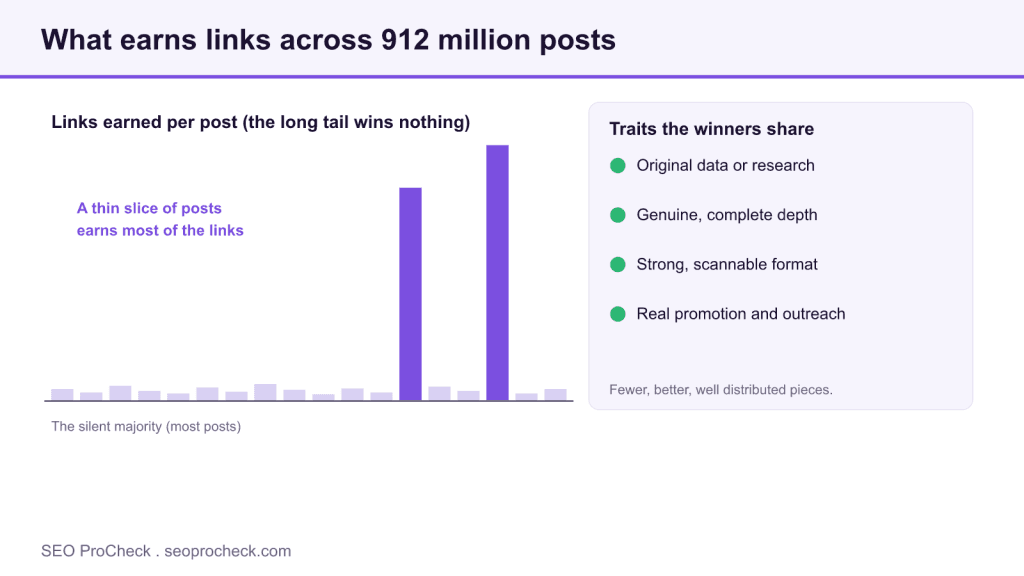
Across 912 million posts, most content earns almost no links or shares while a thin slice captures the majority. The winners are not random: they combine original data, real depth, strong format, and deliberate promotion, so publishing fewer and better pieces beats publishing more.
- Most posts earn close to zero links; a small share earns nearly all of them.
- The traits that travel: original data, comprehensive depth, strong format, real promotion.
- More volume mostly multiplies pieces that earn nothing.
- Treat distribution as roughly half the work, planned before you publish.
TL;DR
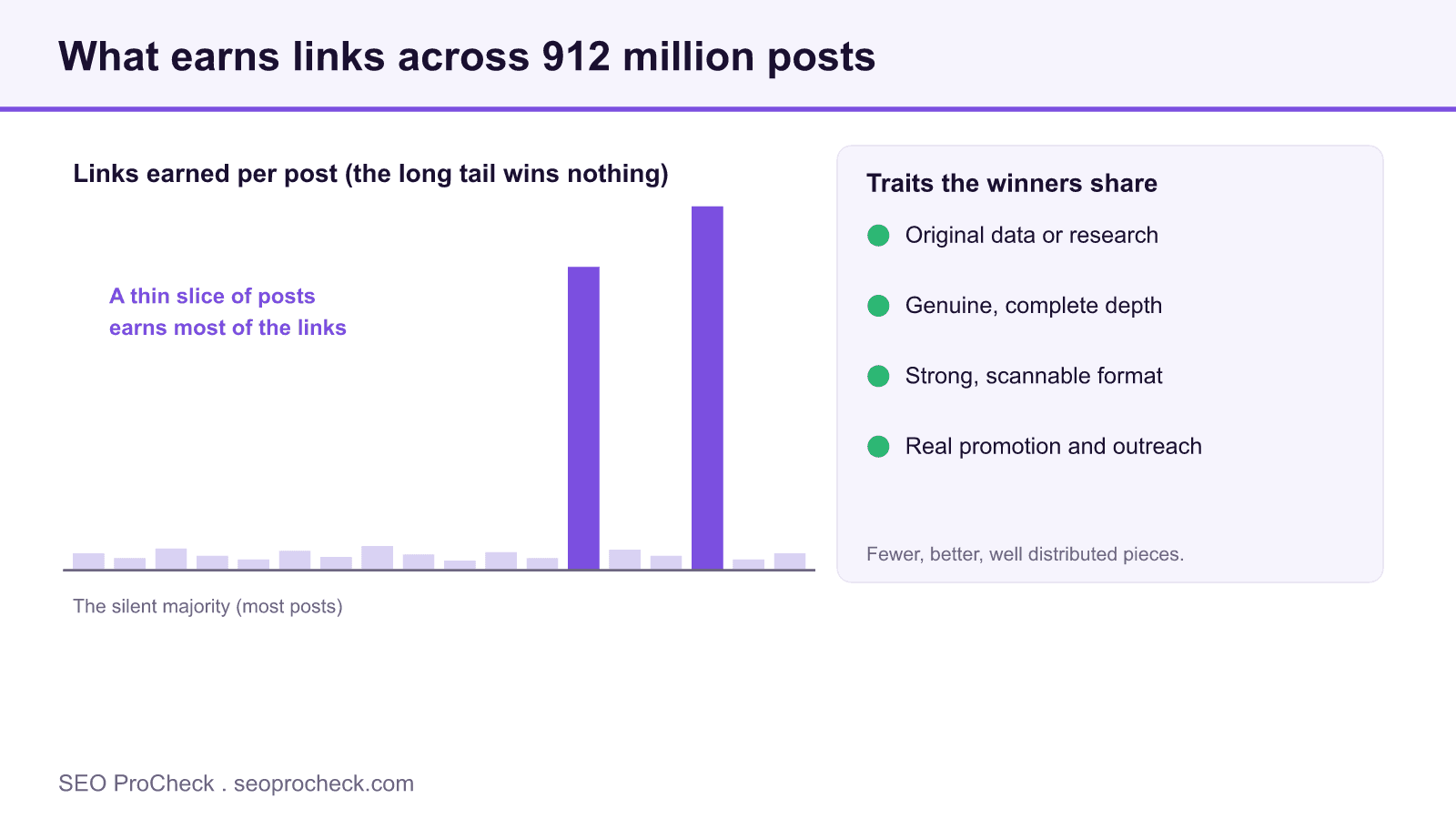
We looked at the patterns across 912 million blog posts, and the headline is uncomfortable: most content earns almost no links and almost no shares. A small share of pieces captures the bulk of the attention, and the winners share traits you can engineer on purpose, namely original data, genuine depth, strong formats, and real promotion. Publishing more posts will not move the needle. Publishing fewer, better, well-distributed pieces will.
The big-picture takeaway
When you study content at this scale, one finding overwhelms everything else: the majority of posts get little traction. Links cluster around a small group of standout pieces, and so do shares. The long tail of ordinary articles sits quietly with next to nothing, while a thin slice of content earns most of the references and social pickup that anyone cares about.
This is not a reason to despair. It is a reason to be selective. If most content fails to earn links by default, the goal is not to produce more of the average. It is to understand what separates the pieces that travel from the pieces that disappear, and to deliberately build more of the former. The pattern is consistent enough that you can plan around it instead of hoping a post catches fire.
What actually earns links and shares
Across the data, a handful of qualities show up again and again in content that performs. None of them are secret, but few teams execute all of them together.
Original data and research
Content built on proprietary numbers, surveys, or first-hand analysis tends to earn links because other writers need something to cite. When you are the source, you become the reference. Roundups of common knowledge rarely get linked, because anyone could have written them.
Comprehensive, long-form depth
Thorough pieces that fully cover a topic tend to attract more links and shares than thin posts. Depth signals that the page is a destination, not a stop along the way. This does not mean padding for word count. It means answering the question completely enough that a reader has no reason to look elsewhere.
Strong formats
Format matters more than many writers expect. Clear structure, scannable sections, useful visuals, and a headline that promises something specific all help a piece get noticed and passed along. The same insight as a wall of text and as a well-organized guide will not perform equally.
Promotion and distribution
Even excellent content does not spread on its own. The pieces that earn links and shares almost always had a push behind them, whether through outreach, email, communities, or partnerships. Promotion is part of the work, and often the difference between a piece that lands and one that never gets seen.
Why more content is not a strategy
The instinct, when results are thin, is to publish more. The data argues against it. If the average post earns little, doubling your output mostly doubles your count of pieces that earn little. Volume spreads your effort thinner, dilutes your promotion across more targets, and rarely lifts the pieces that could have become standouts with more attention.
A publishing calendar is a plan for activity, not results. Activity feels productive, but outcomes concentrate in a few pieces. The teams that win decide which few deserve real investment and back them properly, rather than spreading themselves across a long list of forgettable posts.
How to apply it
You can turn these patterns into a working approach. Start by doing fewer things, better.
- Publish fewer, stronger pieces. Concentrate your time on a smaller set of articles you genuinely intend to make the best resource on the topic.
- Lead with an original angle. Find a dataset or a perspective that only you can offer, then build the piece around it so others have a reason to cite you.
- Go deep where it counts. Choose topics worth covering completely, and cover them completely. For more on shaping content so it gets cited, see our guide on content structure for AI search.
- Treat distribution as half the job. Budget as much energy for promotion as for writing. Our digital PR for SEO guide covers how to do this well.
Done together, these moves bias your output toward the small group of pieces that capture most links and shares, instead of adding to the silent majority.
Honest caveats
A few cautions are worth stating plainly. Patterns across hundreds of millions of posts describe what tends to happen, not what will happen to any single piece. Correlation is not a guarantee, and traits that travel together in aggregate can still fail in a specific case. Topic, audience, timing, and existing authority all shape outcomes. The right takeaway is directional: focus, depth, originality, and promotion improve your odds. They do not remove the risk, and no study can promise that a given post will earn links.
The four traits, and how to engineer each
| Trait | Why it earns links | How to build it in |
|---|---|---|
| Original data or research | Gives other writers something only you can cite | Publish surveys, first party analytics, or hands on testing |
| Comprehensive depth | Signals a destination page worth referencing | Answer the question completely, not padded for word count |
| Strong format | Helps a piece get noticed and passed along | Clear structure, scannable sections, useful visuals, a specific headline |
| Promotion and distribution | Nothing spreads on its own | Budget outreach, email, and community sharing before you publish |
FAQ
Does this mean short content never works?
No. Depth tends to help, but the real driver is fully answering the reader's question. A focused, complete short piece can outperform a long, padded one. Match the length to what the topic genuinely needs.
If most content earns no links, why publish at all?
Because the small share that does earn links delivers outsized value, and content also serves readers, search visibility, and trust beyond link counts. The lesson is to be selective about where you invest, not to stop.
How much should I spend on promotion versus writing?
Treat them as roughly equal partners. A strong piece with no distribution usually stalls. Plan your outreach and promotion before you publish, not after, so the launch has momentum behind it.
How many posts should we publish?
There is no universal number. The point is to move effort from volume toward a smaller set you can make the best resource on each topic and then promote properly. Match your cadence to the resources you can give each piece, not to a calendar target.
What counts as original data if we cannot run a survey?
Your own product, support, and analytics data often hold unpublished patterns worth writing up. First hand testing, teardowns, and structured observations also read as original, because no competitor can copy your exact numbers.
Does this study mean SEO content is dead?
No. It means average, undifferentiated content rarely earns links or attention. Focused, deep, well promoted pages still perform, which is exactly where your effort should concentrate.
Want fewer, better pieces that actually earn links?
An audit shows where your content is failing to travel and which pages are worth real investment. We will map the gaps and the opportunities.
Claude Vincent is a technical SEO consultant focused on crawlability, rendering, and AI-search visibility. He writes the field guides and case studies at SEO ProCheck, with a bias toward the durable, unglamorous work that decides whether search engines and AI answer engines can actually read and cite a site.
About SEO ProCheck
Technical SEO consulting and GEO strategy with 20 years of enterprise experience. Case studies, resources, and tools for search and AI visibility.
Work With Me
Technical SEO audits, GEO strategy, site migrations, and international SEO. Hourly consulting for teams who need hands-on support, not just reports.
Subscribe to our newsletter!






Recent Posts
- Can AI Crawlers Actually Read Your Site? I Measured 400 of the Biggest September 5, 2026
- The Pre-Publish Quality Gate for AI-Assisted Content August 6, 2026
- AGENTS.md vs llms.txt vs llms-full.txt: Which Agent File Does What July 18, 2026