

AI Summary
B2B lead generation through SEO means ranking for the low volume, high intent queries a buying committee runs during a long sales cycle, then converting that traffic with assets matched to the funnel stage. Success is measured in qualified pipeline per landing page rather than raw traffic, because a B2B keyword with 50 searches a month can be worth more than a consumer keyword with 50,000.
- Build bottom up. Comparison, alternatives, pricing and integration pages convert at 3 to 10%, against under 1% for educational content.
- One deal produces searches from several stakeholders, so the technical evaluator, the economic buyer and the end user each need their own page.
- Keyword tools under report B2B volume. Treat them as relative interest, and let sales calls and GSC queries decide what to build.
- Attribution needs a CRM join on first touch landing page. GA4 windows are too short for a six month cycle.
Quick answer: B2B lead generation through SEO means ranking for the low-volume, high-intent queries your buying committee searches during a long sales cycle (comparison, pricing, integration, and "alternatives" terms), then converting that traffic with gated and ungated assets mapped to funnel stage. Unlike B2C, success is measured in qualified pipeline per landing page, not raw traffic, because a B2B keyword with 50 searches a month can be worth more than a consumer keyword with 50,000.
Understanding B2B SEO for Lead Generation
B2B represents a critical component of modern SEO strategy. As search engines continue to evolve and user expectations shift, understanding the nuances of b2b becomes essential for maintaining and improving organic visibility. This guide covers the key concepts, implementation approaches, and strategic considerations that SEO practitioners need to master.
Three structural differences separate B2B SEO from everything else. First, the buying committee: research from firms like Gartner has consistently shown that B2B purchases involve multiple stakeholders, which means one deal generates searches from a technical evaluator ("API rate limits comparison"), an economic buyer ("pricing," "ROI calculator"), and an end user ("how to migrate from X"): you need pages for each. Second, sales cycles run months, not minutes, so attribution must tolerate long lags between first organic touch and closed deal. Third, search volumes are tiny and tools under-report them: keyword planners routinely show "10 to 100" or even zero volume for terms that reliably produce demo requests. In B2B, keyword tools tell you relative interest; your own lead data tells you value.
Key Considerations for B2B Lead Generation Through SEO
When approaching b2b, several factors require careful attention. Technical implementation must align with broader SEO objectives while maintaining site performance and user experience. The balance between optimization and over-optimization requires ongoing monitoring and adjustment based on performance data and algorithm changes. Industry benchmarks and competitor analysis provide context for evaluating your own implementation.
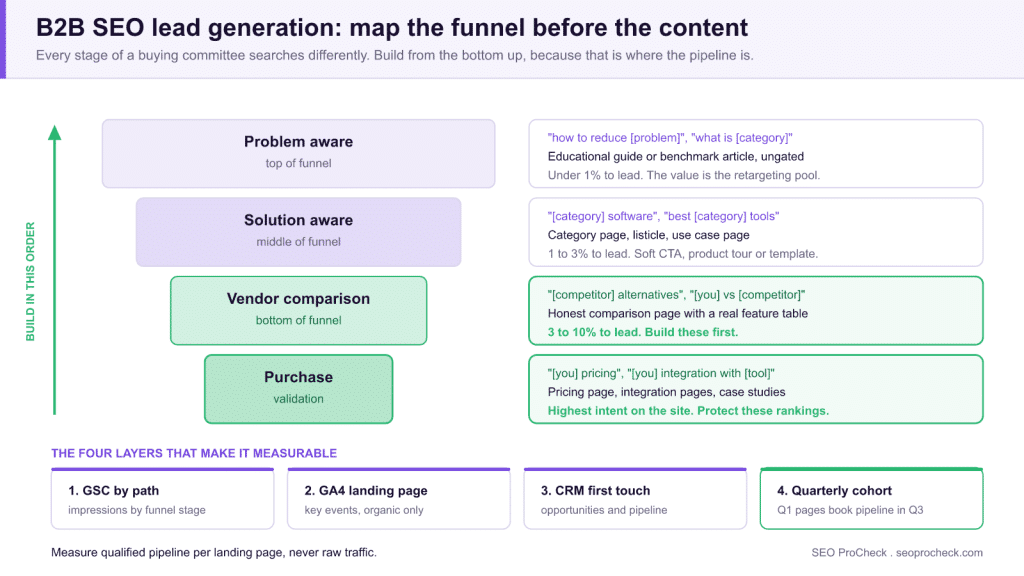
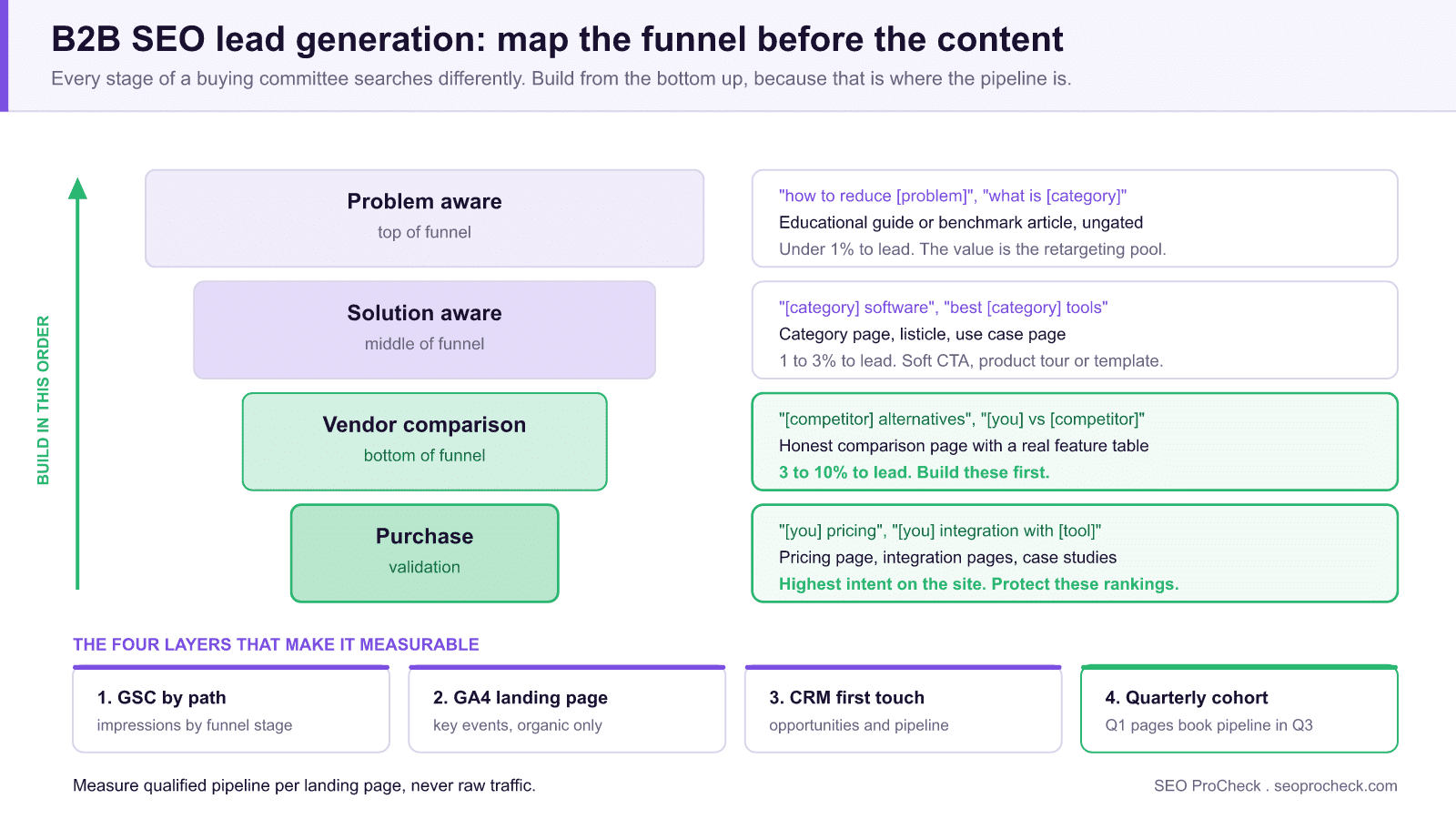
The core planning artifact is a funnel-stage keyword map, which is really a search intent map with revenue attached. Build it before writing a single page:
| Funnel stage | Query patterns | Page type that converts | CTA / capture | Realistic conversion expectation |
|---|---|---|---|---|
| Problem-aware (TOFU) | "how to reduce [problem]", "what is [category]" | Educational guide, glossary, benchmark article | Ungated; newsletter or content upgrade | <1% to lead: value is retargeting pool + topical authority |
| Solution-aware (MOFU) | "[category] software", "best [category] tools", "[category] for [industry]" | Category/listicle page, use-case page | Soft CTA to product tour or template download | 1 to 3% to lead |
| Vendor comparison (BOFU) | "[competitor] alternatives", "[you] vs [competitor]", "[competitor] pricing" | Honest comparison page, alternatives roundup | Demo / trial CTA above the fold | 3 to 10% to lead: build these first |
| Purchase validation (BOFU) | "[you] pricing", "[you] reviews", "[you] integration with [tool]" | Pricing page, integration pages, case studies | Demo / contact sales | Highest intent on the site; protect these rankings |
Decision criterion for sequencing: work bottom-up. A ten-page integration library and three competitor-comparison pages will usually out-produce fifty blog posts in pipeline terms, because they intercept buyers who already have budget. Only after BOFU coverage is complete does TOFU content earn its keep, as the audience pool that feeds retargeting and brand search later.
Implementation Best Practices
Successful implementation begins with thorough auditing of current state and clear goal definition. Document baseline metrics before making changes to enable accurate impact measurement. Prioritize changes based on potential impact and implementation effort, focusing on high-impact items first. Test changes in staging environments when possible, and monitor closely after deployment to production. Maintain documentation of changes for future reference and troubleshooting.
Concretely, a B2B SEO lead-gen build has four workstreams:
- Keyword-to-page mapping: one primary intent per URL. Comparison intent and category intent look similar but need separate pages: "best CRM software" (roundup) and "CRM software" (category pitch) rank for different SERPs. A pillar and cluster architecture keeps that distinction visible in the URL structure itself.
- Lead capture that matches intent: gate only what a buyer would trade an email for (benchmark reports, templates, calculators). Gating a basic blog post inflates form abandonment and earns nothing. Put demo CTAs on BOFU pages and soft CTAs on educational pages.
- Conversion tracking wired before content ships: in GA4, mark form submissions and demo bookings as key events, then verify organic attribution (the GA4 and Search Console attribution guide covers the joins) under Reports > Life cycle > Acquisition > Traffic acquisition, filtered to Session default channel group = Organic Search, with the key-event columns visible. For per-page analysis, use Engagement > Landing page and add a session default channel group filter: landing page plus key events is the single most useful B2B SEO report in GA4.
- CRM loop-back: pass the landing page and first-touch source into your CRM (hidden form fields or a first-touch cookie) so you can eventually report "organic page X produced Y opportunities and $Z pipeline." Marketing-qualified form fills from careers-page traffic and pipeline from comparison pages look identical in GA4; only the CRM join tells them apart.
The first ten pages to build, in order
Sequencing beats volume in B2B. This is the build order that reaches pipeline fastest on a domain that already has some authority, because every page in the top half intercepts a buyer who already has budget:
| Order | Page | Why it earns its slot | Who searches it |
|---|---|---|---|
| 1 | /compare/[you]-vs-[main competitor]/ | Highest converting organic page on most B2B sites | An evaluator with a shortlist of two |
| 2 | /alternatives/[main competitor]/ | Captures active churn intent from a rival's install base | A buyer already unhappy with what they own |
| 3 | /pricing/ (indexable, with real numbers or real ranges) | Hiding pricing sends the query to review sites that rank instead of you | The economic buyer building a business case |
| 4 to 6 | /integrations/[tool]/ for your three biggest ecosystem partners | Tiny volume, near zero competition, and the query implies an existing stack | The technical evaluator checking compatibility |
| 7 | Case study for your clearest vertical | Supplies the proof the comparison pages assert | The committee member who needs internal cover |
| 8 | /[category]-software/ category page | The one broad term worth owning, because it frames your positioning | A buyer at the start of a shortlist |
| 9 to 10 | Two use case pages for named jobs to be done | Where long tail volume actually clusters in B2B | The end user who has the problem daily |
Common Mistakes to Avoid
Several patterns consistently cause problems in b2b implementations. Rushing implementation without proper planning leads to errors that can be costly to fix. Ignoring the interplay between different SEO factors creates conflicts that undermine results. Failing to monitor and iterate based on performance data means missing optimization opportunities. Over-optimization signals can trigger algorithmic penalties that take months to recover from.
The B2B-specific failure modes, in the order they usually appear: chasing volume instead of intent (ranking #1 for a definitional term that CFOs never search); publishing thin "vs" pages that trash competitors instead of honestly comparing (they don't rank and they poison trust when they do); gating everything and wondering why organic converts at 0.2%; and reporting rankings to a leadership team that only cares about pipeline. Every one of these is a targeting or measurement error, not a content-quality error, which is why more content rarely fixes them.
Measuring Success
Effective measurement requires defining appropriate KPIs aligned with business objectives. Track both leading indicators (rankings, impressions, technical metrics) and lagging indicators (traffic, conversions, revenue) to build a complete picture. Establish reasonable timeframes for evaluation, as SEO changes often take weeks or months to fully manifest in results. Compare performance against historical baselines and competitor benchmarks to contextualize results.
A working B2B dashboard needs exactly four layers: (1) GSC Performance > Search results filtered by page group (use regex filters on URL paths like /compare/ or /integrations/) for impressions and position by funnel stage; (2) GA4 landing-page key events for organic, as above; (3) CRM-sourced opportunities and pipeline by first-touch landing page; (4) a quarterly cohort view, because a page published in Q1 often books its pipeline in Q3. Judge TOFU content at 6 to 12 months and BOFU pages at 6 to 12 weeks: they mature on completely different clocks.
If you sell software specifically, the sequencing differs again in places: see the B2B SaaS content SEO breakdown for the product-led variations.
Strategic Recommendations
Approach b2b as an ongoing program rather than a one-time project. Build processes for regular auditing, monitoring, and optimization. Stay current with industry developments and algorithm changes that may affect your strategy. Invest in education for team members to build internal capabilities. Consider how b2b fits within your broader digital marketing and business strategy for maximum impact.
One structural bet worth making now: AI-assisted search surfaces (AI Overviews, ChatGPT-style research) increasingly answer TOFU questions without a click, but they cite and recommend vendors for BOFU-style "best tool for X" prompts. Pages with clear positioning, named use cases, and honest comparison tables are exactly what those systems quote: a second reason to overweight bottom-of-funnel assets.
Frequently Asked Questions
How long does B2B SEO take to generate leads?
Expect first leads from BOFU pages (comparisons, integrations, pricing-adjacent terms) within 2 to 4 months on an established domain, because those SERPs are low-volume and often weakly contested. Meaningful pipeline contribution from a broader program typically takes 6 to 12 months, and on a new domain add 6 months to everything. Anyone promising qualified B2B leads from SEO in 30 days is selling something else.
Should B2B content be gated or ungated?
Ungate anything that exists to rank: gated content is invisible to crawlers and to the AI systems summarizing your category. Gate only high-effort assets with standalone exchange value: original benchmark data, templates, calculators, detailed teardowns. A practical split: the HTML page ranks and educates ungated; the downloadable companion (spreadsheet, PDF report) carries the form.
What conversion rate should a B2B site expect from organic traffic?
Blended sitewide organic-to-lead rates of roughly 1 to 2% are common, but the blend hides everything: educational posts often convert under 0.5% while competitor-comparison and pricing pages can convert 5% or better. Benchmark per page type against your own history rather than industry averages, which vary wildly by deal size and definition of "lead."
How do I do keyword research when tools show zero volume?
Triangulate. Mine GSC (Performance > Search results > Queries, filtered to a page or path) for real queries you already receive; mine sales-call notes and support tickets for the customer's actual vocabulary; check whether competitors maintain pages for the term (they have the conversion data you don't). If buyers say it on calls, build the page regardless of what the volume column claims.
Do competitor comparison pages actually work, and are they risky?
They're routinely the highest-converting organic pages on a B2B site because "[competitor] alternatives" searchers are actively shopping. Keep them factual and current (real feature tables, honest "when they're the better choice" sections), both because inaccurate claims create legal exposure and because obviously biased pages convert worse. Using a competitor's name in editorial content is normal nominative use; fabricating their pricing or capabilities is the risk.
How do I attribute closed deals to SEO with a 6-month sales cycle?
Capture first-touch source and landing page into the CRM at form submission (hidden fields populated from a first-visit cookie or UTM persistence), then report opportunities and revenue by that first-touch page quarterly. GA4's default attribution windows are too short to see a long cycle on their own: the CRM join is non-negotiable. Accept that self-reported "how did you hear about us" answers will credit brand and word-of-mouth for deals SEO actually started; run both and present them together.
Claude Vincent is a technical SEO consultant focused on crawlability, rendering, and AI-search visibility. He writes the field guides and case studies at SEO ProCheck, with a bias toward the durable, unglamorous work that decides whether search engines and AI answer engines can actually read and cite a site.
About SEO ProCheck
Technical SEO consulting and GEO strategy with 20 years of enterprise experience. Case studies, resources, and tools for search and AI visibility.
Work With Me
Technical SEO audits, GEO strategy, site migrations, and international SEO. Hourly consulting for teams who need hands-on support, not just reports.
Subscribe to our newsletter!







Recent Posts
- Can AI Crawlers Actually Read Your Site? I Measured 400 of the Biggest September 5, 2026
- The Pre-Publish Quality Gate for AI-Assisted Content August 6, 2026
- AGENTS.md vs llms.txt vs llms-full.txt: Which Agent File Does What July 18, 2026