

AI Summary
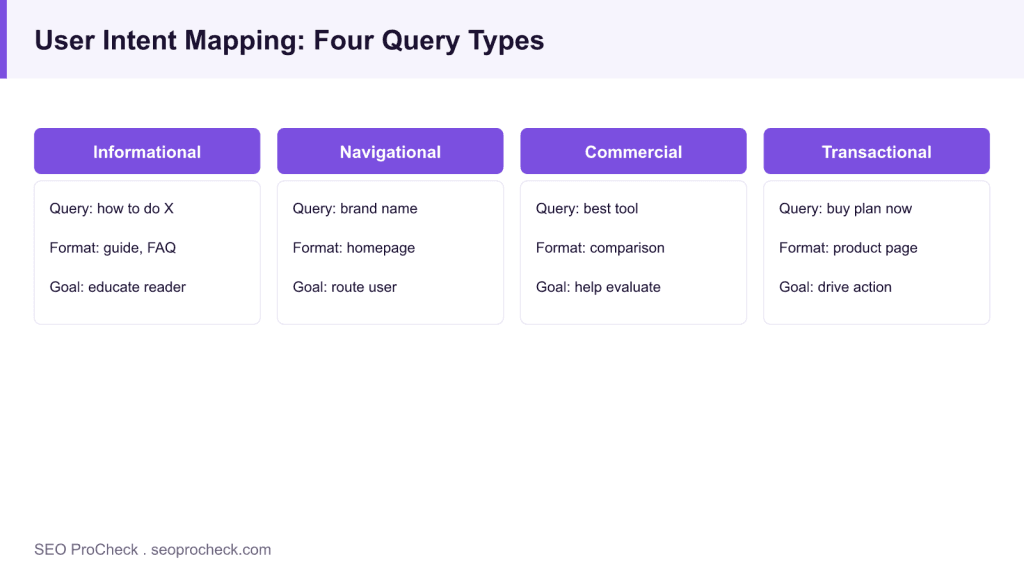
User intent mapping is the practice of matching every target query to the outcome the searcher wants, then choosing the page type and format that delivers it. Do it before you write, so each URL serves one dominant intent instead of quietly competing with your other pages.
- Plan around four core intents: informational, navigational, commercial investigation, and transactional.
- Confirm intent by reading the live SERP: the page types that already rank reveal what Google rewards.
- Keep one dominant intent per URL to prevent keyword cannibalization.
- Map each intent to a format: guides for learning, comparisons for evaluating, product or signup pages for buying.

What Intent Mapping Actually Involves
Intent mapping is the step where you decide what each searcher wants before you decide what to publish. The workflow is concrete: export your query list from Google Search Console or a keyword tool, cluster the queries into topics, label the dominant intent of each cluster, note the SERP features that appear, then assign a single target URL and page format to each cluster. Doing this first prevents the most common planning mistake, which is writing a long guide for a query that only ranks product pages.
Treat the map as the blueprint for the whole content plan. When every cluster has an owner URL and a format, you can see gaps (clusters with no page), overlaps (two pages chasing one cluster), and mismatches (a guide aimed at a transactional query) at a glance.
Reading the SERP to Confirm Intent
The fastest and most reliable intent signal is the current top ten. Open an incognito window, search the head term for a cluster, and note the dominant page type. A page of how-to articles and definitions signals informational intent. A page of category grids and product listings signals transactional intent. A page of best-of listicles and review roundups signals commercial investigation. Also record the SERP features present, because a shopping pack points to buying intent while a large People Also Ask block points to research intent.
Intent Signals and the Format Each One Needs
| Intent | Signals in the SERP | Best page format | Primary call to action |
|---|---|---|---|
| Informational | Guides, how-to posts, People Also Ask, videos | In-depth guide or tutorial | Read next, subscribe |
| Navigational | Brand homepage, sitelinks, login pages | Homepage or branded landing page | Go to account |
| Commercial | Listicles, best of roundups, review pages | Comparison or buyer guide | Compare options |
| Transactional | Product pages, category grids, shopping pack | Product or signup page | Buy or start trial |
Building the Intent Map
A working intent map is a simple spreadsheet with one row per query cluster and these columns: query, monthly volume, cluster, intent, target URL, format, and gap status. For example, a row for "keyword research tips" would be labelled informational, formatted as a guide, and pointed at your keyword research hub. A row for "best rank tracker" would be labelled commercial, formatted as a comparison, and pointed at a dedicated roundup. Filling the sheet forces a decision on every query and surfaces the cannibalization cases where two rows share one target URL.
Once the map is stable, it drives briefs. Each brief inherits the intent label and the format so writers know whether they are teaching, comparing, or converting before the first sentence.
Mixed and Shifting Intent
Some queries carry split intent, and Google shows a blend of formats to hedge. When that happens, lead with the dominant format and add one supporting section for the secondary need rather than trying to serve both equally on one page. Intent also drifts: a term can lean informational most of the year and turn transactional during a buying season. Re-check the SERP for your priority terms a few times a year and update the assigned format when the result mix moves.
For related workflows, see our guide to optimizing existing content for better rankings once pages are live, our framework for deciding when to consolidate versus create new content when a cluster already has pages, and more planning tactics in the keyword research library.
Understanding Search Intent
Search Intent represents a critical component of modern SEO strategy. As search engines continue to evolve and user expectations shift, understanding the nuances of search intent becomes essential for maintaining and improving organic visibility. This guide covers the key concepts, implementation approaches, and strategic considerations that SEO practitioners need to master.
Key Considerations for User Intent Mapping for Content Planning
When approaching search intent, several factors require careful attention. Technical implementation must align with broader SEO objectives while maintaining site performance and user experience. The balance between optimization and over-optimization requires ongoing monitoring and adjustment based on performance data and algorithm changes. Industry benchmarks and competitor analysis provide context for evaluating your own implementation.
Implementation Best Practices
Successful implementation begins with thorough auditing of current state and clear goal definition. Document baseline metrics before making changes to enable accurate impact measurement. Prioritize changes based on potential impact and implementation effort, focusing on high-impact items first. Test changes in staging environments when possible, and monitor closely after deployment to production. Maintain documentation of changes for future reference and troubleshooting.
Common Mistakes to Avoid
Several patterns consistently cause problems in search intent implementations. Rushing implementation without proper planning leads to errors that can be costly to fix. Ignoring the interplay between different SEO factors creates conflicts that undermine results. Failing to monitor and iterate based on performance data means missing optimization opportunities. Over-optimization signals can trigger algorithmic penalties that take months to recover from.
Measuring Success
Effective measurement requires defining appropriate KPIs aligned with business objectives. Track both leading indicators (rankings, impressions, technical metrics) and lagging indicators (traffic, conversions, revenue) to build a complete picture. Establish reasonable timeframes for evaluation, as SEO changes often take weeks or months to fully manifest in results. Compare performance against historical baselines and competitor benchmarks to contextualize results.
Strategic Recommendations
Approach search intent as an ongoing program rather than a one-time project. Build processes for regular auditing, monitoring, and optimization. Stay current with industry developments and algorithm changes that may affect your strategy. Invest in education for team members to build internal capabilities. Consider how search intent fits within your broader digital marketing and business strategy for maximum impact.
Frequently Asked Questions
How many search intents should I plan for?
Most planners use four: informational, navigational, commercial investigation, and transactional. Some teams split informational into learn and do, but four buckets are enough to assign a page type and format to every query.
How do I tell which intent a keyword has?
Search the term and read the top ten results. If the page types are guides and how-to articles the intent is informational; if they are product and category pages the intent is transactional. The pages Google already rewards reveal the intent it expects.
Can one page target more than one intent?
Aim for one dominant intent per URL so the page does not compete with itself. If a query shows blended results, lead with the dominant format and add a short secondary section rather than splitting focus across the whole page.
What tool columns do I need in an intent map?
A working map has query, monthly volume, cluster, intent label, target URL, format, and gap status. That is enough to spot cannibalization, missing formats, and pages that need to be built or merged.
Does search intent change over time?
Yes. Seasonality, news, and new SERP features can shift the dominant intent for a term. Re-check the SERP for priority keywords a few times a year and adjust the assigned format when the result mix changes.
Take this with you
The assistant links open with a question about this page already written. Nothing is sent until you press enter.
Claude Vincent is a technical SEO consultant focused on crawlability, rendering, and AI-search visibility. He writes the field guides and case studies at SEO ProCheck, with a bias toward the durable, unglamorous work that decides whether search engines and AI answer engines can actually read and cite a site.
About SEO ProCheck
Technical SEO consulting and GEO strategy with 20 years of enterprise experience. Case studies, resources, and tools for search and AI visibility.
Work With Me
Technical SEO audits, GEO strategy, site migrations, and international SEO. Hourly consulting for teams who need hands-on support, not just reports.
Subscribe to our newsletter!








Recent Posts
- Most Top Sites Never Say Who They Are in Structured Data October 14, 2026
- Homepage Titles Are Mostly Too Short, Not Too Long October 8, 2026
- Who Actually Serves an llms.txt? 184 Top Sites Measured September 29, 2026