

AI Summary
A HARO style link building strategy earns editorial links by pitching yourself as an expert source to journalists who post queries, now through successors like Qwoted and Featured after the original HARO platform closed in 2024. You win by responding fast, answering the exact question first, proving specific expertise, and handing over a publication ready quote with your link.
- The original HARO closed in 2024, but reactive source pitching thrives on successor platforms.
- These pitches earn high value editorial links from real publications.
- Speed and a self contained, quotable answer beat a famous name.
- Never fabricate credentials or data, because journalists verify sources.
HARO, short for Help a Reporter Out, taught a generation of SEOs a simple trick: journalists constantly need expert quotes, and if you supply a good one, you often earn a link from a publication you could never buy your way into. The platform itself is gone, but the method is stronger than ever. This guide covers the modern reactive PR landscape and, more importantly, the exact mechanics of writing pitches that get picked, because the strategy lives or dies on pitch quality, not on which tool you use.
What happened to HARO, and where the practice lives now
Cision rebranded Help a Reporter Out to Connectively in 2024 and then shut the service down in December 2024. The demand that made HARO work, journalists needing credible sources on deadline, did not disappear, so reporters moved to a set of successor platforms. When practitioners say HARO strategy today, they mean the discipline of reactive source pitching, and you execute it across the tools below rather than on any single site.
| Platform | Best for | Notes |
|---|---|---|
| Qwoted | Broad B2B and consumer queries | A leading successor after Connectively closed, free tier available |
| Featured | Expert answers for content and roundups | Question led, answers can appear across many publications |
| SourceBottle | Lifestyle, consumer, and niche media | Strong in some regions, lighter B2B coverage |
| Help a B2B Writer | Software, marketing, and B2B topics | Focused audience, less noise per query |
Sign up for the ones that match your niche, set alerts, and check them daily. The queries move fast, and the ones in your lane are the only ones worth your time.
Why these links are worth the effort
Reactive PR produces editorial links: a real journalist citing you inside a real article. These are the links Google trusts most because they are given on merit, hard to fake, and frequently placed on high authority news and trade domains. They also build the author authority and brand recognition that increasingly feed AI answer engines. The honest tradeoff is that you cannot guarantee placement and the volume is modest, so treat reactive PR as a quality play that complements, not replaces, the rest of your link program.
The anatomy of a pitch that gets picked
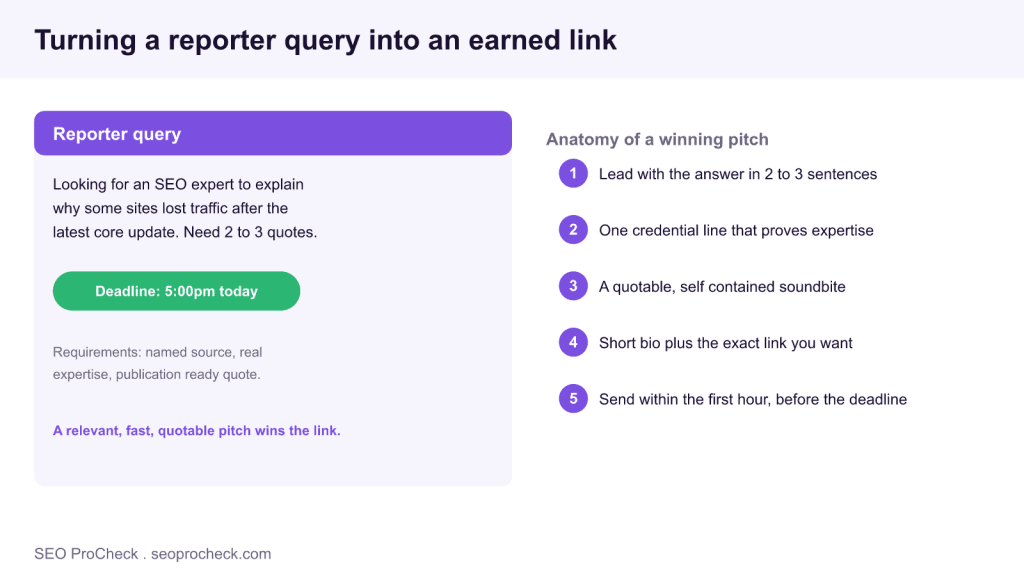
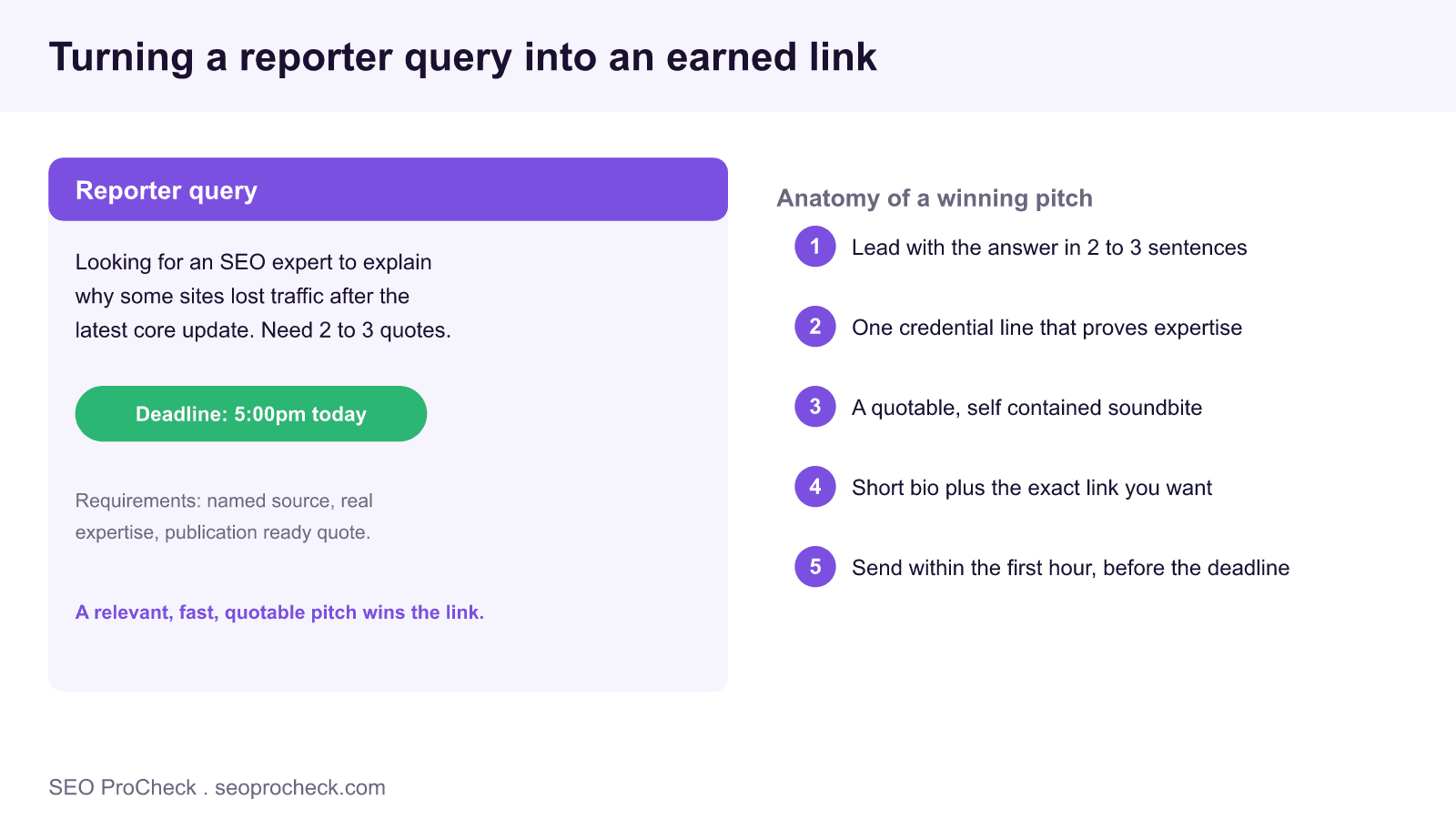
Journalists skim dozens of responses under deadline pressure, so your pitch has seconds to prove it is usable. Five elements separate a winning pitch from the pile that gets deleted. Lead with the answer in the first two or three sentences, before anything about yourself. Prove expertise with one tight credential line, a real role and a specific track record. Hand over a quotable, self contained soundbite the reporter can paste with no editing. Close with a short bio and the exact link you want, formatted cleanly. And send it fast, ideally within the first hour, because many journalists stop reading once they have enough good quotes.
Subject: SEO expert on why sites lost traffic after the core update

Hi [Name],

Answer first: most sites that dropped were hit on thin, templated
pages rather than the whole domain. The pattern is a quality signal
problem, not a penalty.

Quotable line: "Core updates do not punish sites, they re rank them.
The pages that fall are the ones a reader would not miss."

Why me: I have run technical SEO audits for 12 years and reviewed
40 plus sites through this update cycle.

Bio: Jane Doe, Senior SEO Consultant, https://example.com/author/jane/
Happy to expand or jump on a quick call before your 5pm deadline.
Notice the structure: the answer comes first, the credential is one line, the soundbite is genuinely quotable, and the link is delivered without fuss. There is no throat clearing and no padded introduction.
The mistakes that get you ignored or blacklisted
Most failed pitches share the same flaws. They arrive late. They pitch a product instead of answering the question. They bury the quote under a paragraph about the sender. They pad length to look substantial when journalists want the opposite. Worst of all, some invent statistics or inflate credentials, which is fatal: reporters verify sources, and a single exposed fabrication ends the relationship and can force a correction. Never manufacture data or claim expertise you do not have. If a query is outside your genuine wheelhouse, skip it.
Build authority so your pitches convert better
Journalists vet the sources they quote. A credible author page, a real bio, and verifiable profiles make the difference between a quote used and a quote dropped. Strengthen the person behind the pitch with a proper author entity, since that is what a reporter finds when they search your name. Our guide to ProfilePage schema for author bios shows how to make that authority machine readable and easy to verify.
Track results and stay on the right side of the line
Log every pitch, response, and placement, and monitor for the live link with a backlink tool or brand alerts, since reporters rarely notify you when a piece runs. Record the domain, whether the link is followed, and the anchor. Keep the whole practice clean: reactive PR is the opposite of the manipulative outreach that gets sites penalized, and it only works long term if journalists trust you. For the contrast, see our piece on avoiding spammy link outreach.
Related reading
Continue with our guide to avoiding link building outreach spam, the ProfilePage schema guide for author authority, and the wider link building resources.
Frequently asked questions
Is HARO still active in 2026?
The original Help a Reporter Out service was rebranded by Cision to Connectively in 2024 and then shut down in December 2024. The reactive PR practice it pioneered is very much alive, and journalists now source quotes through successors such as Qwoted, Featured, SourceBottle, and Help a B2B Writer. When people say HARO strategy today, they mean the method of pitching yourself as an expert source, not the specific defunct platform.
What kind of links does reactive PR build?
It earns editorial links from news sites, trade publications, and established blogs, placed inside real articles by real journalists. These are among the most valuable links in SEO because they are editorially given, hard to replicate, and often sit on high authority domains. The tradeoff is that placement is never guaranteed and volume is lower than with scalable tactics.
How fast do I need to respond to a query?
Speed is one of the strongest predictors of success. Journalists work on tight deadlines and often stop reading once they have enough usable quotes, so a pitch sent within the first hour has a large advantage over one sent near the deadline. Set up alerts, filter to your niche, and treat relevant queries as time sensitive.
Why do most pitches get ignored?
The common failures are being slow, being off topic, burying the quote under introductions, and failing to prove expertise. Journalists want a publication ready quote from a credible source with no editing required. A pitch that leads with a padded pitch about yourself instead of answering the question is deleted in seconds.
Do I need to be a recognized expert to get quoted?
You need demonstrable, specific expertise, not fame. A clear credential line, a real role, and a genuinely useful, specific answer will beat a vague pitch from a bigger name. Never fabricate credentials or invent data, since journalists verify sources and a single exposed fabrication ends the relationship and can trigger a correction.
How do I track results from reactive PR?
Track pitches sent, responses, and published placements, then monitor for the live link using a backlink tool or Google alerts for your brand. Record the publication, the domain authority, whether the link is followed or nofollowed, and the anchor. Reporters do not always notify you when a piece runs, so proactive monitoring is how you confirm the link and the referral value.
Take this with you
The assistant links open with a question about this page already written. Nothing is sent until you press enter.
Claude Vincent is a technical SEO consultant focused on crawlability, rendering, and AI-search visibility. He writes the field guides and case studies at SEO ProCheck, with a bias toward the durable, unglamorous work that decides whether search engines and AI answer engines can actually read and cite a site.
About SEO ProCheck
Technical SEO consulting and GEO strategy with 20 years of enterprise experience. Case studies, resources, and tools for search and AI visibility.
Work With Me
Technical SEO audits, GEO strategy, site migrations, and international SEO. Hourly consulting for teams who need hands-on support, not just reports.
Subscribe to our newsletter!








Recent Posts
- Most Top Sites Never Say Who They Are in Structured Data October 14, 2026
- Homepage Titles Are Mostly Too Short, Not Too Long October 8, 2026
- Who Actually Serves an llms.txt? 184 Top Sites Measured September 29, 2026