

AI Summary
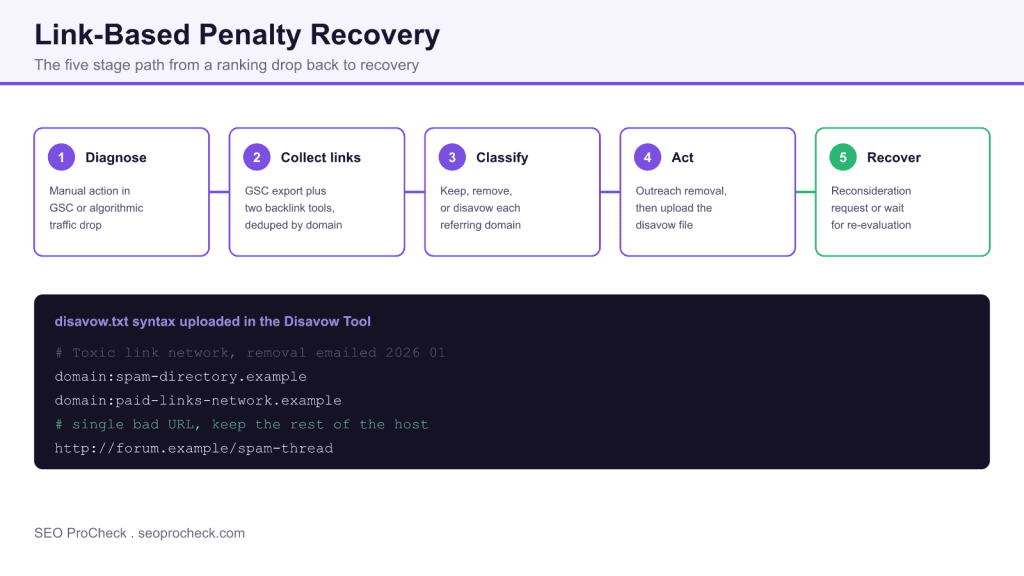
Link based penalty recovery is the process of diagnosing whether a ranking loss is a manual action or an algorithmic devaluation, cleaning the harmful part of your backlink profile, and proving the fix to Google. You collect the full link profile, classify each referring domain as keep, remove, or disavow, act through outreach and the disavow tool, then file a reconsideration request or wait for re-evaluation.
- Manual actions show in Search Console and need a reconsideration request; algorithmic drops lift only after a recrawl.
- Merge Search Console links with two backlink tools and dedupe by domain for a complete list.
- Disavow uses domain:example.com per host or a full URL per page, one entry per line, uploaded in a URL-prefix property, since the disavow tool does not support Domain properties.
- Recovery is staged, not instant: allow weeks to months for re-evaluation.
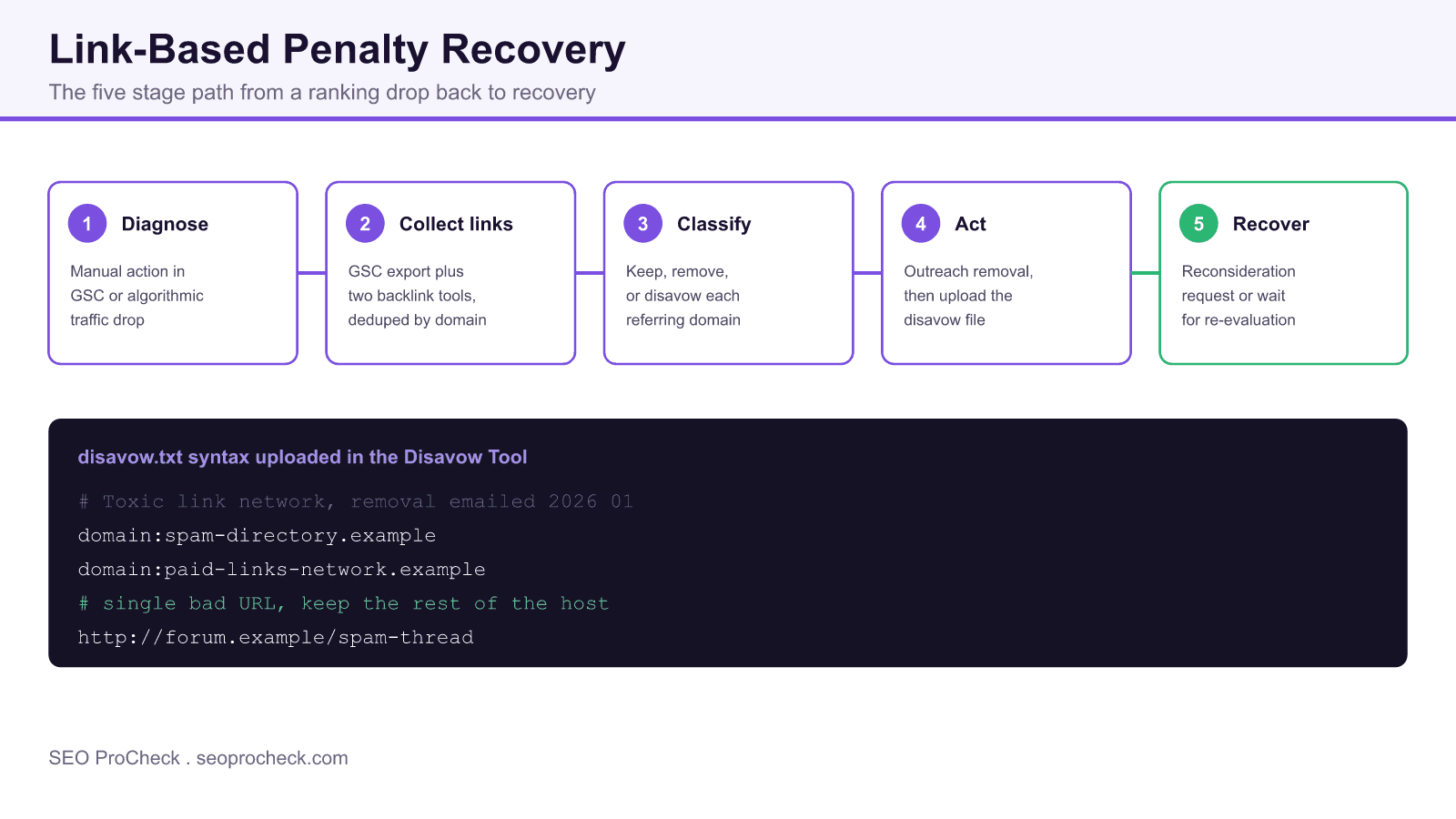
A link based penalty is one of the few SEO problems that can erase months of traffic overnight, and it is also one of the most misdiagnosed. Teams reach for the disavow tool at the first sign of a ranking dip, disavow healthy links, and make things worse. Recovery is a disciplined sequence: confirm what actually happened, assemble a complete picture of your link profile, judge each link on intent and relevance, act only where warranted, then prove the cleanup to Google. This guide walks the full process with the exact tools, file formats, and timelines involved.
Stage 1: Diagnose before you touch anything
Open Search Console and check Security and Manual Actions first. If there is a manual action for unnatural links, you will see it named there with the affected scope, and recovery will require a reconsideration request. If that panel is clean but traffic fell, you are likely dealing with algorithmic devaluation, which since Penguin 4.0 in 2016 runs inside Google core ranking and re-evaluates links continuously rather than during discrete refreshes. Line up the traffic drop date against known Google update dates and your own link building activity. If the fall matches an update and you have an aggressive link history, treat it as link related; if it matches a content or technical change, do not start disavowing links you do not need to.
Stage 2: Assemble the complete link profile
No single source sees every link. Export links from Search Console (Links report, then export External links, latest links and top linking sites), then supplement with at least two independent backlink crawlers so you catch what Google may not have surfaced. Merge everything and dedupe at the domain level, because you will make most decisions per referring domain rather than per URL.
| Source | What it gives you | Export path |
|---|---|---|
| Search Console | Links Google actually associates with you | Links, External links, Export |
| Backlink tool A | Historic and lost links, anchor text | Referring domains export |
| Backlink tool B | Cross check coverage gaps | Referring domains export |
| Merged master | Deduped domain level list for scoring | Your spreadsheet |
Stage 3: Classify keep, remove, or disavow
Score every referring domain into one of three buckets. Keep genuine editorial links from relevant sites. Flag for removal or disavow anything manipulative: paid link networks, private blog networks, site wide footer and sidebar links, exact match anchor text at scale, and links from unrelated or non indexed junk. Do not outsource judgment to a single toxicity score; a low score on a real editorial link is a false positive that costs you equity if you disavow it.
| Signal | Likely keep | Likely disavow |
|---|---|---|
| Relevance | Same topic or industry | Unrelated or spun content |
| Anchor text | Brand or natural phrases | Exact match money terms at scale |
| Placement | In content, editorial | Site wide footer or sidebar |
| Source quality | Indexed, real traffic | Non indexed link farm or PBN |
Stage 4: Act with removal first, then disavow
Try to get the worst links physically removed first, since a link that is gone is stronger evidence of good faith than a disavowed one. Send a short, specific outreach email to each host asking for removal and log the date and response. Whatever you cannot remove goes into the disavow file. Build a plain text UTF-8 file and upload it in the disavow tool for a URL-prefix property, since the tool does not support Domain properties. The syntax is strict:
# Paid network, removal requested Jan 2026
domain:spam-directory.example
domain:paid-links-network.example
# one bad page, keep the rest of the host
http://forum.example/spam-thread
Remember that each upload replaces the previous file entirely, so always submit your full cumulative list. Use domain: entries for whole hosts and reserve bare URLs for the rare case where one page on an otherwise fine site is the problem.
Stage 5: Recover and monitor
If you had a manual action, file a reconsideration request that documents what you found, what you removed, the outreach you attempted, and the disavow you uploaded. Be concrete and honest; reviewers reward evidence of genuine cleanup, not promises. If the issue was algorithmic, there is nothing to submit: you wait for Google to recrawl the disavowed domains and re-run its link systems, which typically takes several weeks to a few months. Track recovery on the affected pages and keywords rather than sitewide, and expect a staged return instead of an instant snap back.
Related work worth doing in parallel
Penalty recovery pairs naturally with rebuilding a clean profile and proving its worth, so plan your next campaign around measuring link building ROI so the replacements you earn are demonstrably profitable. If your traffic loss overlaps with weak pages, resolve any thin content penalty at the same time, and use the broader link building resources for the prospecting and outreach systems that keep future profiles clean.
Mistakes that stall recovery
The fastest way to prolong a penalty is to disavow in a panic. Teams that upload huge domain lists built from raw toxicity scores routinely neutralize the editorial links that were holding their remaining rankings up, deepening the loss they were trying to fix. Another common failure is uploading a partial disavow file, forgetting that each upload overwrites the last, which silently re-enables everything left off the new list. Weak reconsideration requests stall too: a one line note saying you cleaned up your links, with no export, no outreach log, and no disavow evidence, gives a reviewer nothing to approve. Impatience is its own trap, since re-crawling the disavowed domains takes time and re-uploading the same file every week does not speed anything up. Finally, many sites recover the penalty and then rebuild with the same manipulative tactics that caused it, guaranteeing a repeat. Treat recovery as a reset that only holds if the next profile is earned rather than bought, and keep the master link spreadsheet, outreach log, and disavow file version history so the whole cleanup is auditable months later when you need to prove what you did.
Frequently asked questions
What is the difference between a manual action and an algorithmic penalty?
A manual action is a human reviewer at Google flagging your site, and it appears in Search Console under Security and Manual Actions with a description and affected scope. An algorithmic suppression has no notification: rankings simply fall when a system like the link spam update re-evaluates your profile. Manual actions require a reconsideration request to lift; algorithmic ones lift on their own once the bad signals are gone and the site is recrawled.
Do I still need the disavow tool now that Penguin ignores spam links?
For purely algorithmic devaluation, Google says it often just ignores low quality links, so disavow is not always required. You still need it when you have a manual action for unnatural links, or when you paid for or built links yourself and cannot get them removed. Disavow is the honest way to tell Google you do not vouch for links you cannot control.
How do I format the disavow file correctly?
Upload a plain text UTF-8 file to the disavow tool in a URL-prefix property, since the tool does not support Domain properties. Use domain:example.com to neutralize an entire host, or a full URL on its own line for a single page. Lines starting with a hash are comments for your own records. Do not add spaces around the colon and keep one entry per line.
How long does link penalty recovery take?
A manual action can be lifted within days to a few weeks of an approved reconsideration request. Algorithmic recovery is slower because it waits for Google to recrawl the disavowed domains and re-run the relevant systems, which commonly takes several weeks to a few months. Recovery is rarely a full snap back; expect partial, staged improvement.
Can disavowing links hurt my rankings?
Yes, if you are careless. Disavowing healthy editorial links removes real equity, so classify conservatively and only neutralize links that are clearly manipulative or that you created. Because the file replaces the previous one on every upload, always work from your complete current list rather than a partial one.
How do I know which links are actually toxic?
Toxic patterns include site wide footer or sidebar links, exact match anchor text at scale, links from unrelated or non indexed sites, paid link networks, and obvious private blog networks. Judge intent and relevance rather than trusting a single third party toxicity score. When a link would embarrass you if a Google reviewer saw it, it belongs in the remove or disavow bucket.
Take this with you
The assistant links open with a question about this page already written. Nothing is sent until you press enter.
Claude Vincent is a technical SEO consultant focused on crawlability, rendering, and AI-search visibility. He writes the field guides and case studies at SEO ProCheck, with a bias toward the durable, unglamorous work that decides whether search engines and AI answer engines can actually read and cite a site.
About SEO ProCheck
Technical SEO consulting and GEO strategy with 20 years of enterprise experience. Case studies, resources, and tools for search and AI visibility.
Work With Me
Technical SEO audits, GEO strategy, site migrations, and international SEO. Hourly consulting for teams who need hands-on support, not just reports.
Subscribe to our newsletter!








Recent Posts
- Most Top Sites Never Say Who They Are in Structured Data October 14, 2026
- Homepage Titles Are Mostly Too Short, Not Too Long October 8, 2026
- Who Actually Serves an llms.txt? 184 Top Sites Measured September 29, 2026