

AI Summary
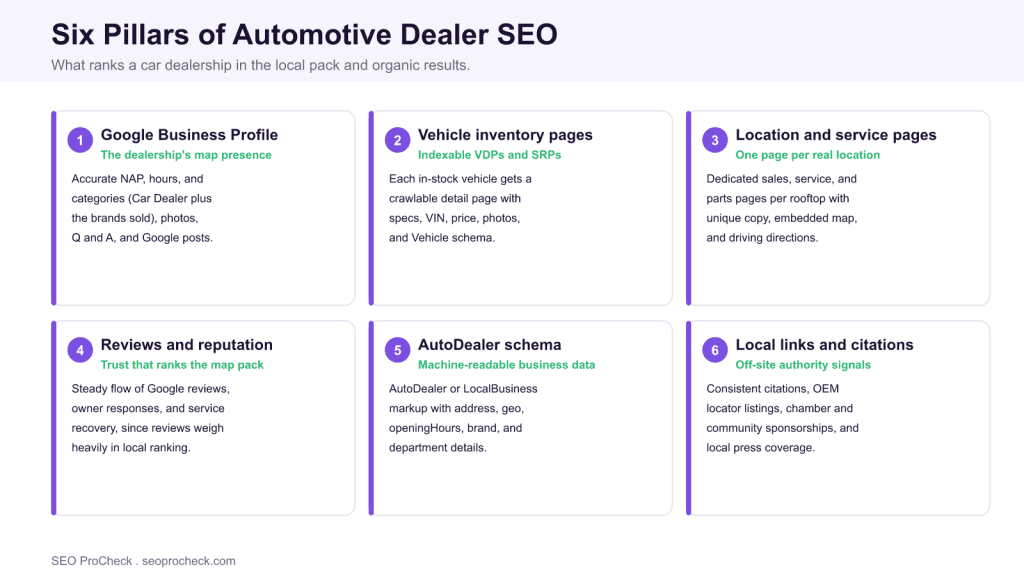
Automotive dealer SEO combines local SEO, which wins the map pack for "car dealer near me" style searches, with a large indexable inventory of vehicle pages that capture make, model, and trim queries. The work rests on six pillars: a fully optimized Google Business Profile, crawlable vehicle inventory pages, per location service pages, a steady flow of reviews, AutoDealer schema, and local links and citations.
- Optimize the Google Business Profile with correct categories, hours, photos, and posts for every rooftop.
- Make vehicle detail pages crawlable and indexable with specs, price, and Vehicle schema.
- Build a unique page per location and service, never one thin page for many stores.
- Earn reviews continuously, since they weigh heavily in local pack ranking.
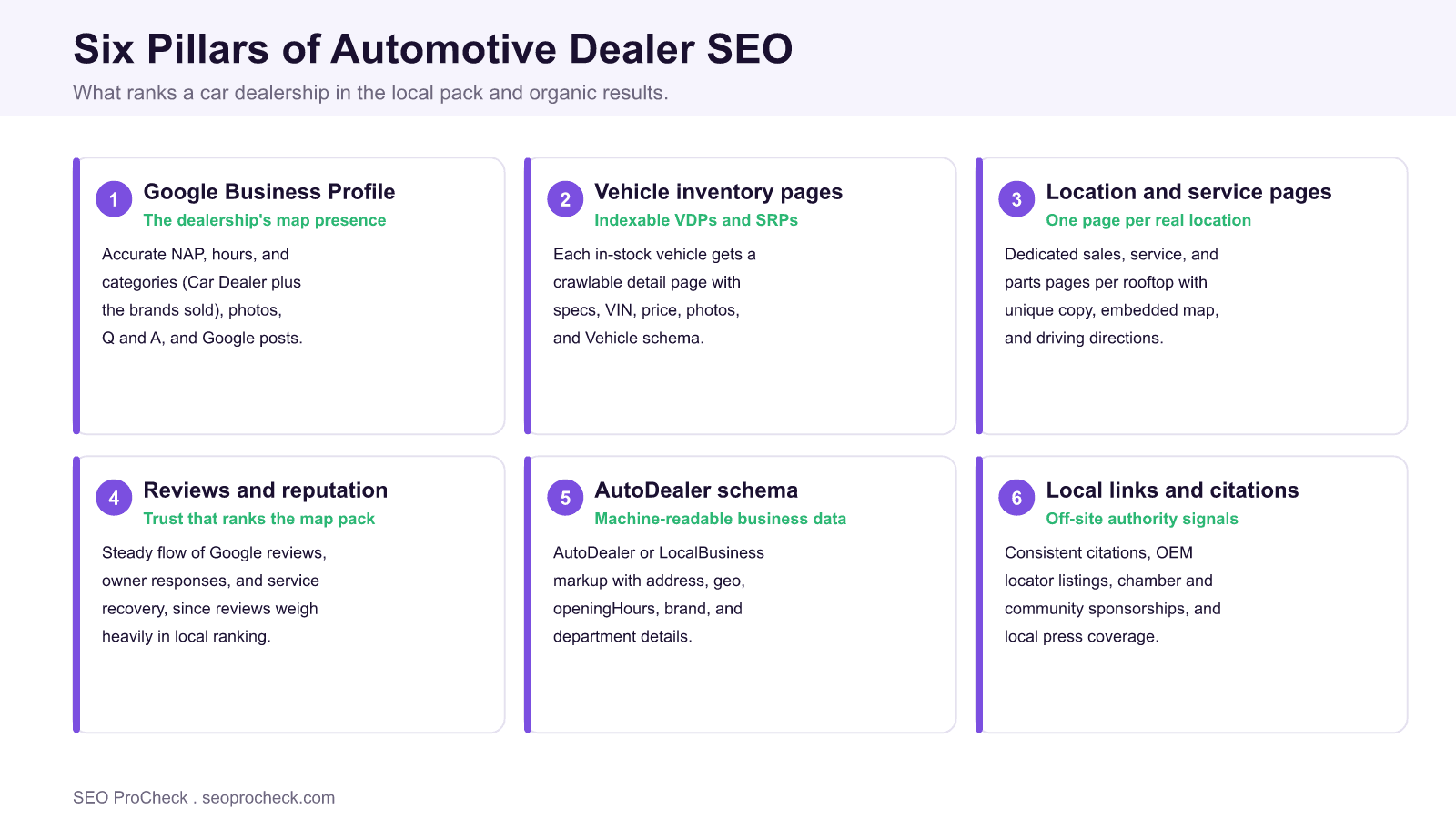
A car dealership is one of the hardest local businesses to rank because it competes on two fronts at once. It needs to win the local pack for high intent searches like "Toyota dealer near me," and it needs thousands of indexable inventory pages to capture the specific make, model, and trim queries that shoppers run before they ever visit. Most dealer sites, often built on a locked down platform provided by the manufacturer or a vendor, do neither well. This guide breaks automotive dealer SEO into six pillars and the concrete work each one demands.
The local pack half of this builds on standard local SEO fundamentals. If you are new to the discipline, start with our complete local SEO optimization guide and the local SEO ranking factors that decide map placement, then apply the dealer specific layers below.
1. Google Business Profile: the dealership's map presence
The Google Business Profile is the single biggest lever for map pack visibility. Claim and verify a profile for each physical rooftop, and get the details exactly right: the primary category should be the most specific option, usually "Car Dealer" or a brand specific category like "Toyota Dealer," with secondary categories for used cars, auto repair, and parts as applicable. Keep the name, address, and phone identical to what appears on your website and citations. Add current hours including service and parts departments, upload real photos of the lot and showroom, answer questions in the Q and A section, and publish Google posts for current offers. A neglected profile costs you the pack placement no amount of on-page work can recover.
2. Vehicle inventory pages: your indexable long tail
Every in-stock vehicle should have its own crawlable detail page (a VDP) reachable from indexable search result pages (SRPs). This is where dealers capture the enormous long tail of "2024 Honda CR-V EX-L" style queries. The problem on most platforms is that inventory pages are rendered through JavaScript, blocked from crawling, or churn so fast that pages 404 the moment a car sells. Ensure VDPs render their specs, VIN, price, and photos in crawlable HTML, and handle sold vehicles gracefully with a redirect to a relevant SRP or a "similar vehicles" page rather than a hard 404. Add Vehicle schema so the details are machine readable.
3. Location and service pages: one page per real location
Dealer groups with multiple rooftops must give each location its own page with genuinely unique content: address, embedded map, driving directions, staff, and location specific copy. Duplicating one template across every store with only the city name swapped is the classic multi location mistake that leaves all of them ranking poorly. Do the same for services: dedicated sales, service, parts, and financing pages carry their own keywords. Our guide to multi-location local SEO pages covers how to scale this without creating doorway pages.
4. Reviews and reputation: trust that ranks the pack
Reviews are a heavy local ranking factor and the deciding trust signal for a high consideration purchase like a car. Build a routine that requests a Google review after every sale and service visit, respond to every review including the critical ones, and use service recovery to turn a bad experience into a resolved public thread. Volume, recency, and velocity all matter, so a steady flow beats an occasional burst.
5. AutoDealer schema: machine-readable business data
Structured data helps search engines and AI assistants understand the dealership as an entity. Use AutoDealer markup, a specialized type of LocalBusiness, on your location pages. The properties below are the ones that carry the most weight.
| Schema property | What it describes | Why it matters |
|---|---|---|
@type: AutoDealer | The business is a car dealership | Correct entity type for the vertical |
address and geo | Postal address and coordinates | Anchors the location for local results |
openingHoursSpecification | Hours per department | Powers hours in the knowledge panel |
brand | Makes the dealer sells | Ties the dealer to brand queries |
department | Sales, service, parts as sub-entities | Represents distinct hours and roles |
For the full LocalBusiness property set that AutoDealer inherits, and the validation rules, see our LocalBusiness schema guide. For a deeper walkthrough of the vertical, our automotive SEO resource expands on inventory and platform issues.
6. Local links and citations: off-site authority
Consistent citations across directories, the manufacturer's dealer locator, local chambers, and community sponsorships build the off-site authority that supports both the pack and organic rankings. Keep the name, address, and phone identical everywhere, claim the OEM locator listing, and pursue genuinely local links through event sponsorships and press. Consistency matters more than volume: conflicting NAP data across citations actively suppresses local rankings.
Key takeaways
Automotive dealer SEO is local SEO plus a large, fast-changing inventory. Optimize a Google Business Profile per rooftop, keep vehicle detail pages crawlable and handle sold cars gracefully, build a unique page for every location and service, earn reviews continuously, mark up locations with AutoDealer schema, and keep citations consistent. Dealers that get all six pillars working together dominate both the map pack and the model level long tail that drives real showroom visits.
A fully optimized and actively managed Google Business Profile for each rooftop, backed by a steady flow of reviews. Together they drive the local pack placement that captures high intent "dealer near me" searches, which is where most dealership foot traffic originates.
Yes. Each in-stock vehicle should have a crawlable detail page with specs, VIN, price, and photos, reachable from indexable search result pages. These pages capture the specific make, model, and trim queries shoppers run, which is a large source of organic traffic dealers routinely miss.
Avoid a hard 404. Redirect the sold vehicle URL to a relevant search result page or a similar vehicles page so the visitor and any link equity land somewhere useful. Mass 404s from fast inventory turnover throw away link equity, clutter your reports, and hurt the experience.
Give every rooftop its own page with unique content, address, embedded map, and directions, plus a claimed Google Business Profile each. Never duplicate one template across stores with just the city swapped, which creates doorway style pages that all rank poorly.
Use AutoDealer schema, a specialized LocalBusiness type, on location pages, with address, geo, opening hours per department, brand, and department entities. Add Vehicle schema on individual inventory pages so their specs and price are machine readable.
Many locked down dealer platforms render inventory through JavaScript, block crawling, duplicate content across locations, and offer little control over titles and schema. Auditing what the platform actually outputs to crawlers, and supplementing it where you can, is often the biggest available win.
Is your dealer platform hiding your inventory from Google?
Blocked VDPs, duplicate location pages, and inconsistent citations quietly cap dealer rankings. An audit shows exactly what crawlers see.
Take this with you
The assistant links open with a question about this page already written. Nothing is sent until you press enter.
Claude Vincent is a technical SEO consultant focused on crawlability, rendering, and AI-search visibility. He writes the field guides and case studies at SEO ProCheck, with a bias toward the durable, unglamorous work that decides whether search engines and AI answer engines can actually read and cite a site.
About SEO ProCheck
Technical SEO consulting and GEO strategy with 20 years of enterprise experience. Case studies, resources, and tools for search and AI visibility.
Work With Me
Technical SEO audits, GEO strategy, site migrations, and international SEO. Hourly consulting for teams who need hands-on support, not just reports.
Subscribe to our newsletter!








Recent Posts
- Most Top Sites Never Say Who They Are in Structured Data October 14, 2026
- Homepage Titles Are Mostly Too Short, Not Too Long October 8, 2026
- Who Actually Serves an llms.txt? 184 Top Sites Measured September 29, 2026