

AI Summary
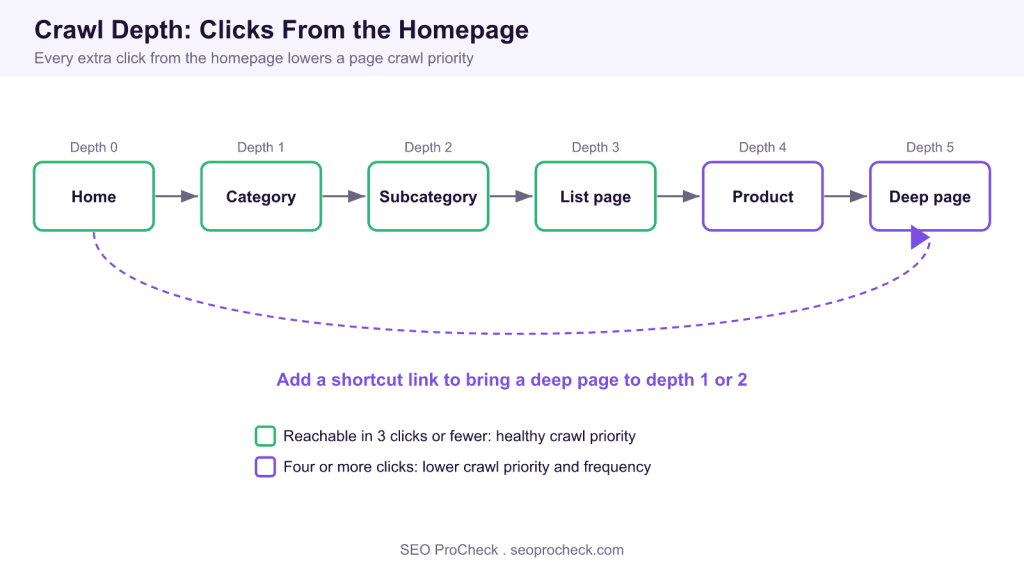
Crawl depth is the number of clicks it takes to reach a page from the homepage. Pages that sit four or more clicks deep are crawled less often and are treated as less important, so the fix is to flatten the path with internal links, breadcrumbs, and sitemaps until every page that matters is reachable in three clicks or fewer.
- Crawl depth counts clicks from the homepage, not folders in the URL path.
- Depth of four or more lowers crawl frequency and can push pages out of the index.
- Fix it by linking deep pages from shallow hubs and category pages, not only from the sitemap.
- Detect it with Screaming Frog or Sitebulb, which both report a crawl depth value per URL.
Quick Reference
Element Code: LI-013
Issue: Pages require many clicks from homepage to reach
Impact: Lower crawl priority, may be seen as less important
Fix: Flatten site architecture or add shortcut links
Detection: Screaming Frog, Sitebulb
What Is This Issue?
Pages deep in your site structure (requiring 4+ clicks from homepage) receive less crawl attention and may be perceived as less important by search engines.
Why This Matters for Your Website
Crawl depth correlates with page importance signals. Deep pages are crawled less frequently and may rank lower.
How to Fix This Issue
- Flatten structure: Reduce clicks needed to reach pages
- Add links: Link from higher-level pages
- Use sitemaps: HTML sitemaps can provide shortcuts
Tools for Detection
- Screaming Frog: Reports crawl depth
TL;DR (The Simple Version)
Important pages are buried too deep in your site. If a page matters, it should be reachable in 3 clicks or fewer from your homepage.
How Crawl Depth Is Actually Measured
Crawl depth is the shortest number of link clicks a crawler needs to travel from the homepage to reach a given page. A crawler starts at the homepage, which is depth 0, follows every link it finds to build depth 1, follows the links on those pages to build depth 2, and continues outward. The depth recorded for any page is the shallowest path found, so a product page that is buried five clicks down through category navigation but also linked from a homepage promo block is recorded at depth 1. This is why a single well placed link can rescue an otherwise deep page.
One point causes constant confusion: crawl depth is not the same as the folder depth in the URL. A page at example.com/a/b/c/d/ can still be depth 1 if the homepage links straight to it, and a page at example.com/page/ can be depth 6 if the only route to it runs through five layers of pagination. Search engines care about the click path, not the slashes in the address.
Why Deep Pages Get Crawled Less
Search engines allocate a finite crawl budget to every site and spend it where they expect value. Depth is one of the clearest signals they use to rank that expectation: a page the site itself keeps many clicks away from the homepage looks like a page the site considers minor. The practical effects compound. Deep pages are discovered later, recrawled less often, and slower to reflect content changes in the index. On large sites the deepest pages may go so long between crawls that they quietly fall out of the index altogether, which is the point at which a depth problem becomes a lost traffic problem.
Depth also interacts with internal link equity. Authority flows through internal links, and every additional hop from a strong page dilutes what reaches the destination. A page at depth 6 is not only crawled rarely, it also inherits very little ranking strength from the pages that link to it. Flattening the structure fixes both problems at once.
Crawl Depth Bands and What They Mean
The table groups depth into practical bands so you can triage a crawl report quickly. Treat the bands as guidance for a typical site, then adjust for scale: a very large catalog will naturally run one band deeper than a small brochure site.
| Depth (clicks from home) | Typical crawl behavior | What to do |
|---|---|---|
| 0 to 1 | Crawled most often and read as the most important pages | Reserve this band for the homepage and top hub pages |
| 2 to 3 | Crawled regularly, a healthy home for most content | Keep money pages and priority content within this band |
| 4 to 5 | Crawled less often, slower to update and to rank | Add shortcut links from shallower category and hub pages |
| 6 or more | Rarely crawled and at real risk of dropping from the index | Restructure the navigation or flatten the hierarchy |
How to Flatten the Path to Deep Pages
Flattening is a linking exercise, not a URL rewrite. You rarely need to move pages or change addresses. You need to give important pages shorter routes in from pages the crawler already reaches early. Work through these levers in order of impact.
- Link from hub and category pages. The fastest win is to surface deep pages on the category, collection, or hub pages that already sit at depth 1 or 2. A well curated category page that links to its best products pulls all of them up a level.
- Add contextual and related links. In body content, related product blocks, and see also modules, link across to pages that would otherwise only be reachable through deep navigation.
- Use breadcrumbs. Breadcrumb navigation gives every page a short, consistent path back toward the homepage and spreads shallow internal links throughout the site.
- Fix pagination traps. Content reachable only by clicking through page 2, page 3, and beyond climbs in depth fast. Add filtered hub pages, a view all option where practical, or direct links to the important items so they are not stranded behind paging.
- Keep sitemaps as a backstop, not the fix. An XML sitemap helps discovery, but it does not lower crawl depth or pass internal link equity. Submit the sitemap, then still fix the on site links.
How to Find Your Deepest Pages
Every technical crawler reports depth, though each labels it slightly differently. In Screaming Frog, run a crawl from the homepage, then read the Crawl Depth column in the Internal tab or open the Site Structure tab in the right panel for a depth histogram. Sort the Crawl Depth column descending to list your deepest URLs first. In Sitebulb, the Crawl Depth and Crawl Maps views show the same information visually and flag pages that sit unusually far from the homepage. To confirm the real world impact, cross reference those deep URLs with the Crawl Stats report and the Pages report in Google Search Console, where rarely crawled pages show a stale Last crawled date.
How to Verify the Fix
After you add the internal links, recrawl the site from the homepage and confirm the pages you cared about now report a lower depth value. The pages you shortcut from the homepage should show depth 1 or 2, and no important page should remain at depth 6 or beyond. Over the following weeks, watch the Last crawled dates in Search Console move forward on those URLs, which is the signal that the crawler is now returning more often.
Common Mistakes
- Treating the XML sitemap as the cure. A sitemap aids discovery but does not reduce depth or pass link equity, so deep pages listed only in the sitemap stay deep.
- Confusing folder depth with crawl depth. A short URL can still be many clicks deep, and a long URL can be one click deep. Measure the click path, not the slashes.
- Linking deep pages only from other deep pages. A shortcut only helps when it comes from a page the crawler already reaches early, so link in from shallow hubs.
- Ignoring orphan pages. A page with no internal links at all has effectively infinite depth. See the orphan pages check below for how those surface.
Related SEO ProCheck resources
- Orphan pages: pages with no internal links at all, the extreme case of a depth problem.
- Redirect chains and loops: extra hops that quietly add to the click path and slow crawling.
- Links checks overview: the full set of internal linking and crawl checks.
Frequently Asked Questions
What is crawl depth in SEO?
Crawl depth is the number of link clicks it takes a search engine to reach a page starting from the homepage. The homepage is depth 0, pages linked directly from it are depth 1, and so on. The value recorded for a page is its shortest click path, so one well placed link can make a deep page shallow.
How many clicks deep is too deep?
As a rule of thumb, keep any page you want ranked within three clicks of the homepage. Pages at four or more clicks are crawled less often and treated as less important, and pages beyond six clicks risk dropping out of the index on larger sites. Adjust the threshold up slightly for very large catalogs.
Does crawl depth affect rankings?
Indirectly, yes. Depth is not a direct ranking factor, but deep pages are crawled less often, update slower in the index, and inherit less internal link equity, all of which suppress how well they rank. Flattening the path improves both crawl frequency and the authority that reaches the page.
How do I find pages with high crawl depth?
Crawl your site from the homepage with Screaming Frog or Sitebulb and read the Crawl Depth column, sorted from deepest to shallowest. Both tools also offer a visual site structure or crawl map view. Cross reference the deepest URLs with the Crawl Stats and Pages reports in Google Search Console to see which are rarely crawled.
How do I reduce a page crawl depth?
Add internal links to the deep page from pages the crawler already reaches early, such as category pages, hub pages, and related content blocks near depth 1 or 2. Breadcrumbs and fixing pagination traps help too. Submitting an XML sitemap aids discovery but does not lower depth on its own.
Is crawl depth the same as URL folder depth?
No. Crawl depth counts clicks from the homepage, while folder depth counts the slashes in the URL path. A page with a long URL can be one click deep if the homepage links to it, and a page with a short URL can be many clicks deep if it is buried in navigation. Search engines care about the click path.
Take this with you
The assistant links open with a question about this page already written. Nothing is sent until you press enter.
Claude Vincent is a technical SEO consultant focused on crawlability, rendering, and AI-search visibility. He writes the field guides and case studies at SEO ProCheck, with a bias toward the durable, unglamorous work that decides whether search engines and AI answer engines can actually read and cite a site.
About SEO ProCheck
Technical SEO consulting and GEO strategy with 20 years of enterprise experience. Case studies, resources, and tools for search and AI visibility.
Work With Me
Technical SEO audits, GEO strategy, site migrations, and international SEO. Hourly consulting for teams who need hands-on support, not just reports.
Subscribe to our newsletter!








Recent Posts
- Most Top Sites Never Say Who They Are in Structured Data October 14, 2026
- Homepage Titles Are Mostly Too Short, Not Too Long October 8, 2026
- Who Actually Serves an llms.txt? 184 Top Sites Measured September 29, 2026