

AI Summary
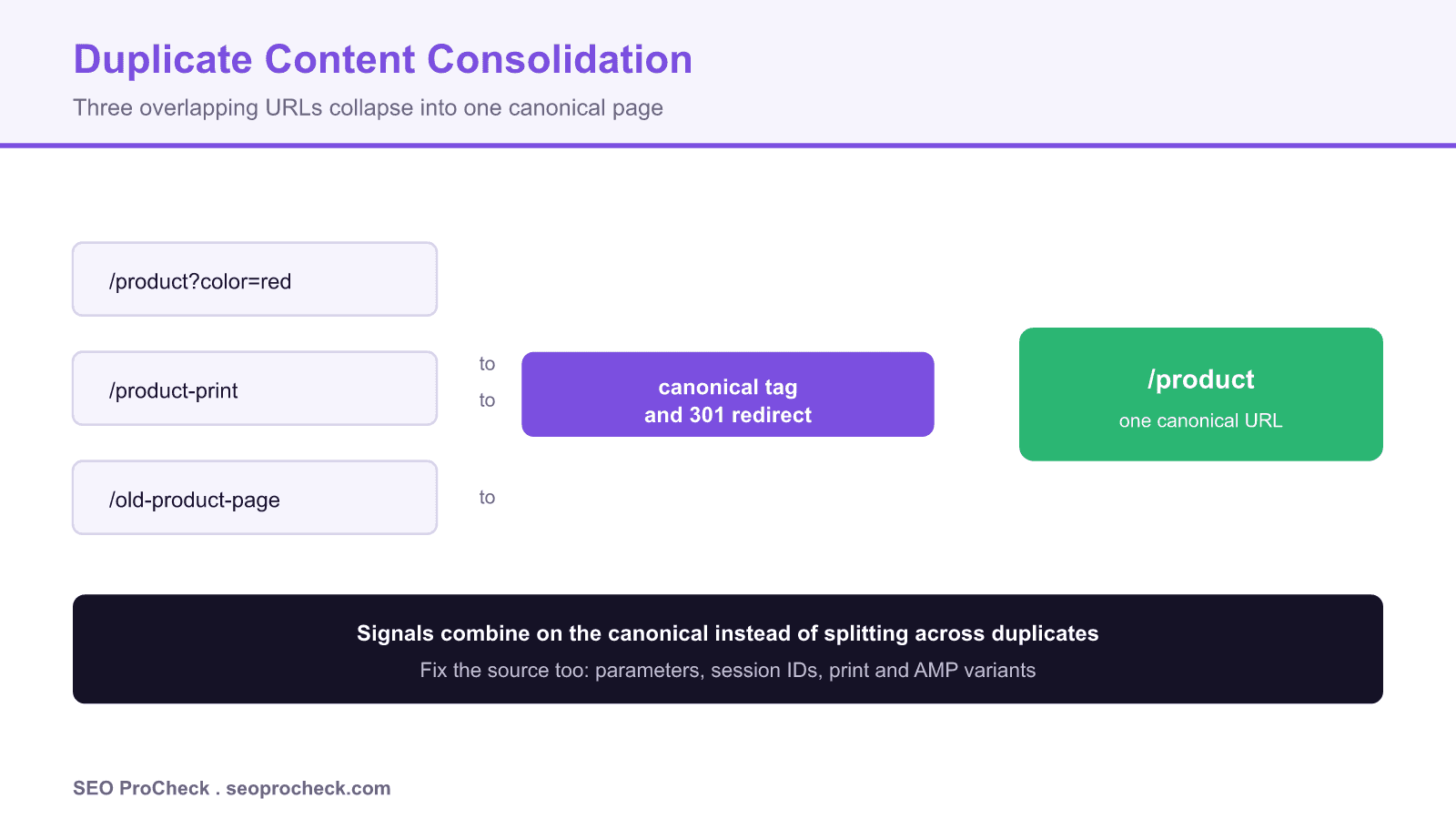
Duplicate content consolidation combines overlapping or near-identical pages into a single canonical URL so their ranking signals stack instead of competing. The main tools are the canonical tag for near-duplicates you must keep and the 301 redirect for pages you can merge outright.
- Duplicate content splits ranking signals across URLs that compete with each other.
- Use rel canonical to point near-duplicates at the version you want indexed.
- Use a 301 redirect to merge pages you can retire, combining their equity on one URL.
- Fix the source of duplication too: URL parameters, session IDs, and printer or AMP variants.
Duplicate content rarely triggers a penalty, but it quietly caps performance. When the same or nearly the same content lives at several URLs, search engines have to pick which one to rank, and the ranking signals that should sit on one strong page get split across competing copies. Consolidation is the fix: you combine those overlapping pages into a single canonical URL so their signals stack. This piece covers when to use a canonical tag, when to use a redirect, and how to stop duplication at its source, drawing on the patterns common to consolidation case studies.
Why duplicate content limits growth
Imagine three URLs that each cover the same product or topic. Each might attract a few links and a little ranking strength, but none is strong enough to compete because the equity is spread thin. Search engines also waste crawl attention fetching redundant copies, and they may index a version you did not intend, such as a parameter URL or a print page. The symptom is a set of pages that all rank on page two rather than one page that ranks on page one. A free duplicate content checker helps you find these clusters, and our duplicate content guide frames the whole problem.
Tool one: the canonical tag
The rel="canonical" link element tells search engines which version of a set of near-duplicates is the one to index and rank. You place it in the <head> of every duplicate, pointing at the preferred URL, and the others are treated as signals feeding that canonical rather than as independent competitors. Canonicalisation is the right tool when you need to keep the duplicate URLs live, for example product variants by colour or size, or tracking-parameter URLs; for syndicated copies, Google now recommends that partners block indexing of their copy instead. Remember that a canonical is a strong hint, not an absolute command, so keep the duplicates consistent and do not send mixed signals. Our canonical tags complete reference covers the edge cases.
| Situation | Best tool | Why |
|---|---|---|
| Keep both URLs live | rel canonical | Consolidates signals without removing the page |
| Retire a page for good | 301 redirect | Merges equity and sends users to the survivor |
| Parameter and session URLs | Canonical plus parameter handling | Stops accidental duplicate indexing |
| Print or AMP variants | Canonical to the main version | Keeps the primary URL as the indexed one |
| Merging thin overlapping articles | Consolidate then 301 | One strong page beats several weak ones |
Tool two: the 301 redirect
When you do not need the duplicate URL to exist any more, a 301 redirect is stronger than a canonical because it removes the duplicate outright and passes its accumulated equity to the target. This is the tool for merging several thin, overlapping articles into one comprehensive page: move the useful content into the survivor, then 301 each retired URL to it. The result is one authoritative page carrying the combined links and history of all the originals. Case studies of consolidation repeatedly show that this merge-and-redirect pattern, rather than canonical tags alone, produces the clearest ranking gains, because it fully removes the internal competition.
Fix the source, not just the symptom
Consolidating today's duplicates is wasted effort if your site keeps generating new ones. The common sources are URL parameters for filtering and tracking, session IDs appended to URLs, trailing-slash and case inconsistencies, HTTP and HTTPS or www and non-www versions served in parallel, and separate print or AMP variants. Address each at the platform level: enforce one canonical protocol and host with redirects, handle parameters deliberately, and canonicalise machine-generated variants to their primary URL. Our guide to managing duplicate content from URL variations lists the specific rules to put in place.
A simple consolidation workflow
Find the duplicate clusters, decide the single winner for each, and choose the tool: canonical when the duplicates must stay live, 301 when they can be retired. Update internal links to point at the survivor so you are not routing authority through redirects, then verify in Search Console that the intended URL is the one indexed. Finally, close the tap by fixing whatever was generating duplicates in the first place. Done in that order, consolidation turns a scattered set of also-ran pages into a smaller set of pages strong enough to win.
A checklist before you consolidate
Consolidation is easy to get wrong in ways that cost traffic, so run a short checklist first. Confirm the two pages truly serve the same intent rather than merely sharing keywords, because merging pages that answer different questions can strip out useful coverage. Choose the survivor by strength, using existing rankings, backlinks, and traffic rather than which URL you happen to prefer. Preserve the best material from every page you retire so the merged page is genuinely more complete, not just a copy of the winner. Map every retired URL to its 301 target before you flip anything, and update the internal links and any XML sitemap entries that referenced the old URLs. Finally, keep the redirects permanent rather than temporary, and check in Search Console after a few weeks that the surviving URL is the one indexed and that the retired URLs show as redirected. Follow that sequence and consolidation reliably concentrates strength instead of scattering it further.
Source: https://searchengineland.com/3-case-studies-duplicate-content-consolidation-286263
Frequently asked questions
Does duplicate content cause a Google penalty?
Usually not a penalty, but it caps performance. Search engines must choose which duplicate to rank, so the ranking signals that should sit on one page get split across competing copies.
Should I use a canonical tag or a 301 redirect?
Use a canonical tag when the duplicate URLs must stay live, such as product variants or parameter URLs. Use a 301 redirect when you can retire the duplicate, because it merges equity onto the surviving page.
How do I consolidate several thin articles?
Pick the strongest page as the survivor, move the useful content from the others into it, then 301 redirect each retired URL to the survivor and update internal links to point at it.
What causes duplicate content in the first place?
Common sources include URL parameters, session IDs, trailing-slash and case inconsistencies, parallel HTTP and HTTPS or www and non-www versions, and separate print or AMP variants.
Is a canonical tag a command or a hint?
It is a strong hint, not an absolute command. Keep your signals consistent, avoid pointing canonicals in conflicting directions, and pair them with clean internal linking so search engines follow your intent.
How do I find duplicate pages on my site?
Use a duplicate content checker or a crawl tool to surface clusters of near-identical pages, then review URL parameters and variant pages, and confirm in Search Console which version is indexed.
Take this with you
The assistant links open with a question about this page already written. Nothing is sent until you press enter.
Claude Vincent is a technical SEO consultant focused on crawlability, rendering, and AI-search visibility. He writes the field guides and case studies at SEO ProCheck, with a bias toward the durable, unglamorous work that decides whether search engines and AI answer engines can actually read and cite a site.
About SEO ProCheck
Technical SEO consulting and GEO strategy with 20 years of enterprise experience. Case studies, resources, and tools for search and AI visibility.
Work With Me
Technical SEO audits, GEO strategy, site migrations, and international SEO. Hourly consulting for teams who need hands-on support, not just reports.
Subscribe to our newsletter!








Recent Posts
- Most Top Sites Never Say Who They Are in Structured Data October 14, 2026
- Homepage Titles Are Mostly Too Short, Not Too Long October 8, 2026
- Who Actually Serves an llms.txt? 184 Top Sites Measured September 29, 2026