

AI Summary
Adding a qualifier word such as Custom to an H1 is a small on-page change that can shift how well a page matches intent, and SEO split testing is how you find out whether it helps before rolling it out site wide. Test the wording on a bucket of similar pages against a control, then deploy only if the uplift is statistically clear.
- Small H1 wording changes can change how a page matches searcher intent.
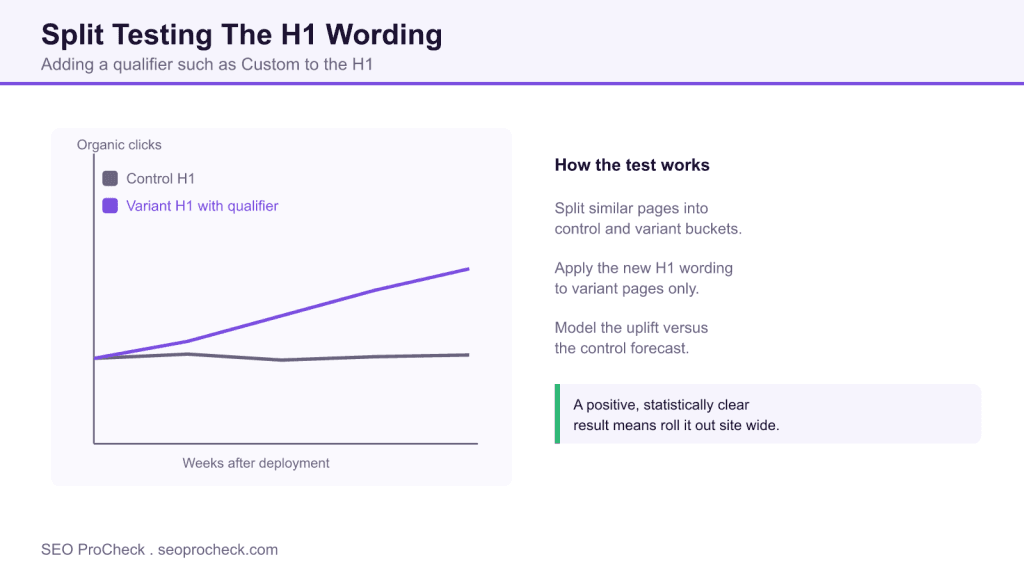
- Split testing applies the change to variant pages and holds similar pages as control.
- A positive, statistically clear result is the signal to roll the change out broadly.
- Heading wording works best when it aligns with the title tag and the on-page intent.

The hypothesis behind the test
The case study in the source below sits in the SEO split-testing tradition, where a specific wording change is treated as a hypothesis to be measured rather than an assumption to be trusted. Here the change was adding a qualifier, the word Custom, to the H1 of a group of pages. The logic is that a single well-chosen word can sharpen how a page matches what searchers actually want, for example signaling made to order rather than off the shelf.
Because headings and titles carry different weight, it helps to read this alongside our guide on how to structure headings for SEO and the companion piece on title tags and meta descriptions.
How SEO split testing works
The method is what separates a case study from an anecdote. Take a set of similar pages, a category of product or location templates, and randomly split them into two buckets. Apply the new H1 wording to the variant bucket only, leaving the control bucket unchanged. Then compare organic performance between the two groups and model the uplift against what the control predicts the variant would have done without the change. That control forecast is the point: it strips out seasonality, algorithm updates and general trend, so the remaining difference can be attributed to the H1 edit with statistical confidence.
Reading the result
A test can land three ways. A positive, statistically clear result means the wording helped and should roll out across the template. A flat result means the change made no meaningful difference, which is itself useful because it saves you from cargo-culting a tweak that does nothing. A negative result means back it out. The discipline is to act on the data rather than on how much you like the idea. Relevance is why wording moves the needle at all, and the heading structure reference is a good grounding for what a heading is supposed to communicate.
Applying it without a testing platform
Most sites cannot run a formal split test, but the thinking still transfers. Change the H1 wording on a coherent group of pages at once, annotate the exact date, and hold a comparable group untouched as an informal control. Watch clicks and average position for both groups over several weeks. It is less rigorous than a modeled test, but it beats changing one page and crediting any movement to your edit. Whatever you conclude, make sure the H1, the title tag and the page body all tell the same story about intent.
Possible split test outcomes
| Outcome | What it means | Action |
|---|---|---|
| Positive and statistically clear | The wording helped variant pages | Roll out to the full template |
| Flat or inconclusive | No meaningful difference detected | Keep the simpler version, test something else |
| Negative | The change reduced performance | Revert the variant pages |
What has changed since
Since this case study, SEO split-testing tooling and methodology have matured and become more widely adopted, but the underlying logic is unchanged: measure a wording change against a control forecast before rolling it out, and let the data rather than opinion drive the decision.
Case summary and source
The original third-party summary and attribution for this page are preserved below.
Content-driven SEO success requires strategic approaches to creation, optimization, and management. This case study demonstrates how content strategy directly drives organic growth when aligned with user needs and search behavior.
Content Strategy Framework
Effective content strategy begins with understanding target audiences, their questions, and the competitive content landscape. This case study outlines the strategic framework that guided content decisions, from topic selection to format choices.
Content Development Process
Moving from strategy to published content requires efficient processes for research, creation, and optimization. This case study documents workflows, quality standards, and production approaches that enabled consistent, high-quality output.
Optimization and Distribution
Published content requires ongoing optimization based on performance data. This case study covers how content was refined post-publication, how internal linking supported content performance, and how distribution amplified content reach.
Results and Attribution
Measuring content ROI requires connecting content efforts to business outcomes. This case study demonstrates the traffic, engagement, and business results achieved through strategic content investment. Attribution methodology helps validate content strategy effectiveness.
Content SEO case studies help practitioners build cases for content investment with documented results.
Source: https://www.searchpilot.com/resources/case-studies/seo-split-test-lessons-adding-custom-to-the-h1/
Frequently asked questions
Why would adding a word to the H1 change rankings?
A single qualifier can sharpen how well a page matches searcher intent, for example signaling a custom or made to order option. That improved match can affect click-through and relevance, which is why it is worth testing rather than assuming.
What is a control group in an SEO split test?
It is a bucket of similar pages left unchanged so their performance can predict what the changed pages would have done without the edit. Comparing the variant against that forecast isolates the real effect of the change.
How long should an SEO split test run?
Long enough to gather statistically meaningful data across normal weekly cycles, often several weeks. The exact duration depends on traffic volume and how large an effect you are trying to detect.
What if I do not have a split-testing tool?
Change the wording across a coherent group of pages at once, record the date, and watch clicks and position against a comparable untouched group. It is less rigorous but far better than editing a single page and guessing.
Should the H1 and title tag use the same qualifier?
Aligning them helps because the H1, title tag and body should tell a consistent story about intent. They do not have to be identical, but a contradictory H1 and title send mixed signals.
Is a flat test result a failure?
No. A flat result tells you the change does not help, which saves effort and prevents you from rolling out a tweak with no benefit. Knowing what does not work is a legitimate testing outcome.
Take this with you
The assistant links open with a question about this page already written. Nothing is sent until you press enter.
Claude Vincent is a technical SEO consultant focused on crawlability, rendering, and AI-search visibility. He writes the field guides and case studies at SEO ProCheck, with a bias toward the durable, unglamorous work that decides whether search engines and AI answer engines can actually read and cite a site.
About SEO ProCheck
Technical SEO consulting and GEO strategy with 20 years of enterprise experience. Case studies, resources, and tools for search and AI visibility.
Work With Me
Technical SEO audits, GEO strategy, site migrations, and international SEO. Hourly consulting for teams who need hands-on support, not just reports.
Subscribe to our newsletter!








Recent Posts
- Most Top Sites Never Say Who They Are in Structured Data October 14, 2026
- Homepage Titles Are Mostly Too Short, Not Too Long October 8, 2026
- Who Actually Serves an llms.txt? 184 Top Sites Measured September 29, 2026