

Does aligning keywords with search queries increase organic traffic?
- August 10, 2023
- Content

AI Summary
Aligning the words on your page with the words people actually search for tends to increase organic traffic, and it can be proven with a controlled split test. The gains come from matching searcher language in titles, headings, and body copy rather than from stuffing keywords.
- Match page language to the real queries a page already earns impressions for.
- Rewrite titles, H1, and headings before touching the body.
- Validate the change with a controlled SEO split test, not a before and after guess.
- The effect is about relevance and intent match, not keyword density.
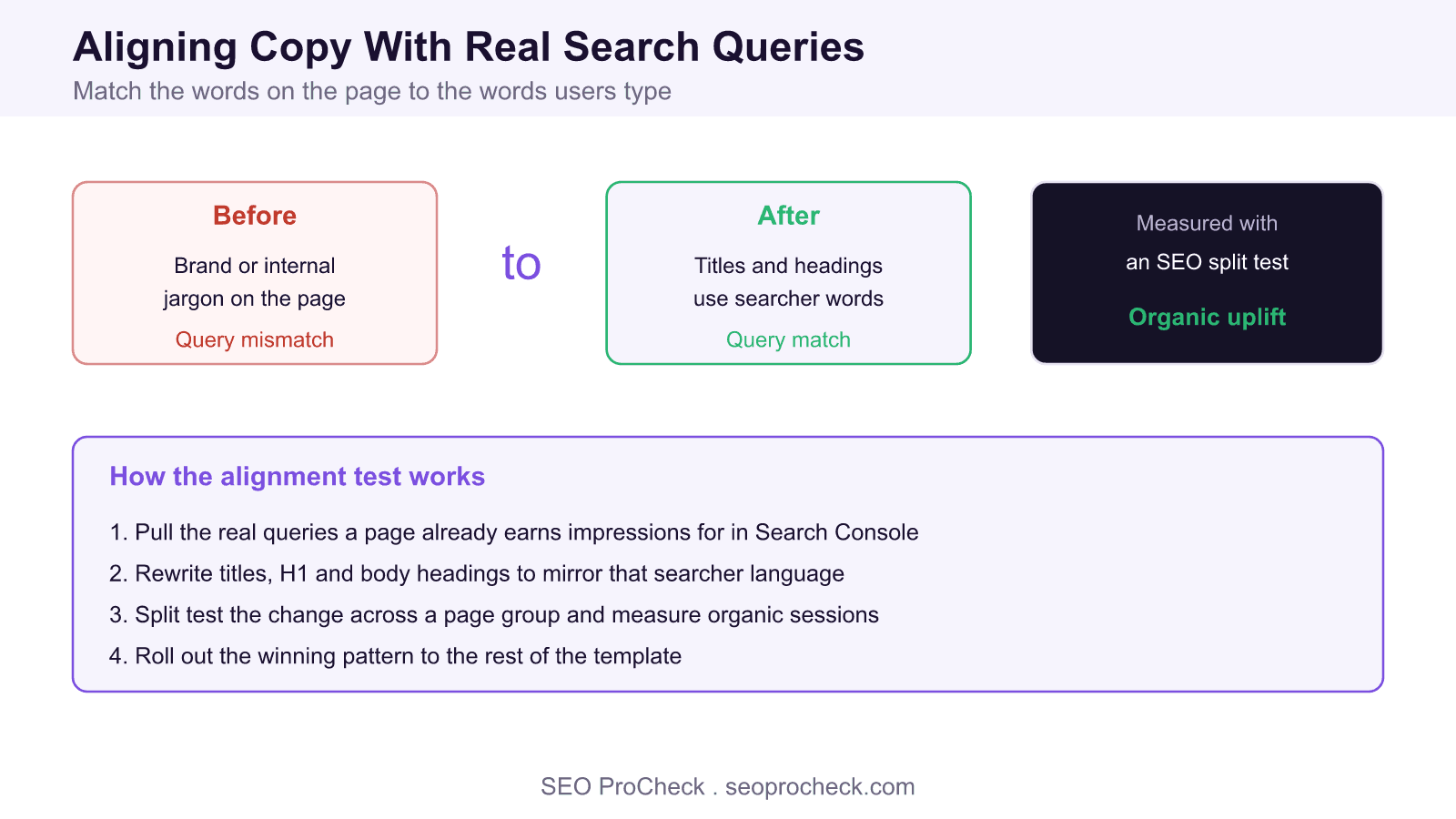
Does changing the words on a page to match how people search actually move organic traffic, or is it superstition. The case study referenced below tackles exactly that question with a controlled test, and its source is preserved at the foot of this page. Around it we explain how query alignment works, how to run the test properly, and why this is about relevance rather than old fashioned keyword density.
What query alignment really means
Query alignment is the practice of making the visible language of a page mirror the language of the searches it should serve. If people search for a plain phrase but your page uses internal jargon or a brand term, you create a gap that costs relevance. Closing that gap is not keyword stuffing. It is making sure the title, headings, and opening copy use the words a searcher would recognize as a match. That recognition also affects whether people stay once they click, which connects directly to pogosticking and click patterns.
Find the queries a page already earns
Start with data, not imagination. In Search Console, open the performance report, filter to a single page, and read the queries that already generate impressions. Those queries are the searcher language you should align to. This is a core move inside a broader content audit process, because it tells you what a page is close to ranking for before you change anything.
Rewrite the high leverage elements first
Change the elements that carry the most relevance weight before you touch anything else: the title tag, the H1, and the subheadings. Rewrite them to use the searcher phrasing you found, while keeping them natural and readable. Then adjust the opening paragraph so it confirms the match in the first sentence a reader sees. Leave the deeper body copy mostly intact so you can attribute any change to the alignment edits rather than a full rewrite.
Prove it with a split test
The reason the referenced case study is credible is that it uses a controlled test rather than a simple before and after. An SEO split test divides similar pages into a control group and a variant group, applies the change to the variant, and compares organic performance while accounting for seasonality and sitewide trends. Without a control group you cannot separate your edit from a core update or a seasonal swing, and broad updates like the recent core update can easily masquerade as a result if you are not testing carefully.
Roll out the winning pattern
If the variant group outperforms the control by a meaningful and stable margin, roll the pattern out across the rest of the template or page type. Treat the winning phrasing as a reusable rule rather than a one off edit, and document it so future pages start aligned instead of needing correction later.
| Stage | Action | Tool or source |
|---|---|---|
| Discover | Read queries a page earns impressions for | Search Console performance report |
| Rewrite | Match title, H1, and headings to those queries | On page editor |
| Confirm | Restate the match in the opening sentence | On page editor |
| Test | Split control versus variant page groups | SEO split testing platform |
| Scale | Roll the winning pattern across the template | CMS template |
Frequently asked questions
Does aligning keywords with search queries increase organic traffic?
Generally yes. Matching the visible language of a page to the queries it should serve improves relevance, and controlled tests have shown organic uplift from this kind of alignment.
Is query alignment the same as keyword stuffing?
No. Stuffing repeats keywords unnaturally to game density. Alignment makes titles, headings, and opening copy use the natural language searchers actually use, which improves relevance without harming readability.
How do I find the right queries to align to?
Filter the Search Console performance report to a single page and read the queries that already generate impressions. Those are the terms the page is closest to ranking for and the language you should mirror.
Why use an SEO split test instead of before and after?
A before and after cannot separate your edit from seasonality or a core update. A split test compares a variant group against a control group, so you can attribute the change to the alignment edit with confidence.
Which page elements matter most for alignment?
The title tag, H1, and subheadings carry the most relevance weight, followed by the opening paragraph. Rewrite those first before changing deeper body copy.
What if the test shows no improvement?
Then the page may already be aligned, or the queries you targeted are not a good fit. Keep the control in place, revisit the query data, and avoid rolling out a change that did not beat the control.
Source: https://www.searchpilot.com/resources/case-studies/aligning-keywords-with-search-queries
Take this with you
The assistant links open with a question about this page already written. Nothing is sent until you press enter.
Claude Vincent is a technical SEO consultant focused on crawlability, rendering, and AI-search visibility. He writes the field guides and case studies at SEO ProCheck, with a bias toward the durable, unglamorous work that decides whether search engines and AI answer engines can actually read and cite a site.
About SEO ProCheck
Technical SEO consulting and GEO strategy with 20 years of enterprise experience. Case studies, resources, and tools for search and AI visibility.
Work With Me
Technical SEO audits, GEO strategy, site migrations, and international SEO. Hourly consulting for teams who need hands-on support, not just reports.
Subscribe to our newsletter!








Recent Posts
- Most Top Sites Never Say Who They Are in Structured Data October 14, 2026
- Homepage Titles Are Mostly Too Short, Not Too Long October 8, 2026
- Who Actually Serves an llms.txt? 184 Top Sites Measured September 29, 2026