

AI Summary
WebMD's playbook shows how a health publisher builds durable organic visibility by compounding Experience, Expertise, Authoritativeness and Trust across the whole domain rather than page by page. In your money or your life topics, credentialed authorship, visible medical review, strong sourcing and consistent site level trust signals are what let content rank and stay ranked.
- E-E-A-T is compounded at the site level, not earned one page at a time.
- Credentialed authors and visible expert review are the backbone in YMYL topics.
- Trust signals like review dates, citations and clear policies must be explicit and consistent.
- The source estimates this authority approach at an eight figure traffic value.
In health, finance and other your money or your life topics, Google holds content to a higher bar because bad information can cause real harm. The E-E-A-T framework, Experience, Expertise, Authoritativeness and Trust, describes the signals Google's raters and systems use to judge whether a page and the site behind it deserve to rank. This case study looks at how a large health publisher operationalizes those signals, and what a smaller site can borrow from the same playbook.
E-E-A-T is a site level property
The most useful shift in thinking is to stop treating E-E-A-T as something you sprinkle on individual articles and start treating it as a property of the whole domain. A single well sourced page on an otherwise anonymous site struggles, while the same page on a domain with a track record of credentialed, reviewed, well cited content inherits that reputation. Authority compounds: every expert authored, medically reviewed, properly sourced page raises the trust the next page starts with. That compounding is exactly why an established health publisher can rank new content quickly while a newcomer cannot.
The four pillars in practice
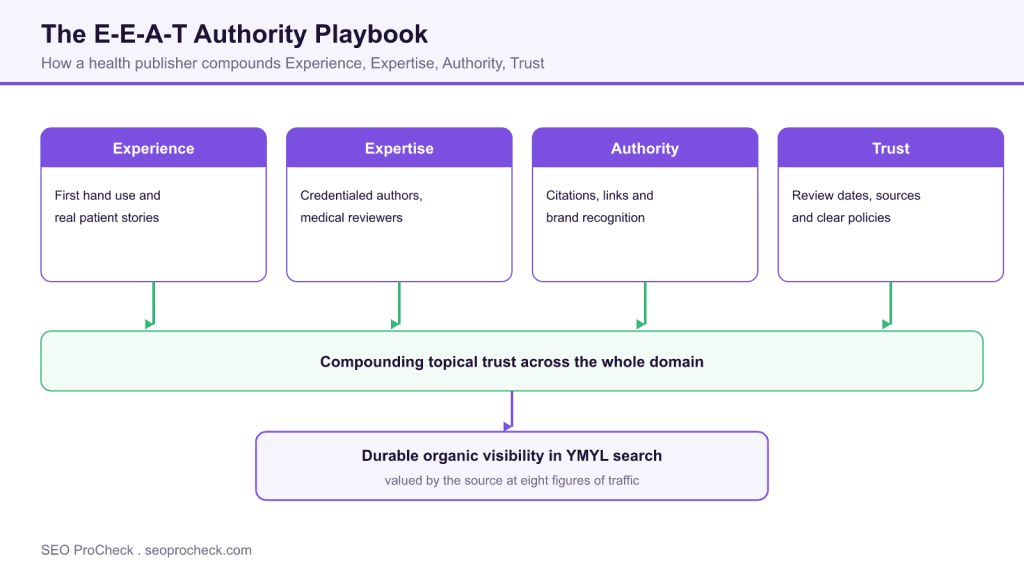
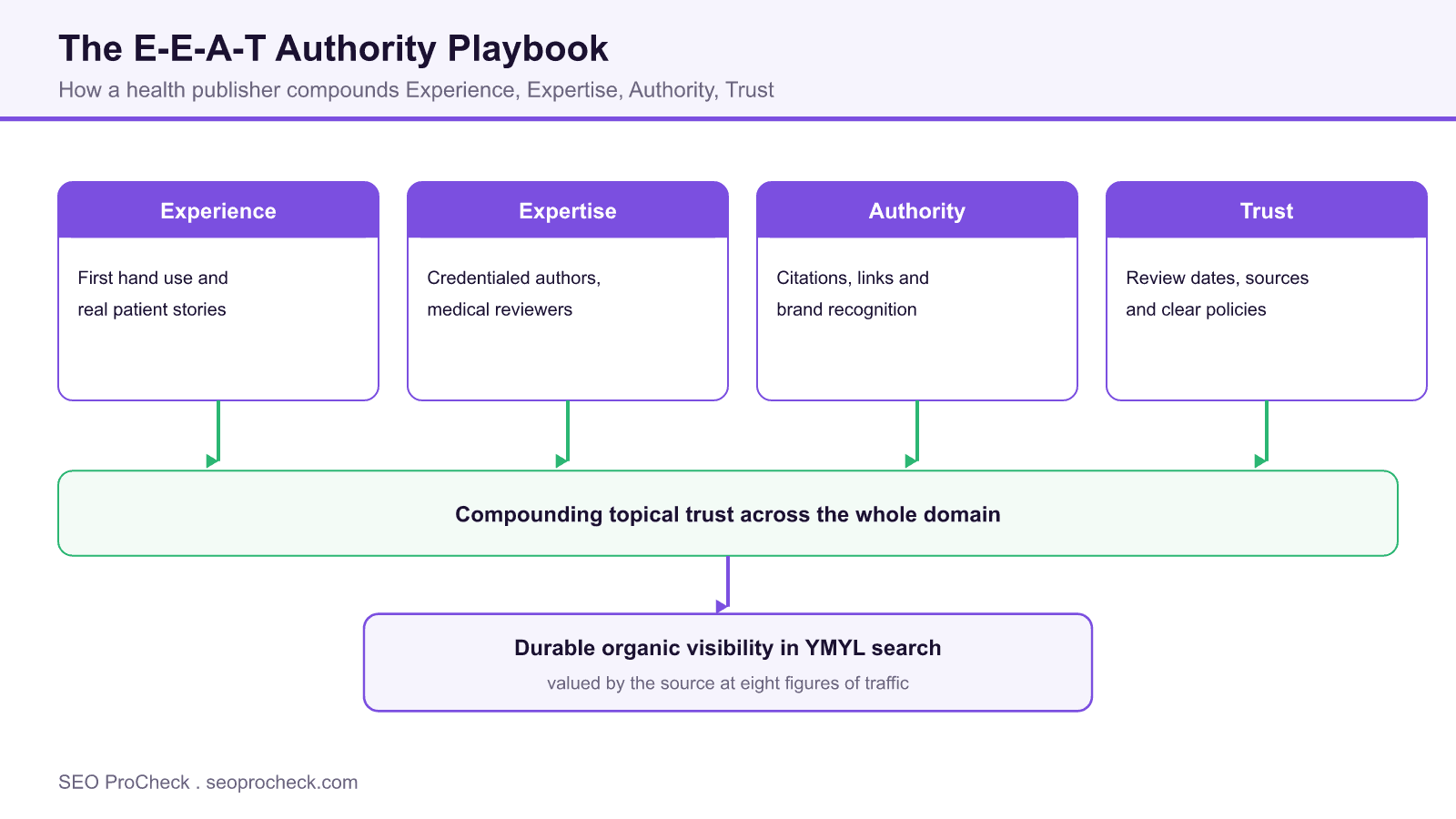
Experience means first hand knowledge: real use of a product, lived patient perspective, or direct clinical practice, shown rather than claimed. Expertise means the content is created or reviewed by people with genuine credentials in the subject, and those credentials are visible. Authoritativeness means the site and its authors are recognized and cited by others in the field, reflected in links, mentions and brand searches. Trust, the pillar the others support, means the page is accurate, transparent and safe to rely on: clear sourcing, honest disclosures, sensible policies and no deceptive patterns. In the diagram above, the four pillars feed a single outcome, compounding topical trust across the whole domain, which in turn produces durable organic visibility.
How to operationalize the playbook
Make expertise legible. Give every article a real, credentialed author with a detailed bio, and where the topic is medical, add a named reviewer and a visible medical review date. Cite primary sources, guidelines, studies and official bodies, and link to them so claims are checkable. Maintain the trust infrastructure a serious publisher needs: an about page that explains editorial standards, transparent authorship, correction and update policies, and consistent contact and organization details. Keep content current, because in health a page that has not been reviewed in years signals neglect. None of this is a trick; it is the visible evidence that real expertise stands behind the words.
Structure and consistency amplify the signals
Support the human signals with clean structure. Use Person and Organization schema so authors and the publisher are explicit entities, keep author and reviewer information consistent across the site, and organize topics so related content reinforces itself rather than competing. Consistency matters as much as any single signal: an author whose credentials, bio and byline match across every page they touch reads as a genuine authority, while mismatched or anonymous bylines undermine the whole effort. The source values this compounded authority in the range of eight figures of traffic, which reflects how much durable visibility a trusted domain accumulates over time.
What has changed since this playbook
Google added the second E, Experience, to the framework, underscoring that first hand knowledge now sits alongside formal expertise. The rise of AI overviews raises the stakes further: answer engines lean on sources they can trust, and a domain with clear authorship, strong sourcing and consistent trust signals is a safer citation than an anonymous page. The core lesson holds and has arguably strengthened: build E-E-A-T deliberately at the site level, make every signal explicit, and let the authority compound.
The four E-E-A-T pillars and how to show them
| Pillar | What it means | How to show it |
|---|---|---|
| Experience | First hand knowledge of the topic | Real use, patient stories, practitioner notes |
| Expertise | Genuine subject credentials | Named credentialed authors and reviewers |
| Authoritativeness | Recognition in the field | Citations, links, brand searches |
| Trust | Accurate, transparent, safe | Sources, review dates, clear policies |
Related reading on SEO ProCheck: E-E-A-T guidance, content SEO strategy, content case studies.
Frequently asked questions
What does E-E-A-T stand for?
Experience, Expertise, Authoritativeness and Trust. It describes the signals Google uses to judge whether content, and the site behind it, is credible enough to rank, especially in your money or your life topics.
Is E-E-A-T a ranking factor?
It is not a single dialable score, but it describes qualities Google's systems and quality raters reward. Improving the signals that demonstrate experience, expertise, authority and trust tends to help visibility in sensitive topics.
Why does E-E-A-T compound at the site level?
Because trust transfers. A domain with a track record of credentialed, reviewed, well sourced content lets each new page start with more authority, which is why established publishers rank new content faster than anonymous sites.
How do I show expertise on a health article?
Give it a real credentialed author with a visible bio, add a named medical reviewer and a review date, and cite primary sources so every claim is checkable. Make the credentials easy to find, not buried.
Does schema help with E-E-A-T?
Person and Organization schema make your authors and publisher explicit entities, which supports the trust signals. Schema does not replace real expertise, but it helps search engines connect the credentials to the content.
How does E-E-A-T affect AI search?
Answer engines prefer sources they can trust, so a domain with clear authorship, strong sourcing and consistent trust signals is more likely to be cited in AI overviews than an anonymous page.
Source: https://foundationinc.co/lab/webmds-eat-seo-playbook/
Take this with you
The assistant links open with a question about this page already written. Nothing is sent until you press enter.
Claude Vincent is a technical SEO consultant focused on crawlability, rendering, and AI-search visibility. He writes the field guides and case studies at SEO ProCheck, with a bias toward the durable, unglamorous work that decides whether search engines and AI answer engines can actually read and cite a site.
About SEO ProCheck
Technical SEO consulting and GEO strategy with 20 years of enterprise experience. Case studies, resources, and tools for search and AI visibility.
Work With Me
Technical SEO audits, GEO strategy, site migrations, and international SEO. Hourly consulting for teams who need hands-on support, not just reports.
Subscribe to our newsletter!








Recent Posts
- Most Top Sites Never Say Who They Are in Structured Data October 14, 2026
- Homepage Titles Are Mostly Too Short, Not Too Long October 8, 2026
- Who Actually Serves an llms.txt? 184 Top Sites Measured September 29, 2026