

AI Summary
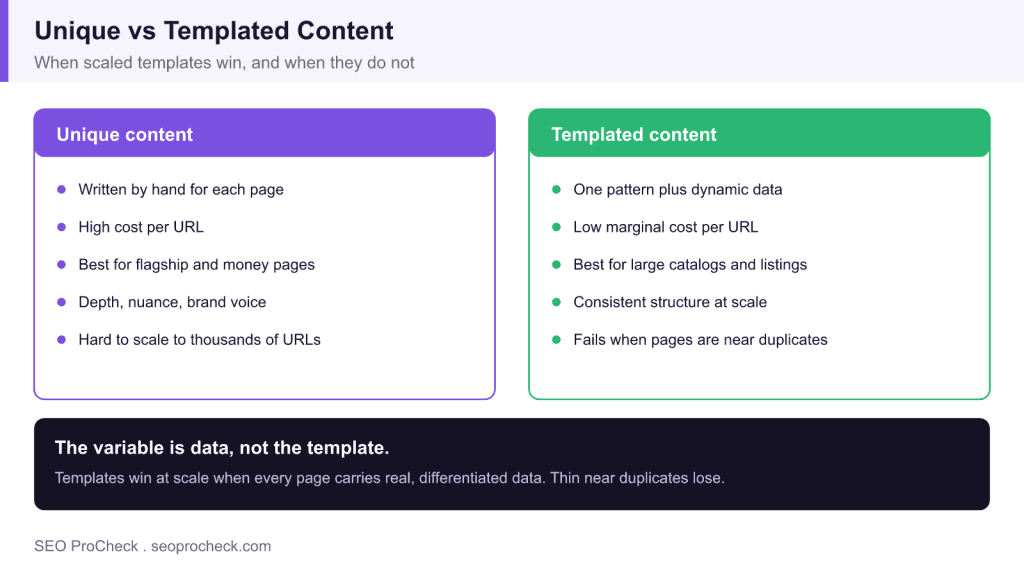
Neither unique nor templated content is universally better for SEO; the right choice depends on scale and on how much genuinely different data each page carries. Hand written unique content wins for a handful of flagship pages, while a well built template with real per page data wins for large catalogs, because the deciding factor is differentiated information, not whether a human typed every sentence.
- Unique content suits flagship and money pages where depth and brand voice pay off.
- Templated content suits large catalogs where the same structure wraps genuinely different data.
- The failure mode is not the template; it is near duplicate pages with no distinct data.
- Google's scaled content abuse policy targets mass low value pages, not legitimate templates.
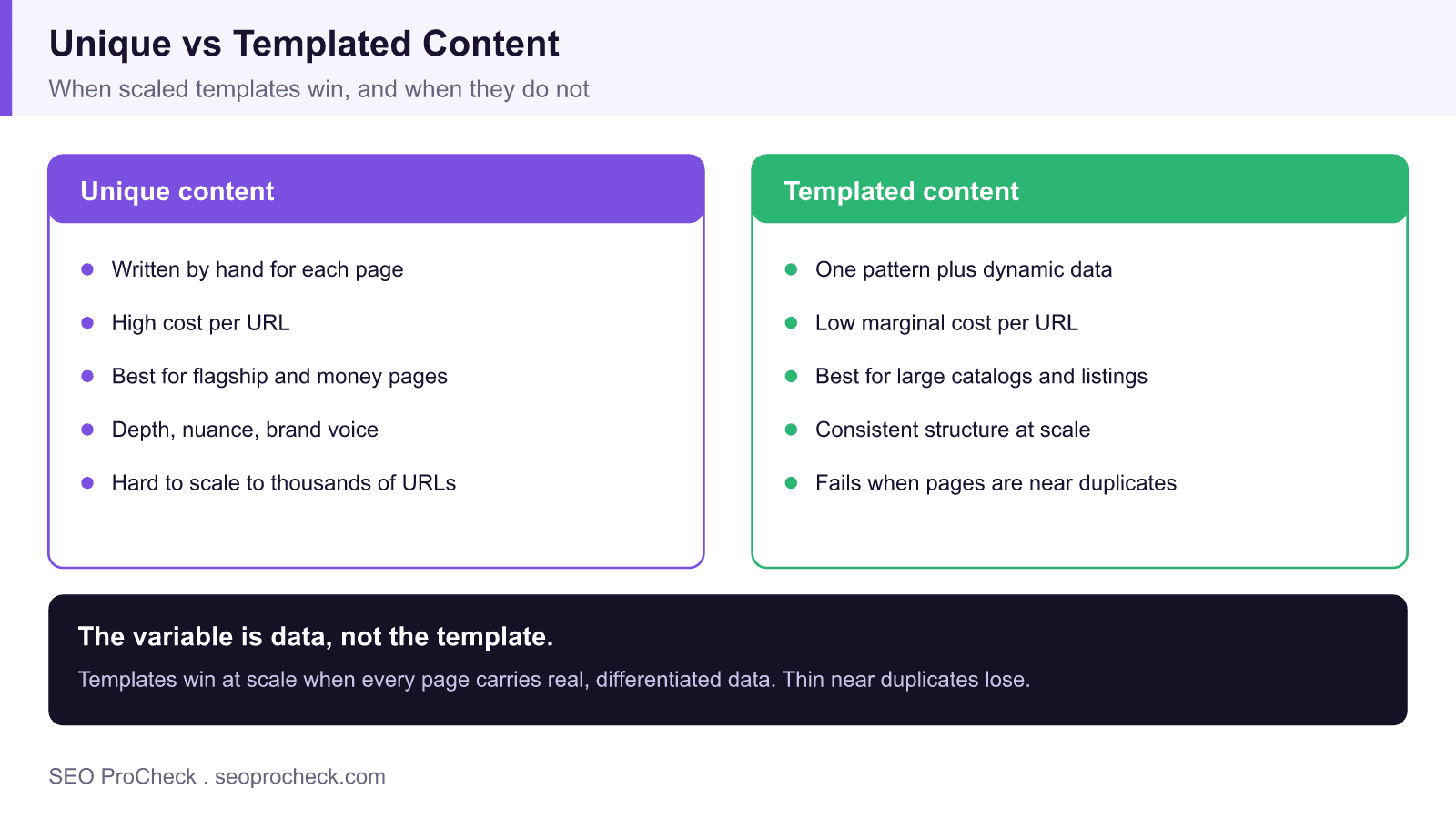
The unique versus templated debate is usually framed as a moral question, as if hand written prose is virtuous and templates are cheating. That framing hides the real engineering decision. Search engines do not reward effort; they reward pages that satisfy a query. A template that assembles genuinely different data for every URL can satisfy queries at a scale no writing team could ever match. A unique essay on a page that duplicates ten others helps no one. The useful question is not unique or templated, it is where does differentiated data come from.
What unique content is good at
Unique, hand crafted content earns its cost on a small number of high value pages: your pillar guides, category strategy pages, comparison pieces, and anything that carries brand voice or original analysis. These pages benefit from nuance, narrative, expert framing, and editorial judgment that no template can generate. The economics only work because there are few of them. Writing a thousand of them by hand is neither affordable nor necessary.
What templated content is good at
Templated content shines when you have a large set of items that each hold real, distinct data: products, locations, listings, sports fixtures, financial instruments, recipes. The template provides a consistent, crawlable structure, and the data layer makes each page a unique, useful answer. A store locator page for one city and another for a second city share a skeleton, but the addresses, hours, inventory, and reviews differ, so each one is a legitimate result. That is templated content working exactly as intended.
The real dividing line: data density
Templates fail when the data behind them is thin or repetitive. If ten pages differ only by a swapped city name in otherwise identical boilerplate, they are near duplicates, and Google will fold them together or ignore them. Before scaling a template, audit the data density of a single page. Ask what a human would learn on this page that they could not learn on the sibling page. If the honest answer is nothing meaningful, the template needs more data, not more prose.
- Strong templated page: unique specs, pricing, availability, structured attributes, user reviews, media.
- Weak templated page: one variable swapped into a paragraph of generic filler.
What has changed since: scaled content abuse
In March 2024 Google introduced its scaled content abuse policy, replacing the older automatically generated content language. The target is producing many pages primarily to manipulate rankings that add little value for users, whether they are made by automation, humans, or a mix. This does not outlaw templates. A template that surfaces real, differentiated data for each URL is fine. What the policy catches is mass produced near duplicates and filler. The practical takeaway is unchanged: scale structure freely, but only scale pages that each carry distinct, useful data.
When to choose unique or templated content
| Scenario | Better approach | Why |
|---|---|---|
| Pillar guide or strategy page | Unique | Depth, nuance, and brand voice drive value |
| Product or listing catalog | Templated | Consistent structure over real per item data |
| Local landing pages | Templated with real local data | Unique addresses, hours, and reviews per page |
| Comparison or opinion piece | Unique | Original analysis cannot be templated |
| Pages that differ by one swapped word | Neither, consolidate | Near duplicates add no value |
Related reading
- The duplicate content guide explains when templated pages tip into near duplicates.
- Index bloat shows what happens when thin templated pages flood the index.
- Crawl budget explained covers why low value templated URLs waste crawling.
Case study summary and source
Content-driven SEO success requires strategic approaches to creation, optimization, and management. This case study demonstrates how content strategy directly drives organic growth when aligned with user needs and search behavior.
Content Strategy Framework
Effective content strategy begins with understanding target audiences, their questions, and the competitive content landscape. This case study outlines the strategic framework that guided content decisions, from topic selection to format choices.
Content Development Process
Moving from strategy to published content requires efficient processes for research, creation, and optimization. This case study documents workflows, quality standards, and production approaches that enabled consistent, high-quality output.
Optimization and Distribution
Published content requires ongoing optimization based on performance data. This case study covers how content was refined post-publication, how internal linking supported content performance, and how distribution amplified content reach.
Results and Attribution
Measuring content ROI requires connecting content efforts to business outcomes. This case study demonstrates the traffic, engagement, and business results achieved through strategic content investment. Attribution methodology helps validate content strategy effectiveness.
Content SEO case studies help practitioners build cases for content investment with documented results.
Source: https://www.searchpilot.com/resources/case-studies/unique-or-templated-content/
Frequently asked questions
Is unique content always better for SEO than templated content?
No. Unique content wins for a small number of flagship pages, but templated content wins at scale when each page carries real, differentiated data. The deciding factor is whether the page offers distinct value, not whether a human wrote every word.
Does Google penalize templated content?
Not by itself. Google targets scaled content abuse, meaning mass pages made mainly to manipulate rankings with little user value. A template that surfaces genuinely different data per URL is fine. Thin near duplicates are the problem.
When should I invest in unique hand written content?
For pillar guides, category strategy pages, comparisons, and anything needing original analysis or brand voice. These are few enough that the cost pays off, and they carry nuance a template cannot generate.
How do I know if my templated pages are too thin?
Compare two sibling pages and ask what a user learns on one that they cannot learn on the other. If the only difference is a swapped word in generic filler, the pages are near duplicates and need more real data or should be consolidated.
What changed with the 2024 scaled content abuse policy?
In March 2024 Google replaced its automatically generated content language with a scaled content abuse policy aimed at mass low value pages made to manipulate rankings, regardless of how they are produced. Legitimate data driven templates are not the target.
Can I mix unique and templated content on the same site?
Yes, and most strong sites do. Use unique content for a handful of high value hub pages and templated content for large catalogs, making sure each templated page carries distinct data that justifies its existence.
Take this with you
The assistant links open with a question about this page already written. Nothing is sent until you press enter.
Claude Vincent is a technical SEO consultant focused on crawlability, rendering, and AI-search visibility. He writes the field guides and case studies at SEO ProCheck, with a bias toward the durable, unglamorous work that decides whether search engines and AI answer engines can actually read and cite a site.
About SEO ProCheck
Technical SEO consulting and GEO strategy with 20 years of enterprise experience. Case studies, resources, and tools for search and AI visibility.
Work With Me
Technical SEO audits, GEO strategy, site migrations, and international SEO. Hourly consulting for teams who need hands-on support, not just reports.
Subscribe to our newsletter!








Recent Posts
- Most Top Sites Never Say Who They Are in Structured Data October 14, 2026
- Homepage Titles Are Mostly Too Short, Not Too Long October 8, 2026
- Who Actually Serves an llms.txt? 184 Top Sites Measured September 29, 2026