

AI Summary
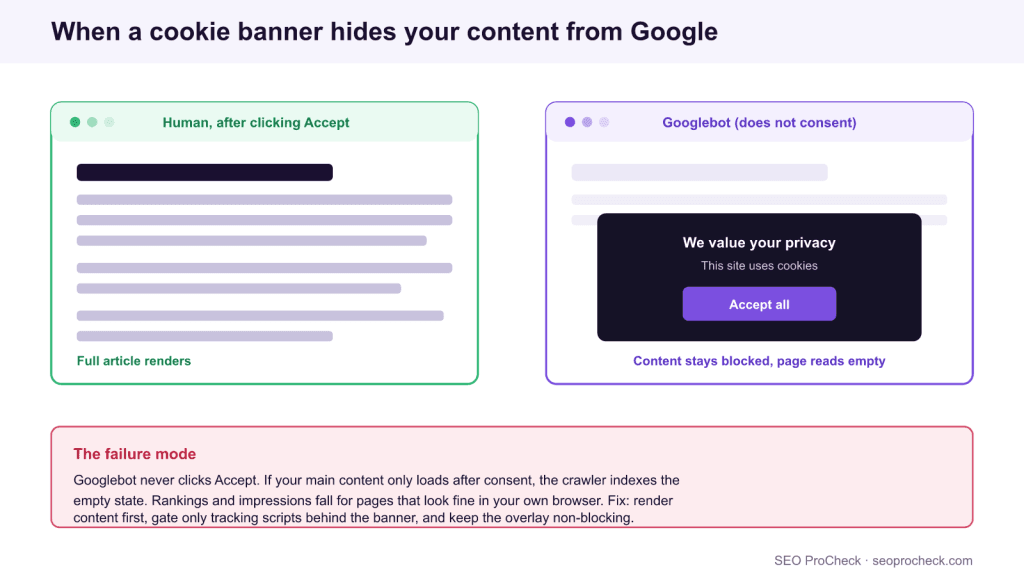
A cookie consent banner can cut organic visibility when the page hides its main content until a visitor clicks Accept. Googlebot never consents, so if content depends on that click it renders an empty page, and the case study this page cites reports a 22% visibility loss from exactly this pattern.
- Googlebot does not accept cookies or click consent buttons, so any content gated behind consent is invisible to it.
- The damage is silent: the page looks perfect in your own browser because you already clicked Accept.
- Cookie walls, consent-gated JavaScript, and a consent script blocked in robots.txt are the three usual culprits.
- The fix is to render the main content first and gate only tracking scripts behind the banner.
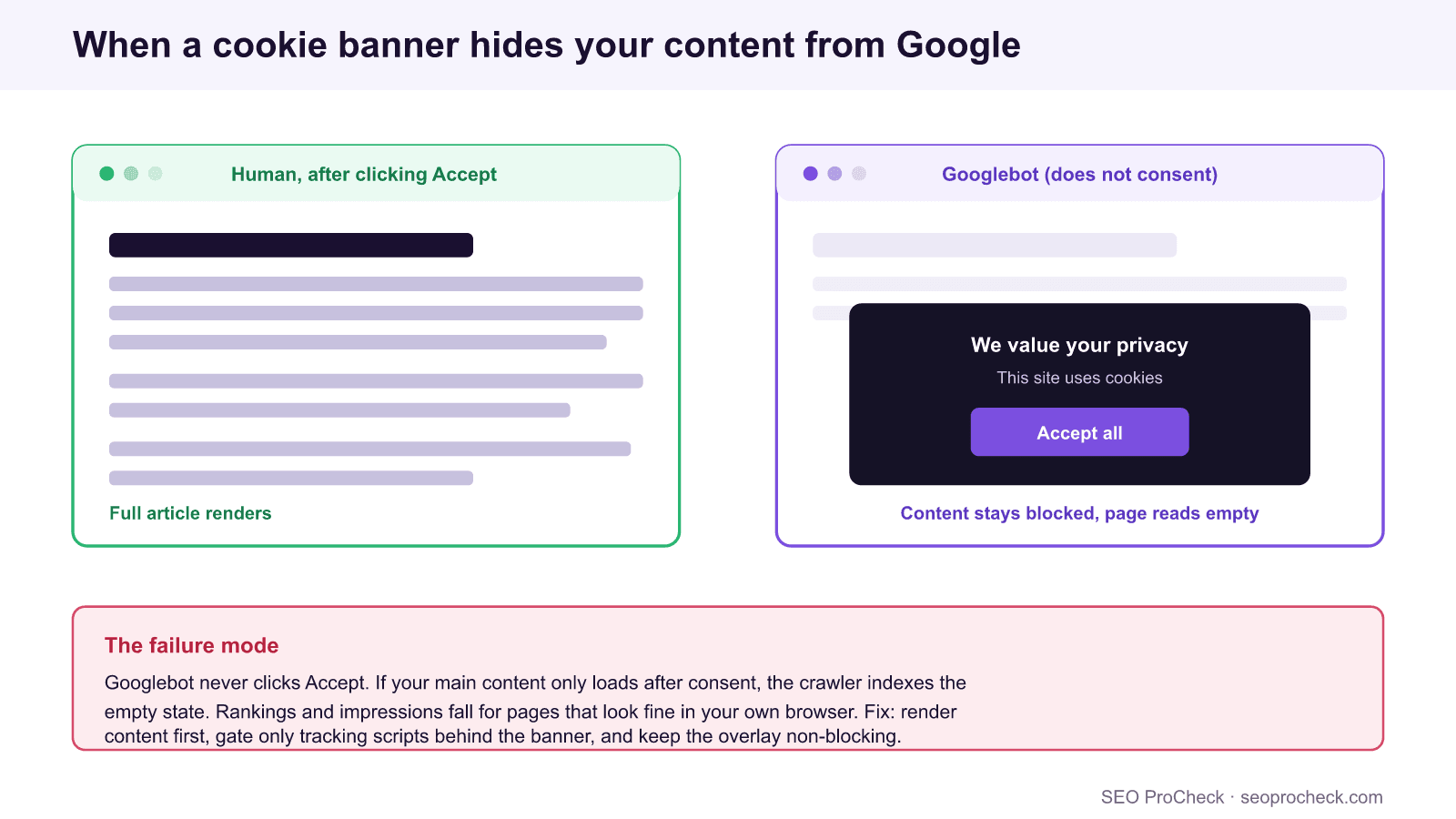
The case study this page points to has one of the best titles in technical SEO: the cookie monster ate 22% of the site’s visibility. The villain was not a Google update or a competitor. It was the site’s own cookie consent banner, which stopped the main content from loading until a visitor accepted cookies. Real people clicked Accept and read the article. Googlebot never clicks anything, so it fetched a page that was, as far as the index was concerned, nearly empty. Impressions and rankings fell for pages that looked completely healthy in a normal browser.
This is one of the most under-diagnosed problems in modern SEO, because consent management platforms are installed once, tested in a browser that already has consent stored, and then forgotten. Below is how the failure works, the three variants that cause it, a ten-minute diagnosis, and the fix that keeps you compliant with privacy law without feeding Google an empty shell.
This SEO case study documents a successful optimization initiative, providing actionable insights for practitioners. The documented approach demonstrates how strategic SEO implementation drives measurable results.
Initial Situation
Understanding the starting point is essential context for evaluating any case study. This documentation covers the initial challenges, competitive position, and business objectives that shaped the SEO strategy.
Strategy and Approach
The strategic approach combined multiple SEO disciplines to address identified opportunities. Key decisions around prioritization and resource allocation provide a template for similar initiatives.
Implementation
Moving from strategy to execution required specific technical implementations, content development, and process changes. This case study documents the practical steps that translated strategy into action.
Results and Learnings
The outcomes demonstrate effectiveness through measurable improvements in rankings, traffic, and business metrics. Analysis of successes and challenges provides learning value for practitioners.
Case studies like this contribute to the SEO knowledge base, helping practitioners learn from documented real-world experiences.
How a consent banner erases content from Google
Googlebot renders pages roughly the way a fresh, signed-out Chrome would: no stored cookies, no local storage, and no human to dismiss an overlay. A consent management platform (CMP) typically runs early in the page lifecycle and can do one of several things while it waits for a choice: hold back the scripts that build the article, hide the content area with CSS, or replace the body with a placeholder. For a human that pause lasts one click. For the crawler it lasts forever, because the crawler makes no choice.
If the main content is injected by JavaScript that only fires after consent, the rendered DOM Google indexes contains the banner and little else. This is closely related to ordinary JavaScript rendering problems, with one cruel twist: the trigger is a user interaction the crawler will never perform.
The three ways cookie and consent setups hurt SEO
Almost every case traces back to one of these patterns. The table pairs each with the risk and the corrective.
| Pattern | Why it hurts | Fix |
|---|---|---|
| Cookie wall: no content until the visitor clicks Accept | Googlebot receives an empty or placeholder page and can deindex it | Serve the full content in the initial HTML; make the banner an overlay, not a gate |
| Main content built by consent-gated JavaScript | The rendered DOM the crawler indexes is missing the article | Render content server-side; load only tracking scripts after consent |
| CMP or content endpoint blocked in robots.txt | The crawler cannot fetch the resource needed to paint the page | Allow the CMP script and any content API in robots.txt |
| Cookie-based redirect or A/B test on first visit | A no-cookie crawler gets bounced to the wrong or empty variant | Default the cookieless client to the canonical, indexable version |
| Consent overlay paired with noindex on an interstitial URL | The indexable state is the interstitial, not the article | Keep the article URL indexable; never route the crawler through a noindex gate |
The pattern in row three is worth stressing because it hides in plain sight. If the consent script itself is disallowed, Google cannot even build the page to discover the empty content. Confirm your rules against the robots.txt reference, and check the related check on a disallowed JavaScript file.
Diagnose it in ten minutes
You do not need the original incident to reproduce this. Three checks settle it.
1. Fetch the raw HTML with no cookies and search for your content. If the article text is not in the server response, it is being added later, possibly after consent:
curl -s https://example.com/article | grep -i "a distinctive sentence from your article"No match means the sentence is not in the initial HTML. That alone is a warning sign for any crawler that fails to render.
2. Run the live URL Inspection test in Search Console. Open the rendered HTML and the screenshot. If you see the consent overlay and no article, you have reproduced exactly what Google indexes. This is the single most convincing piece of evidence to show stakeholders.
3. Load the page with JavaScript disabled and cookies cleared. In an incognito window with scripting off, does the article appear? If the page is blank behind the banner, so is the crawler’s copy. A consent overlay that paints over content also relates to render-blocking behaviour, since the CMP often blocks the first meaningful paint.
The fix: content first, consent for tracking
Privacy law asks you to obtain consent before setting non-essential cookies and running tracking. It does not ask you to hide your journalism, product copy, or documentation until someone clicks a button. Those two things are separated by good engineering, not by a legal trade-off. The reliable architecture is:
- Render the main content in the initial server response, or with client-side code that does not depend on consent.
- Show the consent banner as a genuine overlay that sits above fully-loaded content, never as a gate that withholds it.
- Behind the Accept action, load only what actually needs consent: analytics, remarketing pixels, and similar trackers.
- Keep the consent script and any content endpoints crawlable in robots.txt.
Ship that arrangement and the crawler sees the same article a reader sees, minus the trackers it was never going to run anyway. The consent banner keeps you compliant, and the cookie monster goes hungry.
FAQ
Yes. If the banner hides or delays your main content until a visitor accepts cookies, Googlebot, which never accepts, renders an empty page. That can drop rankings and impressions even though the page looks normal in your own browser.
No. Googlebot generally crawls without stored cookies and does not interact with overlays, so it will not click Accept. Any content that only appears after consent is effectively invisible to it.
Use the live URL Inspection test in Search Console and read the rendered HTML and screenshot. Also fetch the raw HTML with curl and search for a sentence from your article, and load the page with cookies cleared and JavaScript disabled.
No. If the CMP script is disallowed, Googlebot may fail to render the page at all. Keep the consent script and any content APIs crawlable, and gate only the tracking scripts behind the user’s consent.
A cookie wall that returns no indexable content to crawlers effectively hides your page, which undermines indexing and can resemble cloaking if crawlers and users get materially different content. Serve the content and gate only tracking.
Separate content from consent. Render the article first, present the banner as a non-blocking overlay, and load non-essential cookies and trackers only after the visitor accepts. That satisfies consent law and keeps the page fully indexable.
Worried your consent banner is hiding pages from Google?
An audit renders your templates the way Googlebot does and flags any content that only appears after consent.
Claude Vincent is a technical SEO consultant focused on crawlability, rendering, and AI-search visibility. He writes the field guides and case studies at SEO ProCheck, with a bias toward the durable, unglamorous work that decides whether search engines and AI answer engines can actually read and cite a site.
About SEO ProCheck
Technical SEO consulting and GEO strategy with 20 years of enterprise experience. Case studies, resources, and tools for search and AI visibility.
Work With Me
Technical SEO audits, GEO strategy, site migrations, and international SEO. Hourly consulting for teams who need hands-on support, not just reports.
Subscribe to our newsletter!







Recent Posts
- Can AI Crawlers Actually Read Your Site? I Measured 400 of the Biggest September 5, 2026
- The Pre-Publish Quality Gate for AI-Assisted Content August 6, 2026
- AGENTS.md vs llms.txt vs llms-full.txt: Which Agent File Does What July 18, 2026