

AI Summary
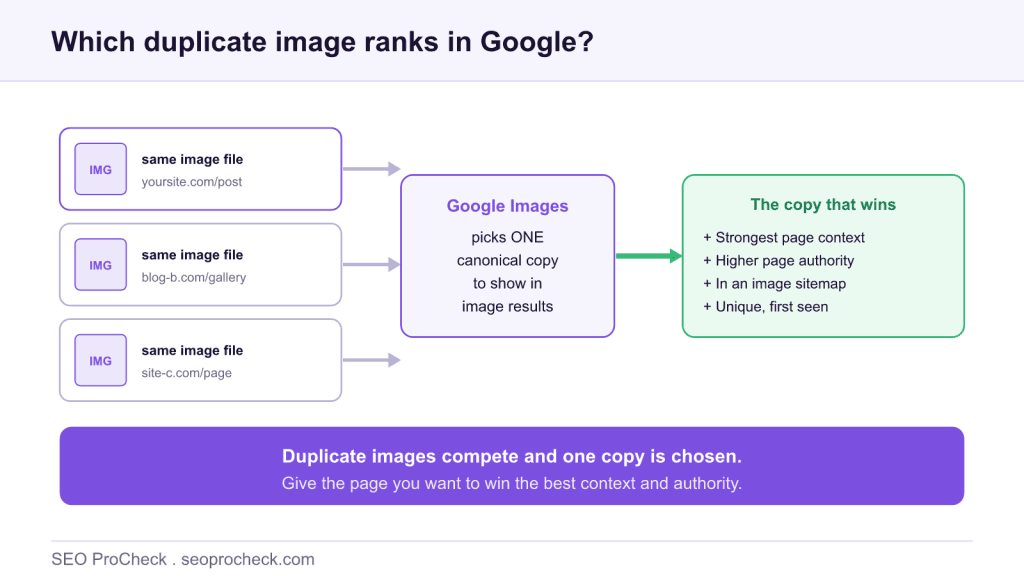
When the same image is published on several pages or domains, Google usually ranks only one copy in image search and canonicalises the rest. The copy that wins is decided by the hosting page's context and authority, not by the image file, which is identical everywhere.
- Google canonicalises duplicate images and typically shows a single copy in Google Images.
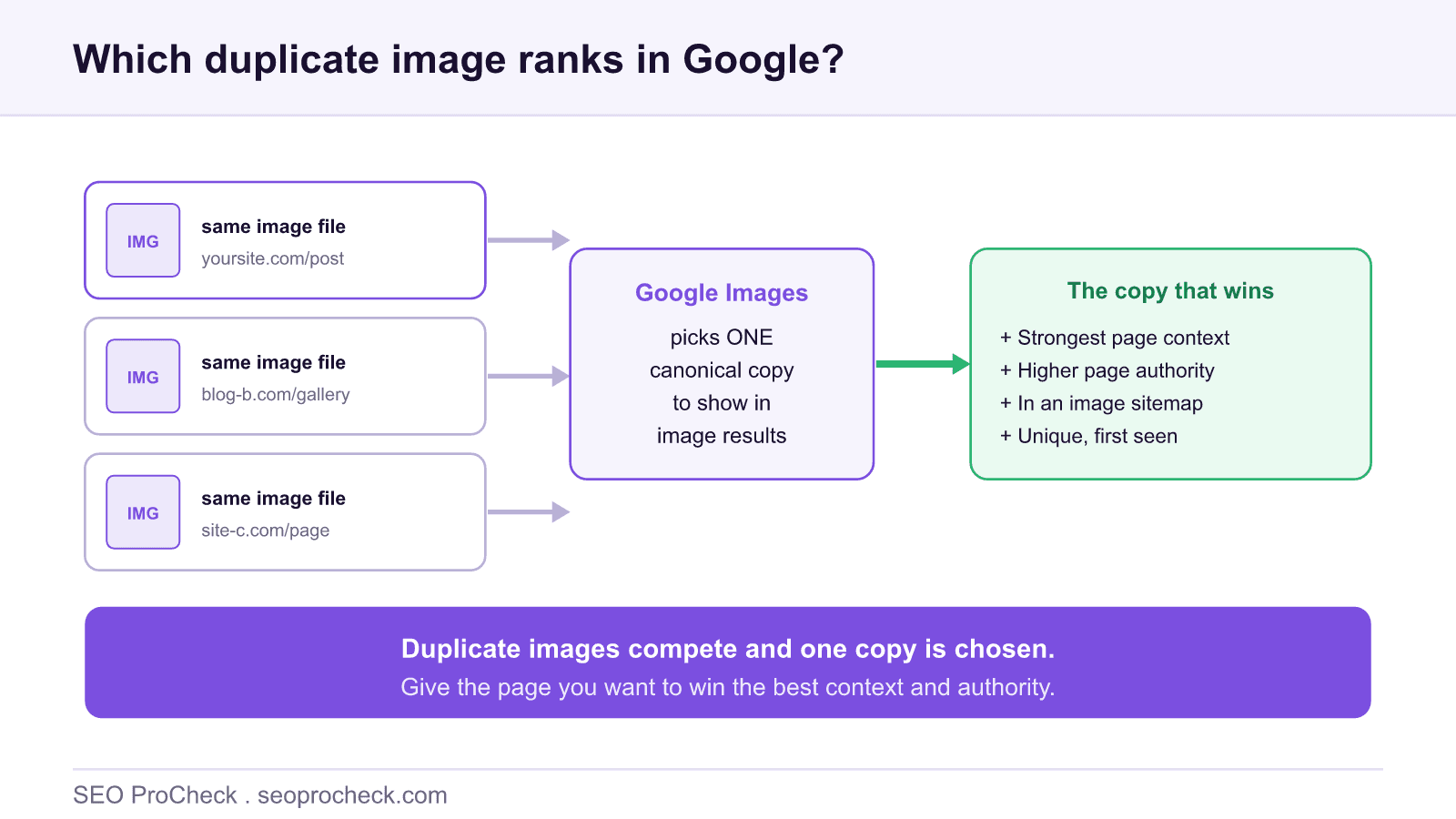
- The winning copy is chosen by page context, authority, image sitemap inclusion and first-seen order.
- This mirrors a long-term duplicate-image experiment by Reboot Online; see the source below.
- To own the ranking copy, host a unique image on a strong, relevant, crawlable page.
If you publish an image that also exists on other sites, a fair question follows: can your copy rank in Google Images, or does the biggest site always win? The short answer is that duplicate images are canonicalised much like duplicate pages, so normally one copy is chosen to represent the image in results. Understanding how that copy is picked is what lets you win the slot, or decide it is not worth chasing.
What the experiment tested
The case study linked below, a long-term duplicate-image ranking experiment by Reboot Online, is the kind of test this topic needs: the same image placed across different pages, tracked over time, to observe which copy Google surfaces and why. Reboot run these as extended live experiments rather than one-off checks, which matters because image canonicalisation can take a while to settle. We summarise the question and the mechanics here and link to their full write-up for the underlying data; the practitioner guidance is our own.
How Google handles duplicate images
Google groups identical or near-identical images and selects a canonical, the copy it treats as the primary version, in the same spirit as URL canonicalisation. The other copies still exist and can still load on their pages, but in image search they generally do not appear as separate results. This is not a penalty. It is deduplication so that one image does not fill the results with the same picture from ten sites.
Because the file is identical across copies, the image bytes cannot break the tie. Google leans on the page that hosts each copy, which is exactly where your leverage is.
Which copy wins: the signals
No single factor decides it, but a consistent set of signals tilts the choice.
| Signal | Effect on which copy ranks | Practitioner takeaway |
|---|---|---|
| Page context and relevance | Strong | Surround the image with descriptive, on-topic text |
| Hosting page authority | Strong | A copy on a stronger page tends to be chosen |
| Image sitemap inclusion | Moderate | List the image in an image sitemap to aid selection |
| First-seen / discovery order | Moderate | The version Google indexed first often has an edge |
| Alt text and filename | Supporting | Descriptive alt and filename reinforce relevance |
| Structured data on the page | Supporting | Clear page semantics help Google trust the copy |
The theme across the table is unmistakable: the image cannot differentiate itself, so the page does. That is why a stock photo is hard to rank in image search, your copy competes against the same file on higher-authority pages, and one of those is likely to be chosen ahead of you.
A practical playbook
If ranking in image search matters for a page, stack the signals in your favour:
1. Prefer unique images. An original photo, diagram or screenshot has no competing copies, so canonicalisation is not a contest and you own the image by default. This is the single most effective move.
2. Strengthen the hosting page. Give the image genuinely relevant surrounding text, a descriptive filename and useful alt text. Our guides on the image SEO complete guide and image SEO beyond alt text cover the context signals in depth.
3. Make it discoverable. Include the image in an image sitemap and ensure the page is crawlable and internally linked, so Google finds and associates your copy quickly. First-seen order can matter, so do not leave a new image orphaned.
4. If you must reuse a shared image, accept that ranking the image itself will be hard and lean on the surrounding page instead. When duplication is a broader on-page concern, our duplicate content guide and canonical tags reference explain how Google chooses a representative in the page context too.
The bottom line
Duplicate images do not earn a penalty, but they do force a competition your copy can easily lose if it sits on a weaker page. Win it the honest way: publish unique images where image visibility counts, and give the page around them the context and authority that Google uses to pick a winner.
FAQ
Yes, but usually only one copy ranks for a given image in Google Images. When the same image appears on several pages or domains, Google canonicalises them and shows a single copy, chosen by the strength and relevance of the hosting page rather than by the image file alone.
The copy on the page with the strongest, most relevant context tends to win: better surrounding text, a more authoritative page, presence in an image sitemap, and often the version Google saw first. The image bytes being identical, the page around them is the tiebreaker.
For image search visibility, yes, it helps. Unique images avoid competing against copies on stronger domains and let you own the canonical. For on-page SEO generally, relevance and context matter more than uniqueness, but original images remove the duplicate-image contest entirely.
It rarely hurts your page rankings, but it makes ranking the image itself in Google Images hard, because the same stock file lives on many higher-authority pages that are likely to be chosen as the canonical copy over yours.
Give the hosting page strong, relevant text around the image, add descriptive alt text and a filename, include the image in an image sitemap, and make sure the page is crawlable and authoritative. Consistent internal linking to that page reinforces it as the home of the image.
It is a related but separate mechanism. Google canonicalises duplicate images the way it canonicalises duplicate pages, picking one representative. It is not a penalty; the non-chosen copies simply do not appear separately in image results.
Losing image search visibility to copies on other sites?
An audit reviews your image canonicalisation, sitemaps and on-page context, and shows where original images would earn visibility you are currently giving away.
Source: https://www.rebootonline.com/blog/long-term-duplicate-image-experiment/
Take this with you
The assistant links open with a question about this page already written. Nothing is sent until you press enter.
Claude Vincent is a technical SEO consultant focused on crawlability, rendering, and AI-search visibility. He writes the field guides and case studies at SEO ProCheck, with a bias toward the durable, unglamorous work that decides whether search engines and AI answer engines can actually read and cite a site.
About SEO ProCheck
Technical SEO consulting and GEO strategy with 20 years of enterprise experience. Case studies, resources, and tools for search and AI visibility.
Work With Me
Technical SEO audits, GEO strategy, site migrations, and international SEO. Hourly consulting for teams who need hands-on support, not just reports.
Subscribe to our newsletter!








Recent Posts
- Most Top Sites Never Say Who They Are in Structured Data October 14, 2026
- Homepage Titles Are Mostly Too Short, Not Too Long October 8, 2026
- Who Actually Serves an llms.txt? 184 Top Sites Measured September 29, 2026