AI Summary
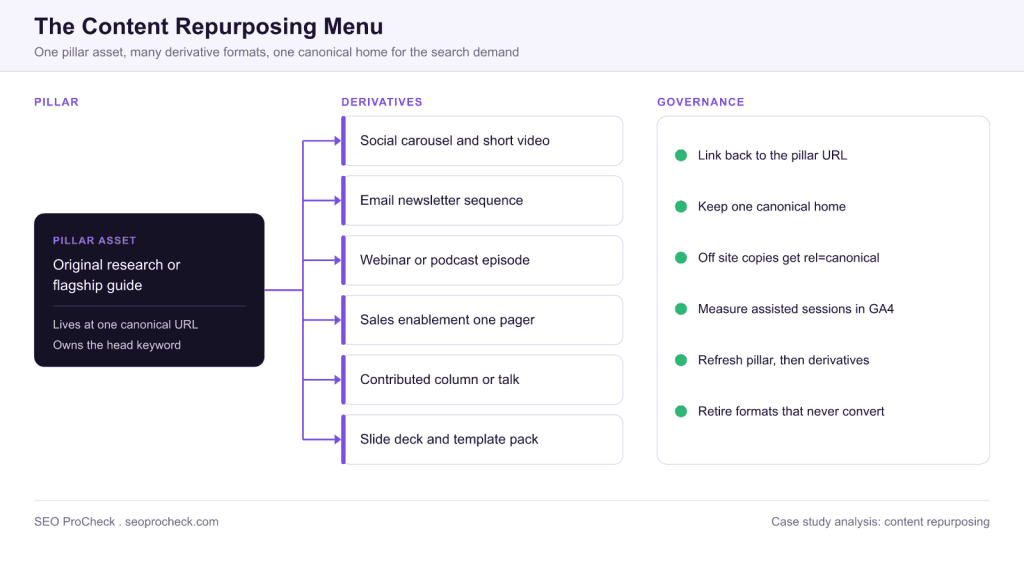
A repurposing menu is a standing list of derivative formats that every pillar asset gets turned into, so that one piece of research funds a quarter of publishing across social, email, video and sales material. The SEO discipline behind it is simple: the pillar keeps one canonical URL and every derivative points back to it, so attention compounds on a single page instead of being split across near duplicates.
- Repurpose from your best linked assets, not your newest ones.
- Derivatives belong on channels (email, video, social, slides), not on extra indexable URLs covering the same query.
- Any off site republication should carry
rel=canonicalback to your original, or at minimum a prominent in text link. - Measure the pillar URL across the whole push, using GA4 conversion paths and a Search Console page filter, not per post vanity metrics.
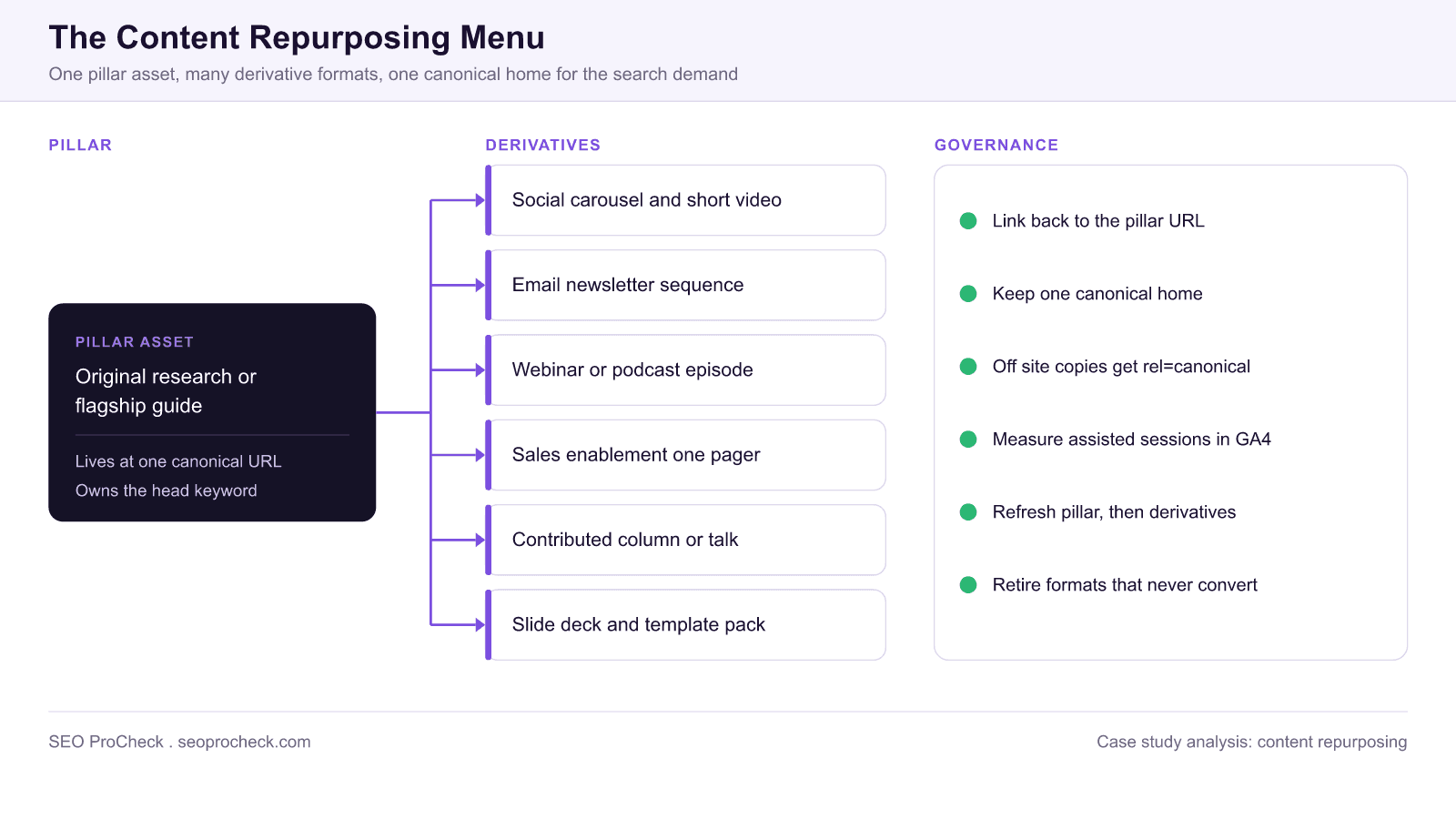
Content repurposing is a distribution system, not a content hack. Pick the assets that already earn links, define a fixed menu of derivative formats, and give each format an owner and a metric. Keep exactly one indexable URL per search intent so the derivatives feed the pillar rather than compete with it, and use rel=canonical or a clear attribution link on anything republished elsewhere. Measure at the level of the pillar URL over an eight week window, because most of the value shows up as assisted sessions and new referring domains rather than as direct clicks on the derivative itself.
The case study below is summarised from the original source, which is credited in full at the end of the summary. Underneath it you will find the part that is usually missing from a write up like this: the operating detail needed to run the same play, including the format menu, the internal linking rules, the production loop and the exact reports used to tell whether any of it worked.
This case study documents a successful organic growth strategy, demonstrating how strategic SEO implementation drives measurable business results. The approach provides actionable insights for practitioners facing similar challenges.
Challenge and Context
Every successful SEO initiative begins with understanding the starting position and objectives. This case study reveals the initial challenges, competitive landscape, and business goals that shaped the strategy. Understanding context helps practitioners assess applicability to their own situations.
Strategic Approach
The methodology employed combined technical optimization, content strategy, and authority building in a coordinated approach. Key decisions around prioritization, resource allocation, and tactical execution provide a template for similar initiatives. The strategy balanced quick wins with sustainable long-term growth.
Implementation Details
Moving from strategy to execution required specific technical implementations, content creation processes, and measurement frameworks. This case study documents the practical steps taken, tools used, and workflows developed. These implementation details help practitioners translate strategy into action.
Results and Analysis
The outcomes demonstrate the effectiveness of the approach through measurable metrics: traffic growth, ranking improvements, and business impact. Analysis of what worked best and what could have been done differently provides learning value beyond the raw results.
This case study contributes to the evidence base for effective SEO strategy, helping practitioners learn from documented successes.
Source: https://foundationinc.co/lab/hootsuite-content-repurposing
Practitioner notes: building the repurposing menu
The word menu is doing real work here. A menu is a fixed, written set of options that you order from every time, which is very different from the way most teams repurpose: sporadically, when someone remembers, usually with the newest post rather than the best one. Writing the menu down converts repurposing from an intention into a checklist item on the publication ticket, and that single change is responsible for most of the compounding effect.
Selection comes before production. Before any format work starts, rank your existing library by the signals that show demand already exists: referring domains in Ahrefs under Site Explorer then Pages then Best by links, and clicks in Search Console under Performance then Pages sorted descending over the last twelve months. The intersection of those two lists is your repurposing shortlist. Repurposing amplifies existing demand, so an asset with no links and no clicks will not become valuable because you also made a carousel of it. For a related read on how link equity behaves once it lands, see the link building tactics study.
The menu itself: format, effort, and what each one is actually for
Every format on the menu should have a stated job. If two formats have the same job, one of them is waste. The table below is a working menu with realistic effort estimates for a small team and the metric that tells you whether that format earned its slot.
| Derivative format | Typical effort | Job it does | Metric that proves it worked | SEO handling |
|---|---|---|---|---|
| Short video or carousel | 2 to 4 hours | Reach people who will never read 3,000 words | Saves, shares, profile visits | No indexable copy, link in bio or caption to pillar |
| Email newsletter sequence | 2 to 3 hours | Convert existing subscribers into readers and links | Click through rate to the pillar URL | Plain link to pillar, no gated duplicate |
| Webinar or podcast episode | 6 to 10 hours | Build relationships that turn into citations | Referring domains earned in the 90 days after | Show notes page links to pillar with descriptive anchor |
| Sales enablement one pager | 2 hours | Make the asset useful internally so it keeps getting funded | Internal usage and deals influenced | PDF, apply X-Robots-Tag noindex if it should stay private |
| Contributed column or talk | 8 to 12 hours | Reach a new audience with third party credibility | Referral sessions and branded search lift | Ask for a follow link to the pillar in the bio or body |
| Slide deck or template pack | 3 to 5 hours | Give people something to reuse, which earns links passively | Downloads and unsolicited links | Host on your domain, link from the pillar and back |
The internal linking rules that stop repurposing from eating the pillar
The failure mode is predictable. A team repurposes a strong guide into four blog posts on the same domain, each covering a slice of the same query, and six months later the original guide has lost its position to its own offspring. The engine now sees five candidate pages for one intent, internal links are spread across all five, and no single URL is strong enough to hold the position the original had.
Three rules prevent this. First, one indexable URL per search intent: if a derivative would target the same primary query as the pillar, it does not get published as a page, it gets published as a channel asset. Second, every derivative that does live on your domain links to the pillar with a descriptive anchor, not with a generic phrase. Third, the pillar links out to the derivatives from a clearly labelled section, which makes the hierarchy explicit to both users and crawlers. The practical background on getting that hierarchy right is covered in semantic SEO and content strategy.
For anything republished on a partner domain, ask in this order: cross domain rel=canonical pointing at your original, then noindex on their copy, then at minimum a prominent in text link back to your original within the first few paragraphs. Get the answer in writing before you send the text, because renegotiating after publication almost never works.
A production loop that survives contact with a real calendar
The loop below fits a two week cycle and assumes one pillar asset per cycle. It is deliberately boring, because the value comes from it happening every time rather than from any individual step being clever.
- Day 1, select. Pull the shortlist from Best by links and Search Console clicks. Pick one asset. Record the baseline: clicks, impressions, average position and referring domains.
- Day 2, extract. Break the pillar into its atomic claims: every statistic, framework, quote and screenshot becomes a row in a sheet. Most teams find between fifteen and forty atoms in a long guide, and each derivative is assembled from a subset of them.
- Days 3 to 7, produce. Build the three to five formats on the menu. Nothing new gets researched at this stage, which is what keeps the cost down.
- Day 8, wire the links. Add the derivative section to the pillar page, add pillar links to every derivative, and update the internal links from older related posts so the pillar gains inlinks rather than losing them.
- Days 9 to 14, distribute. Ship on a stagger rather than all at once, so each format gets its own moment and you can tell the formats apart in the analytics.
- Day 45 and day 90, review. Re measure the same baseline metrics on the pillar URL and decide, per format, keep or cut.
How to measure it without fooling yourself
The unit of measurement is the pillar URL, over a window long enough for links and rankings to move. Per post engagement metrics on the derivatives are useful for deciding which formats to keep, but they are not the outcome. These are the exact reports worth having open:
- Search Console, Performance then Search results. Filter Page contains the pillar slug, switch to the Compare tab, and set the eight weeks before the push against the eight weeks after. Watch impressions and average position first: clicks lag both.
- Search Console, Performance then Pages. Sort by impression change to catch the queries the pillar picked up that you were not targeting, which is often where the repurposing return actually shows.
- GA4, Explore then Path exploration. Start from the derivative landing pages and look at whether sessions reach the pillar at all. If they never do, the link placement is wrong.
- GA4, Advertising then Attribution then Conversion paths. This is the only place assisted contribution is visible, and repurposing is almost entirely an assist channel.
- Ahrefs, Site Explorer then Backlinks, filtered to new links in the last 90 days. Sort by the pillar URL as the target to see whether the campaign earned citations or only impressions.
- Screaming Frog, Bulk Export then Links then All Inlinks. Filter the destination column to the pillar URL to confirm the internal links you meant to add actually exist and are not sitting behind a JavaScript component that never renders.
Where these programs go wrong
- Repurposing weak assets. The menu is a multiplier, and multiplying zero gives zero. Select on existing demand.
- Creating competing URLs. The most expensive mistake, and the slowest to notice, because the damage lands two quarters later.
- No owner per format. A format with no named owner silently stops happening after cycle three, which is why the menu records an owner alongside the effort estimate.
- Gating the derivative but not the pillar. If the same content sits behind a form and also sits open on a blog post, the form collects nothing and you have built two versions of one asset.
- Measuring in week two. Ranking and link effects need at least 45 days. Judging the program before then guarantees you cut the formats that were about to pay off.
- Letting the pillar go stale. Refresh the pillar first, then the derivatives, otherwise you are distributing an out of date claim across six channels at once.
For more worked examples of growth programs on this site, browse the growth case study library.
FAQ
It is a written list of the derivative formats you will produce from every pillar asset, plus the owner, the effort level and the success metric for each one. The point of writing it down is that repurposing stops being an afterthought that happens when someone remembers, and becomes a checklist that runs on every major publication.
Not when the derivatives live on channels rather than on competing URLs of your own site. The risk appears when you publish three near identical blog posts on your own domain covering the same query, because then the engine has to pick a winner and internal links get split. Keep one indexable page per search intent and push the other formats to email, video, social and slides.
Yes, whenever the partner will accept one. A cross domain rel=canonical tells Google the original is the version to index and consolidates the ranking signals. If the partner refuses, ask for noindex on their copy, and if that also fails, ask for a prominent in text link back to your original as the minimum acceptable outcome.
Most teams get the return from three to five formats, chosen to match where their audience actually is rather than to fill a template. Producing ten formats for an asset nobody links to is a much worse use of the hour than producing three formats for the asset that already earns links.
Set the pillar URL as the unit of measurement, not the campaign. In GA4 use Explore with a path exploration starting at the derivative landing pages, and check Advertising then Attribution then Conversion paths so assisted sessions are visible. In Search Console filter Performance by page and compare the eight weeks before and after the repurposing push.
Start with the assets that already have links and rankings, not the newest publication. Pull your top pages by referring domains in Ahrefs Site Explorer under Best by links, or by clicks in Search Console, and repurpose from that list. Repurposing amplifies whatever demand already exists, so feeding it a page nobody wanted produces nothing.
Want this analysed against your own site?
Case studies are only useful once you know which constraint is actually holding your site back. An audit tells you that.
Claude Vincent is a technical SEO consultant focused on crawlability, rendering, and AI-search visibility. He writes the field guides and case studies at SEO ProCheck, with a bias toward the durable, unglamorous work that decides whether search engines and AI answer engines can actually read and cite a site.
About SEO ProCheck
Technical SEO consulting and GEO strategy with 20 years of enterprise experience. Case studies, resources, and tools for search and AI visibility.
Work With Me
Technical SEO audits, GEO strategy, site migrations, and international SEO. Hourly consulting for teams who need hands-on support, not just reports.
Subscribe to our newsletter!