

Lessons From Growing Greatist to 50M Visitors w/ Derek Flanzraich - Siege Media
- January 5, 2023
- Growth
AI Summary
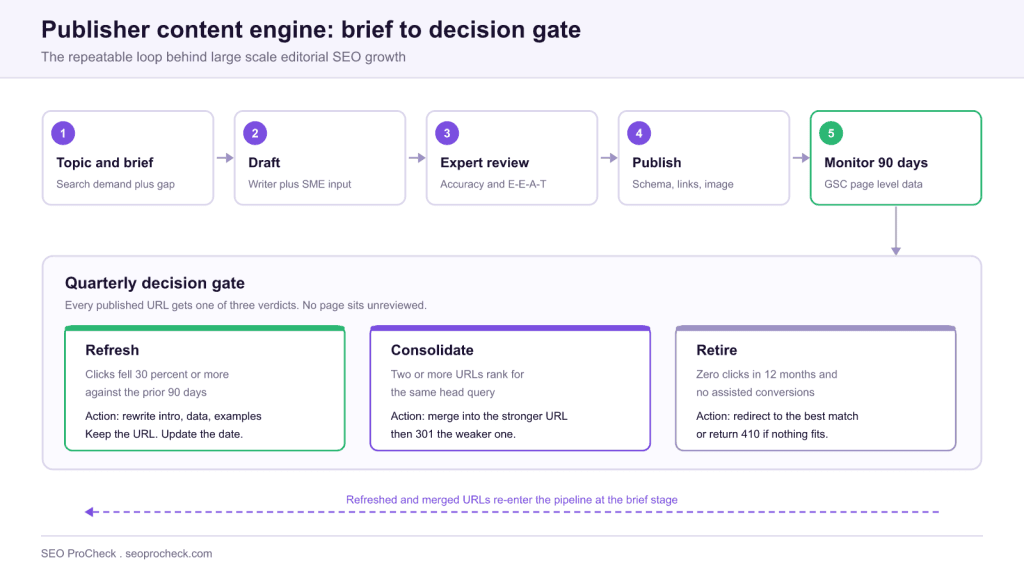
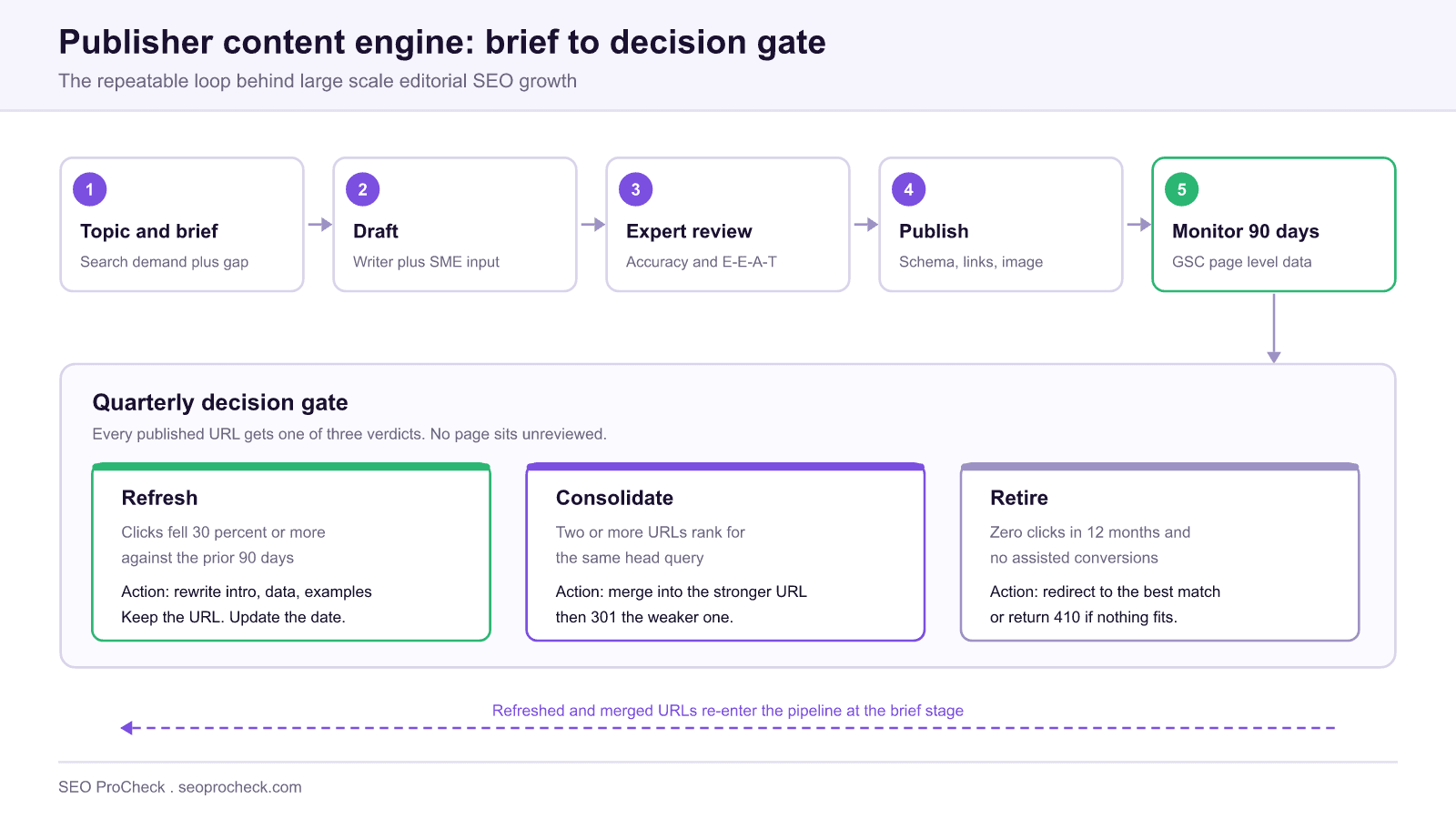
Greatist scaled to a publisher sized audience on the back of a repeatable editorial system, not a single clever tactic. The transferable part of the story is the operating model: a fixed pipeline from brief to publish, a 90 day monitoring window, and a quarterly gate that forces every URL into refresh, consolidate or retire.
- Publisher scale growth is an operations problem: throughput, review capacity and a decay loop, not a list of tricks.
- Track clicks per indexed URL quarterly. If page count rises while that number falls, you are diluting the library.
- Every URL needs a verdict on a schedule. Pages with no owner and no review date are the ones that decay silently.
- For health and wellness topics, named authors, credentials and a stated review process are baseline requirements, not extras.
Case study overview
This case study documents a successful organic growth strategy, demonstrating how strategic SEO implementation drives measurable business results. The approach provides actionable insights for practitioners facing similar challenges.
Challenge and Context
Every successful SEO initiative begins with understanding the starting position and objectives. This case study reveals the initial challenges, competitive landscape, and business goals that shaped the strategy. Understanding context helps practitioners assess applicability to their own situations.
Strategic Approach
The methodology employed combined technical optimization, content strategy, and authority building in a coordinated approach. Key decisions around prioritization, resource allocation, and tactical execution provide a template for similar initiatives. The strategy balanced quick wins with sustainable long-term growth.
Implementation Details
Moving from strategy to execution required specific technical implementations, content creation processes, and measurement frameworks. This case study documents the practical steps taken, tools used, and workflows developed. These implementation details help practitioners translate strategy into action.
Results and Analysis
The outcomes demonstrate the effectiveness of the approach through measurable metrics: traffic growth, ranking improvements, and business impact. Analysis of what worked best and what could have been done differently provides learning value beyond the raw results.
This case study contributes to the evidence base for effective SEO strategy, helping practitioners learn from documented successes.
What publisher scale actually changes
Below roughly 100 URLs, an SEO program is a content problem: pick better topics, write better pages, earn a few links. Past a few hundred URLs the bottleneck moves. The library itself becomes the thing you manage, and the failure modes change shape. Pages go stale faster than you can notice. Two articles start competing for the same query. An editor leaves and forty URLs quietly lose their owner. None of that is fixed by writing more.
That is why interviews like this one are worth reading as operations case studies rather than tactic lists. The headline figure in the source is the outcome. The reusable part is the machine: a fixed number of stages, an explicit exit test at each stage, and a scheduled review that no URL can escape. The diagram above is that machine drawn out, and the rest of this page is how to build each piece with tools you already have.
If you are building the topical foundation underneath a library like this, start with building topical authority and the way clusters are wired together, because a large library with no internal structure decays much faster than a small one.
The five stage pipeline and its exit criteria
A pipeline only works if each stage has a test that can fail. Stages without exit criteria turn into queues, and queues turn into a backlog of half finished drafts that nobody wants to own. Use the table below as the definition of done for each handoff.
| Stage | Exit criteria (do not advance until true) | Artifact produced | Typical owner |
|---|---|---|---|
| 1. Topic and brief | Primary query has confirmed demand and the SERP is not locked to a page type you cannot produce | Brief with target query, intent, required subtopics, internal link targets | Strategist |
| 2. Draft | Every claim has a source; every required subtopic from the brief is covered | Draft with inline citations and image requests | Writer |
| 3. Expert review | Subject matter expert has signed off on factual accuracy and the author byline is real and credentialed | Reviewed draft plus reviewer name and date | SME or medical reviewer |
| 4. Publish | Schema valid, featured image with descriptive alt, 2 to 4 internal links in, at least 1 out | Live URL submitted for indexing | Editor |
| 5. Monitor 90 days | URL has a full 90 days of Search Console data and is queued for the next gate | Row in the decay tracker | Editor |
The stage that gets skipped first, and costs the most later, is stage 3. Expert review is slow, it creates friction with writers, and its value is invisible in the first month. It is also the only stage that protects a health or finance library from being classed as low quality at scale.
Instrumentation: the exact reports to pull
You cannot run a decision gate on intuition. Four data pulls cover almost everything, and all four are free.
1. Search Console click decay
Open Performance then Search results. Set Date to Compare, choose Compare last 90 days to previous period, then open the Pages tab and export. The export gives you clicks and impressions for both periods per URL. Add a computed column for percentage change in clicks and sort ascending. Everything in the top decile of decline is your refresh queue for the quarter. Export the same view filtered by Query to see whether the loss is one query or the whole tail.
2. Search Console coverage
Indexing then Pages. The two rows that matter for a large library are Crawled, currently not indexed and Discovered, currently not indexed. On a big site these are quality and crawl budget signals rather than bugs. We cover how to read them in the Search Console page indexing report guide, and the specific fix path in crawled currently not indexed.
3. Screaming Frog internal link health
Crawl the site, then run Crawl Analysis from the top menu, which is what populates the orphan and link score data. Two exports matter: Reports then Orphan Pages (requires a Search Console or sitemap source connected so the crawler knows about URLs it cannot reach), and the Inlinks column on the Internal tab sorted ascending. Any URL with fewer than three internal inlinks is under supported. Fixing that is usually cheaper than rewriting.
4. GA4 landing page engagement
Reports then Engagement then Landing page, with Sessions, Engagement rate and Key events as columns, filtered to the organic search channel. This is where you catch pages that still rank but no longer satisfy, which are refresh candidates that click decay alone will not surface for another quarter.
A worked decay example
Take a hypothetical evergreen guide with the following comparison export:
| Metric | Previous 90 days | Last 90 days | Change |
|---|---|---|---|
| Clicks | 4,120 | 2,455 | down 40 percent |
| Impressions | 96,400 | 94,800 | down 2 percent |
| Average position | 4.1 | 4.3 | roughly flat |
| Distinct queries | 612 | 598 | roughly flat |
Impressions, position and query count all held. Only clicks fell. That pattern is not a ranking loss, it is a click through rate loss, and the causes are a short list: the SERP gained a feature above you, a competitor rewrote a more compelling title, your title and description no longer match the dominant intent, or an AI Overview now answers the query outright. The fix is title and snippet work plus adding the specific answer the AI surface is pulling, not a full rewrite. If position had fallen alongside clicks while impressions held, that would be the opposite diagnosis and a full content rebuild would be justified.
Running this comparison per URL, per quarter, is the entire decay system. Everything else is bookkeeping.
The quarterly decision gate
The gate is a meeting with a spreadsheet, not a tool. Every URL that has 90 days of data comes up, gets exactly one verdict, and gets a date. The table below is the rule set to run it with.
| Signal | Where you read it | Threshold | Verdict | First action |
|---|---|---|---|---|
| Click decay | Search Console Performance, Pages tab, compare last 90 days to previous period | Clicks down 30 percent or more with position roughly flat | Refresh | Rewrite the intro and the first two sections, replace dated data, add a new example |
| Position slide | Same report, Average position column, same comparison | Position dropped more than 3 places on the head query | Refresh | Compare against the current top 3 for coverage gaps, then expand the thin sections |
| Query overlap | Performance report filtered by query, then Pages tab for that query | Two or more of your URLs impress on the same head query | Consolidate | Merge the weaker into the stronger, 301 the loser, repoint internal links |
| Zero engagement | Search Console Pages tab plus GA4 landing page report | Zero clicks over 12 months and no assisted conversions | Retire | Redirect to the closest live match, or return 410 if nothing is close |
| Not indexed | Search Console Page indexing report, Crawled currently not indexed | URL crawled but excluded for more than 60 days | Refresh or consolidate | Treat it as a quality signal: raise substance or merge it away, do not resubmit repeatedly |
| Orphaned | Screaming Frog, Configuration then Spider then Crawl Analysis, Orphaned Pages report | Zero internal inlinks from the crawl | Refresh | Add contextual links from the two strongest related URLs |
Consolidation is the verdict teams avoid, because deleting work feels like a loss. It is usually the highest return action on a mature library. The mechanics, including how to choose the surviving URL and what to do with the redirects, are in the content refresh, prune and merge system, and the audit that feeds the gate is in the content audit process.
E-E-A-T controls for health and wellness libraries
A wellness publisher operates entirely inside what Google's quality rater guidelines treat as sensitive territory. That does not create a ranking factor you can toggle, but it does set a floor you have to clear. The practical controls are boring and checkable:
- Named authors with real credentials. An author archive page per writer, with qualifications, professional history and links to work elsewhere. Anonymous or invented bylines are a liability at scale.
- A visible review layer. A reviewer name and a review date on the page, plus a published description of what the review covers. This is a content operations commitment, not a plugin.
- Primary sources only for claims. Link to the study, the guideline body or the official dataset, not to another article that cites it. One layer of indirection is how misinformation propagates through a library.
- A correction policy that gets used. Date stamped corrections at the foot of the page. It costs nothing and it is one of the few visible signals that a real editorial process exists.
- Separation of commercial and editorial. Affiliate placements disclosed and kept out of the medical guidance sections.
What to copy and what to leave
Copy the operating system: staged pipeline, explicit exit criteria, 90 day monitoring, scheduled verdicts. That transfers to any vertical and any team size, and it is the part that compounds.
Do not copy the timeline or the traffic curve. Growth stories from a different competitive era, a different domain history and a different funding position are not a forecast for your site. The useful question from any case study of this kind is not how fast did they grow, it is which constraint did they remove first. In publisher scale content, that constraint is almost always review capacity, because review capacity is what caps how many URLs you can keep alive rather than how many you can create.
For a related view on how newsroom trained SEOs approach the same problem, see our notes on content strategy for publishers.
FAQ
There is no shortcut on volume, but the constraint is usually review capacity rather than writing capacity. A team that can brief, draft, fact check and publish four articles a week reaches roughly 200 URLs a year. The compounding effect comes from the refresh loop, because a library only keeps its traffic if roughly a fifth of it is being updated at any time.
Clicks per indexed URL, tracked quarterly. Total sessions hide the fact that a library can grow in page count while the average page earns less. If clicks per indexed URL is falling while page count rises, you are diluting, not scaling, and the fix is consolidation rather than more publishing.
Compare the trailing 90 days against the previous 90 days in the Search Console Performance report with a Page filter, and flag any URL down 30 percent or more in clicks. Impressions falling while position holds usually means the query set shrank or an AI Overview absorbed the click, whereas position falling means a competitor overtook you. The two need different fixes.
For any topic that touches money or health, Google's raters are explicitly told to weigh the reputation of the site and the credentials of the author. That does not translate into a ranking dial you can flip, but it does mean named authors, verifiable credentials, a stated review process and primary source citations are the baseline. Publishing anonymous health advice at scale is the fastest way to be classed as low quality.
Both, on a fixed ratio. A workable default is 70 percent new and 30 percent refresh once the library passes roughly 100 URLs, shifting toward 50/50 past 500 URLs. Refreshes usually return faster because the URL already has history, internal links and some crawl priority.
Between 150 and 300 URLs if the editor is only responsible for the quarterly decision gate and not for writing. Past that, the review stops being real and pages start defaulting to no action, which is how orphaned and decayed content accumulates.
Is your content library growing while its traffic per page shrinks?
An audit maps decay, cannibalization and orphaned URLs across the whole library, then turns them into a ranked action queue.
Source: https://www.siegemedia.com/conversation/derek-flanzraich
Claude Vincent is a technical SEO consultant focused on crawlability, rendering, and AI-search visibility. He writes the field guides and case studies at SEO ProCheck, with a bias toward the durable, unglamorous work that decides whether search engines and AI answer engines can actually read and cite a site.
About SEO ProCheck
Technical SEO consulting and GEO strategy with 20 years of enterprise experience. Case studies, resources, and tools for search and AI visibility.
Work With Me
Technical SEO audits, GEO strategy, site migrations, and international SEO. Hourly consulting for teams who need hands-on support, not just reports.
Subscribe to our newsletter!







Recent Posts
- Can AI Crawlers Actually Read Your Site? I Measured 400 of the Biggest September 5, 2026
- The Pre-Publish Quality Gate for AI-Assisted Content August 6, 2026
- AGENTS.md vs llms.txt vs llms-full.txt: Which Agent File Does What July 18, 2026