


AI Summary
This piece looks at what happens when SEO work is broken into small iterations instead of delivered as one large project. The core move is slicing vertically: each iteration runs all the way through research, specification, build and measurement for a narrow scope, and is live at the end, rather than completing one layer at a time across the whole site and shipping nothing until the finish.
- A valid slice is thin but complete: one template, one country, one query set, live at the end.
- SEO tickets need acceptance criteria and a test method, or developers will guess.
- Definition of done for SEO includes live in rendered HTML, recrawled, and baselined.
- The gain is learning speed: a wrong assumption costs one template instead of twenty.
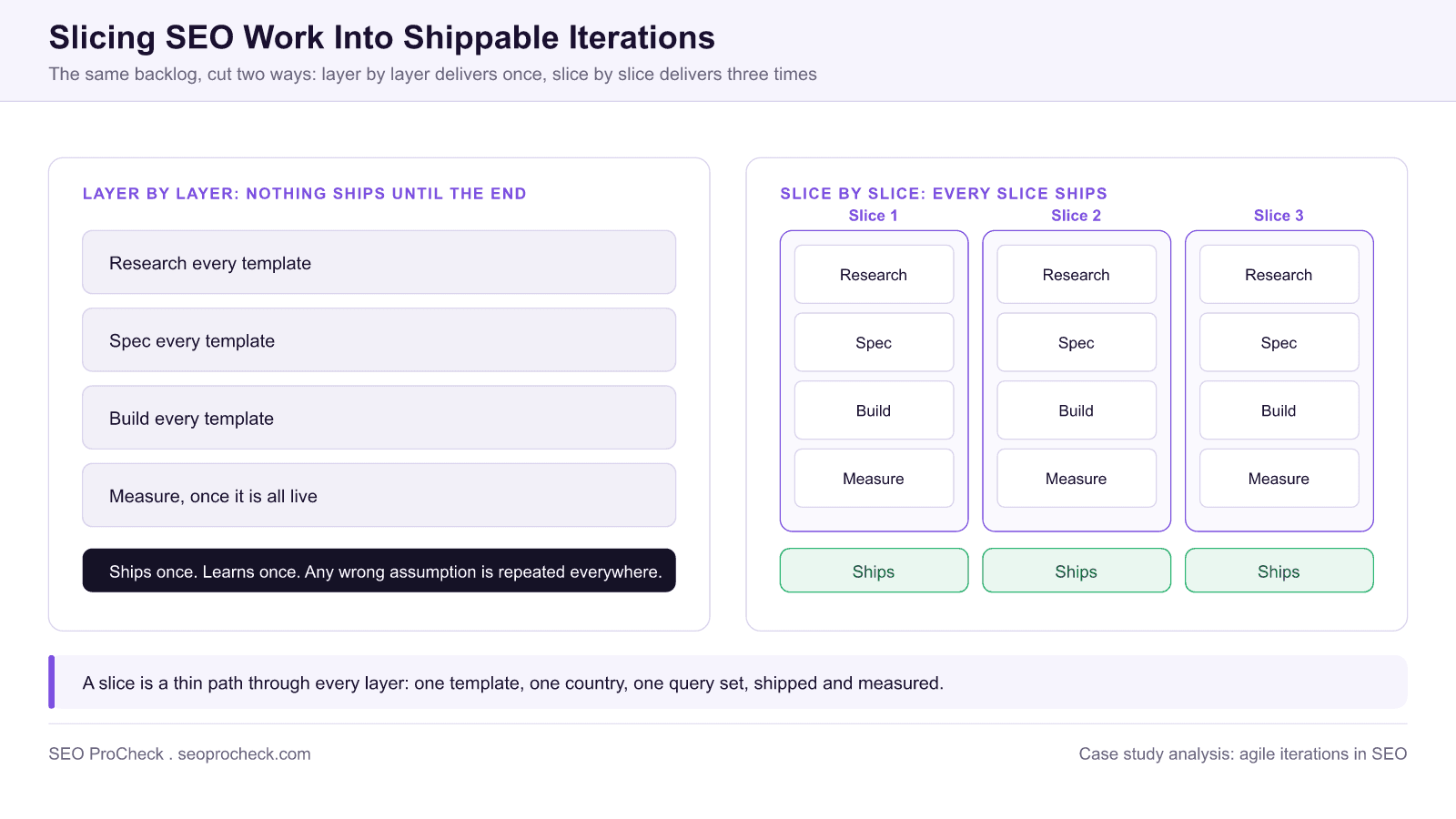
Most SEO delivery fails at the handover, not at the analysis. Iterating fixes that by changing the unit of work from the project to the slice: a narrow scope taken all the way to live, with a recorded baseline and a measurement date. To make it run you need refined tickets with explicit acceptance criteria, a definition of done that ends at production rather than at merged, a prioritisation score you are willing to show people, and a review at the end of each slice that is allowed to change the plan. The real payoff is not speed, it is that a wrong assumption gets caught after one template instead of after the whole rollout.
The mini case studies below are summarised from the original source, credited in full at the end of the summary. After them you will find the operating detail: how to cut a slice that is actually thin and complete, how to write a ticket that gets built as specified, what belongs in a definition of ready and a definition of done for SEO, and how to review a slice without pretending the ranking data has arrived yet.
This case study documents a successful organic growth strategy, demonstrating how strategic SEO implementation drives measurable business results. The approach provides actionable insights for practitioners facing similar challenges.
Challenge and Context
Every successful SEO initiative begins with understanding the starting position and objectives. This case study reveals the initial challenges, competitive landscape, and business goals that shaped the strategy. Understanding context helps practitioners assess applicability to their own situations.
Strategic Approach
The methodology employed combined technical optimization, content strategy, and authority building in a coordinated approach. Key decisions around prioritization, resource allocation, and tactical execution provide a template for similar initiatives. The strategy balanced quick wins with sustainable long-term growth.
Implementation Details
Moving from strategy to execution required specific technical implementations, content creation processes, and measurement frameworks. This case study documents the practical steps taken, tools used, and workflows developed. These implementation details help practitioners translate strategy into action.
Results and Analysis
The outcomes demonstrate the effectiveness of the approach through measurable metrics: traffic growth, ranking improvements, and business impact. Analysis of what worked best and what could have been done differently provides learning value beyond the raw results.
This case study contributes to the evidence base for effective SEO strategy, helping practitioners learn from documented successes.
Source: https://www.theseosprint.com/p/agile-iterations-seo
Practitioner notes: what makes a slice a slice
The distinction that does all the work here is vertical versus horizontal slicing. A horizontal slice completes one layer across everything: research every template, then spec every template, then build every template. Nothing is live until the end, so nothing is learned until the end, and every assumption made in month one is baked into all of it. A vertical slice takes a narrow scope through every layer and puts it live: one template, one country, one query set, one page type.
A useful slice passes three tests. It is thin, meaning it can be delivered inside one cycle rather than spanning three. It is complete, meaning something is different on the production site at the end of it. And it is informative, meaning the outcome will change what you do next: if the result cannot change the plan, you are shipping work rather than learning anything. A technical audit fails the second test on its own, which is why audits so often sit unimplemented. The fix is to treat the audit as input to a sequence of slices, structured the way a technical SEO audit should be structured and communicated.
Cutting a real backlog into slices
The table below takes projects that usually arrive as one large request and shows a first slice that is thin, complete and informative, along with what that first slice tells you.
| Project as requested | First slice | Why this slice first | What it tells you |
|---|---|---|---|
| Fix internal linking sitewide | Add a related links module to one category template | One template, one component, testable in a single deploy | Whether the module renders server side and whether inlinks actually change |
| Rewrite all product page copy | Rewrite twenty products in one subcategory | Small enough to write properly, large enough to read a signal | Whether copy alone moves anything on this catalogue |
| Implement structured data everywhere | Product schema on one template, validated on ten URLs | Schema errors are template level, so one template exposes them all | Whether the data layer has the fields the markup needs |
| Migrate to a new URL structure | Move one low risk section with full redirect mapping | Rehearses the migration where a mistake is survivable | Whether the redirect logic and the crawl budget behave as expected |
| Improve Core Web Vitals | One template, one metric, one fix | Isolates cause and effect instead of shipping five changes at once | Whether the field data actually responds to the lab improvement |
| Build a content hub | Publish the hub page plus three supporting articles | Proves the internal linking pattern before scaling it | Whether the hub gets crawled and whether the pattern earns impressions |
Writing tickets that get built as specified
An SEO ticket competes for attention with tickets that have clear outcomes and clear tests. If yours does not, it will be deferred or approximated. Four elements make the difference:
- The outcome, stated for a crawler or a user. Not improve internal linking, but: on product pages, output a Related Products module containing six links rendered in the initial HTML response.
- The exact scope. Name the templates and URL patterns. Ambiguity here is the single most common cause of a change landing on the wrong page type.
- Acceptance criteria that can be tested. Written so the developer can check them without asking you: the module appears in view source with JavaScript disabled, links are standard anchor tags with href attributes, no rel attribute is added.
- The test method. Name the tool and the check. Fetch the URL with curl and confirm the anchors are present, or run URL Inspection and read the rendered HTML.
Definition of ready and definition of done
Two short checklists remove most of the friction between an SEO team and a delivery team. A ticket is ready when the scope names specific templates, acceptance criteria are written, the baseline metrics are captured, the measurement date is set, and someone has confirmed the change is technically possible on this stack. A ticket is done when the change is live on production, visible in the rendered HTML a crawler receives, the affected URLs have been resubmitted or have been recrawled, the change date is annotated, and the review date is in the calendar.
That last set matters more than it looks. Work that is merged but not deployed, or deployed but only visible after client side rendering, is work that will show no result and will be recorded as an SEO tactic that did not work. Where indexing directives are part of the change, verify them the way the meta robots and X-Robots-Tag reference describes, because a directive that stays cached is a change that never happened.
Reviewing a slice when the ranking data has not arrived
The obvious objection to iterating in SEO is that results lag by weeks or months, so an end of iteration review has nothing to look at. The answer is to review two different things on two different clocks. At the end of the slice, review delivery: did it ship, did it ship as specified, what slowed it down, and what did we learn about this codebase. Weeks later, on the date already in the calendar, review outcome: what happened to the baseline metrics for the affected URLs.
- Delivery review, end of each slice. Shipped or not, scope changes, blockers, and whether the acceptance criteria held up.
- Outcome review, on the scheduled date. Search Console Performance filtered to the affected URL pattern, compared with the recorded baseline and with the same window last year.
- Assumption log. Write down what you expected before shipping. Comparing that to what happened is the only way an iteration teaches you anything durable.
- Next slice decision. Scale the pattern, adjust it, or drop it. If the answer is always scale, the slices were not informative and you are running a rollout, not an experiment.
Where iterating goes wrong
- Slices that are thin but not complete. Research only, or spec only. These feel like progress and change nothing.
- Slices too small to read. Three product pages will not produce a signal you can act on. Thin has a lower bound.
- Skipping the baseline. Without it the outcome review becomes an argument about what the number used to be.
- Shipping several slices at once. Attribution collapses, and so does the learning that justified iterating.
- Never revisiting priorities. If the backlog order never changes after a result, the iteration loop is decorative.
- Ceremony without delivery. Standups and boards are not the point. Something being live at the end of the slice is the point.
Related process and delivery examples are collected in the growth case study library.
FAQ
It is a thin slice of work that runs all the way through research, specification, implementation and measurement, and that is live at the end of it. One template on one country site is an iteration. A full technical audit is not, because nothing about the site has changed when it is finished.
Give it a user or crawler outcome, explicit acceptance criteria, and a way to test it. Name the exact templates and URL patterns affected, state what the rendered HTML must contain, and describe how the developer can verify it themselves. Tickets that say improve internal linking get returned or guessed at.
The change is live on production, it is visible in the rendered HTML that a crawler sees, the affected URLs have been resubmitted or recrawled, the baseline was recorded before the change, and the measurement date is in the calendar. Merged to main is not done for SEO work.
Work to their cadence rather than asking for a separate process. Bring tickets that are already refined, sized and testable to backlog refinement, attach the acceptance criteria and the test method, and accept that a small item shipping this sprint beats a large item that keeps getting deferred.
Score each item on expected impact, confidence in that impact, and effort, then sort. The value of writing the score down is not precision, it is that it makes the reasoning visible when someone asks why their request is not at the top. Revisit the scores when new data arrives rather than defending old ones.
Yes, because the iteration is about delivery, not about the result landing. Each slice ships a change and records a baseline, then the measurement happens on its own schedule weeks later. What iterating buys you is finding out that an assumption was wrong after one template instead of after twenty.
Want this analysed against your own site?
Case studies are only useful once you know which constraint is actually holding your site back. An audit tells you that.
Take this with you
The assistant links open with a question about this page already written. Nothing is sent until you press enter.
Claude Vincent is a technical SEO consultant focused on crawlability, rendering, and AI-search visibility. He writes the field guides and case studies at SEO ProCheck, with a bias toward the durable, unglamorous work that decides whether search engines and AI answer engines can actually read and cite a site.
About SEO ProCheck
Technical SEO consulting and GEO strategy with 20 years of enterprise experience. Case studies, resources, and tools for search and AI visibility.
Work With Me
Technical SEO audits, GEO strategy, site migrations, and international SEO. Hourly consulting for teams who need hands-on support, not just reports.
Subscribe to our newsletter!








Recent Posts
- Most Top Sites Never Say Who They Are in Structured Data October 14, 2026
- Homepage Titles Are Mostly Too Short, Not Too Long October 8, 2026
- Who Actually Serves an llms.txt? 184 Top Sites Measured September 29, 2026