

AI Summary
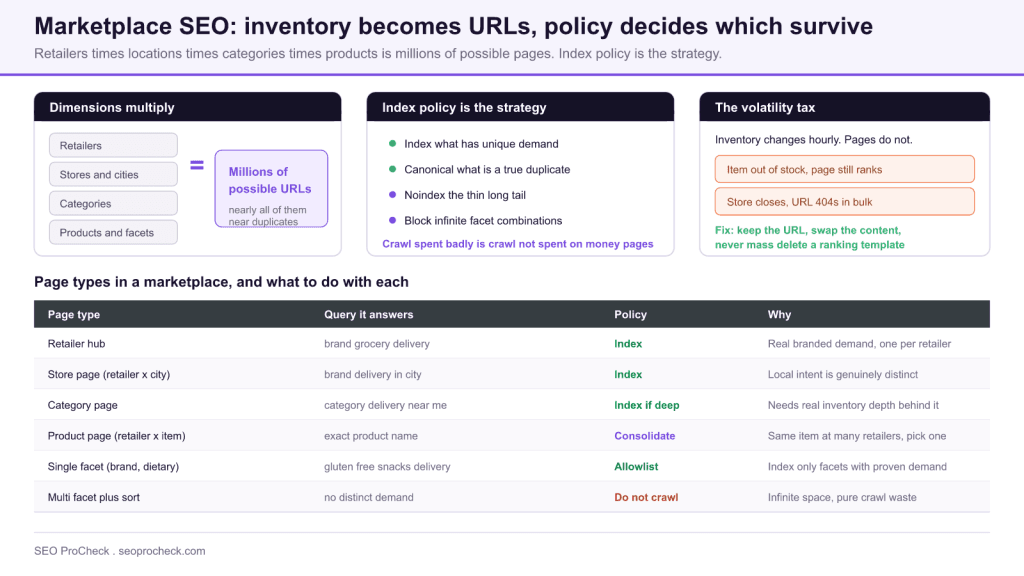
Marketplace SEO is not a content problem, it is an inventory to URL problem. Retailers times stores times categories times products generates millions of possible pages automatically, so the strategic work is deciding which of those pages are allowed to exist, which get consolidated, and which never get crawled at all.
- Index policy is the strategy: most marketplace URLs are near duplicates of a sibling.
- Local intent makes retailer times city pages genuinely distinct; a fourth filter combination is not.
- Facets need an allowlist, not a blocklist, because the combination space is effectively infinite.
- Inventory changes hourly and pages do not, so plan for out of stock and store closure handling before launch.
This case study documents a successful organic growth strategy, demonstrating how strategic SEO implementation drives measurable business results. The approach provides actionable insights for practitioners facing similar challenges.
Challenge and Context
Every successful SEO initiative begins with understanding the starting position and objectives. This case study reveals the initial challenges, competitive landscape, and business goals that shaped the strategy. Understanding context helps practitioners assess applicability to their own situations.
Strategic Approach
The methodology employed combined technical optimization, content strategy, and authority building in a coordinated approach. Key decisions around prioritization, resource allocation, and tactical execution provide a template for similar initiatives. The strategy balanced quick wins with sustainable long-term growth.
Implementation Details
Moving from strategy to execution required specific technical implementations, content creation processes, and measurement frameworks. This case study documents the practical steps taken, tools used, and workflows developed. These implementation details help practitioners translate strategy into action.
Results and Analysis
The outcomes demonstrate the effectiveness of the approach through measurable metrics: traffic growth, ranking improvements, and business impact. Analysis of what worked best and what could have been done differently provides learning value beyond the raw results.
This case study contributes to the evidence base for effective SEO strategy, helping practitioners learn from documented successes.
Why marketplace SEO is a different discipline
A grocery delivery marketplace is a three sided inventory problem: retailers, physical stores tied to locations, and hundreds of thousands of products whose availability changes by the hour. Every one of those dimensions can become a URL, and they multiply. A few hundred retailers, a few thousand serviceable cities, a few hundred categories and a large product catalogue produce a theoretical URL space in the millions.
That is the defining constraint. On a normal content site you decide what to publish and then publish it. On a marketplace the pages generate themselves as a byproduct of the catalogue, so the meaningful decision is subtractive: which of these automatically available URLs deserve to be indexed, which should be folded into a canonical sibling, and which should never be crawled. Teams that skip that decision end up with a crawl budget spent almost entirely on filter permutations while the pages that convert go stale in the index.
The page type inventory and its index policy
Start by writing down every page type the platform can emit and assigning each an explicit policy. This document is worth more than any amount of on page optimisation, because it determines what the crawler spends its time on.
| Page type | URL shape | Demand it captures | Policy |
|---|---|---|---|
| Retailer hub | /store/{retailer}/ | Branded queries for that retailer plus delivery | Index. One page per retailer, heavily linked |
| Store or city page | /store/{retailer}/{city}/ | Local intent: retailer plus a place name | Index where the service area is real |
| Category page | /category/{category}/ | Head category demand, often with a local modifier | Index when inventory depth justifies it |
| Product page | /products/{product}/ | Exact product name searches | Consolidate: one canonical per real world item |
| Single facet | ?diet=gluten-free | Genuine modifier demand for some facets only | Allowlist the proven ones, noindex the rest |
| Facet combinations and sorts | ?brand=x&diet=y&sort=price | Essentially none | Keep out of the crawl entirely |
The single most valuable line in that table is the store or city page. It is the one place where the multiplication genuinely produces distinct demand, because "retailer name delivery in city name" is a real query with real local intent, and the answer differs by location: different store, different service area, different availability. Everything below it in the table trends toward duplication.
Facets: allowlist, never blocklist
Faceted navigation is where marketplace crawl budget goes to die. The maths is unforgiving: ten filters with five values each, in any combination and any order, produce more URLs than the entire product catalogue, all of them near duplicates of a list view.
The mistake is treating this as a blocklist problem, adding rules as bad URLs are discovered. The space is unbounded, so you will always be behind. Invert it: nothing in the facet space is crawlable by default, and specific combinations are promoted onto an allowlist when they have demonstrated search demand.
- Promote on evidence. A facet earns indexation when keyword data shows people search that modifier, for example a dietary or brand filter, and when it returns enough results to be a useful page.
- Give promoted facets clean URLs. Move them from query strings to a static path, and give them their own title, description and intro copy. Now it is a landing page, not a filter state.
- Never link to unpromoted combinations in crawlable HTML. If the crawler cannot reach a filter state through an
<a href>, most of the problem disappears before robots.txt is even involved. - Fix parameter order. Canonicalise parameter sequence and drop empty parameters at the server, so the same filter state cannot present as several URLs.
Our faceted navigation guide covers the full decision tree, including when a filter deserves to become a permanent landing page. For the crawl side of the equation, the crawl budget FAQ explains how wasted requests displace the pages you care about.
Consolidating product pages across retailers
The same physical product is sold by many retailers, so the naive data model produces one URL per retailer per product. Those pages are duplicates in every meaningful way: same product name, same manufacturer description, same image, differing only in price and store.
The workable pattern is a canonical product entity: one indexable page per real world item, keyed on a stable identifier such as a GTIN, with retailer specific pricing and availability rendered on that single page. Retailer scoped variants either do not get their own URL, or carry a canonical pointing at the entity page. This also solves a second problem: a consolidated page accumulates all the links, engagement and history that would otherwise be split across dozens of near identical URLs.
When Google disagrees with your canonical choice you will see it in Search Console > Indexing > Pages as Duplicate, Google chose different canonical than user. That report is the feedback loop for this work. The canonical tags reference covers how the signal interacts with internal links and sitemaps when they disagree.
The volatility tax
Marketplaces have a problem that publishers do not: the underlying facts change constantly, and ranking pages describe a state of the world that expires. Three failure modes recur.
- Out of stock items on ranking pages. The page still ranks, the user arrives, the product is unavailable. Do not delete or 404 the URL; keep it, mark availability honestly, and surface substitutes. Deleting a ranking URL forfeits an asset you may want back next week.
- Store closures and coverage changes. When a retailer partnership ends, a whole cohort of city pages loses its reason to exist. Redirect them to the nearest surviving equivalent, usually the retailer hub or a city page for a different retailer, rather than serving a bulk 404 wall.
- Seasonal catalogue churn. Products that vanish and return annually should keep stable URLs across cycles. Recreating them under new URLs each season discards accumulated ranking history.
The general rule: the URL is the asset, the content is the variable. Change what a page says as the world changes, but keep the URL stable and keep it linked. Mass deletion of a page type that has ranking history is one of the few genuinely irreversible mistakes available in technical SEO.
Internal linking at marketplace scale
Millions of URLs will not be crawled evenly. Link structure, not sitemap size, decides what gets attention. Three habits carry most of the weight.
First, build genuine hub pages: a retailer hub linking to every city it serves, a city hub linking to every retailer available there. This gives both dimensions a crawlable path rather than relying on the sitemap alone. Second, keep click depth shallow for revenue pages; anything beyond about four clicks from the home page on a large site gets crawled rarely. Third, add lateral links between related leaves, for example nearby cities or related categories, which distributes authority into the long tail instead of stranding it at the hubs. The internal linking guide covers depth and link equity distribution in more detail.
What to measure
Aggregate traffic numbers hide everything on a site this shape. Segment by page type from the start and track each separately: indexed URLs per type, clicks per type, and the ratio between them. A category template that grows to 40,000 URLs with a 20% index rate is a liability, not an achievement, and only per template reporting makes that visible. Segmented XML sitemaps are the cheapest way to get it, since the Sitemaps report gives you submitted versus indexed per file. Pair that with the Page indexing report to see which exclusion reason dominates each template.
FAQ
A marketplace has an extra dimension: it sells other people's inventory across many locations, so pages multiply by retailer and by place as well as by product. That produces far more near duplicate URLs than a single retailer's store, and it means availability changes are outside your control. The core discipline shifts from creating pages to deciding which automatically generated pages should exist.
Yes, where the location is genuinely served and the page reflects real local differences such as the actual store, service area and availability. Location pages are usually the highest value cell in the matrix because local intent queries are distinct and commercially valuable. Generating a page for every city you might one day serve, with identical content, is the version that fails.
Treat the facet space as closed by default and promote specific combinations onto an allowlist when keyword data proves demand and the filter returns enough results. Promoted facets get clean static URLs and their own copy so they function as landing pages. Everything else should not be reachable through crawlable links at all, which is more effective than trying to block an unbounded space after the fact.
Keep the URL live and returning 200, state availability honestly, and offer substitutes. Returning a 404 or removing the page throws away ranking history for an item that will probably be back in stock. Only remove a URL when the product is genuinely discontinued, and even then redirect to the closest equivalent rather than serving a dead end.
Model one canonical page per real world item, keyed on a stable identifier such as a GTIN, and render retailer specific price and availability on that single page. Retailer scoped duplicates either get no URL of their own or carry a canonical pointing at the entity page. Consolidating also concentrates links and engagement signals that would otherwise be split across dozens of near identical URLs.
Usually because the site emits far more URLs than it earns crawl for, and most of them are near duplicates. Check the exclusion reasons per template in the Page indexing report: "Discovered, currently not indexed" points at scale outrunning crawl capacity, while duplicate related reasons point at templates that vary too little. Segment your sitemaps by page type so you can see which template is responsible.
Source: https://www.kevin-indig.com/seo-strategy-case-study-instacart/
Take this with you
The assistant links open with a question about this page already written. Nothing is sent until you press enter.
Claude Vincent is a technical SEO consultant focused on crawlability, rendering, and AI-search visibility. He writes the field guides and case studies at SEO ProCheck, with a bias toward the durable, unglamorous work that decides whether search engines and AI answer engines can actually read and cite a site.
About SEO ProCheck
Technical SEO consulting and GEO strategy with 20 years of enterprise experience. Case studies, resources, and tools for search and AI visibility.
Work With Me
Technical SEO audits, GEO strategy, site migrations, and international SEO. Hourly consulting for teams who need hands-on support, not just reports.
Subscribe to our newsletter!








Recent Posts
- Most Top Sites Never Say Who They Are in Structured Data October 14, 2026
- Homepage Titles Are Mostly Too Short, Not Too Long October 8, 2026
- Who Actually Serves an llms.txt? 184 Top Sites Measured September 29, 2026