
• Articles
    & Evergreen
    • Articles
      • Algorithm Updates
      • Analytics & Measurement
      • CMS and Platforms
      • Content Strategy
      • E-commerce SEO
      • General
      • Industry Guides
      • Keyword Research
      • Link Building
      • Local SEO
      • Mobile SEO
      • On-Page SEO
      • SEO Tools
    • Evergreen
      • AI and Search
        • AEO (Answer Engine Optimization)
        • AI Overviews and SGE
        • GEO (Generative Engine Optimization)
        • LLM Citation Optimization
      • Content SEO
        • Content Architecture
        • E-E-A-T Optimization
        • Internal Linking Strategy
      • Python and Automation
      • Technical SEO
        • Core Web Vitals and Performance
        • Crawlability and Indexation
        • International SEO and Hreflang
        • Log File Analysis
        • Schema and Structured Data
        • Site Architecture
        • Site Migrations
  • Case Studies
    & Researches
    • Case Studies
      • Content
      • Crawling and Indexing
      • Growth
      • International SEO
      • JavaScript SEO
      • Metadata
      • Migrations
      • Website Architecture
      • Web Performance
    • Research
      • AI Search
      • Cross-Industry
      • E-commerce
      • Enterprise
      • Local and Listings
      • Publisher
  • Free
    Tools
    • Free SEO & AI Search Tools
    • Free SEO Tools
      • Content Analysis
      • Developer Utilities
      • GEO & AI Visibility
      • Local SEO
      • Schema & Structured Data
      • Social & Meta
      • Technical SEO
    • Browser Extensions
  • Resources
    & Guides
    • Executive Briefings
      • What SEO Actually Is
      • Why SEO Takes Time
      • Technical vs Content SEO
      • What AI Search Changes
      • Is Your SEO Working?
      • Case Studies
      • Is It Worth It?
      • Hiring an Agency
      • SEO vs Paid
      • Resourcing SEO
    • Best Practices
      • Accessibility
      • AMP
      • Content & GEO
      • Duplicates
      • HTML Structure
      • hrefLang
      • Images
      • Indexation
      • Links
      • Mobile
      • On-Page SEO
      • Organic & Analytics
      • Performance
      • Redirections
      • Robots.txt
      • Security
      • Structured Data
      • Technical GEO
      • URLs
      • XML Sitemaps
    • FAQ
      • AI & Search FAQ
      • Technical SEO FAQ
      • Content SEO FAQ
      • Off-Page SEO FAQ
      • Local SEO FAQ
      • E-commerce SEO FAQ
      • Tools and Analytics FAQ
    • Glossary
      • Glossary | Algorithms
      • Glossary | Analytics
      • Glossary | Business
      • Glossary | Content SEO
      • Glossary | E-commerce
      • Glossary | Emerging
      • Glossary | GEO & AI SEO
      • Glossary | International SEO
      • Glossary | Link Building
      • Glossary | Local SEO
      • Glossary | Search Behavior
      • Glossary | Technical SEO
      • Glossary | Tools
  • Articles
    & Evergreen
    • Articles
      • Algorithm Updates
      • Analytics & Measurement
      • CMS and Platforms
      • Content Strategy
      • E-commerce SEO
      • General
      • Industry Guides
      • Keyword Research
      • Link Building
      • Local SEO
      • Mobile SEO
      • On-Page SEO
      • SEO Tools
    • Evergreen
      • AI and Search
        • AEO (Answer Engine Optimization)
        • AI Overviews and SGE
        • GEO (Generative Engine Optimization)
        • LLM Citation Optimization
      • Content SEO
        • Content Architecture
        • E-E-A-T Optimization
        • Internal Linking Strategy
      • Python and Automation
      • Technical SEO
        • Core Web Vitals and Performance
        • Crawlability and Indexation
        • International SEO and Hreflang
        • Log File Analysis
        • Schema and Structured Data
        • Site Architecture
        • Site Migrations
  • Case Studies
    & Researches
    • Case Studies
      • Content
      • Crawling and Indexing
      • Growth
      • International SEO
      • JavaScript SEO
      • Metadata
      • Migrations
      • Website Architecture
      • Web Performance
    • Research
      • AI Search
      • Cross-Industry
      • E-commerce
      • Enterprise
      • Local and Listings
      • Publisher
  • Free
    Tools
    • Free SEO & AI Search Tools
    • Free SEO Tools
      • Content Analysis
      • Developer Utilities
      • GEO & AI Visibility
      • Local SEO
      • Schema & Structured Data
      • Social & Meta
      • Technical SEO
    • Browser Extensions
  • Resources
    & Guides
    • Executive Briefings
      • What SEO Actually Is
      • Why SEO Takes Time
      • Technical vs Content SEO
      • What AI Search Changes
      • Is Your SEO Working?
      • Case Studies
      • Is It Worth It?
      • Hiring an Agency
      • SEO vs Paid
      • Resourcing SEO
    • Best Practices
      • Accessibility
      • AMP
      • Content & GEO
      • Duplicates
      • HTML Structure
      • hrefLang
      • Images
      • Indexation
      • Links
      • Mobile
      • On-Page SEO
      • Organic & Analytics
      • Performance
      • Redirections
      • Robots.txt
      • Security
      • Structured Data
      • Technical GEO
      • URLs
      • XML Sitemaps
    • FAQ
      • AI & Search FAQ
      • Technical SEO FAQ
      • Content SEO FAQ
      • Off-Page SEO FAQ
      • Local SEO FAQ
      • E-commerce SEO FAQ
      • Tools and Analytics FAQ
    • Glossary
      • Glossary | Algorithms
      • Glossary | Analytics
      • Glossary | Business
      • Glossary | Content SEO
      • Glossary | E-commerce
      • Glossary | Emerging
      • Glossary | GEO & AI SEO
      • Glossary | International SEO
      • Glossary | Link Building
      • Glossary | Local SEO
      • Glossary | Search Behavior
      • Glossary | Technical SEO
      • Glossary | Tools
consulting
Home / Metadata / Adding FAQ Schema: SEO Split Testing Lessons from SearchPilot

Adding FAQ Schema: SEO Split Testing Lessons from SearchPilot

  • July 29, 2020
  • Metadata
No Comments
Adding faq schema: seo split testing lessons from searchpilot

AI Summary

Adding FAQ schema rarely moves click through rate today because Google restricted FAQ rich results to authoritative government and health sites in August 2023, removing the enhancement for most sites. Keep the visible FAQ content for user help and for featured snippets and AI citations, which do not require the markup.

  • FAQ rich results are limited to gov and health sites since August 2023
  • Adding FAQPage markup usually will not produce a rich result for other sites
  • Visible FAQ content still earns snippets and generative citations
  • Test outcomes you can actually win, such as question query rankings
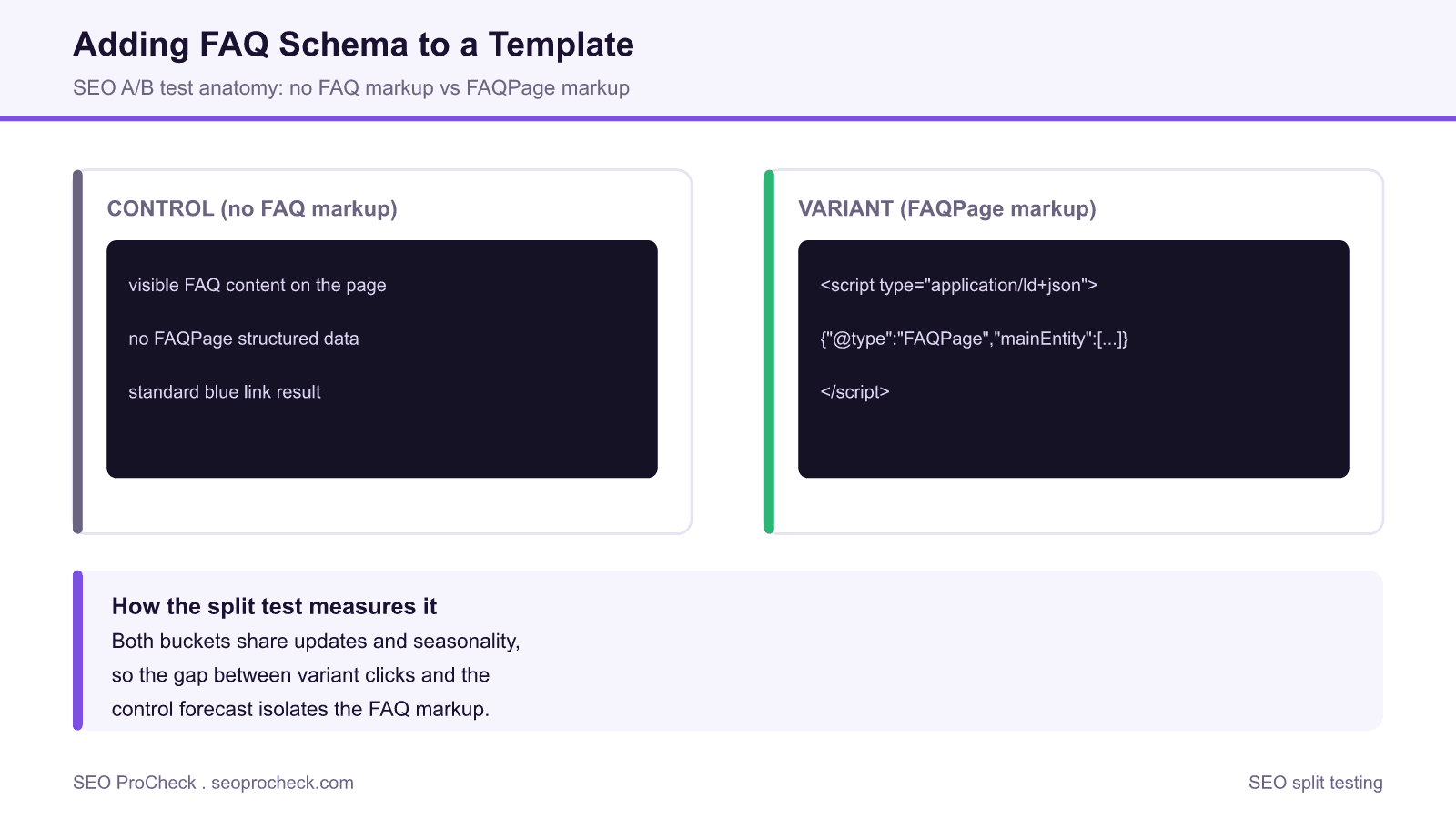
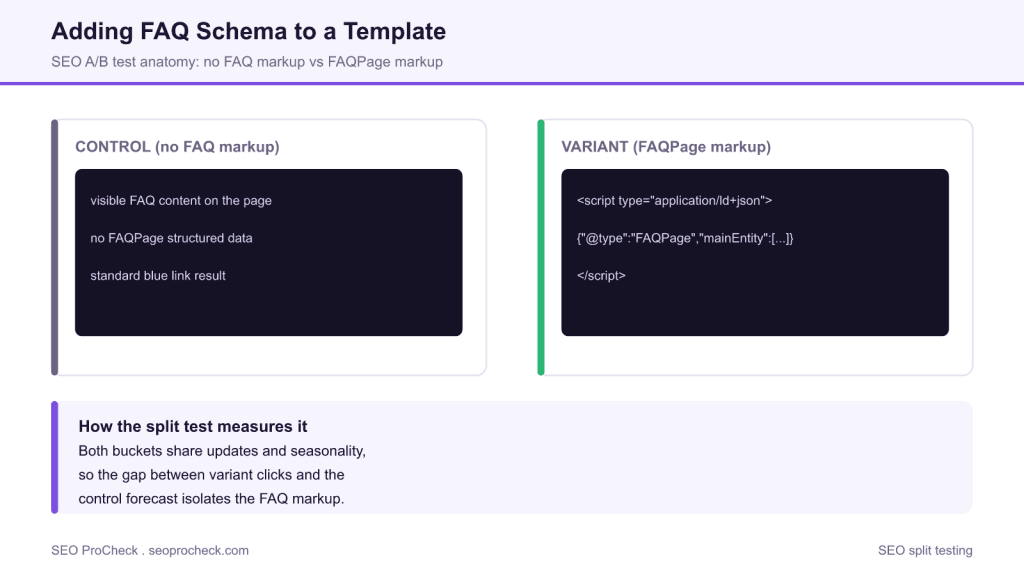
Diagram comparing a page with no faq structured data against a variant that adds faqpage json-ld markup inside a controlled seo split test.
Adding FAQPage structured data to a template and measuring the search impact.

This SEO case study documents a successful optimization initiative, providing actionable insights for practitioners. The documented approach demonstrates how strategic SEO implementation drives measurable results.

Initial Situation

Understanding the starting point is essential context for evaluating any case study. This documentation covers the initial challenges, competitive position, and business objectives that shaped the SEO strategy.

Strategy and Approach

The strategic approach combined multiple SEO disciplines to address identified opportunities. Key decisions around prioritization and resource allocation provide a template for similar initiatives.

Implementation

Moving from strategy to execution required specific technical implementations, content development, and process changes. This case study documents the practical steps that translated strategy into action.

Results and Learnings

The outcomes demonstrate effectiveness through measurable improvements in rankings, traffic, and business metrics. Analysis of successes and challenges provides learning value for practitioners.

Case studies like this contribute to the SEO knowledge base, helping practitioners learn from documented real-world experiences.

Source: https://www.searchpilot.com/resources/case-studies/seo-split-test-lessons-adding-faq-schema/

Practitioner commentary

FAQ schema once expanded a result with a stack of question and answer accordions that dominated vertical space on the SERP. This case study tests whether adding FAQPage structured data to a template moves organic click through rate, and the answer has shifted dramatically since the original test ran.

What FAQ schema was supposed to do

When you mark up on page questions and answers with FAQPage structured data, Google was once able to render them as expandable rich results beneath your listing. The theory was twofold: the extra vertical space pushed competitors down and could lift click through rate, and the visible answers pre qualified the click. In practice the effect was mixed, because the expanded answers sometimes satisfied the searcher on the SERP itself and reduced the need to click, a classic case where a rich result can cannibalise the very traffic it was meant to attract.

That ambiguity is exactly why it was worth a controlled test rather than a blanket rollout. The only honest way to know whether FAQ markup helped or hurt a given template was to add it to half the pages, hold the other half, and measure the click through rate difference against a forecast.

How to test it, then and now

The mechanics are the same as any SearchPilot style test. Assign templated pages to control and variant buckets, add valid FAQPage markup built from genuinely visible on page questions and answers to the variant, keep the control unchanged, and measure click through rate against the control forecast over the same window. A required rule, both then and now, is that the marked up content must be visible on the page, because structured data that does not match visible content is a guidelines violation.

The critical difference today is eligibility. In August 2023 Google restricted FAQ rich results to well known, authoritative government and health sites, so for almost every other site the FAQPage markup no longer produces the expandable rich result at all. That turns the classic version of this test into a null by default: with no rich result to win, adding FAQ schema will usually not move click through rate for a typical commercial or content site.

What to do about FAQ content in the current landscape

Keep the FAQ content, drop the expectation of a rich result. Well structured questions and answers still help users, still target long tail question queries, and are strong candidates for featured snippets and for citation in AI Overviews and other generative answers, none of which depend on FAQPage markup. If you already ship FAQPage schema and it validates without errors, there is little harm in leaving it, but do not invest in adding it to earn a rich result you are not eligible for.

The durable lesson is that structured data eligibility is a moving target set by Google, not a permanent property of a schema type. Test the outcome you can actually win today, which for FAQ content is answering question intent in visible copy and competing for snippets and generative citations, rather than chasing a deprecated enhancement.

FAQ schema then and now

AspectWhen the test first ranToday
Rich result eligibilityMost sites eligibleLimited to gov and health sites
Main benefit soughtExpandable SERP rich resultUser help and snippet and AI citation
Click through effectMixed, could cannibaliseUsually neutral from markup alone
Recommended actionTest markup for a rich resultKeep visible content, do not chase the rich result

What has changed since this test

In August 2023 Google limited FAQ rich results to authoritative government and health sites, and reduced HowTo rich results at the same time. For the vast majority of sites FAQPage markup no longer generates the expandable rich result, which removes the main mechanism this test relied on.

Visible FAQ content has taken on a new value as source material for AI Overviews and other generative search answers, which pull concise question and answer passages regardless of FAQPage markup. The winning move has shifted from marking up FAQs for a rich result to writing clear, citable answers in visible copy.

Related reading

  • changing microdata to JSON-LD
  • adding ratings and reviews structured data
  • metadata case studies

Frequently asked questions

Does adding FAQ schema still help SEO?

For most sites the FAQ rich result is no longer available, so adding FAQPage markup rarely moves click through rate on its own. The FAQ content itself still helps by answering question intent and by being eligible for featured snippets and AI generated answers, which do not require the markup.

Why did FAQ rich results disappear for my site?

In August 2023 Google restricted FAQ rich results to well known, authoritative government and health sites. If your site is outside those categories, the expandable FAQ enhancement no longer shows even when your markup is valid.

Should I remove FAQPage markup I already have?

Not necessarily. If it validates without errors and matches visible content, leaving it in place is low risk. Just do not expect it to produce a rich result, and do not spend effort adding it elsewhere for that purpose.

Can FAQ markup ever reduce clicks?

It could when the rich result was still shown, because the expanded answers sometimes satisfied searchers on the results page and removed the reason to click. That cannibalisation risk is largely moot now that the rich result is gone for most sites.

Does FAQ content need schema to appear in AI Overviews?

No. AI Overviews and other generative answers pull concise question and answer passages from visible page content regardless of FAQPage markup, so clear, well structured visible answers are what matters most.

How would I test FAQ content today?

Test the outcome you can actually win, such as rankings and click through rate for question queries or capture of featured snippets, by adding strong visible question and answer content to a set of pages and comparing against an unchanged control.

  • Claude Vincent

Claude Vincent is a technical SEO consultant focused on crawlability, rendering, and AI-search visibility. He writes the field guides and case studies at SEO ProCheck, with a bias toward the durable, unglamorous work that decides whether search engines and AI answer engines can actually read and cite a site.

  • FAQ Schema

About SEO ProCheck

Technical SEO consulting and GEO strategy with 20 years of enterprise experience. Case studies, resources, and tools for search and AI visibility.

Learn more about me

Work With Me

Technical SEO audits, GEO strategy, site migrations, and international SEO. Hourly consulting for teams who need hands-on support, not just reports.

Contact now

Subscribe to our newsletter!

More from our blog


A two by two matrix of 126 top websites. Where robots.txt does not block GPTBot, 87 sites serve the page and 20 deny it at the edge. Where robots.txt does block GPTBot, 14 sites serve the page anyway and 5 deny it.

Can AI Crawlers Actually Read Your Site? I Measured 400 of the Biggest

I requested the homepage of 400 of the world's most visited sites…
Continue reading
Flowchart of the five check pre-publish quality gate for AI-assisted content: the anyone test, the no-AI test, says something new, the first screen, and the recommend test. All five passing leads to ship it; any failure leads back to editing.

The Pre-Publish Quality Gate for AI-Assisted Content

The five check gate we run on every AI-assisted page, built after…
Continue reading
Diagram of the agent-readable file stack showing AGENTS.md in the code repository read by coding agents, llms.txt and llms-full.txt at the website root read by answer engines, and robots.txt plus RSL as the access and licensing layer beneath both.

AGENTS.md vs llms.txt vs llms-full.txt: Which Agent File Does What

AGENTS.md, llms.txt and llms-full.txt look alike but serve different readers. What each…
Continue reading

Profound vs Semrush and Ahrefs: What an AI-Search Tool Actually Replaces (and What It Doesn't)

Profound vs Semrush and Ahrefs don't measure the same thing. A practitioner's…
Continue reading
SEO is the foundation everything is built on; AEO (be the answer) and GEO (get cited) are what it makes possible

SEO vs AEO vs GEO: What Each One Means and How They Actually Differ

SEO, AEO, and GEO are three different jobs: rank in search results,…
Continue reading
Google May 2026 Core Update: What We Learned After the Dust Settled

Google May 2026 Core Update: What We Learned After the Dust Settled

The May 2026 Core Update rolled out from May 21 to June…
Continue reading
Pogosticking: The Click Pattern That Quietly Decides Who Ranks

Pogosticking: The Click Pattern That Quietly Decides Who Ranks

Pogosticking is when a searcher clicks your result, bounces back to Google,…
Continue reading
Interaction to Next Paint (INP): The Complete Guide

Interaction to Next Paint (INP): The Complete Guide

Interaction to Next Paint (INP) is the Core Web Vital that replaced…
Continue reading
Prev. Post
Next Post

Recent Posts

  • Can AI Crawlers Actually Read Your Site? I Measured 400 of the Biggest September 5, 2026
  • The Pre-Publish Quality Gate for AI-Assisted Content August 6, 2026
  • AGENTS.md vs llms.txt vs llms-full.txt: Which Agent File Does What July 18, 2026

All Website Tags

AI SEO Analytics B2B Batch Check Content Analysis Content Quality Content Strategy Core Web Vitals Crawl Budget Crawling DOM Parsing E-commerce E-E-A-T Enterprise FAQ GEO Googlebot Google Search Console High Priority Hreflang HTTP Requests Indexing Internal Linking International SEO JavaScript SEO Keyword Research Link Building Live Check Local SEO Low Priority Medium Priority Multiple APIs On-Page SEO Page Speed PageSpeed API Rich Results SaaS Schema Validation SEO Tools SERP Features Site Architecture Site Migrations Structured Data Technical SEO Title Tags

Case studies, research, best practices and free tools for technical SEO, GEO and AI search.

Free tools: SEO & AI search tools · GitHub · browser extensions

SEO Geek since 2004. © All Rights Reserved.

About Me  |  Sitemap for Humans  |  Privacy  |  Terms







