

Analyzing the removal of FAQ and HowTo snippets from the Google search results [Data]
- August 23, 2023
- Metadata
![Analyzing the removal of faq and howto snippets from the google search results [data]](https://seoprocheck.com/wp-content/uploads/analyzing-the-removal-of-faq-and-howto-snippets-from-the-goo-1-1024x576.png "Analyzing the removal of faq and howto snippets from the google search results [data] 3")
AI Summary
On August 8, 2023 Google removed HowTo rich results and limited FAQ rich results to authoritative government and health websites. This analysis reviews the change and what site owners should do now that the FAQ and HowTo stars have largely disappeared from the search results.
- HowTo rich results were removed for all sites in 2023; FAQ results survived only for gov and health domains until May 7, 2026, when Google retired them for every site.
- Losing the rich results changed how listings looked, not the underlying rankings.
- Keeping valid FAQPage schema still helps AI and answer engines parse your content.
- Fold thin FAQ pages into stronger parent pages and put answers in visible copy.
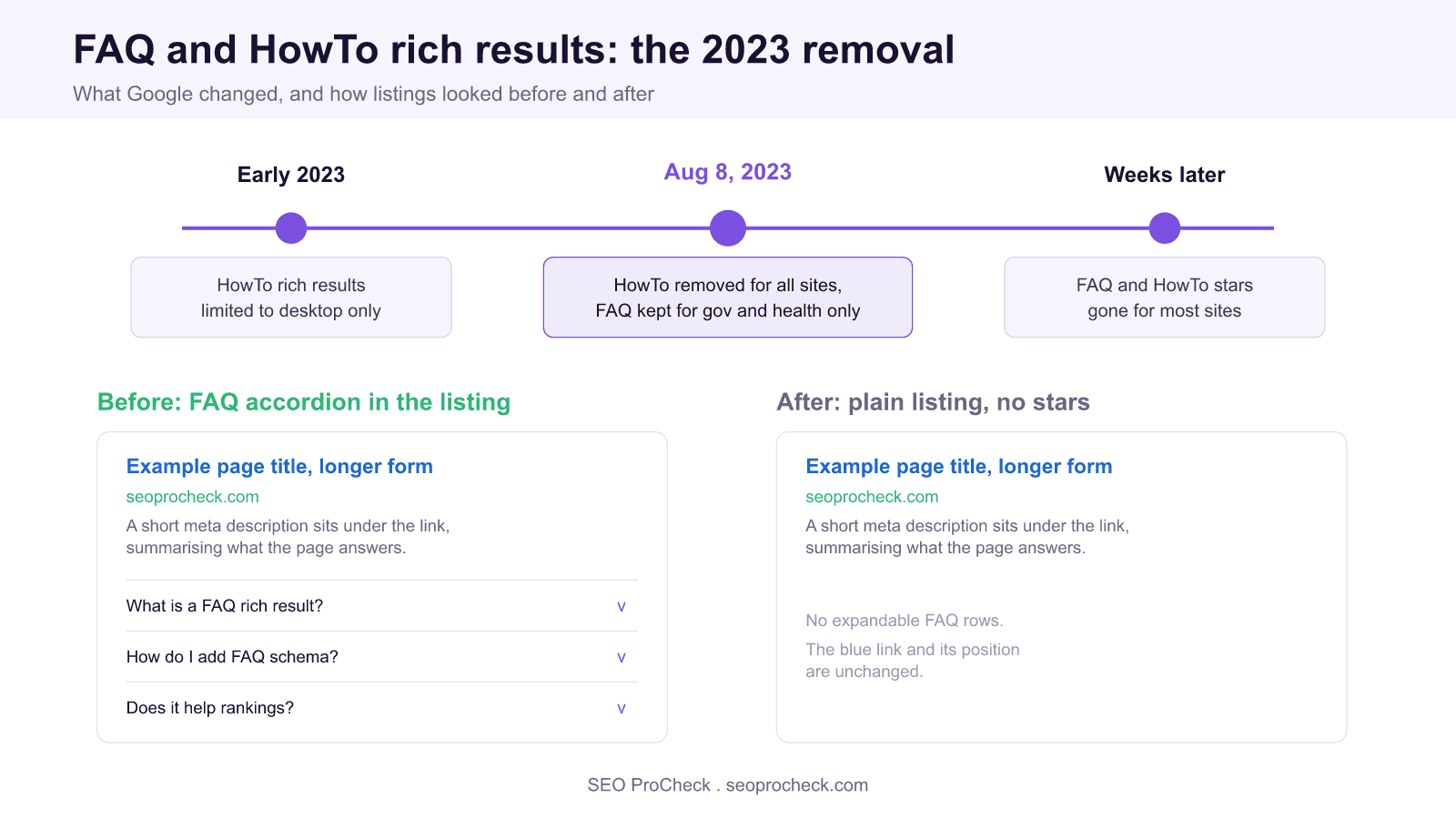
When Google announced on August 8, 2023 that it was retiring HowTo rich results and narrowing FAQ rich results to a short list of authoritative sources, many site owners assumed a ranking penalty was on the way. It was not. This case study separates what actually changed from what people feared. It covers what the FAQ and HowTo enhancements were, who qualified for them until 2026, how the change touched click behaviour, and what to do with your structured data now that the stars are gone for all sites.
Source: https://www.gsqi.com/marketing-blog/analysis-google-remove-faq-howto-snippets/
What Google actually announced
On August 8, 2023 Google Search Central announced two changes to how it renders structured data. HowTo rich results, which had already been limited to desktop, would be removed entirely. FAQ rich results, the expandable question and answer listings, would only be shown for a narrow set of well known, authoritative government and health websites. For the vast majority of sites, both enhancements effectively vanished from the search results within weeks. The analysis linked below tracks the visible impact with data from real sites.
What FAQ and HowTo rich results actually were
A FAQ rich result was the stack of expandable question and answer rows that Google could attach beneath a normal blue link. You produced it by adding FAQPage structured data to a page that already showed those questions and answers to human visitors. When Google chose to render it, the listing grew a set of accordions the searcher could open right in the results, which pushed competing links further down the page.
A HowTo rich result did the same job for step by step instructions. With HowTo structured data, a recipe, repair guide, or setup tutorial could surface its numbered steps, and sometimes step images, directly in the SERP. Both enhancements were cosmetic layers on top of the ranking, not ranking signals themselves. They made a listing physically larger and more eye catching, which is exactly why their removal felt bigger than it was.
Did anyone lose rankings?
This is the key point that gets lost in the panic. Rich results changed how a listing looked, not where it ranked. The blue link and its position were untouched. What changed was the real estate and the click through behaviour: FAQ accordions had let a single result occupy more vertical space, so removing them evened the playing field. Some sites saw click through shift rather than collapse. The honest answer is to measure your own before and after in Search Console instead of assuming a sitewide loss.
| Result type | Status since August 2023 | Practical guidance |
|---|---|---|
| HowTo | Removed for all sites | Drop any reliance on it, keep clear steps in visible copy |
| FAQ | Only for authoritative gov and health sites, then retired for all sites on May 7, 2026 | Keep valid schema for AI, expect no stars |
| Product, Review, and other types | Unaffected | Maintain accurate, valid markup as before |
Who qualified for FAQ rich results until 2026
From 2023 until May 7, 2026, Google kept FAQ rich results alive only for a small pool of well known, authoritative sites in the government and health space. Think national health services, public agencies, and comparable official sources. There is no application form and no setting that promotes an ordinary commercial or editorial site into that pool. If you run a normal business or publisher site, you should plan on never seeing FAQ stars again, even with flawless markup. Treating the exception as something you can qualify for is the most common way this change gets misread.
What to do with your FAQ schema now
Do not rip out your FAQPage markup in a hurry. It no longer earns stars for any site, but valid, accurate schema still helps machines, AI overviews, and answer engines parse your questions and answers, which matters more every year. The stronger move is on the content side: put genuine questions and answers in visible page copy where users and models can both read them, and fold thin standalone FAQ pages into the stronger parent pages they support. Keep the markup concise and truthful, and never mark up content that is not visible on the page. For related metadata work, see our check on duplicate titles and meta descriptions and more metadata case studies.
Should you keep FAQPage or HowTo schema now?
Split the decision by type. For FAQPage, keeping the markup is defensible when the questions and answers are genuinely on the page and useful to readers. It costs nothing, it stays valid, and it gives crawlers and answer engines a clean map of the questions you address. For HowTo, the calculus is weaker. The enhancement is gone entirely, Google's Rich Results Test no longer reports it, and the markup earns no Google feature, so many teams simply remove it and rely on well structured, numbered steps in visible copy. Whichever you choose, follow the two rules that never changed: only mark up content that is visible to users, and keep the structured data an accurate reflection of the page. Stray FAQ markup on pages that no longer show the questions is a classic source of avoidable structured data warnings.
Impact on click through rates
Because a FAQ accordion made a listing taller, some pages had been earning attention partly through sheer size rather than relevance. When the accordions disappeared, two things happened at once. Listings that had dominated a screen shrank back to a standard height, and the results below them became more visible, so click share often redistributed across the page rather than vanishing. Whether any single page gained or lost depends on its position, its competitors, and how compelling its title and meta description are without the extra rows. The correct response is measurement, not assumption: compare impressions, average position, and click through rate for the affected pages in the weeks before and after the change in Google Search Console, and judge each URL on its own data.
What to do instead
- Write the real questions your audience asks directly into visible page copy, with clear, self contained answers a reader or a model can lift.
- Consolidate thin, standalone FAQ pages into the stronger parent page they support, so one authoritative URL answers the cluster.
- Keep concise, accurate
FAQPagemarkup where the questions are visible, and let it serve AI and answer engines rather than SERP stars. - Strengthen the title tag and meta description, since these now carry more of the click weight that accordions used to add.
- Measure each affected URL in Search Console before drawing any conclusion about traffic.
What has changed since 2023
The 2023 position held until 2026, then Google went further: on May 7, 2026 it stopped showing FAQ rich results for every site, government and health included, and on June 15, 2026 it removed the FAQPage documentation. HowTo rich results stay retired, so nothing has quietly returned for ordinary sites. The Rich Results Test reflects the same reality: it no longer reports these enhancements for a typical business or publisher page. What has grown around the change is the role of AI driven answers. As Google AI Overviews and AI Mode, along with third party answer engines, take on more of the summarising that accordions once did in the SERP, the value of clean question and answer content has moved from earning stars to feeding those systems. That is why the guidance now leans on visible, well organised answers rather than markup tricks. For how different crawlers read your content, see the AI crawler map, and for the indexing directives that control snippets and previews, see the meta robots and X-Robots-Tag reference.
Frequently asked questions
When did Google remove FAQ and HowTo rich results?
Google announced the change on August 8, 2023. HowTo rich results were limited to desktop and then removed, and FAQ rich results were restricted to well known, authoritative government and health websites. On May 7, 2026 Google stopped showing FAQ rich results for every site.
Should I remove FAQPage schema from my pages?
Not necessarily. It no longer earns Google rich results for any site, but it still helps machines and AI answer engines parse your questions and answers, so it is reasonable to keep valid, accurate markup.
Do FAQ rich results still appear for any sites?
No. Since May 7, 2026 Google no longer shows FAQ rich results for any site, including the government and health domains that kept them after 2023.
Does losing rich results mean losing traffic?
Not always. Rich results changed how listings looked, not the underlying ranking. Many sites saw click through shift rather than collapse, so measure your own before and after in Search Console.
What should replace FAQ rich results in my strategy?
Put genuine questions and answers in visible page copy, keep concise FAQPage schema for AI and answer engines, and fold thin standalone FAQ pages into stronger parent pages.
Should I keep HowTo structured data on my pages?
HowTo rich results were removed entirely, so the markup no longer earns any Google enhancement and the Rich Results Test no longer reports it. It does no harm when it accurately describes visible steps, but it offers little benefit now, so many teams remove it and keep clear numbered steps in visible copy instead.
Not sure how the rich result changes touched your traffic?
FAQ and HowTo stars are gone for all sites, but the click impact varies page by page. An audit measures it and fixes the structured data still causing warnings.
Take this with you
The assistant links open with a question about this page already written. Nothing is sent until you press enter.
Claude Vincent is a technical SEO consultant focused on crawlability, rendering, and AI-search visibility. He writes the field guides and case studies at SEO ProCheck, with a bias toward the durable, unglamorous work that decides whether search engines and AI answer engines can actually read and cite a site.
About SEO ProCheck
Technical SEO consulting and GEO strategy with 20 years of enterprise experience. Case studies, resources, and tools for search and AI visibility.
Work With Me
Technical SEO audits, GEO strategy, site migrations, and international SEO. Hourly consulting for teams who need hands-on support, not just reports.
Subscribe to our newsletter!








Recent Posts
- Most Top Sites Never Say Who They Are in Structured Data October 14, 2026
- Homepage Titles Are Mostly Too Short, Not Too Long October 8, 2026
- Who Actually Serves an llms.txt? 184 Top Sites Measured September 29, 2026