

AI Summary
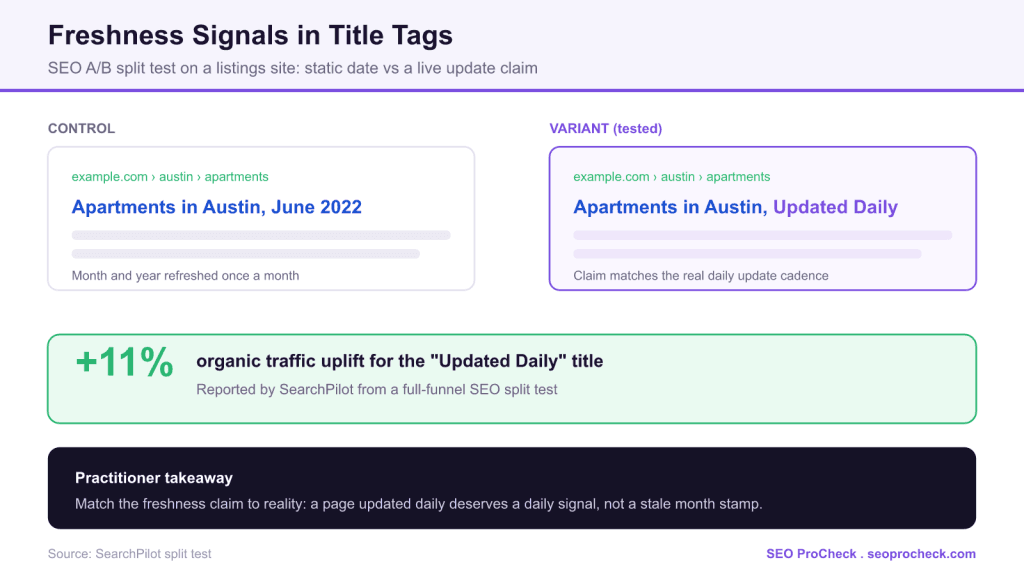
Yes, freshness signals in title tags can lift organic traffic when the signal is true to how often the page actually changes. In a SearchPilot split test on a listings site that updates inventory every day, swapping a static month and year for the phrase "Updated Daily" produced an 11 percent uplift in organic traffic.
- The win came from accuracy: the page really was updated daily, so the title matched reality.
- Freshness tokens work best on high-turnover pages such as real estate, jobs, travel, and price listings.
- A false or stale date is worse than none: it invites Google title rewrites and erodes searcher trust.
- Title tags remain low-risk, high-frequency test candidates, but outcomes vary, so validate with a split test or a Search Console before and after.
The title tag is still one of the highest-leverage on-page elements you can test, and freshness signals are among the cheapest changes to trial. A freshness signal is any element in the title that tells a searcher the page is current: a month and year, a "2026" stamp, a "Last updated" note, or a phrase such as "Updated Daily". The question this case study answers is narrow and useful: does adding or improving that signal actually move organic traffic, or does it just look tidier in the SERP?
Initial Situation
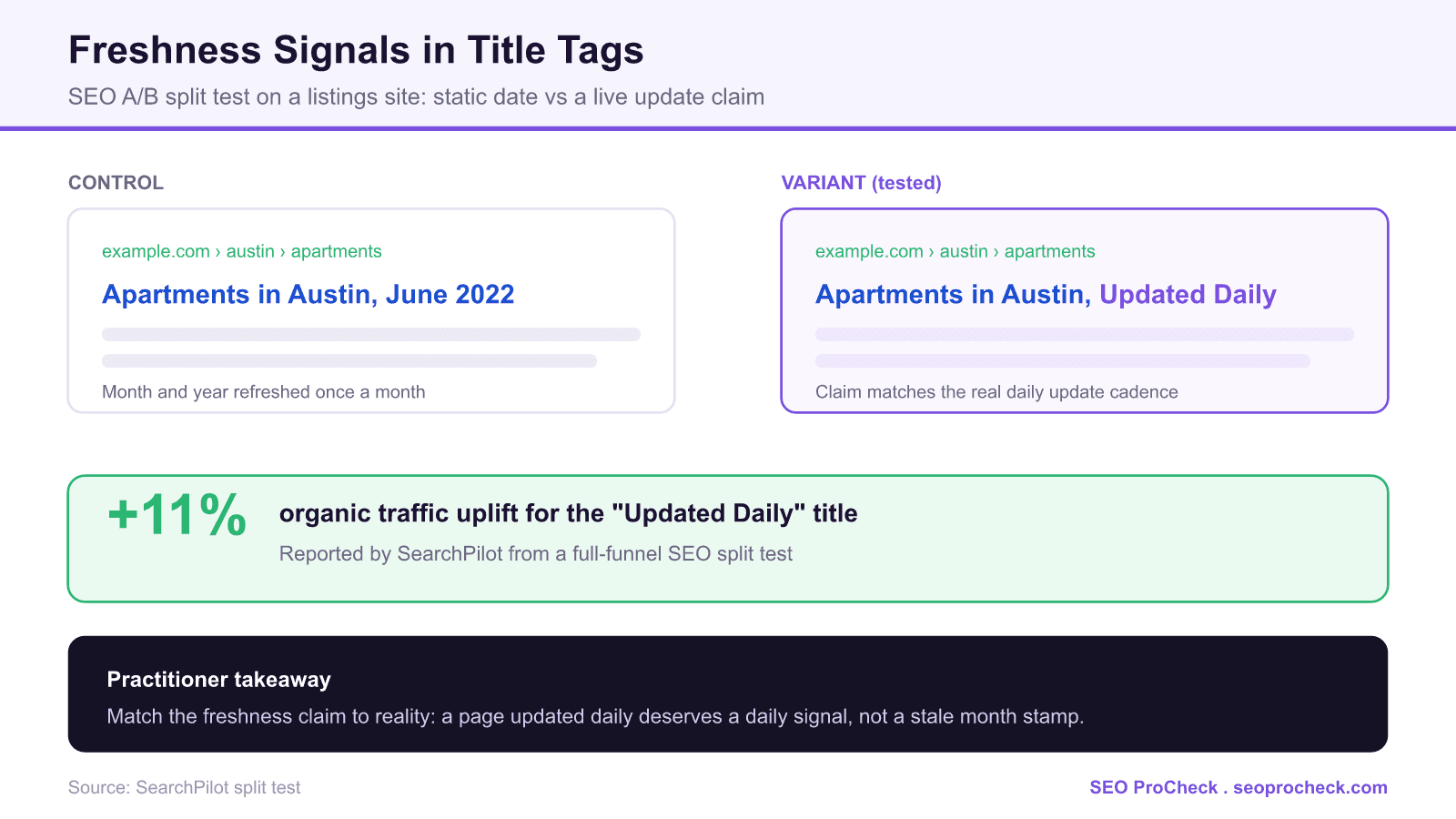
The test documented by SearchPilot ran on a customer in the listings space, on their search results pages. The pages already carried the current month and year in the title tag to imply freshness. The catch was a mismatch between the signal and reality: the listings were not refreshed once a month, they were refreshed every day. A monthly date stamp understated how current the inventory actually was, and for part of each month it could look several weeks stale even though the underlying data was hours old.
Strategy and Approach
The hypothesis was straightforward: replace the static month and year with "Updated Daily" so the title reflects the true update cadence, and measure the effect on organic traffic. SearchPilot validates this kind of change with a full-funnel SEO A/B test: comparable pages are split into a control group that keeps the old title and a variant group that gets the new one, both groups are served live to Googlebot and users, and a forecasting model estimates the traffic difference at a stated confidence level. That design isolates the title change from seasonality and algorithm noise in a way that a simple before and after cannot.
Implementation
Freshness tokens are almost always applied at the template level, not page by page, so one edit to a title format updates thousands of URLs. On a listings or category template you inject the phrase through a variable in your title format. In Rank Math or Yoast you can extend the title template with a custom variable; on a custom stack you concatenate the token server-side so it is present in the initial HTML, not painted in later by JavaScript. A minimal pattern looks like this:
Control:  {city} Apartments for Rent, {month} {year} | Brand
Variant:  {city} Apartments for Rent, Updated Daily | Brand
The rule that makes the difference: only ship the token that is literally true. "Updated Daily" is safe only if the template really does regenerate daily. If your build runs weekly, "Updated Weekly" is the honest and still useful version.
Which freshness signal fits which page
Not every page should carry the same token. Match the phrase to how often the content genuinely changes.
| Freshness signal | Best for | Main risk | Verdict |
|---|---|---|---|
| "Updated Daily" | Listings, prices, live data refreshed every day | Untrue if you do not update daily | Strong when accurate |
| Month and Year (June 2026) | Roundups and pages refreshed monthly | Goes stale fast without automation | Good if auto-generated |
| "Last updated: date" in title | Guides and documentation | Verbose, often truncated in the SERP | Usually better in the snippet than the title |
| No freshness token | Evergreen reference pages | Misses freshness-seeking queries | Fine for stable content |
| Rounded up or fake date | Nothing | Misleads users, invites title rewrites, erodes trust | Avoid |
Results and Learnings
SearchPilot reported that replacing the month and year with "Updated Daily" produced an 11 percent uplift in organic traffic for the variant pages. The lesson is not "add a date to every title." It is that a freshness signal pays off when it closes a gap between what the page does and what the title claims. The listings were genuinely updated daily, so the honest signal both improved click-through from searchers scanning for current results and reinforced relevance for freshness-sensitive queries. A related SearchPilot test found that simply adding the current month and year to title tags on a listings site also lifted organic sessions, which reinforces the pattern for high-turnover inventory.
How to run this test on your own site
- Pick a template with real turnover. Category, listings, or search pages where the content genuinely changes are the best candidates. Evergreen articles are not.
- Choose an honest token. Daily, weekly, or a month and year that a script keeps current. Never hard-code a date you will forget to update.
- Split, do not switch. If you have a testing platform, run a proper A/B split. If you do not, change one template, hold another as control, and compare organic clicks in Search Console for both groups over four to six weeks, adjusting for seasonality.
- Watch for rewrites. Check the live SERP and the Search Console Performance report to confirm Google is actually showing your title rather than rewriting it.
What has changed since this test
Two shifts matter for anyone applying this in 2026. First, Google now rewrites title tags far more often than it did a few years ago, and templated or date-heavy titles are common rewrite targets. Keep the freshness phrase short and unambiguous to reduce the chance Google swaps it out. Second, freshness in the title does not directly change how AI Overviews or AI Mode cite you; those systems lean on on-page dates, structured data, and genuinely updated content. Treat the title token as a click-through and relevance lever, and back it with a visible "Last updated" date in the body so the freshness claim is verifiable on the page itself.
Common mistakes
- Claiming a cadence you do not keep. "Updated Daily" on a page last touched in 2023 is clickbait that Google and users both punish.
- Hard-coding the date. A manual month and year becomes a stale liability the moment the month turns. Automate it or do not use it.
- Testing on evergreen pages. A freshness signal on content that never changes adds noise, not value, and can look manipulative.
- Ignoring truncation. A long freshness phrase can push your primary keyword past the pixel limit, costing more than the token gains.
FAQ
They can, when the signal is true. On a listings page that was genuinely updated every day, swapping a static month and year for "Updated Daily" produced roughly an 11 percent organic traffic uplift in a SearchPilot test. The gain comes from accuracy and click-through, not from the date being a ranking factor on its own.
Match the phrase to your real update cadence. If the page changes every day, "Updated Daily" is the most accurate and tested well. If you refresh monthly, an auto-generated month and year is appropriate and has also tested positive on listings sites. The wrong move is a token that overstates how often you update.
It might. Google rewrites titles more aggressively than it used to, and templated or date-heavy titles are common targets. Keep the freshness phrase short and truthful, and check the live SERP and Search Console to confirm your title is the one being shown.
The title is not a direct ranking factor beyond relevance and click-through. Freshness in the title does not by itself change how AI Overviews cite a page; those systems weigh on-page dates, structured data, and genuinely updated content more heavily. Pair the title token with a visible last-updated date on the page.
Use your SEO plugin's title format with a custom variable, or a small snippet that injects the current date or a phrase such as "Updated Daily" into the title tag for a specific template. Rank Math and Yoast both support custom variables in title templates, so one change updates every URL on that template.
With a proper split test, plan on a few weeks to reach statistical significance. Without a testing platform, compare organic clicks for the affected template against a held-back control over four to six weeks in Search Console, allowing for seasonality before you draw a conclusion.
Source: https://www.searchpilot.com/resources/case-studies/last-updated-in-title/
Not sure your title tags are earning the clicks they should?
Freshness tokens, keyword order, and truncation all move organic traffic, and Google may be rewriting your titles without you noticing. An audit finds the quick wins.
Take this with you
The assistant links open with a question about this page already written. Nothing is sent until you press enter.
Claude Vincent is a technical SEO consultant focused on crawlability, rendering, and AI-search visibility. He writes the field guides and case studies at SEO ProCheck, with a bias toward the durable, unglamorous work that decides whether search engines and AI answer engines can actually read and cite a site.
About SEO ProCheck
Technical SEO consulting and GEO strategy with 20 years of enterprise experience. Case studies, resources, and tools for search and AI visibility.
Work With Me
Technical SEO audits, GEO strategy, site migrations, and international SEO. Hourly consulting for teams who need hands-on support, not just reports.
Subscribe to our newsletter!








Recent Posts
- Most Top Sites Never Say Who They Are in Structured Data October 14, 2026
- Homepage Titles Are Mostly Too Short, Not Too Long October 8, 2026
- Who Actually Serves an llms.txt? 184 Top Sites Measured September 29, 2026